StartseiteMCPWorkbenchSkills
StartseiteWorkbenchBenachrichtigungenMein Bereich
llms.txt · MCP-AnleitungDatenschutz · Nutzungsbedingungen · Supportv1.8.0
  1. Startseite
  2. /Verbindung

1,3-Diamino-propan

1,3-Propanediamine
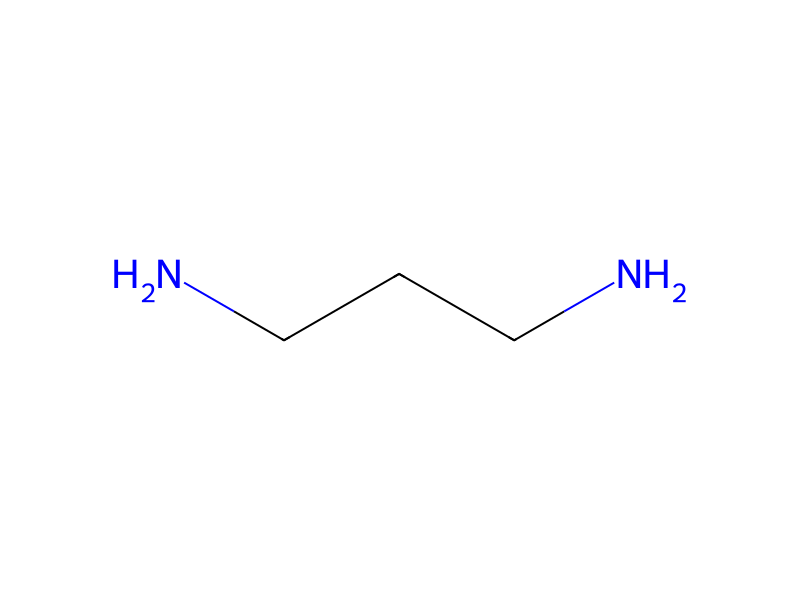
HCID 428
Neue NotizNeue ReaktionAnfrage stellen
Druckvorschau
GrundinformationenÜberblickNamen und BezeichnerEigenschaftenSicherheit und RegulatorischesChemie und IndustrieZugehörige ReaktionenNotizen zur Verbindung
TeilstruktursucheÄhnliche Strukturen suchen

Grundinformationen

CAS
109-76-2
Standard-SMILES
NCCCN
InChIKey
XFNJVJPLKCPIBV-UHFFFAOYSA-N
Summenformel
C3H10N2
Durchschnittliche Molmasse
74,13 g/mol
Monoisotopische Masse
74,08439833

Überblick

1,3-diaminopropane is a water-white mobile liquid with an odor of amine. (NTP, 1992)

Namen und Bezeichner

Bevorzugter Name
1,3-Propanediamine
IUPAC
propane-1,3-diamine
Lokaler Name
1,3-Diamino-propan
Englischer Name
1,3-Diaminopropane
Summenformel
C3H10N2
Molmasse
74.12

Namen und Synonyme

1,3-diaminopropane1,3-Propanediamine109-76-2Trimethylenediamine1,3-Propylenediamine3-Aminopropylaminealpha,omega-Propanediamine1,3-diaminepropaneCB3ISL56KGNSC-8154DTXSID1021906CHEBI:15725
Weitere Namen anzeigen
H2N(CH2)3NH213DAP3-Propanediamine1,3-DiaMinopropane, 99% 1LTFENTAMINE PDAAKOS BBS-000042811,3 Diaminopropan
RefChem:72575DTXCID301906203-702-7611-082-8Propane-1,3-diamine1,3-diaminopropanaminopropylamineMFCD00008228

Datenbank-Bezeichner

CAS
109-76-2、54018-94-9
PubChem CID
428
DTXSID
DTXSID1021906
ChEMBL
CHEMBL174324
ChEBI
CHEBI:15725
UNII
CB3ISL56KG
EC Number
203-702-7、611-082-8
Nikkaji
J1.969K

Eigenschaften

Berechnete Struktureigenschaften

XLogP
-1,4
Polarare Oberfläche (TPSA)
52 Ų
H-Brücken-Donoren
2
H-Brücken-Akzeptoren
2
Frei drehbare Bindungen
2
Schwere Atome
5
Formalladung
0
Komplexität
12,4

Experimentelle und physikochemische Eigenschaften

Chemical ClassesNitrogen Compounds -> Amines, Aliphatic
SpringerMaterials Properties15N nuclear magnetic resonance spectrum
LogP · 2 Einträge

-1.43

-1.43

Density · 2 Einträge

0.881 at 68 °F (NTP, 1992) - Less dense than water; will float

0.8881 @25 °C

SolubilitySoluble (NTP, 1992)
Flash Point75 °F (NTP, 1992)
Boiling Point · 2 Einträge

275.9 °F at 738 mmHg (NTP, 1992)

139.80 °C. @ 760.00 mm Hg

Melting Point · 3 Einträge

10 °F (NTP, 1992)

-12 °C

-12 °C

Vapor Density2.5 (NTP, 1992) - Heavier than air; will sink (Relative to Air)

Sicherheit und Regulatorisches

Sicherheitsangaben dienen nur zur Orientierung und ersetzen weder das Sicherheitsdatenblatt (SDB) des Lieferanten noch geltende Vorschriften oder eine fachliche Bewertung.

GHS-Klassifizierung

GHS Classification · 6 Einträge

Danger

H226 (99.6%): Flammable liquid and vapor [Warning Flammable liquids]

P210, P233, P240, P241, P242, P243, P260, P261, P262, P264, P264+P265, P270, P271, P272, P280, P284, P301+P317, P301+P330+P331, P302+P352, P302+P361+P354, P303+P361+P353, P304+P340, P305+P354+P338, P316, P317, P321, P330, P333+P317, P342+P316, P361+P364, P362+P364, P363, P370+P378, P403, P403+P235, P405, and P501 (click each P-code to see the statement)

Aggregated GHS information provided per 251 reports by companies from 11 notifications to the ECHA C&L Inventory. Each notification may be associated with multiple companies.

Danger

H225: Highly Flammable liquid and vapor [Danger Flammable liquids]

Gefahrenhinweise

Regulatory Information · 4 Einträge

Chemical: 1,3-Propanediamine

1,3-Propanediamine is listed on the EPA's Chemical Data Reporting (CDR) system. Manufacturers and importers of 1,3-Propanediamine are required to report information about their production and use of this chemical to the EPA under the Toxic Substances Control Act (TSCA). (40 eCFR Part 711)

REACH registered substance: Trimethylenediamine (EC: 203-702-7)

1,3-Diaminopropane: Does not have an individual approval but may be used under an appropriate group standard

Other Safety InformationEvaluation - Chemicals that are unlikely to require further regulation to manage risks to environment
DOT LabelCorrosive Flammable Liquid
Fire HazardsThis compound is a flammable liquid. (NTP, 1992)
Health HazardsACUTE/CHRONIC HAZARDS: This compound is a strong irritant to eyes and skin: corrosive HAZARDOUS DECOMPOSITION PRODUCTS. (NTP, 1992)

Chemie und Industrie

Pharmakologische Informationen

Cellular LocationsCytoplasm
Metabolite Pathwaysbeta-Alanine metabolism

Verwendung und Herstellung

UsesUsed as an organic intermediate; [NTP]
U.S. Production2023: <50,000 lb
Industry UsesIntermediate
General Manufacturing Information · 2 Einträge

All Other Basic Organic Chemical Manufacturing

1,3-Propanediamine: ACTIVE

Anwendungen · 1 Eintrag

Verwenden1,3-Diaminopropane is commonly used in the preparation of cholinesterase inhibitors and thrombosis inhibitors. It is also used as a polymer cross linkage agent, polyurethane extender and spray coatings. It is involved in the preparation of agrochemicals and pharmaceutical intermediates. Further, it acts as a building block in the synthesis of heterocyclic compounds, which finds application in textile finishing. In addition to this, it is used as a ligand and form coordination complexes. 1,3-Diaminopropane is also utilized for the production of a chelating agent used in the photo industry and for anticorrosion agents.

Vor- und nachgelagerte Produkte

Vorgelagerte Rohstoffe

Ethanol solution1,2-Dibrompropan1,3-Propanedicarboxamide

Zugehörige Reaktionen

458
Reaktionsaufzeichnung erstellen
Reaktionsgleichung von HRID 2162
HRID 2162als Eduktuspto-grants-1998_03
Reaktionsgleichung von HRID 5555
HRID 5555als Eduktuspto-grants-1993_09
Reaktionsgleichung von HRID 10452
HRID 10452als Eduktuspto-grants-2006_08
Reaktionsgleichung von HRID 10595
HRID 10595als Eduktuspto-grants-2006_08
Reaktionsgleichung von HRID 12987
HRID 12987als Eduktuspto-grants-2010_06
Reaktionsgleichung von HRID 20778
HRID 20778als Eduktuspto-grants-2010_06
Reaktionsgleichung von HRID 22220
HRID 22220als Eduktuspto-grants-1995_06
Reaktionsgleichung von HRID 22228
HRID 22228als Eduktuspto-grants-1995_06
Seite 1 von 58

Notizen zur Verbindung

Wird geladen…

Auf dieser SeiteGrundinformationenÜberblickNamen und BezeichnerEigenschaftenSicherheit und RegulatorischesChemie und IndustrieZugehörige ReaktionenNotizen zur Verbindung
Weitere Aktionen
Neue NotizNeue ReaktionAnfrage stellen
Vapor Pressure
11.5 [mmHg]
Food Contact SubstancesFCS -> FDA Inventory of Food Contact Substances Listed in 21 CFR
Physical Description · 4 Einträge

1,3-diaminopropane is a water-white mobile liquid with an odor of amine. (NTP, 1992)

Liquid

Colorless to yellow liquid with an amine odor; [CHEMINFO (MSDS)] Colorless liquid with an odor of amines; [CAMEO]

Liquid

Physikochemische Eigenschaften

Schmelzpunkt
-12 °C · -12 °C
Siedepunkt
140 °C · 140 °C(lit.)
Dichte
0.888 g/mL · 0.888 g/mL at 25 °C(lit.)
Dampfdruck
8 mm · <8 mm Hg ( 20 °C)
Brechungsindex
20 · n20/D 1.458(lit.)
Flammpunkt
120 °F · 120 °F
storage temp.
30 °C · Store below +30°C.
Löslichkeit
DMSO (Slightly), Methanol (Slightly)
pka
10.94 · 10.94(at 10℃)
Aggregatzustand
Liquid
Farbe
Clear
PH
12 · >12 (100g/l, H2O, 20℃)
Explosionsgrenze
2.8 · 2.8-15.2%(V)
Wasserlöslichkeit
SOLUBLE
BRN
605277 · 605277
Dielectric constant
9.6 · 9.6(Ambient)
Stabilität
Stable. Hygroscopic. Flammable - readily forms explosive mixtures with air. Incompatible with acid anhydrides, acid chlorides, acids, strong oxidizing agents.
InChI
1S/C3H10N2/c4-2-1-3-5/h1-5H2
InChIKey
XFNJVJPLKCPIBV-UHFFFAOYSA-N
SMILES
NCCCN
LogP
-1.05 at · -1.05 at 25℃
CAS Datenbank
109 · 109-76-2(CAS DataBase Reference)
NIST chemische Informationen
1 · 1,3-Propanediamine(109-76-2)
EPA chemische Informationen
1 · 1,3-Diaminopropane (109-76-2)
Hazards Summary · 1 Eintrag

Corrosive to skin; [Quick CPC] Highly irritating or corrosive to skin and eyes; [NTP] Causes burns; Inhalation may cause corrosive injuries to upper respiratory tract and lungs; Harmful by ingestion; Toxic by skin absorption; [Alfa Aesar MSDS]

Reactive GroupAmines, Phosphines, and Pyridines
Reactivity AlertsHighly Flammable
Reactivity Profile1,3-DIAMINOPROPANE is heat sensitive. This compound may react with oxidizing agents. (NTP, 1992)
Air and Water ReactionsHighly flammable. Water soluble.
Hazard Classes and Categories · 2 Einträge

Flam. Liq. 3 (99.6%)

Flammable liquids - Category 2

Sicherheit und Schutzausrüstung

Fire Fighting · 1 Eintrag

This compound is not very flammable but any fire involving this compound may produce dangerous vapors. You should evacuate the area. All firefighters should wear full-body protective clothing and use self-contained breathing apparatuses. You should extinguish any fires involving this chemical with a dry chemical, carbon dioxide, foam, or halon extinguisher. (NTP, 1992)

First Aid · 1 Eintrag

EYES: First check the victim for contact lenses and remove if present. Flush victim's eyes with water or normal saline solution for 20 to 30 minutes while simultaneously calling a hospital or poison control center. Do not put any ointments, oils, or medication in the victim's eyes without specific instructions from a physician. IMMEDIATELY transport the victim after flushing eyes to a hospital even if no symptoms (such as redness or irritation) develop.

Nonfire Spill Response · 1 Eintrag

SMALL SPILLS AND LEAKAGE: If you should spill this chemical, use absorbent paper to pick up all liquid spill material. Seal the absorbent paper, as well as any of your clothing which may be contaminated, in a vapor-tight plastic bag for eventual disposal. Wash any surfaces you may have contaminated with a soap and water solution. Do not reenter the contaminated area until the Safety Officer (or other responsible person) has verified that the area has been properly cleaned.

Isolation and EvacuationExcerpt from ERG Guide 132 [Flammable Liquids - Corrosive]:
Protective Action Criteria (PAC) · 3 Einträge

0.93 [mg/m3]

10 [mg/m3]

62 [mg/m3]

Personal Protective Equipment (PPE)MINIMUM PROTECTIVE CLOTHING: If Tyvek-type disposable protective clothing is not worn during handling of this chemical, wear disposable Tyvek-type sleeves taped to your gloves.

Toxikologische Informationen

Adverse EffectsDermatotoxin - Skin burns.

Sicherheitsdaten

F
34
wgk
2
tsca
TSCA listed
ridadr
UN 2922 8/PG 2
hs_code
29212900
RTECS-Nr.
TX6825000
risk_code
10-22-24-35
Toxizität
LD50 orally in Rabbit: 700 mg/kg LD50 dermal Rabbit 200 mg/kg
hazard_code
T,C
safety_code
26-36/37/39-45-25-16
hazard_class
3
packing_group
III
Speicherklasse
3 - Flammable liquids
Hazard Classifications
Acute Tox. 2 DermalAcute Tox. 4 OralEye Dam. 1Flam. Liq. 3Met. Corr. 1Resp. Sens. 1BSkin Corr. 1BSkin Sens. 1B
Selbstentzündungstemperatur
662 °F
N-Carbobenzoxy-1,3-diaminopropane hydrochloride
1,3-Dibrompropan
Propan-1,3-diol
3-Aminopropiononitril
1,3-Dichlorpropan

Nachgelagerte Produkte

CinmethylinN-Boc-EthylenediamineCocoamidopropyl betainedihydroxyethyl p-octadecyl phenylsulfonyl amino propyl ammoium propylsulfonatePerhydro-1,4-diazepinN-Boc-1,3-propanediaminePropanenitrile, 3-[(3-aminopropyl)amino]-2,3,4,5-Tetrahydro-1H-benzo[b][1,4]diazepineN,N'-Bis(3-aminopropyl)propan-1,3-diamin2-(3,4-Dimethylphenyl)pyridine
Ergänzende Hinweise · 1 Eintrag

DefinitionChEBI: 1,3-Diaminopropane is an alkane-alpha,omega-diamine comprising a propane skeleton with amino substituents at positions 1 and 3. It has a role as a reagent, a human metabolite and a mouse metabolite. It is a conjugate base of a trimethylenediaminium.