
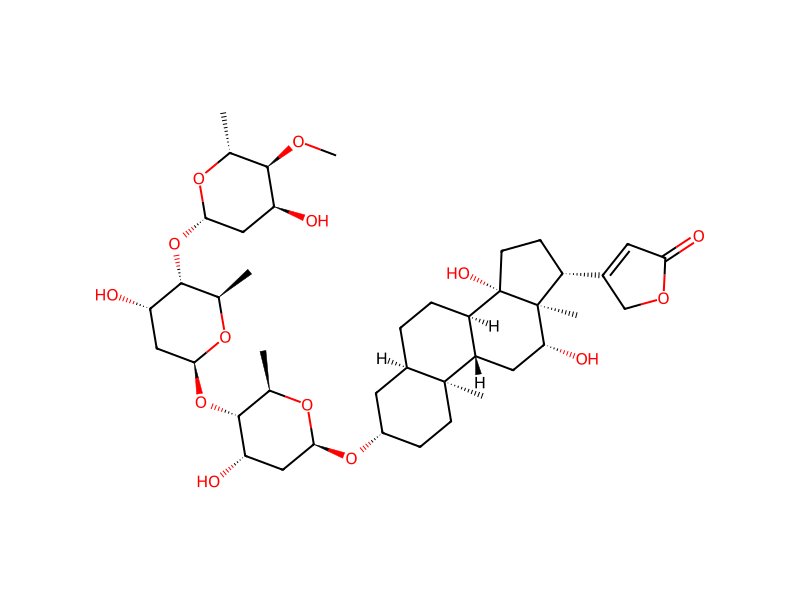
Grundinformationen
- Standard-SMILES
CO[C@H]1[C@@H](O)C[C@H](O[C@H]2[C@@H](O)C[C@H](O[C@H]3[C@@H](O)C[C@H](O[C@H]4CC[C@@]5(C)[C@H](CC[C@@H]6[C@@H]5C[C@@H](O)[C@]5(C)[C@@H](C7=CC(=O)OC7)CC[C@]65O)C4)O[C@@H]3C)O[C@@H]2C)O[C@@H]1C- InChIKey
IYJMSDVSVHDVGT-PEQKVOOWSA-N- Summenformel
- C42H66O14
- Durchschnittliche Molmasse
- 795 g/mol
- Monoisotopische Masse
- 794,44525679
Überblick
Metildigoxin is a cardenolide glycoside.
Namen und Bezeichner
- Bevorzugter Name
- Methyldigoxin
- IUPAC
- 3-[(3S,5R,8R,9S,10S,12R,13S,14S,17R)-12,14-dihydroxy-3-[(2R,4S,5S,6R)-4-hydroxy-5-[(2S,4S,5S,6R)-4-hydroxy-5-[(2S,4S,5S,6R)-4-hydroxy-5-methoxy-6-methyloxan-2-yl]oxy-6-methyloxan-2-yl]oxy-6-methyloxan-2-yl]oxy-10,13-dimethyl-1,2,3,4,5,6,7,8,9,11,12,15,16,17-tetradecahydrocyclopenta[a]phenanthren-17-yl]-2H-furan-5-one
- Lokaler Name
- Card-20(22)-enolid, 3-((O-2,6-Di-deoxy-4-O-methyl-beta-D-ribo-hexo-pyranosyl-(1=>4)-O-2,6-dideoxy-beta-D-ribo-hexopyranosyl-L-(1=>4)-2,6-dideoxy-beta-D-ribo-hexopyranosyl)oxy)-12,14-dihydro-xy-, (3 beta, 5 beta, 12 beta)-
- Englischer Name
- Metildigoxin
- Summenformel
- C42H66O14
- Molmasse
- 794.97
Namen und Synonyme
metildigoxinMethyldigoxin30685-43-9MetildigoxinaMetildigoxineMetildigoxinumDigoxin, 4'''-O-methyl-DTXSID0023294Methyldigoxin, betaI7GG1YUC5VDTXCID0032943-[(3S,5R,8R,9S,10S,12R,13S,14S,17R)-12,14-dihydroxy-3-[(2R,4S,5S,6R)-4-hydroxy-5-[(2S,4S,5S,6R)-4-hydroxy-5-[(2S,4S,5S,6R)-4-hydroxy-5-methoxy-6-methyloxan-2-yl]oxy-6-methyloxan-2-yl]oxy-6-methyloxan-2-yl]oxy-10,13-dimethyl-1,2,3,4,5,6,7,8,9,11,12,15,16,17-tetradecahydrocyclopenta[a]phenanthren-17-yl]-2H-furan-5-one
Weitere Namen anzeigen
b-MethyldigoxinMetildigoxin RSβ-Methyl Digoxin-β-Methyl Digoxinbeta-Methyldigoxin4'''-Methyldigoxin4'''-b-Methyldigoxin
metildigossina3-((3S,5R,8R,9S,10S,12R,13S,14S,17R)-12,14-dihydroxy-3-((2R,4S,5S,6R)-4-hydroxy-5-((2S,4S,5S,6R)-4-hydroxy-5-((2S,4S,5S,6R)-4-hydroxy-5-methoxy-6-methyloxan-2-yl)oxy-6-methyloxan-2-yl)oxy-6-methyloxan-2-yl)oxy-10,13-dimethyl-1,2,3,4,5,6,7,8,9,11,12,15,16,17-tetradecahydrocyclopenta(a)phenanthren-17-yl)-2H-furan-5-oneRefChem:8187634'''-BETA-METHYLDIGOXINC01AA08250-292-0MEDIGOXINLanitop
Datenbank-Bezeichner
- CAS
30685-43-9- PubChem CID
- 443946
- DTXSID
DTXSID0023294- ChEMBL
CHEMBL1697843- ChEBI
CHEBI:135885- UNII
- I7GG1YUC5V
- EC Number
- 250-292-0
- Nikkaji
- J4.091F
Eigenschaften
Berechnete Struktureigenschaften
- XLogP
- 1,8
- Polarare Oberfläche (TPSA)
- 192 Ų
- H-Brücken-Donoren
- 5
- H-Brücken-Akzeptoren
- 14
- Frei drehbare Bindungen
- 8
- Schwere Atome
- 56
- Formalladung
- 0
- Komplexität
- 1.460
Experimentelle und physikochemische Eigenschaften
LogP1.73
Physikochemische Eigenschaften
- Schmelzpunkt
- 200 · 200-202°C (dec.)
- Siedepunkt
- 668.38 °C · 668.38°C (rough estimate)
- Dichte
- 1.102 · 1.1020 (rough estimate)
- Brechungsindex
- 1.613 · 1.6130 (estimate)
- storage temp.
- Hygroscopic, Refrigerator, Under Inert Atmosphere
- Löslichkeit
- DMSO (Sparingly), Methanol (Slightly)
- pka
- 13.5 · 13.50±0.70(Predicted)
- Aggregatzustand
- Solid
- Farbe
- White to Off-White
- Stabilität
- Hygroscopic
Sicherheit und Regulatorisches
GHS-Klassifizierung
GHS Classification
Danger
H300 (50%): Fatal if swallowed [Danger Acute toxicity, oral]
P260, P261, P264, P264+P265, P270, P271, P273, P280, P284, P301+P316, P304+P340, P305+P351+P338, P316, P319, P320, P321, P330, P337+P317, P403+P233, P405, and P501 (click each P-code to see the statement)
Aggregated GHS information provided per 2 reports by companies from 2 notifications to the ECHA C&L Inventory. Each notification may be associated with multiple companies.
Gefahrenhinweise
Hazard Classes and CategoriesAcute Tox. 2 (50%)
Sicherheitsdaten
- Toxizität
- LD50 in rats, mice (mg/kg): 4.8, 4.9 i.v.; 6.2, 4.8 i.p.; 8.3, 7.8 orally (Czerwek)
Chemie und Industrie
Pharmakologische Informationen
ATC Code
C01AA08
C - Cardiovascular system
QC - Cardiovascular system
MeSH Pharmacological Classification
Agents used for the treatment or prevention of cardiac arrhythmias. They may affect the polarization-repolarization phase of the action potential, its excitability or refractoriness, or impulse conduction or membrane responsiveness within cardiac fibers. Anti-arrhythmia agents are often classed into four main groups according to their mechanism of action: sodium channel blockade, beta-adrenergic blockade, repolarization prolongation, or calcium channel blockade.
Agents that have a strengthening effect on the heart or that can increase cardiac output. They may be CARDIAC GLYCOSIDES; SYMPATHOMIMETICS; or other drugs. They are used after MYOCARDIAL INFARCT; CARDIAC SURGICAL PROCEDURES; in SHOCK; or in congestive heart failure (HEART FAILURE).
Compounds or agents that combine with an enzyme in such a manner as to prevent the normal substrate-enzyme combination and the catalytic reaction.
Anwendungen
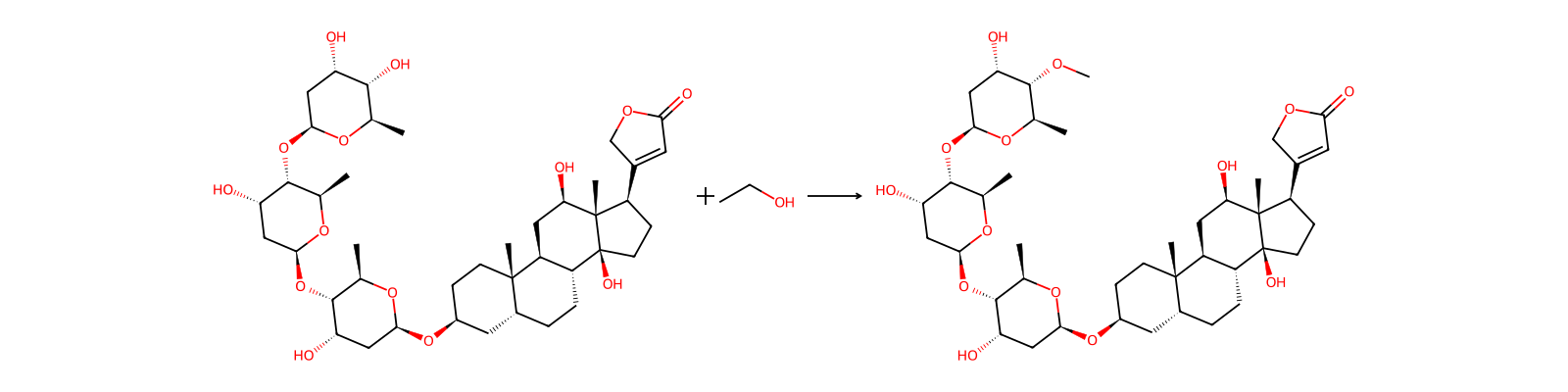
VerwendenCardiotonic. Obtained by the O-methylation of Digoxin.
Vor- und nachgelagerte Produkte
Vorgelagerte Rohstoffe
Zugehörige Reaktionen
2
Verknüpfte Notizen
Wird geladen…