
HRID 77252als Edukt
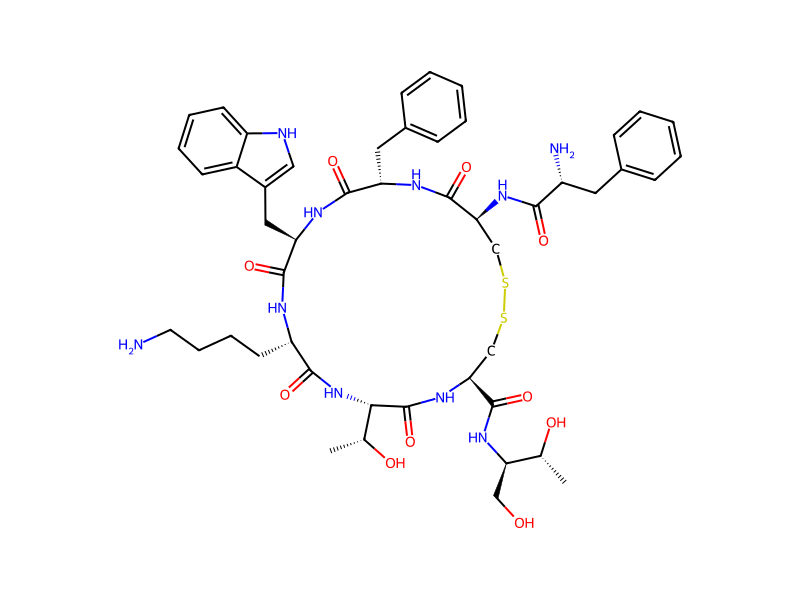
83150-76-9C[C@@H](O)[C@@H]1NC(=O)[C@H](CCCCN)NC(=O)[C@@H](Cc2c[nH]c3ccccc23)NC(=O)[C@H](Cc2ccccc2)NC(=O)[C@@H](NC(=O)[C@H](N)Cc2ccccc2)CSSC[C@@H](C(=O)N[C@H](CO)[C@@H](C)O)NC1=ODEQANNDTNATYII-OULOTJBUSA-NAcromegaly is a disorder caused by excess growth hormone (GH), increasing the growth of body tissues and causing metabolic dysfunction. In most cases, it results from an anterior pituitary growth hormone-releasing tumor. Typically, the feet, hands, and face grow abnormally large; organomegaly and insulin resistance may also occur. Acromegaly is a life-threatening disease requiring life-long management. Octreotide is a long-acting drug with pharmacologic activities that mimic those of the natural hormone, somatostatin, which inhibits the secretion of growth hormone. Additionally, it is used for the treatment of acromegaly and symptoms arising from various tumors, including carcinoid tumors and vasoactive intestinal tumors (VIPomas). In the past, octreotide has been administered solely by injection. On June 26, 2020, the first approved delayed-release oral somatostatin analog, Mycapssa, received FDA approval for the long term maintenance treatment of acromegaly. This drug was developed by Chiasma Inc.
83150-76-9Breast Feeding; Lactation; Milk, Human; Antineoplastic Agents, Hormonal; Gastrointestinal Agents
EMA approved medicines: Human medicine
Medicines for disorders of the pituitary hormone system
Sicherheitsangaben dienen nur zur Orientierung und ersetzen weder das Sicherheitsdatenblatt (SDB) des Lieferanten noch geltende Vorschriften oder eine fachliche Bewertung.
Mild, transient, asymptomatic elevations in serum aminotransferase levels occur in a small proportion of patients receiving octreotide, and in some individuals the elevations are persistent and worsen over time and may require drug discontinuation. In addition, several instances of acute, clinically apparent liver injury attributable to octreotide have been described. The onset is generally within 1 to 6 months of starting therapy and injury may be more frequent with higher doses. Most cases of liver injury associated with octreotide therapy have been asymptomatic and anicteric, and marked by prominent elevations in serum ALT and AST with normal or near normal serum alkaline phosphatase, GGT and bilirubin. In some instances, however, jaundice has arisen, particularly with rechallenge. There have been no instances of acute liver failure or vanishing bile duct syndrome associated with octreotide, and a characteristic feature of the injury is the rapidity of improvement upon stopping the injections or infusions. Several instances of marked aminotransferase elevations with rapid improvements on stopping have been reported in newborns and infants with congenital hyperinsulinemia who were treated with continuous infusions of high doses of octreotide.
* Gastrointestinal abnormalities (34% to 61%) are transient and usually mild to moderate. They include diarrhea, nausea, abdominal discomfort, gallbladder abnormalities, such as cholelithiasis and microlithiasis, biliary sediment and sludge due to alteration of fat absorption, and possibly by decreasing motility of the gallbladder.
Limited studies have assessed octreotide toxicity. However, isolated studies have shown a mild degree of bone marrow suppression and impairment in spermatogenesis due to inhibition of serum inhibin B and concomitant increase in FSH in supratherapeutic doses. There is a need to conduct significantly larger studies and trials to define and establish the therapeutic index of octreotide and identify its toxic effects and its management.
H - Systemic hormonal preparations, excl. sex hormones and insulins
QH - Systemic hormonal preparations, excl. sex hormones and insulin
H01CB02
Octreotide mimics the naturally occurring hormone known as somatostatin. Like somatostatin, it demonstrates activity against growth hormone and glucagon, treating the disordered tissue growth and insulin regulation in patients with acromegaly. In addition, octreotide relieves the flushing and diarrhea associated with gastrointestinal tumors by reducing splanchnic blood flow and various gastrointestinal hormones associated with diarrhea. Product labeling warns that octreotide may reduce gallbladder contractility, bile secretion, and the release of thyroid-stimulating hormone (TSH) in healthy volunteers. In addition, reports of decreased vitamin B12 in patients treated with octreotide have been made. Ensure to monitor vitamin B12 levels in patients taking octreotide.
Octreotide binds to somatostatin receptors coupled to phospholipase C through G proteins and leads to smooth muscle contraction in the blood vessels. Downstream effects that stimulate phospholipase C, the production of 1, 4,5-inositol triphosphate, and action on the L-type calcium channels lead to the inhibition of growth hormone, treating the various growth-hormone and metabolic effects of acromegaly. Octreotide's suppression of luteinizing hormone (LH), reduction in splanchnic blood flow, and inhibition of serotonin, gastrin, vasoactive intestinal peptide, secretin, motilin, and pancreatic polypeptide provide relief for the gastrointestinal and flushing symptoms of carcinoid and/or VIPoma tumors.
After a subcutaneous dose, the plasma half-life is estimated to be 0.2 hours. The average elimination half-lives for subcutaneous and oral administration ranged from 2.3 - 2.7 hours and did not differ significantly. One pharmacokinetic study revealed a plasma half-life ranging from 72-113 minutes.


DTXSID0048682CHEMBL1680Drug-Induced Liver Injury Severity and Toxicity (DILIst)
octreotide
DILI Positive
Intravenous
DOI:10.1016/j.drudis.2019.09.022
RWM8CCW8GP
OCTREOTIDE
Established Pharmacologic Class [EPC] - Somatostatin Analog
Mechanisms of Action [MoA] - Somatostatin Receptor Agonists
Octreotide is a Somatostatin Analog. The mechanism of action of octreotide is as a Somatostatin Receptor Agonist.
OCTREOTIDE
Drugs used for their effects on the gastrointestinal system, as to control gastric acidity, regulate gastrointestinal motility and water flow, and improve digestion.
Antineoplastic agents that are used to treat hormone-sensitive tumors. Hormone-sensitive tumors may be hormone-dependent, hormone-responsive, or both. A hormone-dependent tumor regresses on removal of the hormonal stimulus, by surgery or pharmacological block. Hormone-responsive tumors may regress when pharmacologic amounts of hormones are administered regardless of whether previous signs of hormone sensitivity were observed. The major hormone-responsive cancers include carcinomas of the breast, prostate, and endometrium; lymphomas; and certain leukemias. (From AMA Drug Evaluations Annual 1994, p2079)
After a subcutaneous dose, octreotide is absorbed completely upon administration. After the administration of an oral delayed-release capsule, peak concentrations were found to be 33% lower than after subcutaneous administration. The Cmax was attained at 1.67–2.5 hours after oral administration versus 30 minutes for the subcutaneous route. At 20 mg twice a day in patients with acromegaly, peak concentration was 2.5 mg/nL versus 5.30 ng/mL at 40 mg twice a day. AUC increases in proportion with the dose, regardless of the route.
About 32% of an oral octreotide dose is excreted into the urine and 30-40% is excreted by the liver into the feces.. About 11% of the unchanged parent drug is found in the urine, and 2% of the unchanged parent drug can be recovered in the feces.
In a pharmacokinetic study, the volume of distribution was 13.6 L in healthy volunteers. One pharmacokinetic study revealed a volume of distribution ranging from 18.1-30.4L after intravenous administration in healthy volunteers.
The total body clearance of octreotide is 7-10 L/h. One pharmacokinetic study revealed a total body clearance of 11.4 L/h.
BeschreibungOctreotide is a long-acting somatostatin analog indicated for symptomatic control in acromegaly and gastroenteropancreatic tumors. Other potential uses under investigation include diabetes, psoriasis and Alzheimer's disease.
VerwendenOctreotide Acetate is the acetate salt of a synthetic long-acting cyclic octapeptide with pharmacologic properties mimicking those of the natural hormone somatostatin. It inhibits the secretion of growth hormone, glucagon, insulin, gastrin, vasoactive intestinal peptide, secretin, motilin and pancreatic polypeptide. Octreotide acetate was uses for the treatment of severe diarrhea and flushing associated with malignant carcinoid tumors, acromegaly, and diarrhea associated with VIPoma; and, then in 2010, for the treatment of neuroendocrine tumors.