
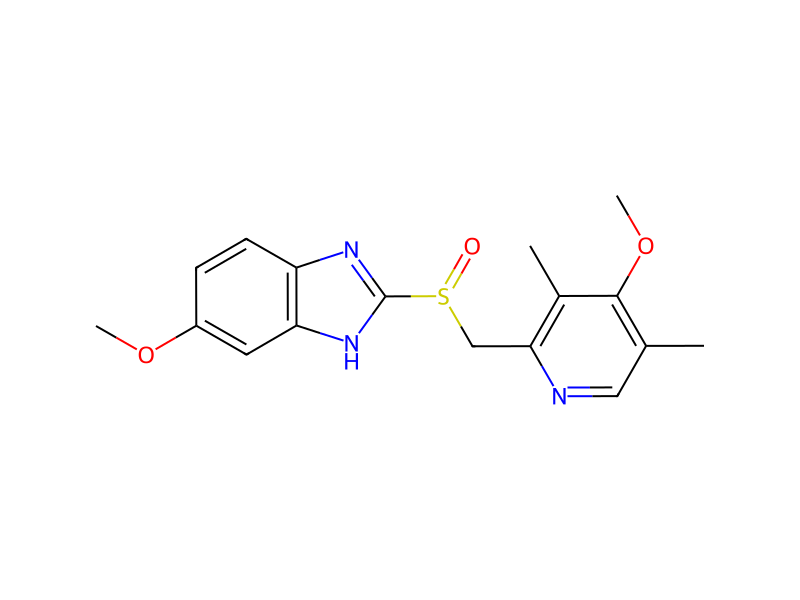
Grundinformationen
- Standard-SMILES
COc1ccc2nc(S(=O)Cc3ncc(C)c(OC)c3C)[nH]c2c1- InChIKey
SUBDBMMJDZJVOS-UHFFFAOYSA-N- Summenformel
- C34H38MgN6O7S2
- Durchschnittliche Molmasse
- 731,14 g/mol
Namen und Bezeichner
- Bevorzugter Name
- Omeprazole
- Englischer Name
- Omeprazole
- Summenformel
- C17H19N3O3S
- Molmasse
- 345.42
Namen und Synonyme
OMEPRAZOLPRILOSECLOSECaulcerbelmazolceprandalOMEPRAZOLE BASEOmeprazole impurity standard5-methoxy-2-(((4-methoxy-3,5-dimethyl-2-pyridyl)methyl)sulfinyl)benzimidazol5-METHOXY-2[(4-METHOXY-3,5-DIMETHYL-2-PYRIDYL)METHYLSULFINYL]-1H-BENZIMIDAZOLE
Datenbank-Bezeichner
- CAS
668985-31-7、73590-58-6- PubChem CID
- 4594
- ChEBI
CHEBI:91766- UNII
- KG60484QX9
- EC Number
- 695-602-9
- Nikkaji
- J33.884B
Eigenschaften
Berechnete Struktureigenschaften
- XLogP
- 2,2
- Polarare Oberfläche (TPSA)
- 96,3 Ų
- H-Brücken-Donoren
- 1
- H-Brücken-Akzeptoren
- 6
- Frei drehbare Bindungen
- 5
- Schwere Atome
- 24
- Formalladung
- 0
- Komplexität
- 453
Physikochemische Eigenschaften
- Schmelzpunkt
- 156 °C · 156°C
- Siedepunkt
- 600 · 600.0±60.0 °C(Predicted)
- Dichte
- 1.332 g/cm3 · 1.332 g/cm3
- Flammpunkt
- 9 ℃ · 9℃
- storage temp.
- 2 · 2-8°C
- Löslichkeit
- 2 O: · H2O: 0.5 mg/mL
- Aggregatzustand
- solid
- pka
- 4.14 · pKa 4.14/8.9(H2O,t =25,I=0.025) (Uncertain)
- Farbe
- white
- Wasserlöslichkeit
- Soluble in water (0.5 mg/ml), DMSO (25 mg/ml), and ethanol (4.5 mg/ml).
- Merck
- 14 · 14,6845
- BCS Class
- 2 · 2
- Stabilität
- Stable, but hygroscopic and photosensitive. Incompatible with strong oxidizing agents. Store in the dark.
- Major Application
- forensics and toxicologypharmaceutical (small molecule)
- InChI
- 1S/C17H19N3O3S/c1-10-8-18-15(11(2)16(10)23-4)9-24(21)17-19-13-6-5-12(22-3)7-14(13)20-17/h5-8H,9H2,1-4H3,(H,19,20)
- InChIKey
- SUBDBMMJDZJVOS-UHFFFAOYSA-N
- SMILES
- COc1ccc2[nH]c(nc2c1)S(=O)Cc3ncc(C)c(OC)c3C
- CAS Datenbank
- 73590 · 73590-58-6(CAS DataBase Reference)
- EPA chemische Informationen
- 1 H-Benzimidazole, · 1H-Benzimidazole, 6-methoxy-2-[[(4-methoxy-3,5-dimethyl-2-pyridinyl)methyl]sulfinyl]- (73590-58-6)
Sicherheit und Regulatorisches
Sicherheitsdaten
- wgk
- 2
- ridadr
- UN1230 - class 3 - PG 2 - Methanol, solution
- hs_code
- 29333990
- RTECS-Nr.
- DD9087000
- risk_code
- 36/37/38-39/23/24/25-23/24/25-11
- Toxizität
- LD50 in mice, rats (g/kg): 0.08, >0.05 i.v.; >4, >4 orally (Ekman)
- hazard_code
- Xi,T,F
- safety_code
- 26-36-37/39-45-36/37-16-7
- Speicherklasse
- 11 - Combustible Solids
- Giftige Stoffe Daten
- 73590-58-6(Hazardous Substances Data)
- Hazard Classifications
- Acute Tox. 4 OralAquatic Chronic 2Skin Sens. 1
Chemie und Industrie
Anwendungen
BeschreibungOmeprazole is a potent gastric antisecretory agent with selective inhibitory effect on the H+,K+-ATPase proton pump. It is highly effective in the treatment of duodenal ulcer and Zollinger-Ellison syndrome, and is reportedly superior to ranitidine in the management of reflux esophagitis.
HistoryOmeprazole was first approved by the FDA in 1989 in the form of extended-release capsules for the treatment of acid-related disorders. Brand name Prilosec, it was initially used over-the-counter (OTC) for adults to help control heartburn that occurs two or more days a week.
VerwendenOmeprazole is a proton pump inhibitor used to treat diseases like gastroesophageal reflux disease (GERD), used for gastric and duodenal ulcers, reflux or erosive esophagitis, and Zollinger-Ellison syndrome. It is also effective for gastric and duodenal ulcers that are ineffective with H2 receptor antagonists. Injections of Omeprazole can also be used for: 1 gastrointestinal bleeding, such as peptic and anastomic ulcer bleeding, and the prevention of severe diseases (such as cerebral hemorrhage, severe trauma, etc.) and gastric surgery caused by upper intestinal bleeding; 2 acute gastric mucosal damage complicated by stress or nonsteroidal anti-inflammatory drugs; 3 general anesthesia, post-surgery, or coma patients, to prevent acid reflux and aspiration pneumonia; 4 Combined with amoxicillin and clarithromycin, or with metronidazole and clarithromycin, it can effectively kill Helicobacter pylori (Hp).
Darstellung
synthetischeThe antiulcer agent omeprazole is produced from 2,3,5-trimethylpyridine N-oxide.Synthesis and Structure of OmeprazoleSteps: 2-(Lithium methyl sulphinyl)-5-methoxy-1H benzimidazole 20g was reacted with 2-chloro-3,5-dimethyl-4-methoxy pyridine 21 g to form sulphide intermediate and then converted to Omeprazole when treated with m-CPBA which used as anoxidizingagents. The acetamide-sulfide compounds modification are oxidised to form the amide sulfinyl compound and gives the sulfinyl carboxylate or salts upon alkaline hydrolysis.On further decarboxylation leads to the target molecules. The residual, unreacted salt, inorganic by-products and other minor by-products can be easily purified by a simple washing from omeprazole or lansoprazole. The amide compounds containing crystalline solids as opposed to the sulphide and sulfoxides of the reported procedures.DOI: http://dx.doi.org/10.20902/IJPTR.2019.120307
Vor- und nachgelagerte Produkte
Vorgelagerte Rohstoffe
Anbieter50 Anbieter
国药集团化学试剂有限公司86-21-63210123 · [email protected]
北京华美互利生物化工010-56205725 · [email protected]
梯希爱(上海)化成工业发展有限公司021-67121386 · [email protected]
上海阿拉丁生化科技股份有限公司400-6206333 13167063860 · [email protected]
INTATRADE GmbH+49 3493/605464 · [email protected]
T&W GROUP021-61551611 13296011611 · [email protected]
韶远科技(上海)有限公司021-50795510 4000665055 · [email protected]
Jai Radhe Sales+(91)-(79)-26431096/65255722 · [email protected]
科瑞迪化学400-821-5857 021-64326257 · [email protected]
LGM Pharma1-(800)-881-8210 · [email protected]
上海迈瑞尔生化科技有限公司4006356688 18621169109 · [email protected]
北京华威锐科化工有限公司0757-86329057 18934348241 · [email protected]
武汉易泰科技有限公司上海分公司18930552037 · [email protected]
大连美仑生物技术有限公司0411-62910999 13889544652 · [email protected]
上海德默医药科技有限公司400-021-7337 2355568890 · [email protected]
安耐吉化学&3A(安徽泽升科技股份有限公司)400-0056266 · [email protected]
上海柯维化学技术有限公司021-64609169 18901607656 · [email protected]
上海相辉医药科技有限公司13761987713 · [email protected]
嘉兴市艾森化工有限公司0573-85285100 18627885956 · [email protected]
上海隆盛化工有限公司58099637 13585536065 · [email protected]
海门慧聚药业有限公司0086-15189180296 · [email protected]
MedChemexpress LLC021-58955995 · [email protected]
合肥天健化工有限公司551-65418679 15856988503;15837135945 · [email protected]
武汉丰泰威远科技有限公司027-87465837 19945049750 · [email protected]
孝感深远化工有限公司15527621225; 15527621225 · [email protected]
济南精合医药科技有限公司0531-88811783 · [email protected]
河南多贝化工有限公司0370-2785118 17550508557 · [email protected]
斯百全化学(上海)有限公司021-021-021-67601398-809-809-809 15221380277 · [email protected]
上海源叶生物科技有限公司13636370518 · [email protected]
艾科试剂4008-755-333 18080918076 · [email protected]
上海明褀化学有限公司86-21-60936353
深圳菲斯生物科技有限公司0755-83725681-603
上海思域化工科技有限公司86-21-34053660 · [email protected]
Wuhan NCE Biomedical Co.,Ltd.4000-027-021 |24 +86-13986109188 | +86-15623472865 | +81-08033611988
南京诺利斯医药科技有限公司13901585132 · [email protected]
江苏艾康生物医药研发有限公司025-66113011 13913916777 · [email protected]
TCI AMERICA800-4238616 · [email protected]
TOKYO CHEMICAL INDUSTRY CO., LTD.03-36680489 · [email protected]
TCI Europe320-37350700 · [email protected]
深圳振强药物研发有限公司0755-66853366 13670046396 · [email protected]
南京友杰医药科技有限公司18860950986 · [email protected]
南京生利德生物科技有限公司025-57798810 18652991625 · [email protected]
深圳市石金谷科技有限公司(0086)755-61930359 (0086)18038192047 · [email protected]
湖北鑫源顺医药化工有限公司13971561712, 13995564702, 027-50664929 · [email protected]
上海将来实业股份有限公司400-0066400 13621662912 · [email protected]
上海将来实业股份有限公司021-61552785 · [email protected]
HBCChem, Inc.+1-510-219-6317 · [email protected]
上海石洋化工有限公司021-56795766 · [email protected]
四川省维克奇生物科技有限公司028-81700200 18116577057 · [email protected]
成都零六生物科技有限公司400-1166-196 13458535857 · [email protected]
Ergänzende Hinweise
DefinitionChEBI: Omeprazole is a member of the class of benzimidazoles that is 1H-benzimidazole which is substituted by a [4-methoxy-3,5-dimethylpyridin-2-yl)methyl]sulfinyl group at position 2 and a methoxy group at position 5.
Zugehörige Reaktionen
84


Verknüpfte Notizen
Wird geladen…