
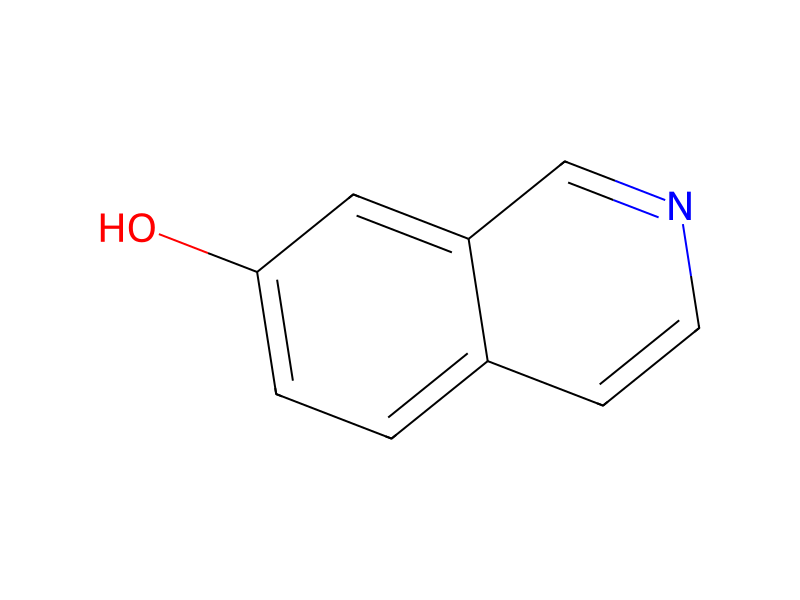
Grundinformationen
- Standard-SMILES
Oc1ccc2ccncc2c1- InChIKey
WCRKBMABEPCYII-UHFFFAOYSA-N- Summenformel
- C9H7NO
- Durchschnittliche Molmasse
- 145,16 g/mol
- Monoisotopische Masse
- 145,05276385
Namen und Bezeichner
- Bevorzugter Name
- 7-Isoquinolinol
- IUPAC
- isoquinolin-7-ol
- Englischer Name
- 7-Hydroxyisoquinoline
- Summenformel
- C9H7NO
- Molmasse
- 145.16
Namen und Synonyme
7-Hydroxyisoquinoline7651-83-47-IsoquinolinolDTXSID90901678RefChem:546618DTXCID901329979676-883-7isoquinolin-7-ol14476-74-5MFCD00456131isoquinoline, 7-hydroxy-SCHEMBL276614
Weitere Namen anzeigen
IFLAB-BB F2124-06597-Hydroxyisoquinoline 98%7-Hydroxyisoquinoline,97%7-Hydroxyisoquinoline,97%,HC-60027-Hydroxyisoquinoline, 95% (Custom work)7-Hydroxyisoquinoline ISO 9001:2015 REACHIsoquinolin-7-ol, 7-Hydroxy-2-azanaphthalene
SCHEMBL276615SCHEMBL1450911WCRKBMABEPCYII-UHFFFAOYSA-NSBB056018AKOS001061431AC-9567CS-W011000MB01177
Datenbank-Bezeichner
- CAS
7651-83-4- PubChem CID
- 459767
- DTXSID
DTXSID90901678- EC Number
- 676-883-7
- Nikkaji
- J1.094.755C
Eigenschaften
Berechnete Struktureigenschaften
- XLogP
- 1,9
- Polarare Oberfläche (TPSA)
- 33,1 Ų
- H-Brücken-Donoren
- 1
- H-Brücken-Akzeptoren
- 2
- Frei drehbare Bindungen
- 0
- Schwere Atome
- 11
- Formalladung
- 0
- Komplexität
- 138
Physikochemische Eigenschaften
- Schmelzpunkt
- 226 · 226-228°C
- Siedepunkt
- 264.27 °C · 264.27°C (rough estimate)
- Dichte
- 1.1555 · 1.1555 (rough estimate)
- Brechungsindex
- 1.45 · 1.4500 (estimate)
- storage temp.
- Inert atmosphere,Room Temperature
- Löslichkeit
- Soluble in methanol and concentrated sulfuric acid.
- pka
- 5.68 · 5.68(at 20℃)
- Aggregatzustand
- solid
- Farbe
- Off-white to light yellow
- BRN
- 113224 · 113224
- CAS Datenbank
- 7651 · 7651-83-4(CAS DataBase Reference)
Sicherheit und Regulatorisches
GHS-Klassifizierung
GHS Classification
Warning
H302 (33.3%): Harmful if swallowed [Warning Acute toxicity, oral];H312 (33.3%): Harmful in contact with skin [Warning Acute toxicity, dermal];H315 (100%): Causes skin irritation [Warning Skin corrosion/irritation];H319 (100%): Causes serious eye irritation [Warning Serious eye damage/eye irritation];H332 (33.3%): Harmful if inhaled [Warning Acute toxicity, inhalation];H335 (100%): May cause respiratory irritation [Warning Specific target organ toxicity, single exposure; Respiratory tract irritation]
P261, P264, P264+P265, P270, P271, P280, P301+P317, P302+P352, P304+P340, P305+P351+P338, P317, P319, P321, P330, P332+P317, P337+P317, P362+P364, P403+P233, P405, and P501 (click each P-code to see the statement)
Aggregated GHS information provided per 6 reports by companies from 3 notifications to the ECHA C&L Inventory. Each notification may be associated with multiple companies.;Information may vary between notifications depending on impurities, additives, and other factors. The percentage value in parenthesis indicates the notified classification ratio from companies that provide hazard codes. Only hazard codes with percentage values above 10% are shown. For more detailed information, please visit ECHA C&L website.
Gefahrenhinweise
Hazard Classes and CategoriesAcute Tox. 4 (33.3%);Acute Tox. 4 (33.3%);Skin Irrit. 2 (100%);Eye Irrit. 2A (100%);Acute Tox. 4 (33.3%);STOT SE 3 (100%)
Sicherheitsdaten
- hs_code
- 2933499090
- risk_code
- 36/37/38-41-37/38-22
- hazard_code
- Xn
- hazard_note
- Harmful/Keep Cold
- safety_code
- 26-36/37/39-39
Chemie und Industrie
Anwendungen
Verwenden7-Hydroxyisoquinoline is used to study its photophysial behavior in polymer matrices such as polymethyl methacrylate, cellulose acetate, polyvinyl alcohol and sulfonated tetrafluoroethylene based fluoropolymer- copolymer. It also used to prepare quinine. Further, it is used as the material for all optical switching due to its excited state proton transfer (ESPT) effect.
Vor- und nachgelagerte Produkte
Vorgelagerte Rohstoffe
Nachgelagerte Produkte
Anbieter50 Anbieter
苏州道澜生物医药科技有限公司15952404857 · [email protected]
上海阿拉丁生化科技股份有限公司400-6206333 13167063860 · [email protected]
上海凌富药物研究有限公司+86(21)5895 0110 19945755304 · [email protected]
陕西缔都新材料有限公司81124267 17392282731 · [email protected]
合肥曼奇诺生物医药技术有限公司19719236623 · [email protected]
广州理文科技有限公司18028686850 · [email protected]
上海麦克林生化科技股份有限公司021-50706066 15221275939 · [email protected]
INTATRADE GmbH+49 3493/605464 · [email protected]
宁波季诺化学品有限公司0574-87314919 057487319282 · [email protected]
河北展药生物科技有限公司15369953316 +8615369953316 · [email protected]
Dayang Chem (Hangzhou) Co.,Ltd.+86-0571-88938639 17705817739 · [email protected]
郑州鸿晟医药科技有限公司0371-55695890 15637198702 · [email protected]
北京炎礼生物科技有限公司18600731423 · [email protected]
上海弘顺生物科技有限公司15901914505 · [email protected]
韶远科技(上海)有限公司021-50795510 4000665055 · [email protected]
毕佳索(上海毕得医药科技股份有限公司)400-6005915 · [email protected]
北京索莱宝科技有限公司010-50973130 17801761073 · [email protected]
阿法埃莎(中国)化学有限公司400-6106006 · [email protected]
安耐吉化学&3A(安徽泽升科技股份有限公司)400-0056266 · [email protected]
武汉凯威斯科技有限公司86-027-67849912 · [email protected]
成都添福瑞生物科技有限公司18030648795 18030648795 · [email protected]
南京圣亿来化工有限公司19951936396 · [email protected]
上海钰康生物科技有限公司18939844854 · [email protected]
常州琬瑶生物科技有限公司051989185693 15312551983 · [email protected]
上海隆盛化工有限公司58099637 13585536065 · [email protected]
上海常丰生物医药科技有限公司+86-021-61727342 13611721451 · [email protected]
杭州东帆化学有限公司86-0571-85151182
山东西亚化学有限公司13355009207 13355009207 · [email protected]
上海法默生物科技有限公司02136680027 15800370750 · [email protected]
白银承泽化工科技有限公司+86 943-8535351 13389336721 · [email protected]
上海卡洛化学有限公司21-33526724 18930996265 · [email protected]
上海睿升化工科技有限公司+86-021-50935922
杭州迈世腾药物科技有限公司0571-82896630 18969958410 · [email protected]
HBCChem, Inc.+1-510-219-6317 · [email protected]
上海毕得医药科技股份有限公司400-164-7117 18317119277 · [email protected]
上海石洋化工有限公司021-56795766 · [email protected]
武汉开诺医药科技有限公司18040571231/1402788087
成都零六生物科技有限公司400-1166-196 13458535857 · [email protected]
上海永叶生物科技有限公司86-021-61559134 15921386130 · [email protected]
江苏艾康生物医药研发有限公司025-66028182 17714375163 · [email protected]
北京九圻化学品有限公司17622371216 · [email protected]
AN PharmaTech Co Ltd86(21)68097365 · [email protected]
宁波智锐新材料有限公司0574-87487840-805 15888368997
上海鼎问化学科技有限公司+86-21-31664694 157 21077413 · [email protected]
北京六合宁远医药科技股份有限公司010-60400365-8001 15910885229 · [email protected]
诺尔凯立科技有限公司86-(0)21-31261262 373522135 · [email protected]
武汉峰耀同辉化学制品有限公司027-87466205 15377579727 · [email protected]
厦门志信化学有限公司+86-5922680277 +86-13806087780 · [email protected]
湖北源梦生物科技有限公司027-68897569 18120462897 · [email protected]
石家庄康西生物科技有限公司13803336640 · [email protected]
Zugehörige Reaktionen
33


Verknüpfte Notizen
Wird geladen…