

Grundinformationen
- Standard-SMILES
O=c1[nH]c2ccccc2n1CCCN1CCN(C(c2ccccc2)c2ccccc2)CC1- InChIKey
BAINIUMDFURPJM-UHFFFAOYSA-N- Summenformel
- C27H30N4O
- Durchschnittliche Molmasse
- 426,6 g/mol
- Monoisotopische Masse
- 426,24196158
Überblick
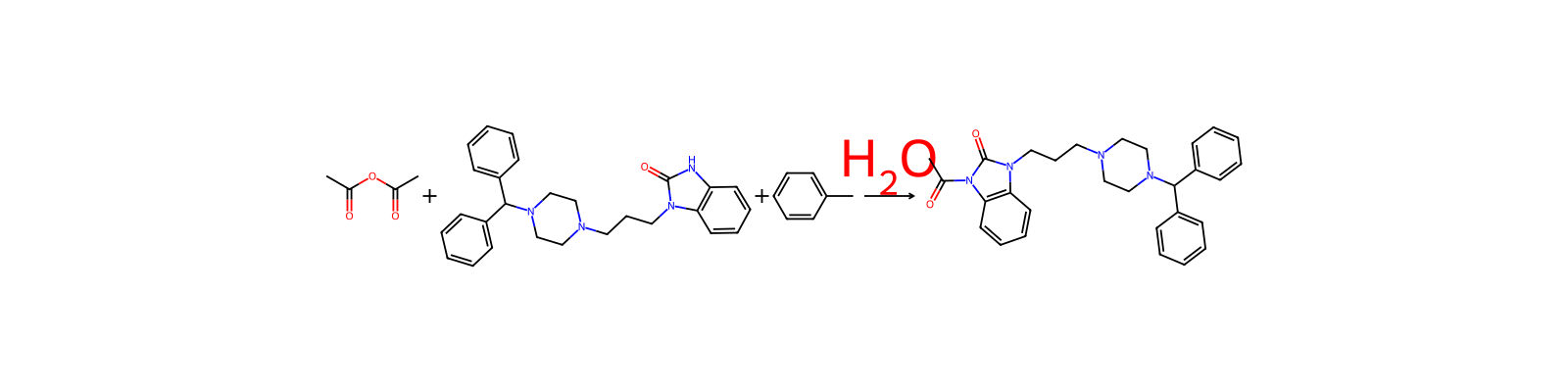
Oxatomide is a member of the class of benzimidazoles that is 1,3-dihydro-2H-benzimidazol-2-one substituted by a 3-[4-(diphenylmethyl)piperazin-1-yl]propyl group at position 1. It is an anti-allergic drug. It has a role as a geroprotector, a H1-receptor antagonist, a serotonergic antagonist, an anti-allergic agent and an anti-inflammatory agent. It is a member of benzimidazoles, a N-alkylpiperazine and a diarylmethane.
Namen und Bezeichner
- Bevorzugter Name
- Oxatomide
- IUPAC
- 3-[3-(4-benzhydrylpiperazin-1-yl)propyl]-1H-benzimidazol-2-one
- Lokaler Name
- Oxatomid
- Englischer Name
- Oxatomide
- Summenformel
- C27H30N4O
- Molmasse
- 426.55
Namen und Synonyme
oxatomide60607-34-3TinsetCeltectOxatimideOxatomidaOxatomidumKW-4354CobionaDastenR-35443DTXSID4045181
Weitere Namen anzeigen
TinseTruxar35443CenacertFensedyl
1-[3-[4-(Diphenylmethyl)-1-piperazinyl]propyl]-1,3-dihydro-2H-benzimidazol-2-oneR 35,443J31IL9Z2EENSC-309710CHEBI:319431-(3-(4-(Diphenylmethyl)-1-piperazinyl)propyl)-1,3-dihydro-2H-benzimidazol-2-one1-(3-(4-(Diphenylmethyl)-1-piperazinyl)propyl)-2-benzimidazolinone2H-Benzimidazol-2-one, 1-(3-(4-(diphenylmethyl)-1-piperazinyl)propyl)-1,3-dihydro-
Datenbank-Bezeichner
- CAS
60607-34-3- PubChem CID
- 4615
- DTXSID
DTXSID4045181- ChEMBL
CHEMBL13828- ChEBI
CHEBI:31943- UNII
- J31IL9Z2EE
- EC Number
- 262-320-9
- Nikkaji
- J18.379B
Eigenschaften
Berechnete Struktureigenschaften
- XLogP
- 4,1
- Polarare Oberfläche (TPSA)
- 38,8 Ų
- H-Brücken-Donoren
- 1
- H-Brücken-Akzeptoren
- 3
- Frei drehbare Bindungen
- 7
- Schwere Atome
- 32
- Formalladung
- 0
- Komplexität
- 574
Experimentelle und physikochemische Eigenschaften
DrugsPharmaceuticals -> Listed in ZINC15
LogP2.73
Physikochemische Eigenschaften
- Schmelzpunkt
- 153.6 C · 153.60C
- Siedepunkt
- 541.98 °C · 541.98°C (rough estimate)
- Dichte
- 1.1239 · 1.1239 (rough estimate)
- Brechungsindex
- 1.6 · 1.6000 (estimate)
- storage temp.
- Refrigerator
- Löslichkeit
- DMSO: soluble
- Aggregatzustand
- White solid.
- pka
- 12.2 · 12.20±0.30(Predicted)
- Farbe
- white
- InChI
- 1S/C27H30N4O/c32-27-28-24-14-7-8-15-25(24)31(27)17-9-16-29-18-20-30(21-19-29)26(22-10-3-1-4-11-22)23-12-5-2-6-13-23/h1-8,10-15,26H,9,16-21H2,(H,28,32)
- InChIKey
- BAINIUMDFURPJM-UHFFFAOYSA-N
- SMILES
- O=C1Nc2ccccc2N1CCCN3CCN(CC3)C(c4ccccc4)c5ccccc5
- CAS Datenbank
- 60607 · 60607-34-3(CAS DataBase Reference)
Sicherheit und Regulatorisches
GHS-Klassifizierung
GHS Classification
Warning
H302 (100%): Harmful if swallowed [Warning Acute toxicity, oral]
P264, P270, P301+P317, P330, and P501 (click each P-code to see the statement)
Aggregated GHS information provided per 46 reports by companies from 1 notifications to the ECHA C&L Inventory.
Gefahrenhinweise
Other Safety InformationIMAP assessments - 2H-Benzimidazol-2-one, 1-[3-[4-(diphenylmethyl)-1-piperazinyl]propyl]-1,3-dihydro-: Environment tier I assessment
Hazard Classes and CategoriesAcute Tox. 4 (100%)
Toxikologische Informationen
Drug Induced Liver Injury
Drug-Induced Liver Injury Severity and Toxicity (DILIst)
Oxatomide
DILI Positive
DOI:10.1016/j.drudis.2019.09.022
Sicherheitsdaten
- wgk
- 3
- RTECS-Nr.
- DE2276000
- risk_code
- 22-36/37/38
- Toxizität
- LD50 in guinea pigs, mice, rats (mg/kg): 320, >2560, >2560 orally; 23, 27, 30 i.v. (Richards)
- hazard_code
- Xn,Xi
- safety_code
- 26-36
- Speicherklasse
- 11 - Combustible Solids
- Hazard Classifications
- Acute Tox. 4 Oral
Chemie und Industrie
Pharmakologische Informationen
ATC Code
R - Respiratory system
QR - Respiratory system
MeSH Pharmacological Classification
Drugs that selectively bind to but do not activate histamine H1 receptors, thereby blocking the actions of endogenous histamine. Included here are the classical antihistaminics that antagonize or prevent the action of histamine mainly in immediate hypersensitivity. They act in the bronchi, capillaries, and some other smooth muscles, and are used to prevent or allay motion sickness, seasonal rhinitis, and allergic dermatitis and to induce somnolence. The effects of blocking central nervous system H1 receptors are not as well understood.
Agents that are used to treat allergic reactions. Most of these drugs act by preventing the release of inflammatory mediators or inhibiting the actions of released mediators on their target cells. (From AMA Drug Evaluations Annual, 1994, p475)
Drugs that are used to treat asthma.
Metabolite PathwaysOxatomide H1-Antihistamine Action
Vor- und nachgelagerte Produkte
Vorgelagerte Rohstoffe
Anbieter50 Anbieter
北京华美互利生物化工010-56205725 · [email protected]
艾吉析科技(上海)有限公司17717235263 · [email protected]
江苏艾康生物医药研发有限公司025-58851090 19370895928 · [email protected]
上海毕得医药科技股份有限公司400-1647117 13681763483 · [email protected]
杭州摩库生物医药科技有限公司+86-057181025280; +8617767106207 · [email protected]
Aladdin Scientific[email protected]
LGM Pharma1-(800)-881-8210 · [email protected]
安耐吉化学&3A(安徽泽升科技有限公司)021-58432009 400-005-6266 · [email protected]
梯希爱(上海)化工贸易有限公司021-61109150 · [email protected]
United Life Science020-82099279 18988941402 · [email protected]
北京博奥森生物技术有限公司400-901-9800 18611424007 · [email protected]
BOC Sciences1-631-485-4226; 16314854226 · [email protected]
深圳振强药物研发有限公司0755-66853366 13670046396 · [email protected]
上海陶素生化科技有限公司021-33632979 · [email protected]
重庆卡兰医药有限公司023-62879767 · [email protected]
天津普西唐生物医药科技有限公司010-60605840 · [email protected]
凯试(上海)科技有限公司021-50135380 · [email protected]
Alfa Chemistry1-516-6625404 · [email protected]
上海陶术生物科技股份有限公司+1-781-999-5354; +1-00000000000 · [email protected]
湖南瑞威尔生物科技有限公司19359985961 · [email protected]
艾吉析科技(上海)有限公司17721401538;17717235263 17721401538 · [email protected]
晶墨(厦门)生物科技有限公司13621943973; 13621943973 · [email protected]
陕西缔都医药化工有限公司+86-29-81139210 +86-17392587031 · [email protected]
上海一飞生物科技有限公司021-65675885 18964387627 · [email protected]
上海源叶生物科技有限公司13636370518 · [email protected]
陕西萃程生物医药科技有限公司13186333400 · [email protected]
成都标样生物科技有限公司028-81700200 13308200041 · [email protected]
上海颖心实验室设备有限公司021-021-59178156 15300768757 · [email protected]
上海超岚化工科技中心QQ:65489617 13301690235 · [email protected]
上海超岚化工科技中心(原上海巢莱)0-2022843681 15618226720 · [email protected]
陕西缔都医药化工有限公司029-81154043 17391733319 · [email protected]
杭州洁汉化工有限公司+86-571-86217390; +8618058761490 · [email protected]
厦门盈融达化工有限公司+86-0592-6210733 · [email protected]
上海瀚香生物科技有限公司17754423994 · [email protected]
深圳聚合生化科技有限公司+86-400-002-6226 · [email protected]
河南阿尔法化工有限公司0371-55055611 18137792234 · [email protected]
海蔚化学86-21-51086038 · [email protected]
安徽今昱生物化工产品技术研发有限公司055167162561 13295518198
XIAMEN AMITY INDUSTRY AND TRADE CO., LTD.+8618950047208 · [email protected]
TargetMol中国(陶术生物)4008200310 15002144251 · [email protected]
上海陌孚医药科技有限公司4000862158 18117107507 · [email protected]
梯尔希(南京)药物研发有限公司18012923235 18012923235 · [email protected]
湖北源梦生物科技有限公司027-68897569 17740516530 · [email protected]
上海安谱实验科技股份有限公司18502138905 · [email protected]
铭龙(咸宁)医药有限公司186-7296-9259 18771307593 · [email protected]
重庆卡兰医药有限公司[email protected]
北京百灵威科技有限公司18210857532 18210857532 · [email protected]
厦门志信化学有限公司86 592 2680277 · [email protected]
上海传芊化工科技中心15869524721 · [email protected]
河南科弘生物科技有限公司0371-55969461 19139748274 · [email protected]
Zugehörige Reaktionen
22




Verknüpfte Notizen
Wird geladen…