StartseiteMCPWorkbenchSkills
StartseiteWorkbenchBenachrichtigungenMein Bereich
llms.txt · MCP-AnleitungDatenschutz · Nutzungsbedingungen · Supportv1.8.0
  1. Startseite
  2. /Verbindung

Tenofovir

HCID 464205
Neue NotizNeue ReaktionAnfrage stellen
Druckvorschau

Daten werden ergänzt – lade die Seite später neu, um den aktuellen Stand zu sehen

GrundinformationenÜberblickNamen und BezeichnerEigenschaftenSicherheit und RegulatorischesChemie und IndustrieZugehörige ReaktionenNotizen zur Verbindung
TeilstruktursucheÄhnliche Strukturen suchen

Grundinformationen

CAS
147127-20-6
Standard-SMILES
C[C@H](Cn1cnc2c(N)ncnc21)OCP(=O)(O)O
InChIKey
SGOIRFVFHAKUTI-ZCFIWIBFSA-N
Summenformel
C9H14N5O4P
Durchschnittliche Molmasse
287,21 g/mol
Monoisotopische Masse
287,07834056

Überblick

Tenofovir (anhydrous) is a member of the class of phosphonic acids that is methylphosphonic acid in which one of the methyl hydrogens is replaced by a [(2R)-1-(6-amino-9H-purin-9-yl)propan-2-yl]oxy group. An inhibitor of HIV-1 reverse transcriptase, the bis(isopropyloxycarbonyloxymethyl) ester (disoproxil ester) prodrug is used as the fumaric acid salt in combination therapy for the treatment of HIV infection. It has a role as an antiviral drug, a drug metabolite and a HIV-1 reverse transcriptase inhibitor. It is a member of phosphonic acids and a nucleoside analogue. It is a conjugate acid of a tenofovir(1-).

Namen und Bezeichner

Bevorzugter Name
Tenofovir
IUPAC
[(2R)-1-(6-aminopurin-9-yl)propan-2-yl]oxymethylphosphonic acid
Englischer Name
Tenofovir
Summenformel
C9H14N5O4P
Molmasse
287.21

Namen und Synonyme

Tenofovir147127-20-6(R)-9-(2-Phosphonomethoxypropyl)adenine(R)-PMPAtenofovir (anhydrous)Tenofovir anhydrousGS-1275anhydrous tenofovirtenofovir (anh.)GS-1278CHEBI:63625({[(2R)-1-(6-amino-9H-purin-9-yl)propan-2-yl]oxy}methyl)phosphonic acid
Weitere Namen anzeigen
(R)-9-(2-PHOSPHONYLMETHOXYPROPYL)-ADENINEVireadApropovir9-PmpaGS 1275Tenofovienofovir
W4HFE001U5[(2R)-1-(6-aminopurin-9-yl)propan-2-yl]oxymethylphosphonic acid(R)-9-(Phosphonomethoxypropyl)adenine(R)-9-(2-Phosphonylmethoxypropyl)adeninePMP-ADTXSID9040132(((1R)-2-(6-Amino-9H-purin-9-yl)-1-methylethoxy)methyl)phosphonic acidPhosphonic acid, (((1R)-2-(6-amino-9H-purin-9-yl)-1-methylethoxy)methyl)-

Datenbank-Bezeichner

CAS
147127-20-6
PubChem CID
464205
DTXSID
DTXSID9040132

Eigenschaften

Berechnete StruktureigenschaftenWird ergänzt

XLogP
-1,6
Polarare Oberfläche (TPSA)
136 Ų
H-Brücken-Donoren
3
H-Brücken-Akzeptoren
8
Frei drehbare Bindungen
5
Schwere Atome
19
Formalladung
0
Komplexität
354

Experimentelle und physikochemische Eigenschaften

Drugs · 2 Einträge

Pharmaceuticals -> Listed in ZINC15

Pharmaceuticals -> Metabolite of Tenofovir alafenamide, 'Tenofovir disoproxil

LogP-1.6
Solubility1.87e+00 g/L
Human DrugsFDA approved drugs -> Active ingredient
Melting Point276 - 280 °C
Physical DescriptionSolid
Dissociation Constants3.8 and 6.7

Physikochemische Eigenschaften

Schmelzpunkt
276 · 276-280°C
Siedepunkt
616.1 · 616.1±65.0 °C(Predicted)
Dichte
1.79 · 1.79±0.1 g/cm3(Predicted)

Sicherheit und Regulatorisches

Sicherheitsangaben dienen nur zur Orientierung und ersetzen weder das Sicherheitsdatenblatt (SDB) des Lieferanten noch geltende Vorschriften oder eine fachliche Bewertung.

GHS-Klassifizierung

GHS Classification · 4 Einträge

Danger

H318 (100%): Causes serious eye damage [Danger Serious eye damage/eye irritation]

P264+P265, P280, P305+P354+P338, and P317 (click each P-code to see the statement)

Aggregated GHS information provided per 2 reports by companies from 1 notifications to the ECHA C&L Inventory.

Gefahrenhinweise

Regulatory InformationStatus: Active Update: 28-04-2021 https://echa.europa.eu/registration-dossier/-/registered-dossier/10529
Hazard Classes and CategoriesEye Dam. 1 (100%)

Toxikologische Informationen

Hepatotoxicity · 1 Eintrag

Like all nucleoside analogues used as therapy of hepatitis B, tenofovir can cause transient increases in serum aminotransferases during or after therapy. These abnormalities appear to be due to an exacerbation or flare of the underlying hepatitis B. Three types of flares due to nucleoside analogue therapy have been described: transient flares during initiation of therapy (treatment flares), flares occurring in association with development of antiviral resistance (breakthrough flares) and flares occurring in the few months after stopping therapy (withdrawal flares). Treatment flares generally arise during the first few months of starting therapy, are usually mild, asymptomatic and self-limited and do not require dose modification or interruption of therapy. Breakthrough flares generally follow the development of antiviral resistance and subsequent rise in HBV DNA levels during nucleoside analogue therapy. Breakthrough flares can be symptomatic and severe. Because tenofovir is associated with a very low rate of antiviral resistance (

Chemie und Industrie

Pharmakologische Informationen

Protein BindingTenofovir is minimally bound to plasma proteins and only about 7.2% of the administered dose is found in the bound state.
Pharmacodynamics · 1 Eintrag

Tenofovir has been shown to be highly effective in patients that have never had an antiretroviral therapy and it seemed to have lower toxicity than other antivirals such as [stavudine]. In phase 3 clinical trials, tenofovir presented a similar efficacy than [efavirenz] in treatment-naive HIV patients. In hepatitis B infected patients, after one year of tenofovir treatment, the viral DNA levels were undetectable.

Mechanism of Action · 1 Eintrag

Once tenofovir is activated by a bi-phosphorylation it acts as an antiviral acyclic nucleoside phosphonate. It is a potent inhibitor of the viral reverse transcriptase with an inhibitory constant of approximately 0.022 micromolar. Once activated, tenofovir acts with different mechanisms including the inhibition of viral polymerase causing chain termination and the inhibition of viral synthesis. All these activities are attained by its competition with deoxyadenosine 5'-triphosphate in the generation of new viral DNA. Once tenofovir is incorporated in the chain, it induces a chain termination which in order inhibits viral replication. The safety of tenofovir relies on its low affinity towards the cellular DNA polymerase including the mitochondrial DNA polymerase gamma.

Biological Half-LifeThe reported half-life of tenofovir is of 32 hours.
Metabolism/MetabolitesTenofovir activation is performed by a bi-phosphorylation which in order forms the biologically active compound, tenofovir biphosphate. This metabolic activation has been shown to be performed in hepG2 cells and human hepatocytes.
FDA Pharmacological Classification · 6 Einträge

W4HFE001U5

TENOFOVIR ANHYDROUS

Established Pharmacologic Class [EPC] - Human Immunodeficiency Virus Nucleoside Analog Reverse Transcriptase Inhibitor

Established Pharmacologic Class [EPC] - Hepatitis B Virus Nucleoside Analog Reverse Transcriptase Inhibitor

Zugehörige Reaktionen

8
Reaktionsaufzeichnung erstellen
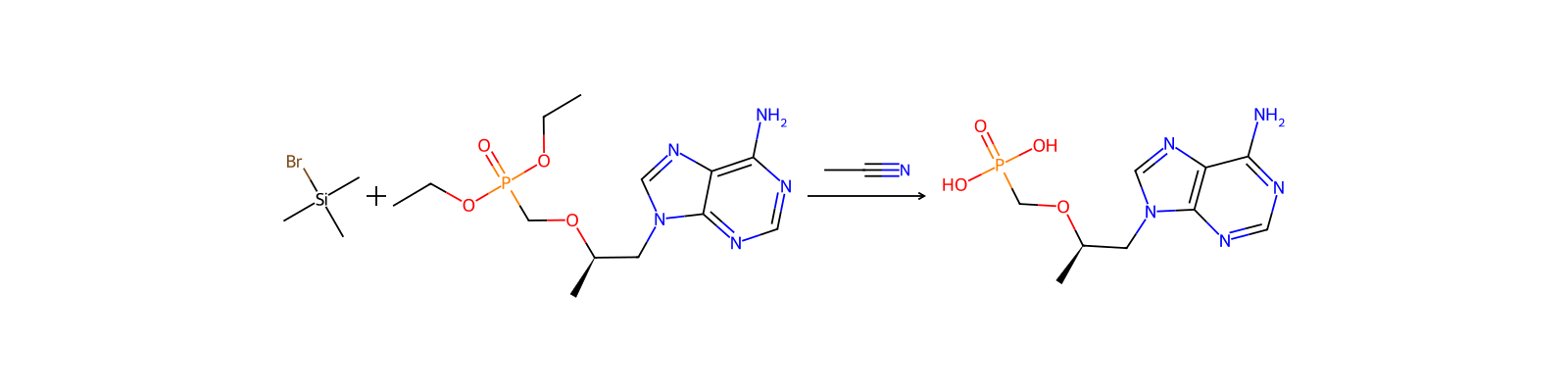
Reaktionsgleichung von HRID 133116
HRID 133116als Eduktuspto-grants-2008_06
Reaktionsgleichung von HRID 554463
HRID 554463als Produktuspto-grants-2011_11
Reaktionsgleichung von HRID 554464
HRID 554464als Produktuspto-grants-2011_11
Reaktionsgleichung von HRID 581681
HRID 581681als Produktuspto-grants-1999_07
Reaktionsgleichung von HRID 1600580
HRID 1600580als Produktuspto-grants-1999_11
Reaktionsgleichung von HRID 1716371
HRID 1716371als Eduktuspto-grants-2010_09
Reaktionsgleichung von HRID 1716372
HRID 1716372als Produktuspto-grants-2010_09
Reaktionsgleichung von HRID 1890236
HRID 1890236als Produktuspto-grants-2013_08

Notizen zur Verbindung

Wird geladen…

Auf dieser SeiteGrundinformationenÜberblickNamen und BezeichnerEigenschaftenSicherheit und RegulatorischesChemie und IndustrieZugehörige ReaktionenNotizen zur Verbindung
Weitere Aktionen
Neue NotizNeue ReaktionAnfrage stellen
ChEMBL
CHEMBL3989702、CHEMBL483
ChEBI
CHEBI:63625
UNII
W4HFE001U5
EC Number
604-571-2
Nikkaji
J540.142I
storage temp.
-20 °C · -20°C
Löslichkeit
Aqueous Acid (Sparingly), DMSO (Slightly, Heated), Water (Slightly, Heated)
pka
2.36 · 2.36±0.10(Predicted)
Aggregatzustand
powder
Farbe
white to beige
Wasserlöslichkeit
13.4 mg/mL · 13.4 mg/mL (25 ºC)
Merck
14 · 14,9146
InChI
InChI=1S/C9H14N5O4P/c1-6(18-5-19(15,16)17)2-14-4-13-7-8(10)11-3-12-9(7)14/h3-4,6H,2,5H2,1H3,(H2,10,11,12)(H2,15,16,17)/t6-/m1/s1
InChIKey
SGOIRFVFHAKUTI-ZCFIWIBFSA-N
SMILES
P(CO[C@H](C)CN1C2C(N=C1)=C(N)N=CN=2)(=O)(O)O
CAS Datenbank
147127 · 147127-20-6(CAS DataBase Reference)
Drug Induced Liver Injury · 6 Einträge

Benchmark Dataset for the Liver Toxicity Knowledge Base (LTKB)

tenofovir

Viread®

Antivirals

8

most-DILI-concern

Sicherheitsdaten

wgk
WGK 3
hs_code
29339900
RTECS-Nr.
SZ6563600
Speicherklasse
11 - Combustible Solids

Chemical Structure [CS] - Nucleosides

Mechanisms of Action [MoA] - Nucleoside Reverse Transcriptase Inhibitors

MeSH Pharmacological Classification · 3 Einträge

Agents used in the prophylaxis or therapy of VIRUS DISEASES. Some of the ways they may act include preventing viral replication by inhibiting viral DNA polymerase; binding to specific cell-surface receptors and inhibiting viral penetration or uncoating; inhibiting viral protein synthesis; or blocking late stages of virus assembly.

Inhibitors of reverse transcriptase (RNA-DIRECTED DNA POLYMERASE), an enzyme that synthesizes DNA on an RNA template.

Agents used to treat AIDS and/or stop the spread of the HIV infection. These do not include drugs used to treat symptoms or opportunistic infections associated with AIDS.

Absorption, Distribution and Excretion · 4 Einträge

Tenofovir as the active moiety presents a very low bioavailability when orally administered. Hence, the administration of this active agent is required to be under its two prodrug forms, [tenofovir disoproxil] and [tenofovir alafenamide]. This reduced absorption is suggested to be related to the presence of two negative charges among its structure. This negative charge limits its cellular penetration, and its passive diffusion across cellular membranes and intestinal mucosa hindering its availability for oral administration. Intravenous tenofovir has been shown to produce a maximum plasma concentration of 2500 ng/ml with an AUC of 4800 ng.h/ml.

Tenofovir is eliminated in the urine by tubular secretion and glomerular filtration. The elimination of this compound is driven by the activity of the human organic anion transporters 1 and 3 and its secretion is mainly ruled by the activity of the multidrug resistance-associated protein 4.

Accumulation of tenofovir in plasma is related to the presence of nephrotoxic effects. It is reported that tenofovir presents a volume of distribution of 0.813 L/kg.

The clearance of tenofovir is highly dependent on the patient renal stage and hence the clearance rate in patients with renal impairment is reported to be of 134 ml/min while in patients with normal function the clearance rate can be of 210 ml/min.

Cellular LocationsCytoplasm
Metabolite PathwaysTenofovir Action Pathway
Anwendungen · 3 Einträge

BeschreibungTenofovir is an analog of adenosine monophosphate that has antiviral activity. It is converted by cellular enzymes to tenofovir diphosphate, an obligate chain terminator that inhibits the activity of HIV reverse transcriptase and hepatitis B virus polymerase. Tenofovir diphosphate is a weak inhibitor of mammalian DNA polymerases α and β and mitochondrial DNA polymerase γ. For in vivo and cell culture use, tenofovir is supplied as a water soluble prodrug in the form of tenofovir disoproxil (fumarate) , which increases the intracellular diphosphorylated compound >1,000-fold above the level attained with unmodified tenofovir.

HistoryTenofovir was developed in the 1980s by Professor Antonín Holý and his team at the Institute of Organic Chemistry and Biochemistry (IOCB Prague) of the Czech Academy of Sciences. Their research focused on the design and synthesis of nucleotide analogs, aiming to develop novel compounds with antiviral activity. As an acyclic nucleotide phosphate analog, tenofovir exhibited broad-spectrum antiviral potential in vitro, but its low oral bioavailability limited its initial development. To overcome this bottleneck, collaboration with Gilead Sciences was crucial, ultimately leading to the successful development of tenofovir disoproxil fumarate (TDF) through a prodrug synthesis strategy. This prodrug was first approved by the FDA in 2001 for the treatment of HIV-1 infection, marking a significant breakthrough in its clinical application. Subsequent research further solidified its position in the treatment of chronic hepatitis B and facilitated the market launch of tenofovir alafenamide (TAF), a prodrug with superior renal and bone safety characteristics.

VerwendenTenofovir is a drug used for the treatment of chronic heptatitis B as well as prevention and treatment of HIV/AIDS. It is a kind of nucleotide analog, acting as the reverse-transcriptase inhibitor (NtRTI). It inhibits the activity of HIV reverse transcriptase through competing with the natural substrate deoxyadenosine 5’-triphosphate, causing the termination of DNA chain.

Vor- und nachgelagerte Produkte

Vorgelagerte Rohstoffe

ParaformaldehydeDiethylcarbonatDiethylphosphonat

Nachgelagerte Produkte

phenyl hydrogen ((((R)-1-(6-amino-9H-purin-9-yl)propan-2-yl)oxy)methyl)phosphonate[2-(6-AMino-9H-purin-9-yl)-1-Methylethoxy]Methyl]-4-Morpholinylphosphinic AcidTenofovir disoproxil fumarate
Ergänzende Hinweise · 1 Eintrag

DefinitionChEBI: A member of the class of phosphonic acids that is methylphosphonic acid in which one of the methyl hydrogens is replaced by a [(2R)-1-(6-amino-9H-purin-9-yl)propan-2-yl]oxy group. An inhibitor of HIV-1 reverse transcriptase, the bis(isopropyloxycarbonyloxy ethyl) ester (disoproxil ester) prodrug is used as the fumaric acid salt in combination therapy for the treatment of HIV infection.