StartseiteMCPWorkbenchSkills
StartseiteWorkbenchBenachrichtigungenMein Bereich
llms.txt · MCP-AnleitungDatenschutz · Nutzungsbedingungen · Supportv1.8.0
  1. Startseite
  2. /Verbindung

2-(3,4-Dichlorphenyl)-4-methyl-1,2,4-oxadiazolidindion

Methazole

HCID 4690
Neue NotizNeue ReaktionAnfrage stellen
Druckvorschau
GrundinformationenÜberblickNamen und BezeichnerEigenschaftenSicherheit und RegulatorischesChemie und IndustrieZugehörige ReaktionenNotizen zur Verbindung
TeilstruktursucheÄhnliche Strukturen suchen

Grundinformationen

CAS
20354-26-1
Standard-SMILES
Cn1c(=O)on(-c2ccc(Cl)c(Cl)c2)c1=O
InChIKey
LRUUNMYPIBZBQH-UHFFFAOYSA-N
Summenformel
C9H6Cl2N2O3
Durchschnittliche Molmasse
261,06 g/mol
Monoisotopische Masse
259,9755474

Überblick

Methazole can cause developmental toxicity according to The Environmental Protection Agency (EPA).

Namen und Bezeichner

Bevorzugter Name
Methazole
IUPAC
2-(3,4-dichlorophenyl)-4-methyl-1,2,4-oxadiazolidine-3,5-dione
Lokaler Name
2-(3,4-Dichlorphenyl)-4-methyl-1,2,4-oxadiazolidindion
Englischer Name
METHAZOLE
Summenformel
C9H6Cl2N2O3
Molmasse
261.06

Namen und Synonyme

Methazole20354-26-1MetazoleOxydiazolBioxonePaxilonTunicMetazolMezopurCHLORMETHAZOLE2-(3,4-Dichlorophenyl)-4-methyl-1,2,4-oxadiazolidine-3,5-dioneProbe 75
Weitere Namen anzeigen
VC 438vcs438probe75
VCS 438E35M7EMD3VDTXSID1040293RefChem:811715DTXCID9020293VSC-438Probe2-(3,4-Dichlorophenyl)-4-methyl-1,2,4-oxadiazolidinedione

Datenbank-Bezeichner

CAS
20354-26-1
PubChem CID
4690
DTXSID
DTXSID1040293
ChEBI
CHEBI:82244
UNII
E35M7EMD3V
EC Number
243-761-6
Nikkaji
J65.682H

Eigenschaften

Berechnete Struktureigenschaften

XLogP
2,7
Polarare Oberfläche (TPSA)
49,9 Ų
H-Brücken-Donoren
0
H-Brücken-Akzeptoren
3
Frei drehbare Bindungen
1
Schwere Atome
16
Formalladung
0
Komplexität
326

Experimentelle und physikochemische Eigenschaften

SpringerMaterials PropertiesFusion temperature
Pesticides · 3 Einträge

Herbicides

Active substance -> EU Pesticides database: Not approved

Pesticides -> Herbicides, Other

Density1.24 at 25 °C
Color/FormWhite solid
Solubility · 2 Einträge

@ 25 °C: 1.5 MG/L WATER, 40 G/L ACETONE, 6.5 G/L METHANOL, 55 G/L XYLENE

@ 25 °C in ethanol approx equal to 1.0% wt/wt

CorrosivityNon-corrosive to metals
Boiling PointDecomposes before boiling
Melting Point123-124 °C
Vapor Pressure · 2 Einträge

0.000001 [mmHg]

133 uPa at 25 °C

Henry's Law Constant

Sicherheit und Regulatorisches

Sicherheitsangaben dienen nur zur Orientierung und ersetzen weder das Sicherheitsdatenblatt (SDB) des Lieferanten noch geltende Vorschriften oder eine fachliche Bewertung.

GHS-Klassifizierung

GHS Classification · 6 Einträge

Warning

H302: Harmful if swallowed [Warning Acute toxicity, oral]

P264, P264+P265, P270, P273, P280, P301+P317, P302+P352, P305+P351+P338, P317, P321, P330, P332+P317, P337+P317, P362+P364, P391, and P501 (click each P-code to see the statement)

Warning

H302: Harmful if swallowed [Warning Acute toxicity, oral]

P264, P264+P265, P270, P273, P280, P301+P317, P302+P352, P305+P351+P338, P317, P321, P330, P332+P317, P337+P317, P362+P364, P391, and P501 (click each P-code to see the statement)

Gefahrenhinweise

Regulatory Information · 3 Einträge

Hazard Traits - Developmental Toxicity

2002/2076

The New Jersey Worker and Community Right to Know Act requires public and private employers to provide information about hazardous substances at their workplaces. (N.J.S.A. 34:5A-1 et. seq.)

Other Safety InformationIMAP assessments - 1,2,4-Oxadiazolidine-3,5-dione, 2-(3,4-dichlorophenyl)-4-methyl-: Environment tier I assessment
Hazards Summary · 1 Eintrag

A mild skin and eye irritant; Not a skin sensitizer; Not a mutagen or teratogen at <60 mg/kg daily in rabbits; Cataract formation was only adverse effect in 3 generation study of rats at 100 mg/kg diet; 90-day feeding studies of rats and dogs at 500 mg/kg/bw caused no effects in blood, urine, or histopathological exams; [HSDB] A skin and eye irritant; [eChemPortal: ESIS]

Reactive GroupAmides and Imides
Special Reports · 2 Einträge

WHITACRE DM ET AL; METHAZOLE; ANAL METHODS PESTIC PLANT GROWTH REGUL 10: 367-84 (1978). A REVIEW WITH 9 REF DISCUSSING BIOLOGICAL, CHEMICAL, & PHYSICAL PROPERTIES & METHODS OF ANALYSIS FOR METHAZOLE.

Chemie und Industrie

Pharmakologische Informationen

Metabolism/Metabolites · 2 Einträge

BIOXONE WAS READILY METABOLIZED BY COTTON (GOSSYPIUM HIRSUTUM L) TO 1-(3,4-DICHLOROPHENYL)-3-METHYLUREA (DCPMU) & 1-(3,4-DICHLOROPHENYL)UREA (DCPU). 3 DAYS AFTER TREATMENT OF EXCISED LEAVES /OF COTTON/, 1-(3,4-DICHLOROPHENYL)UREA ACCOUNTED FOR 55-70% OF APPLIED (14)C. INTACT ROOTS METABOLIZED BIOXONE RAPIDLY TO 1-(3,4-DICHLOROPHENYL)-3-METHYLUREA & 1-(3,4-DICHLOROPHENYL)UREA ... SOME CONJUGATION OF PLANT PROTEINS WITH 1-(3,4-DICHLOROPHENYL)-3-METHYLUREA & 1-(3,4-DICHLOROPHENYL)UREA WAS INDICATED ... .

MOUSE LIVER MICROSOMAL OXIDASE METAB GIVES PRIMARILY DESMETHYLMETHAZOLE UNDER AEROBIC CONDITIONS & ARNHC(O)NHCH3 UNDER NITROGEN. 3-HYDROXY-1-METHYLUREA FROM SPINACH IS REDUCED TO 1-METHYLUREA, REMAINDER IS CONJUGATED AS N-O-BETA-D-GLUCOSIDE & ITS 6-O-MALONYL ESTER.

Absorption, Distribution and Excretion · 2 Einträge

LITTLE OR NO INTACT HERBICIDE WAS TRANSLOCATED FROM ROOTS TO LEAVES BUT RADIOACTIVITY IN LEAVES ACCOUNTED FOR 80-90% OF METHANOL-SOLUBLE LABEL @ 47 DAYS POSTTREATMENT. MOST OF THIS (14)C WAS RECOVERED AS DCPU /1-(3,4-DICHLOROPHENYL)UREA/ (50-60%) & UNIDENTIFIED POLAR METABOLITE (30-40%).

Absorbed via roots and leaves. Translocated in the sap stream.

Verwendung und Herstellung

Uses · 5 Einträge

Used as pre- and post-emergence herbicide for control of annual broad-leaved weeds and some grasses in cotton, onions, potatoes, citrus and stone fruit, vines, lucerne, tea, and nuts; [HSDB]

Cancelled--no longer registered as a pesticide for use in the US; [HSDB]

Farming (Pesticides) [Category: Industry]

The active ingredient is no longer contained in any registered pesticide products ... "cancelled."

Pre- and post-emergence control of annual broad-leaved weeds and some grasses incotton, garlic, onions, potatoes, citrus fruit, stone fruit, vines, lucerne, tea, and nut crops.

Methods of ManufacturingPRODUCED BY CYCLIZATION, WITH A HALOFORMATE, OF 1-(3,4-DICHLOROPHENYL)-1-HYDROXY-3-METHYLUREA, WHICH IS FORMED BY REACTION OF N-(3,4-DICHLOROPHENYL)HYDROXYLAMINE WITH METHYL ISOCYANATE.

Zugehörige Reaktionen

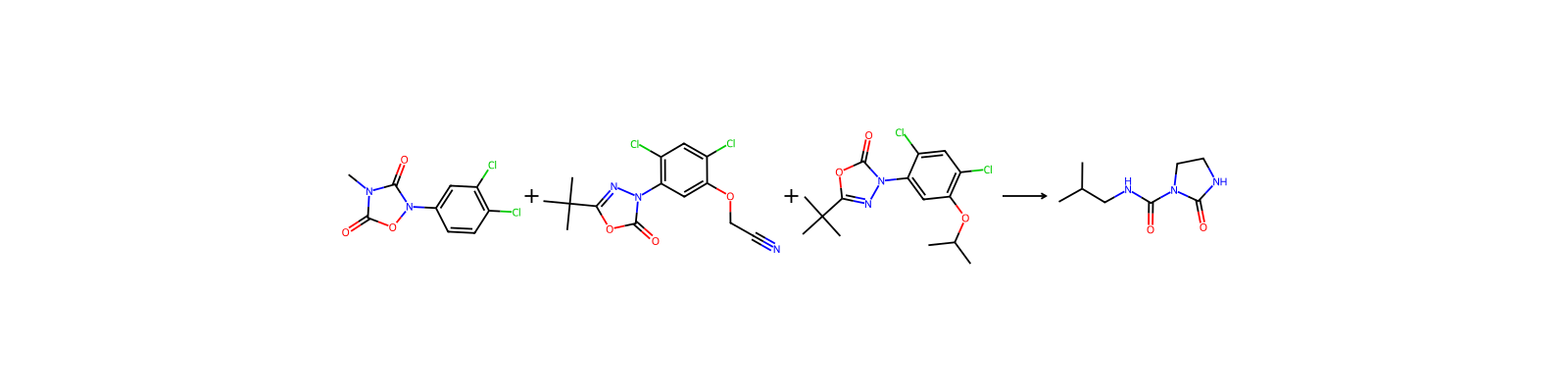
4
Reaktionsaufzeichnung erstellen
Reaktionsgleichung von HRID 993475
HRID 993475als Eduktuspto-grants-2002_10
Reaktionsgleichung von HRID 1005321
HRID 1005321als Eduktuspto-grants-2000_04
Reaktionsgleichung von HRID 1007151
HRID 1007151als Eduktuspto-grants-2004_09
Reaktionsgleichung von HRID 1263443
HRID 1263443als Eduktuspto-grants-2003_04

Notizen zur Verbindung

Wird geladen…

Auf dieser SeiteGrundinformationenÜberblickNamen und BezeichnerEigenschaftenSicherheit und RegulatorischesChemie und IndustrieZugehörige ReaktionenNotizen zur Verbindung
Weitere Aktionen
Neue NotizNeue ReaktionAnfrage stellen
Henry's Law constant= 2.29X10⁻⁷ atm-cu m/mole
Physical Description · 2 Einträge

Methazole appears as colorless crystals to light tan solid. Non corrosive. Herbicide.

White solid; Technical material: Light tan solid; [HSDB]

Stability/Shelf Life · 2 Einträge

Soln of methazole in methanol are decomp by UV light but it is more stable in water when exposed to sunlight ... .

Stable in neutral or acid solution but hydrolyzes in base to form several products.

Physikochemische Eigenschaften

Schmelzpunkt
123 · 123-124°
Siedepunkt
348.7 · 348.7±52.0 °C(Predicted)
Dichte
1.24 · 1.2400
Brechungsindex
1.61 · 1.6100 (estimate)
storage temp.
0 · 0-6°C
pka
-2.16 · -2.16±0.20(Predicted)
Farbe
Light-tan solid
Wasserlöslichkeit
1.5 mg/L · 1.5mg/L(25 ºC)
Henry's Law Constant
4.3 · 4.3×101 mol/(m3Pa) at 25℃, HSDB (2015)
EPA chemische Informationen
Methazole (20354-26-1)

KIMBROUGH RD; INTERNATIONAL SYMPOSIUM ON HAZARDS OF PESTICIDES TO THE ENVIRONMENT AND HUMAN HEALTH, ALEXANDRIA, EGYPT, NOV 1-3 (1978); J ENVIRON SCI HEALTH PESTIC FOOD CONTAM AGRIC WASTES 15 (6): 977 (1980). HUMAN HEALTH EFFECTS OF SELECTED PESTICIDES CHLORO ANILINE DERIVATIVES.

FIFRA Requirements · 2 Einträge

As the federal pesticide law FIFRA directs, EPA is conducting a comprehensive review of older pesticides to consider their health and environmental effects and make decisions about their future use. Under this pesticide reregistration program, EPA examines health and safety data for pesticide active ingredients initially registered before November 1, 1984, and determines whether they are eligible for reregistration. In addition, all pesticides must meet the new safety standard of the Food Quality Protection Act of 1996. Pesticides for which EPA had not issued Registration Standards prior to the effective date of FIFRA, as amended in 1988, were divided into three lists based upon their potential for human exposure and other factors, with List B containing pesticides of greater concern and List D pesticides of less concern. Methazole is found on List B. Case No: 2400; Pesticide type: Herbicide; Case Status: No products containing the pesticide are actively registered ... The case /is characterized/ as "cancelled." Under FIFRA, pesticide producers may voluntarily cancel their registered products. EPA also may cancel pesticide registrations if registrants fail to pay required fees or make/meet certain reregistration commitments, or if EPA reaches findings of unreasonable adverse effects.; Active ingredient (AI): 2-(3,4-Dichlorophenyl)-4-methyl-1,2,4-oxadiazolidine-3,5-dione; Data Call-in (DCI) Date(s): 05/10/91; AI Status: The active ingredient is no longer contained in any registered pesticide products ... "cancelled."

A tolerance is established for combined negligible residues of the herbicide methazole (2-(3,4-dichlorophenyl)-4-methyl-1,2,4- oxadiazolidine-3,5-dione) and its metabolites 1-(3,4-dichlorophenyl)-3- methylurea (DCPMU) and 3,4-dichlorophenylurea (DCPU) in or on cottonseed.

Reactivity ProfileMETHAZOLE is an oxadiazole.
Air and Water ReactionsHydrolyzed by strong acids and bases.
Hazard Classes and Categories · 2 Einträge

Acute toxicity - category 4

Acute Tox. 4 *

Skin, Eye, and Respiratory Irritations... Mildly irritating to the skin and eyes. ...

Sicherheit und Schutzausrüstung

Preventive Measures · 2 Einträge

Avoid skin and eye contact. Keep away from food and feedstuffs.

SRP: The scientific literature for the use of contact lenses in industry is conflicting. The benefit or detrimental effects of wearing contact lenses depend not only upon the substance, but also on factors including the form of the substance, characteristics and duration of the exposure, the uses of other eye protection equipment, and the hygiene of the lenses. However, there may be individual substances whose irritating or corrosive properties are such that the wearing of contact lenses would be harmful to the eye. In those specific cases, contact lenses should not be worn. In any event, the usual eye protection equipment should be worn even when contact lenses are in place.

Allowable Tolerances · 1 Eintrag

A tolerance is established for combined negligible residues of the herbicide methazole (2-(3,4-dichlorophenyl)-4-methyl-1,2,4- oxadiazolidine-3,5-dione) and its metabolites 1-(3,4-dichlorophenyl)-3- methylurea (DCPMU) and 3,4-dichlorophenylurea (DCPU) in or on cottonseed at 0.1 ppm.

Personal Protective Equipment (PPE)Wear protective clothing, including gloves, as methazole can cause chloracne.

Toxikologische Informationen

Ecotoxicity Values · 4 Einträge

LC50 Anas platyrhynchos (Mallard duck) oral 11500 mg/kg in 8 day diet

LC50 Colinus virginianus (Bobwhite quail) oral 1825 mg/kg in 8 day diet

LC50 Lepomis machrochirus (Bluegill) 4 mg/l/96 hr /Conditions of bioassay not specified/

LC50 Salmo gairdneri (Rainbow trout) 4 mg/l/96 hr /Conditions of bioassay not specified/

Environmental Fate · 5 Einträge

TERRESTRIAL FATE: METHAZOLE WAS DEGRADED TO 3-(3,4-DICHLOROPHENYL)-1-METHYLUREA & 3-(3,4-DICHLOROPHENYL) UREA OVER A 6-WK PERIOD FOLLOWING APPLICATION TO ELMWOOD SANDY LOAM SOIL COLUMNS. AFTER APPLICATION TO ELMWOOD SANDY LOAM SOIL COLUMNS, METHAZOLE LEVEL DECR TO 27% OF ORIGINAL AMT, OF TOTAL RADIOACTIVITY REMAINING IN THE SOIL COLUMNS AFTER 44 DAYS, APPROX 80% REMAINED ABOVE 6.35 MM.

TERRESTRIAL FATE: MOVEMENT OF METHAZOLE TAGGED WITH (14)C WAS STUDIED IN LAKELAND SAND, NACOGDOCHES SANDY LOAM, NORWOOD CLAY LOAM, & MILLER CLAY SOILS, VERY LITTLE (14)C WAS DETECTED IN LEACHATE. METHAZOLE WAS READILY CONVERTED TO 1-(3,4-DICHLOROPHENYL)-3-METHYLUREA (DCPMU) & 1-(3,4-DICHLOROPHENYL)UREA (DCPU) IN THE SOILS STUDIED, WITH 1-(3,4-DICHLOROPHENYL)-3-METHYLUREA BEING PRESENT IN LARGEST QUANTITIES.

Terrestrial Fate: Stabilized on attapulgite or montmorillonite clays.

TERRESTRIAL FATE: The results of degradation studies in four different soil types found that 14-C labelled chlormethazole degraded readily to 1-(3,4-dichlorophenyl)-3-methyl urea (DCPMU)(1); the degradation mechanism was not examined, but the degradation product is known to be a major degradation product resulting from aqueous hydrolysis or photodecomposition(2). Soil microorganisms can reportedly degrade chlormethazole to its major metabolites (including DCPMU)(3), but the relative importance of biodegradation in soil is unknown(SRC). The US Dept of Agric's Pesticide Properties Database lists a soil half-life of 14 days for chlormethazole(4). Chlormethazole applied to soil at agricultural rates degrades quickly and generally disappears within 30 to 60 days(3). Soil column leaching tests(1) and a measured Koc value of 2620(5) indicated that chlormethazole will leach very little in most soils(SRC). Chlormethazole will reportedly volatilize from inert surfaces, but much less so from foliar surfaces(3).

For more Environmental Fate (Complete) data for CHLORMETHAZOLE (6 total), please visit the HSDB record page.

Soil Adsorption/Mobility · 1 Eintrag

The US Dept Agric's Pesticide Properties Database lists a Koc value of 3000 for chlormethazole(1). An experimental Koc value of 2620 has also been reported(2). According to a suggested classification scheme(3), these Koc values suggest that chlormethazole has low to slight mobility in soil(SRC). In soil column leaching tests using sand, sandy loam, clay loam and clay soils, very little chlormethazole leached below a 15 cm depth(4).

Artificial Pollution SourcesChlormethazole's use as a herbicide(1-2) releases the compound directly to the environment through applications in powders, sprays and other routes of application(SRC).
Environmental Bioconcentration · 1 Eintrag

Based upon a water solubility of 1.5 mg/L at 25 °C(1), the BCF of chlormethazole can be estimated to be 490 from a regression derived equations(2,SRC). This BCF value suggests that bioconcentration in aquatic organisms may have some importance(SRC); however, it is reported that chlormethazole residues tend to dissipate quickly and do not bioaccumulate(3).

Volatilization from Water/Soil · 1 Eintrag

Based upon a vapor pressure of 1X10⁻⁶ mm Hg(1) and a water solubility of 1.5 mg/L at 25 °C(1), the Henry's Law constant for chlormethazole can be estimated to be 2.29X10⁻⁷ atm-cu m/mole (SRC). This value of Henry's Law constant indicates that chlormethazole is essentially nonvolatile from water(2). Chlormethazole will reportedly volatilize from inert surfaces, but much less so from foliar surfaces(3).

Non-Human Toxicity Excerpts · 4 Einträge

... Mildly irritating to the skin and eyes and chloracne was observed in rabbit-ear studies ... . It does not produce skin sensitization in guinea pigs. ... In 2 yr feeding trials in rats and mice a yellow-brown pigment (of unknown significance) occurred in the spleen or liver at levels >100 mg/kg diet. ... It is not a mutagen and not a teratogen in rabbits less than or equal to 60 mg/kg daily, but foetal toxicity was observed greater than or equal to 30 mg/kg daily. In a 3 generation study in rats NEL was 50 mg/kg diet, cataracts were observed greater than or equal to 100 mg/kg diet but no other ill-effect; in a 1 generation study no effect level for bobwhite quail and mallard duck was 3 mg/kg diet.

Feeding to rats and dogs at 500 mg/kg body wt for 90 days causes no changes in blood and urine status and no histopathological findings. ... Toxic to bees.

Methazole shows minimal toxicity to wildlife and fish.

Purebread albino rats and beagle dogs were fed methazole in the diet at levels up to and including 500 ppm for 90 days. There ws no hematologic, clinical blood chemistry, urinalysis, or histopathologic differences between test and control animals.

Environmental Abiotic Degradation · 1 Eintrag

The rate constant for the vapor phase reaction of chlormethazole with photochemically produced hydroxyl radicals has been estimated to be 2.47X10⁻¹¹ cu cm/molecule-sec at 25 °C which corresponds to an atmospheric half-life of about 15.7 hours at an atmospheric concn of 5X10+5 hydroxyl radicals per cu cm(1,SRC). Results of sunlight exposure studies indicate that chlormethazole is susceptible to photodecomposition(2); when thin films of 14-C labelled chlormethazole on glass plates were exposed to sunlight for 8 hr, nearly 60% of initial chlormethazole degraded while virtually no degradation occurred on dark controls(2); the decomposition products included 6,7-dichloro-1-methyl-2-benzimidazolinone, 5,6-dichloro-1-methyl-2-benzimidazolinone, and 1-methyl-3-(3,4-dichlorophenyl)urea(2); when aqueous solutions of 14-C labelled chlormethazole were exposed to sunlight for 7 days, approximately 65% of initial chlormethazole decomposed while only 20% degraded in dark controls(2); the same degradation products were identified(2); the major formation of the urea product in dark controls suggests a possible hydrolysis route of formation(2,SRC).

Probable Routes of Human ExposureOccupational exposure to chlormethazole occurs through dermal contact and inhalation of sprays, especially to workers applying the compound as a herbicide(1).
Environmental Fate/Exposure Summary · 1 Eintrag

Chlormethazole's use as a herbicide releases the compound directly to the environment through applications in powders, sprays and other routes of application. If released to the atmosphere, chlormethazole will degrade rapidly in the vapor phase by reaction with photochemically produced hydroxyl radicals (half-life of about 15.6 hr). Particulate phase chlormethazole and aerosols released to air during applications of chlormethazole herbicides will be removed from air physically by dry and wet deposition. If released to soil or water, chlormethazole may degrade through photodecomposition, biodegradation and aqueous hydrolysis. The results of degradation studies in different soil types found that chlormethazole degraded readily to 1-(3,4-dichlorophenyl)-3-methyl urea; the degradation mechanism was not examined, but the degradation product is known to be a major degradation product resulting from aqueous hydrolysis or photodecomposition. Soil microorganisms can reportedly degrade chlormethazole, but the relative importance of biodegradation in soil or water is unknown. The US Dept of Agric's Pesticide Properties Database lists a soil half-life of 14 days for chlormethazole. Chlormethazole does not leach readily. Occupational exposure to chlormethazole occurs through dermal contact and inhalation of sprays, especially to workers applying the compound as a herbicide. (SRC)

Antidote and Emergency Treatment · 3 Einträge

1. SKIN CONTAMINATION SHOULD BE REMOVED PROMPTLY BY WASHING WITH SOAP AND WATER. CONTAMINATION OF THE EYES SHOULD BE TREATED IMMEDIATELY BY PROLONGED FLUSHING OF THE EYES WITH COPIOUS AMOUNTS OF CLEAN WATER. IF DERMAL OR OCULAR IRRITATION PERSISTS, MEDICAL ATTENTION SHOULD BE OBTAINED WITHOUT DELAY. /OTHER HERBICIDES/

2. INGESTIONS OF THESE HERBICIDES ARE LIKELY TO BE FOLLOWED BY VOMITING AND DIARRHEA DUE TO THE IRRITANT PROPERTIES OF MOST OF THE TOXICANTS. ... A. IF LARGE AMOUNTS OF HERBICIDE HAVE BEEN INGESTED, AND IF THE PATIENT IS FULLY ALERT INDUCE EMESIS WITH SYRUP OF IPECAC, FOLLOWED BY SEVERAL GLASSES OF WATER. DOSAGE FOR ADULTS AND CHILDREN OVER 12 YEARS: 30 ML; DOSAGE FOR CHILDREN UNDER 12 YEARS 15 ML. WHEN VOMITING HAS STOPPED, GIVE ACTIVATED CHARCOAL. ADD SORBITOL TO THE CHARCOAL SLURRY UNLESS DIARRHEA HAS ALREADY COMMENCED. IF, FOR SOME REASON, THE PATIENT IS NOT FULLY ALERT, PUT IN PLACE A CUFFED ENDOTRACHEAL TUBE TO PROTECT THE AIRWAY, THEN ASPIRATE AND LAVAGE THE STOMACH WITH A SLURRY OF ACTIVATED CHARCOAL. LEAVE A QUANTITY OF CHARCOAL, WITH SORBITOL, IN THE STOMACH BEFORE WITHDRAWING THE STOMACH TUBE. REPEATED ADMINISTRATION OF CHARCOAL AT HALF OR MORE THE INITIAL DOSAGE EVERY 2-4 HOURS MAY BE BENEFICIAL. /OTHER HERBICIDES/

2. B. IF THE AMOUNT OF INGESTED HERBICIDES WAS SMALL, IF EFFECTIVE EMESIS HAS ALREADY OCCURRED, OR IF TREATMENT IS DELAYED, ADMINISTER THE ACTIVATED CHARCOAL AND SORBITOL BY MOUTH. C. IF SERIOUS DEHYDRATION AND ELECTROLYTE DEPLETION HAVE OCCURRED AS A RESULT OF VOMITING AND DIARRHEA, MONITOR BLOOD ELECTROLYTES AND AND FLUID BALANCE AND ADMINISTER INTRAVENOUS INFUSIONS OF GLUCOSE, NORMAL SALINE RINGER'S SOLUTION, OR RINGER'S LACTATE TO RESTORE EXTRACELLULAR FLUID VOLUME AND ELECTROLYTES. FOLLOW THIS WITH ORAL NUTRIENTS AS SOON AS FLUIDS CAN BE RETAINED. FLUIDS SERVE TO SUPPORT EXCRETION OF THE TOXICANTS. D. SUPPORTIVE MEASURES ARE ORDINARILY SUFFICIENT FOR SUCCESSFUL MANAGEMENT OF EXCESSIVE EXPOSURES TO THESE HERBICIDES. /OTHER HERBICIDES/

Non-Human Toxicity Values · 2 Einträge

LD50 RABBIT PERCUTANEOUS GREATER THAN 12500 MG/KG

LD50 Rat inhalation >200 mg/l/4 hr

Regulatorische Informationen

FIFRA Requirements · 2 Einträge

As the federal pesticide law FIFRA directs, EPA is conducting a comprehensive review of older pesticides to consider their health and environmental effects and make decisions about their future use. Under this pesticide reregistration program, EPA examines health and safety data for pesticide active ingredients initially registered before November 1, 1984, and determines whether they are eligible for reregistration. In addition, all pesticides must meet the new safety standard of the Food Quality Protection Act of 1996. Pesticides for which EPA had not issued Registration Standards prior to the effective date of FIFRA, as amended in 1988, were divided into three lists based upon their potential for human exposure and other factors, with List B containing pesticides of greater concern and List D pesticides of less concern. Methazole is found on List B. Case No: 2400; Pesticide type: Herbicide; Case Status: No products containing the pesticide are actively registered ... The case /is characterized/ as "cancelled." Under FIFRA, pesticide producers may voluntarily cancel their registered products. EPA also may cancel pesticide registrations if registrants fail to pay required fees or make/meet certain reregistration commitments, or if EPA reaches findings of unreasonable adverse effects.; Active ingredient (AI): 2-(3,4-Dichlorophenyl)-4-methyl-1,2,4-oxadiazolidine-3,5-dione; Data Call-in (DCI) Date(s): 05/10/91; AI Status: The active ingredient is no longer contained in any registered pesticide products ... "cancelled."

A tolerance is established for combined negligible residues of the herbicide methazole (2-(3,4-dichlorophenyl)-4-methyl-1,2,4- oxadiazolidine-3,5-dione) and its metabolites 1-(3,4-dichlorophenyl)-3- methylurea (DCPMU) and 3,4-dichlorophenylurea (DCPU) in or on cottonseed.

Sicherheitsdaten

hs_code
2934999027
risk_code
21/22-36/38-51/53
Toxizität
LD50 in adult male, female rats (mg/kg): 777, 925 orally (Gaines, Linder)
hazard_code
Xn,N
safety_code
36/37-61
Giftige Stoffe Daten
20354-26-1(Hazardous Substances Data)
Formulations/Preparations · 3 Einträge

TECHNICAL GRADE /IS/ 95% PURE; WETTABLE POWDER (750 G AI/KG); GRANULES (50 G/KG).

Mixed formulations: (methazole +) chlorthal-dimethyl; simazine. Wettable powder;granules

Probe: Herbicide is available as 75% wettable powder and as 5% granules.

General Manufacturing Information · 2 Einträge

METHAZOLE APPEARS TO BE A PROHERBICIDE WHILE DIURON & LINURON ACT DIRECTLY & VIA METABOLITES AS PHOTOSYNTHETIC INHIBITORS.

It is a selective herbicide effective against certain grasses and many broad-leaved weeds: pre-emergence in garlic and potatoes (1-2 kg ai/ha); as a directed spray on soil or emerged weeds in citrus, stone-fruits, nuts, tea and established vines (6 kg/ha) and on cotton 15 cm tall (1-2 kg/ha), onions (>2 leaves) (2.5 kg/ha), newly seeded or winter-dormant lucerne (>1 yr old) (2.25 kg/ha). It is preferably applied to moist soil; lower rates are applicable to light sandy soils.

Anwendungen

VerwendenMethazole is an herbicide used on fungus in the protection of crops.Environmental toxin on US EPA Toxic Release Inventory list (TRI) list.