Naftifine
HCID 47641
Grundinformationen
- CAS
65472-88-0- Standard-SMILES
CN(C/C=C/c1ccccc1)Cc1cccc2ccccc12- InChIKey
OZGNYLLQHRPOBR-DHZHZOJOSA-N- Summenformel
- C21H21N
- Durchschnittliche Molmasse
- 287,4 g/mol
- Monoisotopische Masse
- 287,16739967
Überblick
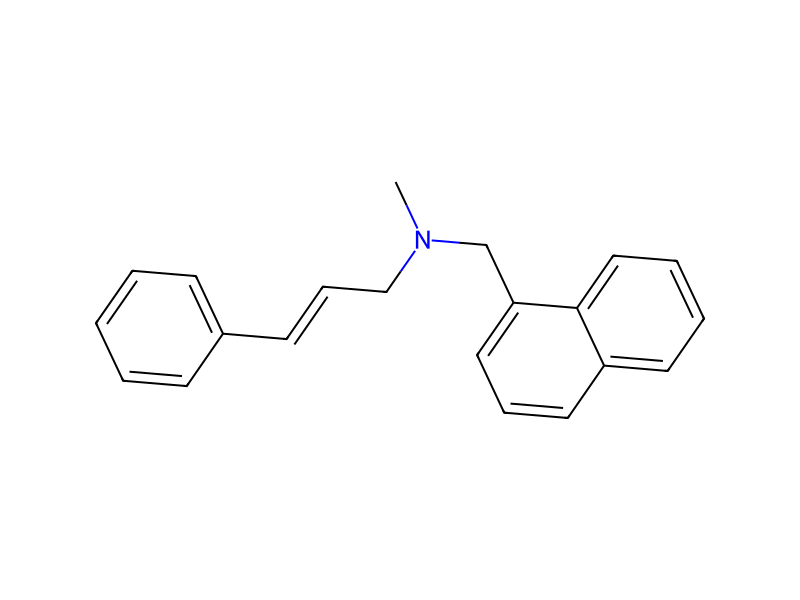
Naftifine is a tertiary amine in which the nitrogen is substituted by methyl, alpha-naphthylmethyl, and (1E)-cinnamyl groups. It is used (usually as its hydrochloride salt) for the treatment of fungal skin infections. It has a role as an EC 1.14.13.132 (squalene monooxygenase) inhibitor and a sterol biosynthesis inhibitor. It is a member of naphthalenes, a tertiary amine and an allylamine antifungal drug.
Namen und Bezeichner
- Bevorzugter Name
- Naftifine
- IUPAC
- (E)-N-methyl-N-(naphthalen-1-ylmethyl)-3-phenylprop-2-en-1-amine
- Englischer Name
- Naftifine
- Summenformel
- C21H21N
- Molmasse
- 287.4
Namen und Synonyme
Naftifine65472-88-0NaftifinaNaftifinumNaftifinNaft-5004FB1TON47ACHEBI:7451AW-105-843DTXSID6048545RefChem:57001methyl(naphthalen-1-ylmethyl)(3-phenylprop-2-en-1-yl)amine
Weitere Namen anzeigen
NaftinExoderilSN-105-843NaftifunginNaftifine D3NaftifinebaseNaftifine 13CD3
DTXCID6028101D01AE22(E)-Naftifine(E)-N-methyl-N-(naphthalen-1-ylmethyl)-3-phenylprop-2-en-1-amine(E)-N-Cinnamyl-N-methyl-1-naphthalenemethylamineNaftifine (INN)CHEMBL626methyl[(naphthalen-1-yl)methyl](3-phenylprop-2-en-1-yl)amine
Datenbank-Bezeichner
- CAS
65472-88-0- PubChem CID
- 47641
- DTXSID
DTXSID6048545- ChEMBL
CHEMBL626- ChEBI
CHEBI:7451- UNII
- 4FB1TON47A
- Nikkaji
- J19.990G、J3.124.773J
Eigenschaften
Berechnete Struktureigenschaften
- XLogP
- 5,1
- Polarare Oberfläche (TPSA)
- 3,2 Ų
- H-Brücken-Donoren
- 0
- H-Brücken-Akzeptoren
- 1
- Frei drehbare Bindungen
- 5
- Schwere Atome
- 22
- Formalladung
- 0
- Komplexität
- 342
Experimentelle und physikochemische Eigenschaften
Drugs
Pharmaceuticals -> Listed in ZINC15
Pharmaceuticals
Pharmaceuticals -> Antibiotics
Human DrugsBreast Feeding; Lactation; Milk, Human; Anti-Infective Agents; Antifungal Agents
Physikochemische Eigenschaften
- Schmelzpunkt
- 177 °C · 177 °C
- Siedepunkt
- 0.015 torr · bp0.015 torr 162-167°
- Dichte
- 1.082 · 1.082±0.06 g/cm3(Predicted)
- Löslichkeit
- Chloroform (Slightly), DMSO (Slightly), Ethyl Acetate (Slightly), Methanol (Very Slightly)
- Aggregatzustand
- Thick Oil
- pka
- 7.99 · 7.99±0.50(Predicted)
- Farbe
- Colourless to Dark Yellow
- Merck
- 6355 · 6355
- CAS Datenbank
- 65472 · 65472-88-0(CAS DataBase Reference)
Sicherheit und Regulatorisches
Sicherheitsangaben dienen nur zur Orientierung und ersetzen weder das Sicherheitsdatenblatt (SDB) des Lieferanten noch geltende Vorschriften oder eine fachliche Bewertung.
Toxikologische Informationen
Effects During Pregnancy and Lactation◉ Summary of Use during Lactation
Sicherheitsdaten
- hs_code
- 29214990
Chemie und Industrie
Pharmakologische Informationen
ATC Code
D - Dermatologicals
QD - Dermatologicals
Pharmacodynamics
Naftifine is a synthetic, broad spectrum, antifungal agent and allylamine derivative. The following in vitro data are available, but their clinical significance is unknown. Naftifine has been shown to exhibit fungicidal activity in vitro against a broad spectrum of organisms including <i>Trichophyton rubrum</i>, <i>Trichophyton mentagrophytes</i>, <i>Trichophyton tonsurans</i>, <i>Epidermophyton floccosum</i>, and <i>Microsporum canis</i>, <i>Microsporum audouini</i>, and <i>Microsporum gypseum</i>; and fungistatic activity against <i>Candida</i> species including <i>Candida albicans</i>. However it is only used to treat the organisms listed in the indications.
Mechanism of Action
Although the exact mechanism of action against fungi is not known, naftifine appears to interfere with sterol biosynthesis by inhibiting the enzyme squalene 2,3-epoxidase. This inhibition of enzyme activity results in decreased amounts of sterols, especially ergosterol, and a corresponding accumulation of squalene in the cells.
Biological Half-LifeApproximately 2 to 3 days following topical administration.
FDA Pharmacological Classification
4FB1TON47A
NAFTIFINE
Chemical Structure [CS] - Allylamine
Established Pharmacologic Class [EPC] - Allylamine Antifungal
Naftifine is an Allylamine Antifungal.
MeSH Pharmacological ClassificationSubstances that destroy fungi by suppressing their ability to grow or reproduce. They differ from FUNGICIDES, INDUSTRIAL because they defend against fungi present in human or animal tissues.
Absorption, Distribution and Excretion
Following single topical applications of 3H-labeled naftifine gel 1% to the skin of healthy subjects, up to 4.2% of the applied dose was absorbed.
Naftifine and/or its metabolites are excreted via the urine and feces with a half-life of approximately two to three days.
Verwendung und Herstellung
UsesUse (kg; approx.) in Germany (2009): >10
Anwendungen
VerwendenNaftifine (Naftin) is a synthetic allylamine derivative topical antifungal agent that works by blocking squalene 2,3-epoxidase, resulting in increased cell membrane permeability and cell death. It is structurally and pharmacologically related to terbinafine. It also has some antiinflammatory properties that may be due to its ability to alter chemotaxis by polymorphonucleocytes. It is most effective against dermatophytes, moderately active against molds, and less active against yeasts, including C. albicans.
Vor- und nachgelagerte Produkte
Vorgelagerte Rohstoffe
Ergänzende Hinweise
DefinitionChEBI: A tertiary amine in which the nitrogen is substituted by methyl, alpha-naphthylmethyl, and (1E)-cinnamyl groups. It is used (usually as its hydrochloride salt) for the treatment of fungal skin infections.
Zugehörige Reaktionen
0
Noch keine zugehörigen Reaktionen