
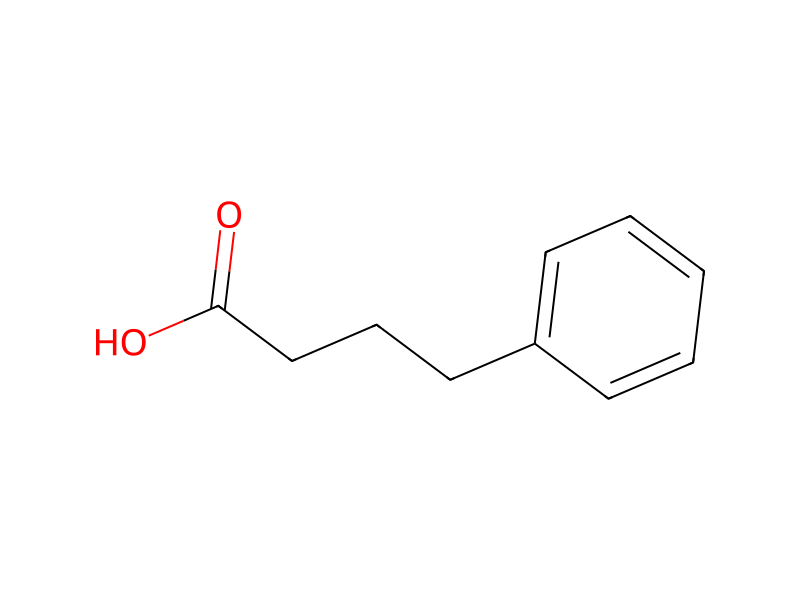
Grundinformationen
- Standard-SMILES
O=C(O)CCCc1ccccc1- InChIKey
OBKXEAXTFZPCHS-UHFFFAOYSA-N- Summenformel
- C10H12O2
- Durchschnittliche Molmasse
- 164,2 g/mol
- Monoisotopische Masse
- 164,08372962
Überblick
4-phenylbutyric acid is a monocarboxylic acid the structure of which is that of butyric acid substituted with a phenyl group at C-4. It is a histone deacetylase inhibitor that displays anticancer activity. It inhibits cell proliferation, invasion and migration and induces apoptosis in glioma cells. It also inhibits protein isoprenylation, depletes plasma glutamine, increases production of foetal haemoglobin through transcriptional activation of the gamma-globin gene and affects hPPARgamma activation. It has a role as an antineoplastic agent, a prodrug, an EC 3.5.1.98 (histone deacetylase) inhibitor and an apoptosis inducer. It is functionally related to a butyric acid. It is a conjugate acid of a 4-phenylbutyrate.
Namen und Bezeichner
- Bevorzugter Name
- 4-Phenylbutyric Acid
- IUPAC
- 4-phenylbutanoic acid
- Lokaler Name
- 4-Phenylbuttersure
- Englischer Name
- 4-Phenylbutyric acid
- Summenformel
- C10H12O2
- Molmasse
- 164.2
Namen und Synonyme
4-PHENYLBUTYRIC ACID4-Phenylbutanoic acid1821-12-1Benzenebutanoic acidBenzenebutyric acidPhenylbutyric acidgamma-Phenylbutyric acidomega-Phenylbutanoic acid4-Phenyl-n-butyric acidCHEBI:41500omega-phenylbutyric acidNSC-295
Weitere Namen anzeigen
BuphenylPHENYLBUTYRIC-4 ACIDNSC 2954-benzene acidAKOS BBS-000037494-PHENYBUTYTIC ACID
gamma-Phenyl-n-butyric acid7WY7YBI87ENSC295DTXSID2037631RefChem:55852DTXCID0017631217-341-8Phenylbutyrate
Datenbank-Bezeichner
- CAS
1821-12-1- PubChem CID
- 4775
- DTXSID
DTXSID2037631- ChEMBL
CHEMBL1469- ChEBI
CHEBI:41500- UNII
- 7WY7YBI87E
- EC Number
- 217-341-8
- Nikkaji
- J101.512E
Eigenschaften
Berechnete Struktureigenschaften
- XLogP
- 2,4
- Polarare Oberfläche (TPSA)
- 37,3 Ų
- H-Brücken-Donoren
- 1
- H-Brücken-Akzeptoren
- 2
- Frei drehbare Bindungen
- 4
- Schwere Atome
- 12
- Formalladung
- 0
- Komplexität
- 137
Experimentelle und physikochemische Eigenschaften
Chemical Classes
Other Classes -> Organic Acids
Industrial compound
DrugsPharmaceuticals -> Listed in ZINC15
LogP
2.42
2.32
Solubility18 mg/mL
Boiling Point290.00 °C. @ 760.00 mm Hg
Melting Point47 - 49 °C
Vapor Pressure0.000664 [mmHg]
Physical Description
White or off-white powder; [Alfa Aesar MSDS]
Solid
Physikochemische Eigenschaften
- Schmelzpunkt
- 49 · 49-51 °C(lit.)
- Siedepunkt
- 165 °C10 · 165 °C10 mm Hg(lit.)
- Dichte
- 1.0326 · 1.0326 (rough estimate)
- Brechungsindex
- 1.5405 · 1.5405 (estimate)
- Flammpunkt
- 230 °F · >230 °F
- storage temp.
- Sealed in dry,Room Temperature
- Löslichkeit
- 5.3 g/l · 5.3g/l. Almost insoluble in water, soluble in alcohol and oils
- Aggregatzustand
- Crystalline Powder
- pka
- 4.76 · 4.76(at 25℃)
- Farbe
- White to slightly yellow
- Wasserlöslichkeit
- 5.3 g/L · 5.3 g/L at 40 ºC
- BRN
- 638180 · 638180
- InChI
- 1S/C10H12O2/c11-10(12)8-4-7-9-5-2-1-3-6-9/h1-3,5-6H,4,7-8H2,(H,11,12)
- InChIKey
- OBKXEAXTFZPCHS-UHFFFAOYSA-N
- SMILES
- OC(=O)CCCc1ccccc1
- LogP
- 2.42 · 2.420
- CAS Datenbank
- 1821 · 1821-12-1(CAS DataBase Reference)
- NIST chemische Informationen
- 4 · 4-Phenylbutanoic acid(1821-12-1)
- EPA chemische Informationen
- 4 · 4-Phenylbutyric acid (1821-12-1)
Sicherheit und Regulatorisches
GHS-Klassifizierung
GHS Classification
Warning
H315 (83.3%): Causes skin irritation [Warning Skin corrosion/irritation]
P261, P264, P264+P265, P271, P280, P302+P352, P304+P340, P305+P351+P338, P319, P321, P332+P317, P337+P317, P362+P364, P403+P233, P405, and P501 (click each P-code to see the statement)
Aggregated GHS information provided per 12 reports by companies from 7 notifications to the ECHA C&L Inventory. Each notification may be associated with multiple companies.
Gefahrenhinweise
Regulatory Information
Status: Active Update: 15-05-2018 https://echa.europa.eu/registration-dossier/-/registered-dossier/16079
Benzenebutanoic acid: Does not have an individual approval but may be used under an appropriate group standard
Hazards SummaryA skin and strong eye irritant; [Alfa Aesar MSDS] See Butyric acid.
Hazard Classes and CategoriesSkin Irrit. 2 (83.3%)
Toxikologische Informationen
Hepatotoxicity
While the urea cycle disorders are caused by deficiencies of hepatic enzymes responsible for the elimination of nitrogen, patients generally present with hyperammonemia without other features or biochemical evidence of hepatic injury. Thus, serum aminotransferase, alkaline phosphatase and bilirubin levels are generally normal or only mildly elevated. Newborns presenting with hyperammonemia may have hepatomegaly but other, non-urea cycle, liver function is normal as is hepatic histology. Phenylbutyrate can help to lower ammonia levels acutely and manage to keep them in the normal or near normal range, but generally does not affect other liver functions. In open label studies, a small proportion of patients (particularly with ornithine transcarbamylase [OTC] deficiency) have had ALT or AST elevations, but these have generally been attributed to the underlying condition or its complications. Phenylbutyrate has not been linked to instances of clinically apparent liver injury with jaundice.
Sicherheitsdaten
- wgk
- 3
- tsca
- TSCA listed
- hs_code
- 29163900
- risk_code
- 36/37/38
- hazard_code
- Xi
- hazard_note
- Irritant
- safety_code
- 22-24/25-36-26
- Speicherklasse
- 11 - Combustible Solids
Chemie und Industrie
Pharmakologische Informationen
Protein BindingWhen co-administered with tauroursodeoxycholic acid as a combination product, the _in vitro_ plasma protein binding of phenylbutyric acid is 82%.
Pharmacodynamics
Phenylbutyric acid decreases elevated plasma ammonia glutamine levels in patients with urea cycle disorders. It increases waste nitrogen excretion in the form of phenylacetylglutamine. In the intestines, phenylbutyric acid was shown to reduce mucosal inflammation, regulate transepithelial fluid transport, and improve oxidative status. Some studies report antineoplastic properties of phenylbutyric acid, showing that phenylbutyric acid can promote growth arrest and apoptosis of cancer cells. It is suggested that phenylbutyric acid can act as an ammonia scavenger, chemical chaperone, and histone deacetylase inhibitor.
Mechanism of Action
Sodium phenylbutyrate is the most commonly used salt used in drug products of phenylbutyric acid. Sodium phenylbutyrate is a pro-drug that rapidly metabolizes to phenylacetate. Phenylacetate is conjugated with phenylacetyl-CoA, which in turn combines with glutamine via acetylation to form phenylacetylglutamine. Phenylacetylglutamine is then excreted by the kidneys, thus providing an alternate mechanism of waste nitrogen excretion to the urea cycle. Phenylacetylglutamine is comparable to urea, as each molecule contains two moles of nitrogen.
Biological Half-LifeFollowing oral administration of a single 5g dose of sodium phenylbutyrate, the elimination half-life of phenylbutyric acid ranged from 0.76 to 0.77 hours.
Metabolism/Metabolites
The major sites for metabolism of sodium phenylbutyrate are the liver and kidney. Phenylbutyric acid is rapidly metabolized to phenylacetate via beta-oxidation. Phenylacetate is conjugated with phenylacetyl-CoA, which in turn combines with glutamine via acetylation to form phenylacetylglutamine.
FDA Pharmacological Classification
7WY7YBI87E
PHENYLBUTYRIC ACID
Mechanisms of Action [MoA] - Ammonium Ion Binding Activity
Established Pharmacologic Class [EPC] - Nitrogen Binding Agent
Phenylbutyric acid is a Nitrogen Binding Agent. The mechanism of action of phenylbutyric acid is as an Ammonium Ion Binding Activity.
MeSH Pharmacological ClassificationSubstances that inhibit or prevent the proliferation of NEOPLASMS.
Absorption, Distribution and Excretion
Following oral administration of a single 5g dose of sodium phenylbutyrate, the Cmax was 195-218 µg/mL under fasting conditions and the Tmax was one hour. The effect of food on drug absorption is unknown.
Approximately 80–100% of the dose was excreted by the kidneys within 24 hours as the conjugation product, phenylacetylglutamine. For each gram of sodium phenylbutyrate administered, it is estimated that between 0.12–0.15 grams of phenylacetylglutamine nitrogen are produced.
Tissue LocationsPancreas
Cellular LocationsMembrane
Verwendung und Herstellung
General Manufacturing InformationBenzenebutanoic acid: ACTIVE
Darstellung
synthetische4-phenylbutyric acid is obtained by the reaction of benzene with butyrolactone in the presence of aluminum chloride, followed by neutralization with base.Synthesis of 4-phenylbutyric acid
Vor- und nachgelagerte Produkte
Vorgelagerte Rohstoffe
Nachgelagerte Produkte
Anbieter50 Anbieter
国药集团化学试剂有限公司86-21-63210123 · [email protected]
梯希爱(上海)化成工业发展有限公司021-67121386 · [email protected]
上海阿拉丁生化科技股份有限公司400-6206333 13167063860 · [email protected]
INTATRADE GmbH+49 3493/605464 · [email protected]
韶远科技(上海)有限公司021-50795510 4000665055 · [email protected]
淮安嘉目生物科技有限公司0517-83187139 18205232085 · [email protected]
南通萧畅医药贸易有限公司0513-82104991 18862997351 · [email protected]
上海迈瑞尔生化科技有限公司4006356688 18621169109 · [email protected]
北京华威锐科化工有限公司0757-86329057 18934348241 · [email protected]
武汉易泰科技有限公司上海分公司18930552037 · [email protected]
宁波亿诺化学品有限公司86-574-27787657 · [email protected]
大连美仑生物技术有限公司0411-62910999 13889544652 · [email protected]
阿法埃莎(中国)化学有限公司400-6106006 · [email protected]
太原市瑞和丰科贸有限公司+86 351 7031519 · [email protected]
安耐吉化学&3A(安徽泽升科技股份有限公司)400-0056266 · [email protected]
成都傲飞生物化学品有限责任公司+86-028-60911900 13540204019 · [email protected]
上海瀚鸿科技股份有限公司021-54306202 13764082696 · [email protected]
上海相辉医药科技有限公司13761987713 · [email protected]
上海景颜化工科技有限公司13817811078 · [email protected]
嘉兴市艾森化工有限公司0573-85285100 18627885956 · [email protected]
Pure Chemistry Scientific Inc.001-857-928-2050 or 1-888-588-9418 · [email protected]
上海泰坦科技股份有限公司400-6009262 15618770481 · [email protected]
上海隆盛化工有限公司58099637 13585536065 · [email protected]
上海攀鸿化工科技有限公司021-56491756 13512199871 · [email protected]
孝感深远化工有限公司15527621225; 15527621225 · [email protected]
山东西亚化学有限公司13355009207 13355009207 · [email protected]
玛雅试剂+86 (573) 82222445 (0)18006601000 452520369 · [email protected]
四川库利南科技有限公司400-1166-196 18981987031 · [email protected]
天津希恩思生化科技有限公司400 638 7771 · [email protected]
湖南汇百侍生物科技有限公司0731-85526065 13308475853 · [email protected]
南京维奥化工有限公司Please Send Email 18652950785 · [email protected]
斯百全化学(上海)有限公司021-021-021-67601398-809-809-809 15221380277 · [email protected]
上海源叶生物科技有限公司13636370518 · [email protected]
上海思域化工科技有限公司86-21-34053660 · [email protected]
赛默飞世尔科技(中国)有限公司800-810-5118 · [email protected]
江苏艾康生物医药研发有限公司025-66113011 13913916777 · [email protected]
TCI AMERICA800-4238616 · [email protected]
TOKYO CHEMICAL INDUSTRY CO., LTD.03-36680489 · [email protected]
TCI Europe320-37350700 · [email protected]
深圳振强药物研发有限公司0755-66853366 13670046396 · [email protected]
越林试剂021-62960152 · [email protected]
上海倍卓生物科技有限公司021-61119791,13386096464 · [email protected]
上海将来实业股份有限公司400-0066400 13621662912 · [email protected]
上海将来实业股份有限公司021-61552785 · [email protected]
HBCChem, Inc.+1-510-219-6317 · [email protected]
美岚实业(上海)有限公司021-58958189 · [email protected]
上海爱蝶实业有限公司021-58957966 18930537195 · [email protected]
成都零六生物科技有限公司400-1166-196 13458535857 · [email protected]
广拓化学(上海)有限公司021-60899189-8001 18918189673 · [email protected]
上海御略医药科技有限公司021-60345187 13671753212 · [email protected]
Ergänzende Hinweise
Definition4-Phenylbutyric acid is a monocarboxylic acid the structure of which is that of butyric acid substituted with a phenyl group at C-4. It is a histone deacetylase inhibitor that displays anticancer activity. It inhibits cell proliferation, invasion and migration and induces apopto is in glioma cells. It also inhibits protein isoprenylation, depletes plasma glutamine, increases production of foetal haemoglobin through transcriptional activation of the gamma-globin gene and affects hPPARgamma activation.
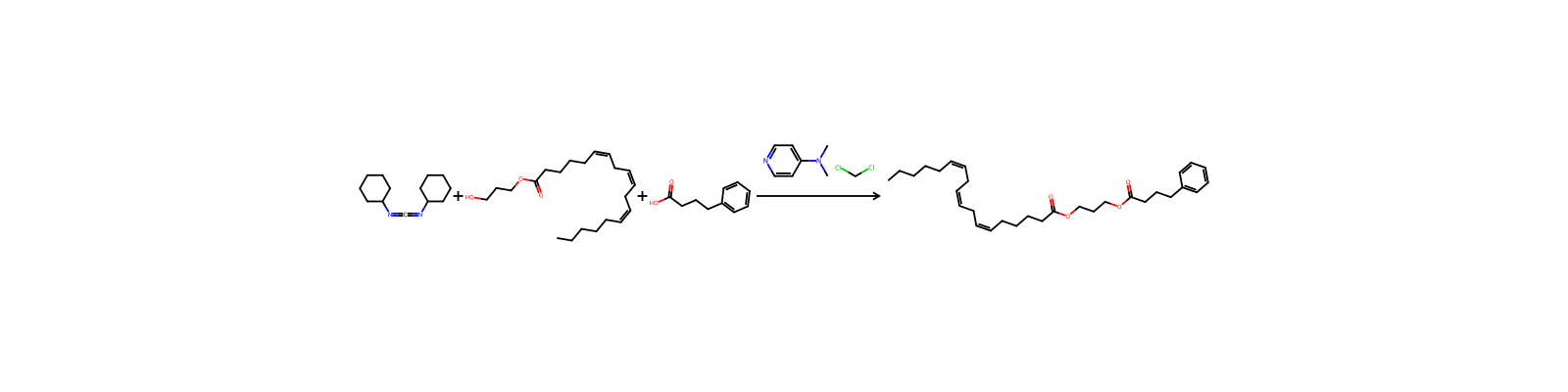
Zugehörige Reaktionen
147


Verknüpfte Notizen
Wird geladen…