
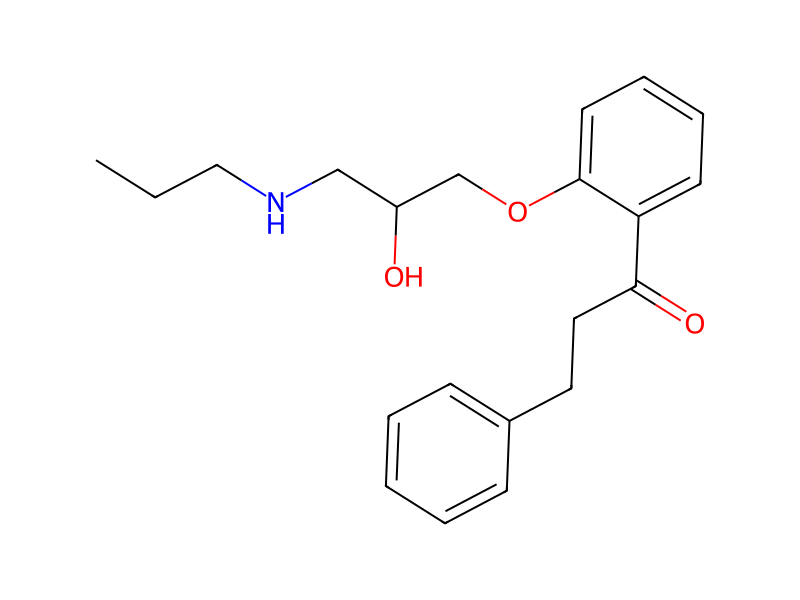
Grundinformationen
- Standard-SMILES
CCCNCC(O)COc1ccccc1C(=O)CCc1ccccc1- InChIKey
JWHAUXFOSRPERK-UHFFFAOYSA-N- Summenformel
- C21H27NO3
- Durchschnittliche Molmasse
- 341,4 g/mol
- Monoisotopische Masse
- 341,19909372
Überblick
Propafenone is an aromatic ketone that is 3-(propylamino)propane-1,2-diol in which the hydrogen of the primary hydroxy group is replaced by a 2-(3-phenylpropanoyl)phenyl group. It is a class 1C antiarrhythmic drug with local anesthetic effects, and is used as the hydrochloride salt in the management of supraventricular and ventricular arrhythmias. It has a role as an anti-arrhythmia drug. It is a secondary alcohol, a secondary amino compound and an aromatic ketone. It is a conjugate base of a propafenone(1+).
Namen und Bezeichner
- Bevorzugter Name
- Propafenone
- IUPAC
- 1-[2-[2-hydroxy-3-(propylamino)propoxy]phenyl]-3-phenylpropan-1-one
- Lokaler Name
- Propafenon
- Englischer Name
- Propafenone
- Summenformel
- C21H27NO3
- Molmasse
- 341.44
Namen und Synonyme
propafenone54063-53-5PropafenonaPropafenonum1-(2-(2-hydroxy-3-(propylamino)propoxy)phenyl)-3-phenylpropan-1-onePropafenon HexalGNF-Pf-4594DTXSID90451841-(2-(2-Hydroxy-3-(propylamino)propoxy)phenyl)-3-phenyl-1-propanone1-[2-[2-hydroxy-3-(propylamino)propoxy]phenyl]-3-phenylpropan-1-one68IQX3T69U1-{2-[2-hydroxy-3-(propylamino)propoxy]phenyl}-3-phenylpropan-1-one
Weitere Namen anzeigen
N-(carboxypheny)guanidine hydrochlorideC07381WZ-884-642WZ-884-643AKOS 215-08Propafenone-dPropafenone USP(RS)-Propafenone
DTXCID7025184CHEBI:636191-Propanone, 1-(2-(2-hydroxy-3-(propylamino)propoxy)phenyl)-3-phenyl-2-(2'-hydroxy-3'-propylaminopropoxy)-omega-phenylpropiophenone1-Propanone, 1-[2-[2-hydroxy-3-(propylamino)propoxy]phenyl]-3-phenyl-NorfenonPintoformPropafenon Minden
Datenbank-Bezeichner
- CAS
54063-53-5- PubChem CID
- 4932
- DTXSID
DTXSID9045184- ChEMBL
CHEMBL631- ChEBI
CHEBI:63619- UNII
- 68IQX3T69U
- EC Number
- 258-955-6
- Nikkaji
- J12.333A
Eigenschaften
Berechnete Struktureigenschaften
- XLogP
- 3,3
- Polarare Oberfläche (TPSA)
- 58,6 Ų
- H-Brücken-Donoren
- 2
- H-Brücken-Akzeptoren
- 4
- Frei drehbare Bindungen
- 11
- Schwere Atome
- 25
- Formalladung
- 0
- Komplexität
- 368
Experimentelle und physikochemische Eigenschaften
Drugs
Pharmaceuticals
Pharmaceuticals -> Used in Switzerland
LogP
3.2
3.83
Solubility
Slightly soluble
7.58e-03 g/L
Human Drugs
Breast Feeding; Lactation; Milk, Human; Antiarrhythmics
Pharmaceuticals
DecompositionWhen heated to decomposition, material emits toxic fumes of NOx and HCl.
Physical DescriptionSolid
Dissociation Constants
9.27
9
8.8
Collision Cross Section
176.48 Ų [M+H]+ [CCS Type: TW; Method: calibrated with polyalanine and drug standards]
178.5 Ų [M+H]+ [CCS Type: TW; Method: Major Mix IMS/Tof Calibration Kit (Waters)]
Other Experimental PropertiesMW: 377.90. Fine white crystals; slightly bitter taste. Soluble in basic lower aliphatic alcohols, carbon tetrachloride, hot water; slightly soluble in cold water. Insoluble in ether /Propafenone hydrochloride/
Physikochemische Eigenschaften
- Siedepunkt
- 519.6 · 519.6±50.0 °C(Predicted)
- Dichte
- 1.096 · 1.096±0.06 g/cm3(Predicted)
- storage temp.
- 2 · 2-8°C
- Löslichkeit
- 68 mg/mL · DMSO: 68 mg/mL (199.16 mM);Ethanol: 41 mg/mL (120.08 mM)
- Aggregatzustand
- Solid
- pka
- 9.27 · pKa 9.27 (Uncertain)
- Farbe
- White to Off-White
- Wasserlöslichkeit
- 759.9 ug/L · 759.9ug/L(22.5 ºC)
- Kosmetik-Inhaltsstoffe Funktionen
- SKIN PROTECTING
- CAS Datenbank
- 54063 · 54063-53-5(CAS DataBase Reference)
- NIST chemische Informationen
- Propafenone(54063-53-5)
Sicherheit und Regulatorisches
GHS-Klassifizierung
GHS Classification
Warning
H302 (100%): Harmful if swallowed [Warning Acute toxicity, oral]
P264, P270, P301+P317, P330, and P501 (click each P-code to see the statement)
Aggregated GHS information provided per 2 reports by companies from 1 notifications to the ECHA C&L Inventory.
Gefahrenhinweise
Regulatory InformationREACH registered substance: Propafenone (EC: 258-955-6)
Fire PotentialThis material is assumed to be combustible.
FDA Requirements
The Approved Drug Products with Therapeutic Equivalence Evaluations identifies currently marketed prescription drug products, including propafenone hydrochloride, approved on the basis of safety and effectiveness by FDA under sections 505 of the Federal Food, Drug, and Cosmetic Act. /Propafenone hydrochloride/
Toxic Combustion ProductsEmits toxic fumes under fire conditions.
Hazard Classes and CategoriesAcute Tox. 4 (100%)
Sicherheit und Schutzausrüstung
Fire Fighting Procedures
Water spray, dry chemical, carbon dioxide, or foam as appropriate for surrounding fire and materials. ... As with all fires, evacuate personnel to a safe area. Firefighters should use self-contained breathing equipment and protective clothing.
Storage Conditions
Store in tight, light-resistant container as defined in the USP-NF. This material should be handled and stored per label instructions to ensure product integrity.
Commercially available propafenone hydrochloride immediate-release tablets and extended-release capsules should be stored in tight containers at a controlled room temperature of 25 °C, but may be exposed to temperatures ranging from 15-30 °C. Propafenone hydrochloride immediate-release tablets should be stored in light-resistant containers. When stored under such conditions, the commercially available immediate-release tablets have an expiration date of 3 years following the date of manufacture.
Cleanup Methods
Wear approved respiratory protection, chemically compatible gloves, and protective clothing. Wipe up spillage or collect spillage using a high- efficiency vacuum cleaner. Avoid breathing dust. Place spillage in appropriately labeled container for disposal. Wash spill site.
Disposal Methods
SRP: Expired or waste pharmaceuticals shall carefully take into consideration applicable DEA, EPA, and FDA regulations. It is not appropriate to dispose by flushing the pharmaceutical down the toilet or discarding to trash. If possible return the pharmaceutical to the manufacturer for proper disposal being careful to properly label and securely package the material. Alternatively, the waste pharmaceutical shall be labeled, securely packaged and transported by a state licensed medical waste contractor to dispose by burial in a licensed hazardous or toxic waste landfill or incinerator.
SRP: At the time of review, regulatory criteria for small quantity disposal are subject to significant revision, however, household quantities of waste pharmaceuticals may be managed as follows: Mix with wet cat litter or coffee grounds, double bag in plastic, discard in trash.
Preventive Measures
As a general rule, when handling USP Reference Standards, avoid all contact and inhalation of dust, mists, and/or vapors associated with the material. Wash thoroughly after handling.
As with all dry powders, it is advisable to ground mechanical equipment in contact with dry material to dissipate the potential buildup of static electricity.
SRP: Local exhaust ventilation should be applied wherever there is an incidence of point source emissions or dispersion of regulated contaminants in the work area. Ventilation control of the contaminant as close to its point of generation is both the most economical and safest method to minimize personnel exposure to airborne contaminants. Ensure that the local ventilation moves the contaminant away from the worker.
Engineering controls such as exhaust ventilation are recommended.
Personal Protective Equipment (PPE)Use a NIOSH-approved respirator, if it is determined to be necessary by an industrial hygiene survey involving air monitoring. If a respirator is not required, an approved dust mask should be used.
Toxikologische Informationen
Interactions
Although specific pharmacokinetic drug interaction studies are not available, the manufacturer of propafenone states that the drug should not be used concomitantly with other drugs that prolong the QT interval, including certain phenothiazines, cisapride, bepridil (not currently commercially available in the US), tricyclic antidepressant agents, or macrolides.
Although specific pharmacokinetic drug interaction studies are not available, the manufacturer of ritonavir states that ritonavir should not be used concomitantly with certain cardiovascular agents, including propafenone, because of the potential for substantially increased plasma concentrations of these cardiovascular drugs and potentially serious and/or life-threatening adverse effects. This pharmacokinetic interaction may occur because ritonavir has high affinity for several cytochrome P-450 (CYP) isoenzymes (e.g., CYP3A, CYP2D6, CYP1A2) involved in propafenone metabolism.
Increased serum theophylline concentrations have been reported in patients receiving theophylline concomitantly with propafenone and some clinicians suggest that serum theophylline concentrations and ECGs be monitored closely in patients receiving such combined therapy.
The manufacturer states that concomitant use of propafenone and local anesthetic agents (i.e., during pacemaker implantation, surgery, or dental procedures) may increase the risk of adverse nervous system effects.
For more Interactions (Complete) data for Propafenone (24 total), please visit the HSDB record page.
Hepatotoxicity
In clinical trials, propafenone was associated with a low rate of serum aminotransferase and alkaline phosphatase elevations. Since its approval and more widescale use, propafenone has been linked to rare instances of clinically apparent liver injury, at least a dozen cases of which have been reported in the literature. Patients usually present with symptoms of jaundice and pruritus 2 to 8 weeks after starting propafenone, and the pattern of serum enzyme elevations are typically mixed (Case 1) or cholestatic (Case 2). Immunoallergic and autoimmune features are uncommon. While the jaundice can be prolonged, patients typically recover in 1 to 3 months and there have been no instances of acute liver failure, chronic hepatitis or vanishing bile duct syndrome attributed to its use.
Human Toxicity Excerpts
/SIGNS AND SYMPTOMS/ In general, overdosage of propafenone may be expected to produce effects that are extensions of the drug's pharmacologic effects, particularly those involving cardiac conduction and function and the CNS. Overdosage of propafenone may result in nausea and/or vomiting, hypotension, somnolence, bradycardia, intra-atrial and intraventricular conduction disturbances, and in rare cases, seizures and high-grade ventricular arrhythmias; fatalities also have occurred. Cardiac manifestations may occur within 30-120 minutes after ingestion. Manifestations of overdosage generally are most severe during the 3 hours following the overdose. Nausea generally is the first manifestation of toxicity and may occur within 30 minutes of ingestion of the drug.
/CASE REPORTS/ A 71-year-old woman with atrial fibrillation developed elevations of greater than two times the upper limit of normal in alkaline phosphatase (ALK), alanine aminotransferase (ALT), aspartate aminotransferase (AST), and gamma glutamyltransferase (GGT) after initiation of propafenone therapy. The patient developed elevations of greater than two times the upper limit of normal in ALK, ALT, and AST, one month after initiating propafenone therapy. The propafenone dose was decreased from 900 to 675 mg/day and, ten days later, the ALK, ALT, and AST were decreased slightly, but still above the upper limit of normal. One month later, serum transaminases had returned to baseline, but propafenone therapy was discontinued because of recurrent atrial fibrillation, persistent elevation in ALK, and elevation in GGT. Two months after discontinuing propafenone, serum aminotransaminase and ALK concentrations had normalized and GGT had decreased and remained only slightly elevated. The occurrence of liver injury secondary to propafenone therapy is rare. Reported cases appear to be secondary to hepatocellular injury, cholestasis, or a combination of the two. In this case, the pattern demonstrated by elevations in liver enzymes may be classified as acute cholestatic liver injury. Because the reported incidence is 0.1-0.2 percent and there are no known fatalities secondary to propafenone liver injury, routine monitoring of liver function tests in all patients receiving propafenone cannot be recommended at this time. Baseline liver function tests prior to initiating propafenone therapy with follow-up laboratory studies one month later are recommended in patients with known liver dysfunction. If elevations are noted, a reduction in dose may result in lower liver enzyme concentrations, although discontinuation of therapy may be required in some cases.
/CASE REPORTS/ ... A patient with episodic jabbing and crushing pain in his hands and feet, aching in his forearms, and hyperesthesias of his extremities /is described/. He had been taking propafenone for 1 year because of ventricular arrhythmias. Results of a nerve conduction velocity test were abnormal. Electron microscopic findings on a sural nerve biopsy specimen represented distal small fiber neuropathy. Findings on a thermoregulatory sweat test and on autonomic tests were abnormal, compatible with a distal small fiber neuropathy. ... . In this patient, propafenone seemed to be responsible for the development of peripheral neuropathy, which resolved after use of the drug had been discontinued.
/CASE REPORTS/ A case of acute liver injury associated with the use of the antiarrhythmic drug propafenone in a 62-year-old woman undergoing clinical observation for recurrent atrial fibrillation is reported. Propafenone hydrochloride, a class 1C antiarrhythmic drug widely used in the clinical practice for the treatment of supraventricular and ventricular arrhythmias, rarely (0.1-0.2% of incidence) causes liver injury characterized by a rise in hepatic cell enzymes or cholestatic enzymes or both. Within 2 months of the discontinuation of therapy the liver function tests return to normal, therefore there are no known fatalities secondary to propafenone liver injury including fulminant hepatitis and death. The close temporal relationship between the administration of the drug and the acute onset of signs of liver injury, the marked rise in liver function tests following the increase of the drug dosage and their gradual normalization after its withdrawal strongly suggest that propafenone is involved in the pathogenesis of this syndrome. Although rare, hepatotoxicity due to this widely used antiarrhythmic drug should be borne in mind in the differential diagnosis of sudden hepatocellular or cholestatic syndrome of obscure origin. It seems prudent to obtain baseline liver function before starting therapy with propafenone and then follow up laboratory tests some months later at least in patients with known liver disease.
For more Human Toxicity Excerpts (Complete) data for Propafenone (26 total), please visit the HSDB record page.
Drug Induced Liver Injury
Drug-Induced Liver Injury Severity and Toxicity (DILIst)
propafenone
DILI Positive
Oral
DOI:10.1016/j.drudis.2019.09.022
Non-Human Toxicity Excerpts
/LABORATORY ANIMALS: Subchronic or Prechronic Exposure/ Renal changes have been observed in the rat following 6 months of oral administration of propafenone hydrochloride at doses of 180 and 360 mg/kg/day (about 2 and 4 times, respectively, the maximum recommended human daily dose (MRHD) on a mg/sq m basis). Both inflammatory and non-inflammatory changes in the renal tubules, with accompanying interstitial nephritis, were observed. These changes were reversible, as they were not found in rats allowed to recover for 6 weeks. Fatty degenerative changes of the liver were found in rats following longer durations of administration of propafenone hydrochloride at a dose of 270 mg/kg/day (about 3 times the MRHD on a mg/sq m basis). There were no renal or hepatic changes at 90 mg/kg/day (equivalent to the MRHD on a mg/sq m basis).
/LABORATORY ANIMALS: Developmental or Reproductive Toxicity/ Decreases in neonatal survival, weight gain, and physiologic development were observed in rats receiving oral propafenone hydrochloride dosages of 360 mg/kg or more daily (4 or more times the maximum recommended human daily dosage) from mid-gestation through weaning.
/LABORATORY ANIMALS: Developmental or Reproductive Toxicity/ Increased maternal death was observed in rats receiving oral propafenone hydrochloride dosages as low as 90 mg/kg daily (equivalent to the maximum recommended human daily dosage) from mid-gestation through weaning.
/LABORATORY ANIMALS: Developmental or Reproductive Toxicity/ Administration of large IV doses of propafenone in monkeys, dogs, and rabbits has caused transient, reversible decreases in spermatogenesis; this effect was observed only at lethal or sublethal dosages and was not seen in rats receiving oral or IV propafenone.
For more Non-Human Toxicity Excerpts (Complete) data for Propafenone (6 total), please visit the HSDB record page.
Populations at Special Risk
Propafenone is extensively metabolized in the liver, and dosage should be reduced substantially in patients with impaired hepatic function. The drug also should be used with caution in patients with renal dysfunction since a considerable portion of the dose is excreted in urine as active metabolites.
Propafenone (immediate-release formulation) is contraindicated in patients with uncontrolled congestive heart failure; the extended-release formulation of the drug is contraindicated in patients with congestive heart failure. Propafenone is contraindicated in patients with cardiogenic shock, atrioventricular or intraventricular disorders of impulse generation and/or conduction (e.g., sick sinus node syndrome, atrioventricular block) unless an artificial pacemaker is present, bradycardia, severe hypotension, marked electrolyte imbalance.
Propafenone has been reported to exacerbate myasthenia gravis, and it has been suggested that use of the drug be avoided in patients with this condition.
Propafenone, like other agents with nonselective beta-adrenergic blocking activity, generally should not be used in patients with asthma/bronchospastic disease or nonallergic bronchospastic disease (e.g., chronic bronchitis, emphysema) since the drugs may inhibit bronchodilation produced by endogenous catecholamines.
Antidote and Emergency Treatment
Intoxication caused by propafenone is very rare, and there are no known detailed epidemiological studies. We present the clinical manifestation of severe propafenone intoxication successfully treated in a 17 year-old male. He was brought to the Intensive Care Unit after he had taken 3.0 g propafenone. The main clinical findings included: sudden cardiac arrest, coma, hypotension, left ventricular failure, bradycardia, sinoatrial block, atrioventricular junctional or/and ventricular tachycardia. During the treatment, transient heart pacing was performed and catecholamines were administered by means of continuous intravenous infusion of pressure doses as well as of infusion liquids. Cessation of toxic signs four hours after admission to hospital was observed. This relatively rare, fully symptomatic intoxication with propafenone deserved to be presented due to the drug's common usage in the treatment of dysrhythmia and life-threatening symptoms of overdosing. The course of the disease was dramatic and the patient survived only thanks to quick resuscitation, artificial ventilation, transient heart pacing, acidosis treatment and administration of pressure doses of catecholamines.
Propafenone is an anti-arrhythmic drug used in the management of supraventricular and ventricular arrhythmias. It is metabolised through cytochrome P450 2D6 pathways; the major metabolites possess anti-arrhythmic activity. The cytochrome P450 CYP2D6 is coded by more than 70 alleles resulting in great genetic polymorphism of CYP2D6 isoenzymes, and up to 7% of Caucasian population are poor metabolisers. This case report describes a patient with severe overdose of propafenone who presented with coma, seizures and cardiotoxicity. The patient was managed with intravenous glucagon, hypertonic sodium bicarbonate, hypertonic saline and inotropic support. The propafenone and its 5-hydroxypropafenone (5-OHP) metabolite were measured by high-performance liquid chromatography with ultraviolet detection (no assay was available at the time to measure N-despropyl propafenone concentrations). Toxicological screen showed propafenone concentrations at a maximum of 1.26 mg/L at 9-10 hr post-presentation, falling to 0.25 mg/L at 27-28 hr post-presentation. No propafenone metabolite 5-OHP was detected in any sample analyzed. No antidepressant or analgesic drugs were detected in toxicological screen. Propafenone overdose has been reported to be associated with features of severe cardiovascular and CNS toxicity. Aggressive treatment, meticulous monitoring and supportive care was associated with a good outcome in this case.
Emergency and supportive measures. Maintain an open airway and assist ventilation if necessary. Treat coma, seizures, hypotension, and arrhythmias if they occur. Continuously monitor vital signs and ECG for a minimum of 6 hours after exposure, and admit the patient for 24 hours of intensive monitoring if there is evidence of toxicity. /Antiarrhythmic drugs/
Specific drugs and antidotes. In patients with intoxication by type 1a or type 1c drugs, QRS prolongation, bradyarrhythmias, and hypoentsion may respond to sodium bicarbonate ... . The sodium bicarbonate reverses cardiac-depressant effects caused by inhibition of the fast sodium channel. /Antiarrhythmic drugs/
For more Antidote and Emergency Treatment (Complete) data for Propafenone (8 total), please visit the HSDB record page.
Effects During Pregnancy and Lactation◉ Summary of Use during Lactation
Non-Human Toxicity Values
LD50 Dogt iv 10 mg/kg /Propafenone hydrochloride/
LD50 Rat iv 18,800 ug/kg /Propafenone hydrochloride/
LD50 Rat oral 700 mg/kg /Propafenone hydrochloride/
EPA Human Health Benchmarks for Pharmaceuticals
Propafenone
10.5
44.4
Initiate therapy with propafenone hydrochloride tablets 150 mg given every eight hours (450 mg/day).
Data used to generate the benchmarks include the following: Lowest Daily Dose (LDD): 450 mg/day, Lowest Therapeutic Dose (LTD): 5.6 mg/kg-day, and Screening Dose: 0.002 mg/kg-day.
28-Feb-19
Regulatorische Informationen
FDA Requirements
The Approved Drug Products with Therapeutic Equivalence Evaluations identifies currently marketed prescription drug products, including propafenone hydrochloride, approved on the basis of safety and effectiveness by FDA under sections 505 of the Federal Food, Drug, and Cosmetic Act. /Propafenone hydrochloride/
Sicherheitsdaten
- wgk
- 3
- RTECS-Nr.
- UH2833000
- risk_code
- 46-22
- hazard_code
- T
- safety_code
- 53-36/37/39-45
- Giftige Stoffe Daten
- 54063-53-5(Hazardous Substances Data)
Chemie und Industrie
Pharmakologische Informationen
ATC Code
C01BC03
C - Cardiovascular system
QC - Cardiovascular system
Protein Binding97%
Pharmacodynamics
Propafenone is a Class 1C antiarrhythmic drug with local anesthetic effects, and a direct stabilizing action on myocardial membranes. It is used in the treatment of atrial and ventricular arrhythmias. It acts by inhibiting sodium channels to restrict the entry of sodium into cardiac cells resulting in reduced excitation. Propafenone has local anesthetic activity approximately equal to procaine.
Mechanism of Action
The electrophysiological effect of propafenone manifests itself in a reduction of upstroke velocity (Phase 0) of the monophasic action potential. In Purkinje fibers, and to a lesser extent myocardial fibers, propafenone reduces the fast inward current carried by sodium ions, which is responsible for the drugs antiarrhythmic actions. Diastolic excitability threshold is increased and effective refractory period prolonged. Propafenone reduces spontaneous automaticity and depresses triggered activity. At very high concentrations in vitro, propafenone can inhibit the slow inward current carried by calcium but this calcium antagonist effect probably does not contribute to antiarrhythmic efficacy.
The effects of the antiarrhythmic drug propafenone at Kv2.1 channels were studied with wild-type and mutated channels expressed in Xenopus laevis oocytes. Propafenone decreased the Kv2.1 currents in a time- and voltage-dependent manner (decrease of the time constants of current rise, increase of block with the duration of voltage steps starting from a block of less than 19%, increase of block with the amplitude of depolarization yielding a fractional electrical distance delta of 0.11 to 0.16). Block of Kv2.1 appeared with application to the intracellular, but not the extracellular, side of membrane patches. In mutagenesis experiments, all parts of the Kv2.1 channel were successively exchanged with those of the Kv1.2 channel, which is much more sensitive to propafenone. The intracellular amino and carboxyl terminus and the intracellular linker S4-S5 reduced the blocking effect of propafenone, whereas the linker S5-S6, as well as the segment S6 of the Kv1.2 channel, abolished it to the value of the Kv1.2 channel. In the linker S5-S6, this effect could be narrowed down to two groups of amino acids (groups 372 to 374 and 383 to 384), which also affected the sensitivity to tetraethylammonium. In segment S6, several amino acids in the intracellularly directed part of the helix significantly reduced propafenone sensitivity. The results suggest that propafenone blocks the Kv2.1 channel in the open state from the intracellular side by entering the inner vestibule of the channel. These results are consistent with a direct interaction of propafenone with the lower part of the pore helix and/or residues of segment S6.
Propafenone is considered a class I (membrane-stabilizing) antiarrhythmic agent, although the antiarrhythmic and electrophysiologic actions of the drug are complex in that it also has demonstrated some beta-adrenergic blocking and calcium-channel blocking activity. Like encainide and flecainide, the principal effect of propafenone on cardiac tissue appears to be a concentration-dependent inhibition of the transmembrane influx of extracellular sodium ions via fast sodium channels, as indicated by a decrease in the maximal rate of depolarization of phase 0 of the action potential and a shift of the membrane-responsiveness curve in the hyperpolarizing direction. Since this effect is greater at higher stimulation frequencies and less negative membrane potentials, the drug's sodium blockade is enhanced in ischemic cardiac tissue. Studies in cardiac tissue in animals indicate that propafenone binds to fast sodium channels in both their active and inactive states; the drug thereby inhibits recovery after repolarization in a time- and voltage-dependent manner, which is associated with subsequent dissociation of the drug from the sodium channels. Propafenone induces phasic (frequency-dependent) sodium channel blockade faster than encainide or flecainide, while recovery is similar to flecainide and faster than encainide. Propafenone also appears to have a slight inhibitory effect (approximately 1/75 the potency of verapamil) on the transmembrane influx of extracellular calcium ions via slow calcium channels (calcium-channel blocking effect), but this effect generally occurs only at high drug concentrations and probably does not contribute to antiarrhythmic efficacy. Propafenone has no vagomimetic or vagolytic effect on cardiac muscle.
Biological Half-Life
2-10 hours
Following single or multiple oral doses of immediate-release tablets in adults with the extensive-metabolizer phenotype and normal renal and hepatic function, the elimination half-life of propafenone averages about 1-3 hours (range: 2-10 hours). The half-life of propafenone averages approximately 8-13 hours (range: 6-36 hours) in adults with the poor-metabolizer phenotype. Following a single oral dose of 300 mg of propafenone hydrochloride as immediate-release tablets, a half-life of 3.5 hours was reported; after administration of 300 mg of propafenone hydrochloride daily for 1 and 3 months, the reported half-lives were 6.7 and 5.8 hours, respectively. Steady-state plasma elimination half-life of propafenone is prolonged in poor metabolizers, averaging 17.2 hours (range: 10-32 hours) compared with 5.5 hours (range: 2-10 hours) in extensive metabolizers.
Metabolism/Metabolites
Metabolized primarily in the liver where it is rapidly and extensively metabolized to two active metabolites, 5-hydroxypropafenone and N-depropylpropafenone. These metabolites have antiarrhythmic activity comparable to propafenone but are present in concentrations less than 25% of propafenone concentrations.
In individuals with the extensive-metabolizer phenotype, propafenone is metabolized in the liver to 2 active metabolites and at least 9 additional metabolites. The 2 active metabolites, 5-hydroxypropafenone (5-OHP) and N-depropylpropafenone (NDPP), are formed through hydroxylation and dealkylation of the parent drug. Propafenone hydroxylation via cytochrome CYP2D6, a cytochrome P-450 isoenzyme under genetic control, produces 5-OHP. Formation of NDPP is catalyzed by different isoenzymes, cytochrome CYP1A2 and CYP3A4. Differences in metabolism between R- and S-propafenone related to stereoselective interaction with the CYP2D6 isoenzyme have been observed in animals and humans receiving single enantiomers of the drug. Following a 250 mg oral dose of R- or S-propafenone hydrochloride administered to adults with the extensive-metabolizer phenotype, the mean values for elimination half-life, clearance, and volume of distribution for R-propafenone were smaller than those for S-propafenone, while AUC was larger; however, these stereospecific effects were not observed in an adult with the poor-metabolizer phenotype who received the separate drug enantiomers. In vitro and in vivo studies indicate that the R-enantiomer is cleared faster than the S-enantiomer via the 5-hydroxylation pathway (CYP2D6). This results in a higher ratio of the S-enantiomer to R-enantiomer at steady state. Although the enantiomers have equivalent sodium-channel blocking potency, the S-enantiomer is a more potent beta-adrenergic antagonist than the R-enantiomer. Following administration of propafenone hydrochloride (immediate-release tablets or extended-release capsules), the observed ratio of S-enantiomer to R-enantiomer (S/R ratio) for AUC was approximately 1.7. The S/R ratios after administration of 225, 325, or 425 mg extended-release capsules were independent of dose. In addition, similar S/R ratios were observed among metabolizer genotypes and following long-term administration
There are two principal patterns of propafenone metabolism. These patterns are genetically determined by an individual's ability to metabolize the drug via a hepatic oxidation pathway. The ability to oxidatively metabolize propafenone is dependent on an individual's ability to metabolize debrisoquin (debrisoquin phenotype). The debrisoquin phenotype or the observed pattern of propafenone metabolites may be used to determine an individual's metabolic phenotype for propafenone. Individuals who extensively metabolize propafenone via the oxidation pathway exhibit the extensive-metabolizer phenotype, while those who have an impaired ability to metabolize the drug by this pathway exhibit the poor-metabolizer phenotype. Approximately 90-95% of Caucasians exhibit the extensive-metabolizer phenotype, with the remainder being poor metabolizers. Propafenone metabolism in patients with the poor-metabolizer phenotype is characterized by a linear dose-concentration relationship and a relatively long terminal elimination half-life; these individuals have increased plasma propafenone concentrations relative to individuals with the extensive-metabolizer phenotype and are more likely to experience beta-adrenergic blocking and adverse effects of the drug.
Propafenone has known human metabolites that include N-Despropylpropafenone and 5-Hydroxypropafenone.
FDA Pharmacological Classification
68IQX3T69U
PROPAFENONE
Established Pharmacologic Class [EPC] - Antiarrhythmic
Propafenone is an Antiarrhythmic.
PROPAFENONE
Antiarrhythmic [EPC]
MeSH Pharmacological Classification
Agents used for the treatment or prevention of cardiac arrhythmias. They may affect the polarization-repolarization phase of the action potential, its excitability or refractoriness, or impulse conduction or membrane responsiveness within cardiac fibers. Anti-arrhythmia agents are often classed into four main groups according to their mechanism of action: sodium channel blockade, beta-adrenergic blockade, repolarization prolongation, or calcium channel blockade.
A class of drugs that inhibit the activation of VOLTAGE-GATED SODIUM CHANNELS.
Absorption, Distribution and Excretion
Nearly completely absorbed following oral administration (90%). Systemic bioavailability ranges from 5 to 50%, due to significant first-pass metabolism. This wide range in systemic bioavailability is related to two factors: presence of food (food increases bioavailability) and dosage (bioavailability is 3.4% for a 150-mg tablet compared to 10.6% for a 300-mg tablet).
Approximately 50% of propafenone metabolites are excreted in the urine following administration of immediate release tablets.
252 L
In patients with ventricular arrhythmias and the extensive-metabolizer phenotype receiving 337.5, 450, 675, or 900 mg of propafenone hydrochloride daily (immediate-release tablets), the proportions of 5-hydroxypropafenone (5-OHP) to propafenone in plasma were 45, 40, 24, or 19%, respectively, while a subset of patients with the poor-metabolizer phenotype had higher relative plasma concentrations of the parent drug at each dosage and no detectable 5-OHP. Ratios of N-depropylpropafenone (NDPP) to propafenone are similar in extensive and poor metabolizers (approximately 10 and 6%, respectively). In poor metabolizers, NDPP is the principal metabolite and 5-OHP may not be detectable. Following oral administration of propafenone hydrochloride 300 mg (immediate-release tablets) every 8 hours for 14 days, plasma propafenone, 5-OHP, and NDPP concentrations averaged 1010, 174, and 179 ng/mL, respectively, in healthy individuals with the extensive-metabolizer phenotype. In an individual presumed to have the poor-metabolizer phenotype, plasma concentrations of propafenone, 5-OHP, and NDPP concentrations were 1048, undetectable, and 219 ng/mL, respectively, following oral administration of immediate-release tablets. Following administration of extended-release capsules of propafenone hydrochloride, plasma concentrations of 5-OHP and NDPP are generally less than 40 and 10% of plasma propafenone concentrations, respectively.
The pattern of plasma concentrations of propafenone and its metabolites observed in an individual patient with long-term oral propafenone therapy depends principally on the genetically determined metabolizer phenotype and, to a lesser extent, on hepatic blood flow and enzyme function. Following oral administration of propafenone (immediate-release tablets), steady-state plasma concentrations of the parent drug and its metabolites are attained within 4-5 days in individuals with normal hepatic and renal function. Plasma concentrations of 5-hydroxypropafenone (5-OHP) and N-depropylpropafenone (NDPP) generally average less than 20% those of propafenone. Poor metabolizers achieve plasma propafenone concentrations 1.5-2 times higher than those of extensive metabolizers at propafenone hydrochloride dosages of 675-900 mg (immediate-release tablets) daily; at lower dosages, poor metabolizers may attain plasma propafenone concentrations more than fivefold higher than those of extensive metabolizers.
The considerable degree of interindividual variability observed in the pharmacokinetics of propafenone in individuals with the extensive-metabolizer phenotype is principally attributable to first-pass hepatic metabolism and non-linear pharmacokinetics. The degree of interindividual variability in propafenone pharmacokinetic parameters is increased following single and multiple dose administration of propafenone hydrochloride extended-release capsules. The fact that interindividual variability in the pharmacokinetics of propafenone appears to be substantially less in individuals with the poor-metabolizer phenotype than in those with the extensive-metabolizer phenotype suggests that such variability may be due to CYP2D6 polymorphism rather than to the formulation.
Cellular LocationsMembrane
Verwendung und Herstellung
Uses
MEDICATION
Use (kg; approx.) in Germany (2009): >5000
Methods of ManufacturingIt is synthesized by reaction of epichlorohydrin with 1-(2-hydroxyphenyl)-3-phenyl-1-propanone (made by Friedel-Crafts reaction of 3-phenylpropionyl chloride and phenol) and epoxide ring opening with propylamine.
Formulations/PreparationsTable: Propafenone Hydrochloride Preparations [Table#7768]
Use ClassificationPharmaceuticals
Anwendungen
VerwendenCardiac depressant (anti-arrhythmic).
Anbieter50 Anbieter
北京华美互利生物化工010-56205725 · [email protected]
Shaanxi LonierHerb Bio Technology Co Ltd+86-86-+86-86-029-87551862 15002946897 · [email protected]
上海麦克林生化科技股份有限公司021-50706066 15221275939 · [email protected]
上海毕得医药科技股份有限公司400-1647117 13681763483 · [email protected]
重庆康洲智通医药科技有限公司173-08362167 17308362167 · [email protected]
Dayang Chem (Hangzhou) Co.,Ltd.+86-0571-88938639 17705817739 · [email protected]
广州隽唐科技有限公司020-36607679 13502246435 · [email protected]
Sinoway Industrial co., ltd.+86-0592-5800732 +86-13806035118 · [email protected]
浙江珲达生物科技有限公司0571-89903022 18679456698 · [email protected]
上海迈瑞尔生化科技有限公司4006356688 18621169109 · [email protected]
武汉易泰科技有限公司上海分公司18930552037 · [email protected]
上海相辉医药科技有限公司13761987713; 13761987713 · [email protected]
銳迪國際科技有限公司18024082417 · [email protected]
上海隆盛化工有限公司58099637 13585536065 · [email protected]
BOC Sciences1-631-485-4226; 16314854226 · [email protected]
孝感深远化工有限公司15527621225; 15527621225 · [email protected]
湖北扬信医药科技有限公司0714-3999001 19171453112 · [email protected]
上海明褀化学有限公司86-21-60936353
深圳振强药物研发有限公司0755-66853366 13670046396 · [email protected]
Clearsynth Labs Limited+91-22-26355700 · [email protected]
南京生利德生物科技有限公司025-57798810 18652991625 · [email protected]
上海喀露蓝科技有限公司18149758185 18149758185 · [email protected]
HBCChem, Inc.+1-510-219-6317 · [email protected]
常州翔龙医药科技有限公司18915873328 18915873328 · [email protected]
上海孚一生物科技有限公司+86 (21) 61124340
湖北源梦生物科技有限公司027-68897569 18120462897 · [email protected]
上海陶术生物科技股份有限公司+1-781-999-5354; +1-00000000000 · [email protected]
HANGZHOU LEAP CHEM CO., LTD.+86-571-87711850 +86-15355479329 · [email protected]
艾吉析科技(上海)有限公司17721401538;17717235263 17721401538 · [email protected]
sgtlifesciences pvt ltd+91-8790379245 · [email protected]
上海阿拉丁生化科技股份有限公司6206333 13167063860 · [email protected]
湖北源梦生物科技有限公司027-68897569 18120462897 · [email protected]
上海珞珐生化科技有限公司021-51111890 15317326293 · [email protected]
BOC Sciences16314854226 · [email protected]
陕西缔都医药化工有限公司+86-29-81139210 +86-17392587031 · [email protected]
青岛海力诺化工有限公司[email protected]
上海源叶生物科技有限公司13636370518 · [email protected]
上海陶术生物科技股份有限公司13564774135 · [email protected]
爱必信(上海)生物科技有限公司13761418683 · [email protected]
陕西缔都医药化工有限公司029-81154043 17391733319 · [email protected]
杭州洁汉化工有限公司+86-571-86217390; +8618058761490 · [email protected]
Capot Chemical Co.,Ltd.+86-(0)57185586718 +86-13336195806 · [email protected]
江苏艾康生物医药研发有限公司025-58859352 15955137747 · [email protected]
厦门盈融达化工有限公司+86-0592-6210733 · [email protected]
医恩医疗系统研发(上海)有限公司021-58958002 18930822973 · [email protected]
南京克罗托鲁宁医药科技有限公司13382066392
career henan chemical co+86-0371-86658258 · [email protected]
北京迈瑞达科技有限公司010-82387566 · [email protected]
深圳聚合生化科技有限公司+86-400-002-6226 · [email protected]
海蔚化学86-21-51086038 · [email protected]
Ergänzende Hinweise
DefinitionChEBI: An aromatic ketone that is 3-(propylamino)propane-1,2-diol in which the hydrogen of the primary hydroxy group is replaced by a 2-(3-phenylpropanoyl)phenyl group. It is a class 1C antiarrhythmic drug with local anesthetic effects, and is used as the hydroch oride salt in the management of supraventricular and ventricular arrhythmias.
Zugehörige Reaktionen
1
Verknüpfte Notizen
Wird geladen…