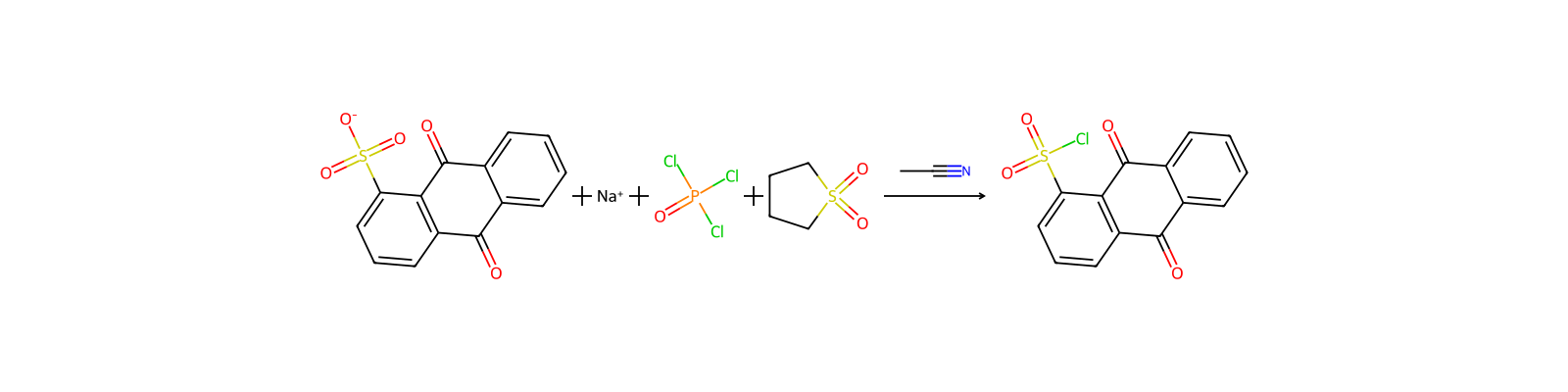
Natrium-9,10-dihydro-9,10-dioxoanthracen-1-sulfonat
Sodium anthraquinone-1-sulfonate

Grundinformationen
- CAS
128-56-3- Standard-SMILES
O=C1c2ccccc2C(=O)c2c1cccc2S(=O)(=O)[O-].[Na+]- InChIKey
SDKPSXWGRWWLKR-UHFFFAOYSA-M- Summenformel
- C14H7NaO5S
- Durchschnittliche Molmasse
- 310,26 g/mol
- Monoisotopische Masse
- 309,99118878
Namen und Bezeichner
- Bevorzugter Name
- Sodium anthraquinone-1-sulfonate
- IUPAC
- sodium 9,10-dioxoanthracene-1-sulfonate
- Lokaler Name
- Natrium-9,10-dihydro-9,10-dioxoanthracen-1-sulfonat
- Englischer Name
- 1-Anthraquinonesulfonic acid sodium salt
- Summenformel
- C14H9NaO5S
- Molmasse
- 312.27
Namen und Synonyme
SODIUM ANTHRAQUINONE-1-SULFONATE1-Anthraquinonesulfonic acid sodium saltSodium anthraquinone-alpha-sulfonate1-Anthracenesulfonic acid, 9,10-dihydro-9,10-dioxo-, sodium saltAnthrachinon-1-sulfonan sodnyHSDB 63861-Anthracenesulfonic acid, 9,10-dihydro-9,10-dioxo-, sodium salt (1:1)NSC 75759,10-Anthraquinone-1-sulfonate sodium saltEINECS 204-894-5Anthrachinon-1-sulfonan sodny [Czech]DTXSID50883320
Weitere Namen anzeigen
goldsaltgoldensaltanthrachinon-1-sulfonansodnySODIUM β-ANTHRAQUINONESULFONATESODIUM ANTHRAQUINONE A-SULFONATESODIUMANTHRAQUINONEALPHA-SULPHONATEanthrachinon-1-sulfonansodny(czech)Anthraquinone-1-Sulfonic Acid Sodium
9,10-Dihydro-9,10-dioxo-1-anthracenesulfonic acid sodium saltAnthrachinon-1-sulfonan sodny (Czech)RefChem:887263Anthrachinon1sulfonan sodnySodium anthraquinonealphasulfonateDTXCID1010228581Anthraquinonesulfonic acid sodium salt9,10Anthraquinone1sulfonate sodium salt
Datenbank-Bezeichner
- CAS
128-56-3- PubChem CID
- 517266
- DTXSID
DTXSID50883320- UNII
- F8Q2GUT8LB
- EC Number
- 204-894-5
- Nikkaji
- J79.453H
Eigenschaften
Berechnete Struktureigenschaften
- Polarare Oberfläche (TPSA)
- 99,7 Ų
- H-Brücken-Donoren
- 0
- H-Brücken-Akzeptoren
- 5
- Frei drehbare Bindungen
- 1
- Schwere Atome
- 21
- Formalladung
- 0
- Komplexität
- 538
Experimentelle und physikochemische Eigenschaften
Chemical ClassesDyes -> Anthraquinone Dyes
Solubility1-Mono anthraquinonesulfonic acid, sodium salt, has a water solubility of 1000 mg/100 ml water at 18 °C.
Physical DescriptionLight yellow crystalline powder; [MSDSonline]
Other Experimental PropertiesAnthraquinonesulfonic acids are strong acids which are readily soluble in water. /Anthraquinonesulfonic acids/
Physikochemische Eigenschaften
- storage temp.
- Store at room temperature
- Aggregatzustand
- powder to crystal
- Farbe
- Light orange to Yellow to Green
- Wasserlöslichkeit
- MODERATELY SOLUBLE
- InChI
- InChI=1S/C14H8O5S.Na.H/c15-13-8-4-1-2-5-9(8)14(16)12-10(13)6-3-7-11(12)20(17,18)19;;/h1-7H,(H,17,18,19);;
- InChIKey
- QEVFVAYERYFCBR-UHFFFAOYSA-N
- SMILES
- S(C1=CC=CC2C(C3=CC=CC=C3C(=O)C1=2)=O)(O)(=O)=O.[NaH]
Sicherheit und Regulatorisches
Sicherheitsangaben dienen nur zur Orientierung und ersetzen weder das Sicherheitsdatenblatt (SDB) des Lieferanten noch geltende Vorschriften oder eine fachliche Bewertung.
Gefahrenhinweise
Hazards Summary
Anthraquinones are toxic by ingestion: vomiting, diarrhea, kidney and liver damage, and coma; Deaths have been reported after children ingested Rhamnus berries; [HSDB] Oral LD50 (rat) = 20,000 mg/kg; Effects include altered kidney and liver function tests; [ChemIDplus] An irritant; [MSDSonline]
Sicherheit und Schutzausrüstung
Disposal Methods
SRP: At the time of review, criteria for land treatment or burial (sanitary landfill) disposal practices are subject to significant revision. Prior to implementing land disposal of waste residue (including waste sludge), consult with environmental regulatory agencies for guidance on acceptable disposal practices.
Toxikologische Informationen
Adverse EffectsOccupational hepatotoxin - Secondary hepatotoxins: the potential for toxic effect in the occupational setting is based on cases of poisoning by human ingestion or animal experimentation.
Human Toxicity ExcerptsChronic neurotoxic effects include vision disturbances. /From table; Quinones/
Non-Human Toxicity ExcerptsAcute neurotoxic effects reported in animals include convulsions; medullary paralysis. /From table; Quinones/
Sicherheitsdaten
- tsca
- TSCA listed
- hs_code
- 29143990
- RTECS-Nr.
- CB1095540
Chemie und Industrie
Pharmakologische Informationen
Metabolism/MetabolitesQuinones (ie, 6,12-dione) have been shown to undergo oxidation-reduction cycles involving quinone, hydroquinone, and molecular oxygen, resulting in the formation of oxygen radicals and semiquinone radicals. /Quinones/
Verwendung und Herstellung
Uses
Anthraquinonesulfonic acids have commercial value because the sulfonic acid group can be replaced by many nucleophiles; [HSDB]
Anthraquinonesulfonic acids are commercially important ... major value is due to the relatively easy replacement of the sulfonic acid group by many nucleophiles affording economically valuable intermediates which are difficult to obtain by other methods. /Anthraquinonesulfonic acids/
Methods of Manufacturing
K salt, also called diamant salt, is prepared by sulfonation in the presence of, eg, 0.5% mercury in 20% oleum, an amount of SO3 adequate for the sulfonation of about 60% of the charge. The reaction is controlled in such a manner that about 50% of the anthraquinone remains unsulfonated. After mercury is precipitated as the sulfide, the unreacted anthraquinone is precipitated by dilution and is collected by filtration. After washing and drying, it is recirculated as "reclaimed quinone". Mercury is removed completely from the filtrate, and the anthraquinone-1-sulfonic acid is then precipitated as the potassium salt. /Anthraquinone-1-sulfonic acid, potassium salt/
Sodium salt, also called silver salt, is prepared by sulfonation of anthraquinone in the absence of mercury. The acid also can be obtained from the 1,6- (or 1,7-) disulfonic acid by desulfonation at the alpha position in dilute sulfuric acid. /Anthraquinone-2-sulfonic acid, sodium salt/
General Manufacturing Information1-Anthracenesulfonic acid, 9,10-dihydro-9,10-dioxo-, sodium salt (1:1): ACTIVE
Anwendungen
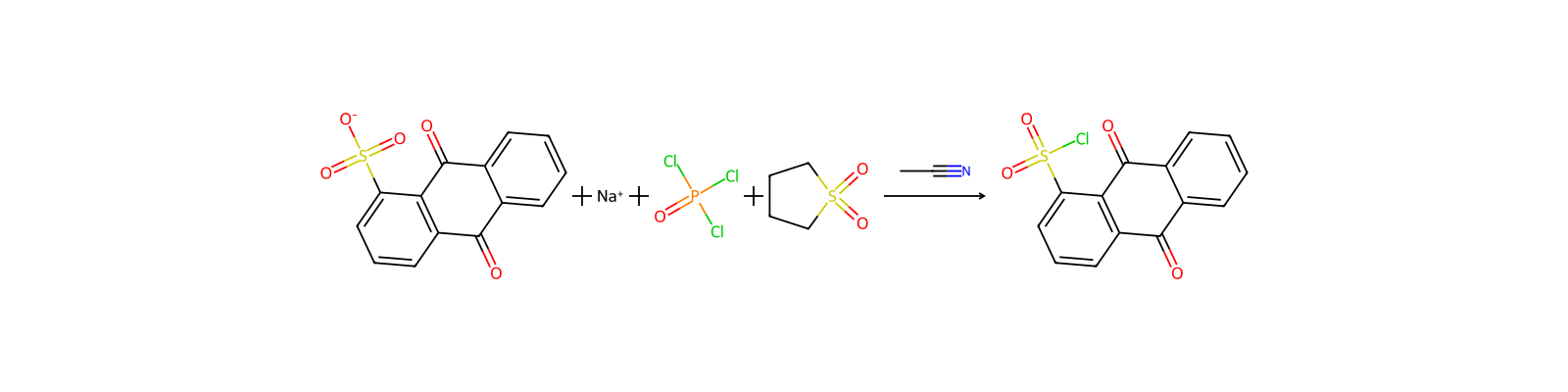
Sodium Anthraquinone-1-sulfonate (cas# 128-56-3) is a compound useful in organic synthesis.
Zugehörige Reaktionen
6



Notizen zur Verbindung
Wird geladen…