
3-(2-Aminoethyl)indol-5-ol
Serotonin

Grundinformationen
- CAS
50-67-9- Standard-SMILES
NCCc1c[nH]c2ccc(O)cc12- InChIKey
QZAYGJVTTNCVMB-UHFFFAOYSA-N- Summenformel
- C10H12N2O
- Durchschnittliche Molmasse
- 176,21 g/mol
- Monoisotopische Masse
- 176,09496301
Überblick
Serotonin is a primary amino compound that is the 5-hydroxy derivative of tryptamine. It has a role as a neurotransmitter, a mouse metabolite and a human metabolite. It is a monoamine molecular messenger, a member of tryptamines, a member of phenols, a primary amino compound and a member of hydroxyindoles. It is functionally related to a tryptamine. It is a conjugate base of a serotonin(1+).
Namen und Bezeichner
- Bevorzugter Name
- Serotonin
- IUPAC
- 3-(2-aminoethyl)-1H-indol-5-ol
- Lokaler Name
- 3-(2-Aminoethyl)indol-5-ol
- Englischer Name
- 5-Hydroxytryptamine
- Summenformel
- C10H12N2O
- Molmasse
- 176.22
Namen und Synonyme
serotonin5-HYDROXYTRYPTAMINE50-67-93-(2-Aminoethyl)-1H-indol-5-olEnteramineThrombotoninThrombocytinSerotonine1H-Indol-5-ol, 3-(2-aminoethyl)-Hippophaine3-(beta-Aminoethyl)-5-hydroxyindole333DO1RDJY
Weitere Namen anzeigen
3-(2-aminoethyl)-1H-indol-5-ol hydrochloride5-htaSEROTONIN BASE5-Hydroxytryptamine,freebaseantemoquaantemovissubstanzds
DTXSID8075330CHEBI:287903-(2-Aminoethyl)-1H-indol-5-oSerotonin (Human)5 HydroxytryptamineSerotonin 1543RefChem:6493DTXCID4040765
Datenbank-Bezeichner
- CAS
50-67-9- PubChem CID
- 5202
- DTXSID
DTXSID8075330- ChEMBL
CHEMBL39
Eigenschaften
Berechnete Struktureigenschaften
- XLogP
- 0,2
- Polarare Oberfläche (TPSA)
- 62 Ų
- H-Brücken-Donoren
- 3
- H-Brücken-Akzeptoren
- 2
- Frei drehbare Bindungen
- 2
- Schwere Atome
- 13
- Formalladung
- 0
- Komplexität
- 174
Experimentelle und physikochemische Eigenschaften
DrugsPharmaceuticals -> Listed in ZINC15
SpringerMaterials PropertiesAngular frequency
LogP
0.21
0.21
Solubility25.5 mg/mL
Physical DescriptionSolid
Ionization Efficiency
Positive
2.35
2.7
Agilent XCT
Electrospray ionization
formic acid (5.3nM)
Collision Cross Section
150.8 Ų [M+Na]+ [CCS Type: DT; Method: stepped-field]
146.9 Ų [M+Na]+ [CCS Type: DT; Method: single field calibrated with ESI Low Concentration Tuning Mix (Agilent)]
135.85 Ų [M-H]- [CCS Type: DT; Method: single field calibrated with Agilent tune mix (Agilent)]
127.98 Ų [M+H-H2O]+ [CCS Type: TW; Method: calibrated with polyalanine and drug standards]
150.9 Ų [M+H]+
Sicherheit und Regulatorisches
Sicherheitsangaben dienen nur zur Orientierung und ersetzen weder das Sicherheitsdatenblatt (SDB) des Lieferanten noch geltende Vorschriften oder eine fachliche Bewertung.
GHS-Klassifizierung
GHS Classification
Danger
H301 (100%): Toxic if swallowed [Danger Acute toxicity, oral]
P203, P264, P270, P280, P301+P316, P318, P321, P330, P405, and P501 (click each P-code to see the statement)
Aggregated GHS information provided per 67 reports by companies from 3 notifications to the ECHA C&L Inventory. Each notification may be associated with multiple companies.
Gefahrenhinweise
Hazard Classes and CategoriesAcute Tox. 3 (100%)
Sicherheitsdaten
- wgk
- 3
- ridadr
- UN 2811 6.1 / PGIII
- risk_code
- 63-25
- hazard_code
- T
- safety_code
- 36/37-45
- hazard_class
- IRRITANT
- Speicherklasse
- 6.1C - Combustible acute toxic Cat.3toxic compounds or compounds which causing chronic effects
- Hazard Classifications
- Acute Tox. 3 OralRepr. 2
Chemie und Industrie
Pharmakologische Informationen
Metabolism/MetabolitesSerotonin has known human metabolites that include 3-Ethyl-1H-indol-5-ol and (2S,3S,4S,5R)-6-[[3-(2-Aminoethyl)-1H-indol-5-yl]oxy]-3,4,5-trihydroxy-2-oxanecarboxylic acid.
MeSH Pharmacological ClassificationEndogenous compounds and drugs that bind to and activate SEROTONIN RECEPTORS. Many serotonin receptor agonists are used as ANTIDEPRESSANTS; ANXIOLYTICS; and in the treatment of MIGRAINE DISORDERS.
Tissue LocationsAdipose Tissue
Cellular LocationsCytoplasm
Metabolite Pathways3-Methylthiofentanyl Action Pathway
Anwendungen
BeschreibungSerotonin is the baby boomer of neurotransmitters: It was identified in the late 1940s, its adolescence was troubled and turbulent, it made the drug scene in the 1960s, and it nearly died of an overdose in the early 1970s. At one point, the remark was made that serotonin doesn't do anything. On reaching its middle years, serotonin has matured and become an important topic of study, a household name, and more complicated than ever. Serotonin has been associated with, among other things, anxiety, depression, schizophrenia, drug abuse, sleep, dreaming, hallucinogenic activity, headache, cardiovascular disorders, and appetite control, and it is now dabbling in acupuncture and transcendental meditation. Serotonin was independently identified in the late 1940s by two groups of investigators: In the United States, it was called serotonin, whereas in Italy, it was called enteramine. Its total synthesis in the early 1950s confirmed that both substances were 5-hydroxytryptamine (5-HT ). Serotonin (5-HT ) was detected in numerous plant and animal species and, in the mid-1950s, was identified in the central nervous system (CNS) of animals. A neurotransmitter role was subsequently proposed for this substance. Later, 5-HT was implicated in a variety of central and peripheral physiologic actions. It seemed to be involved in vasoconstriction and vasodilation, regulation of body temperature, sleep, and hormonal regulation, and evidence suggested that it might be involved in depression. The structural similarity between 5-HT and the then recently discovered hallucinogenic agent (+)-lysergic acid diethylamide (LSD) intrigued investigators. This observation led to speculation that 5-HT might be involved in the mechanism of action of psychoactive substances and that it might play a seminal role in various mental disorders.
Zugehörige Reaktionen
30

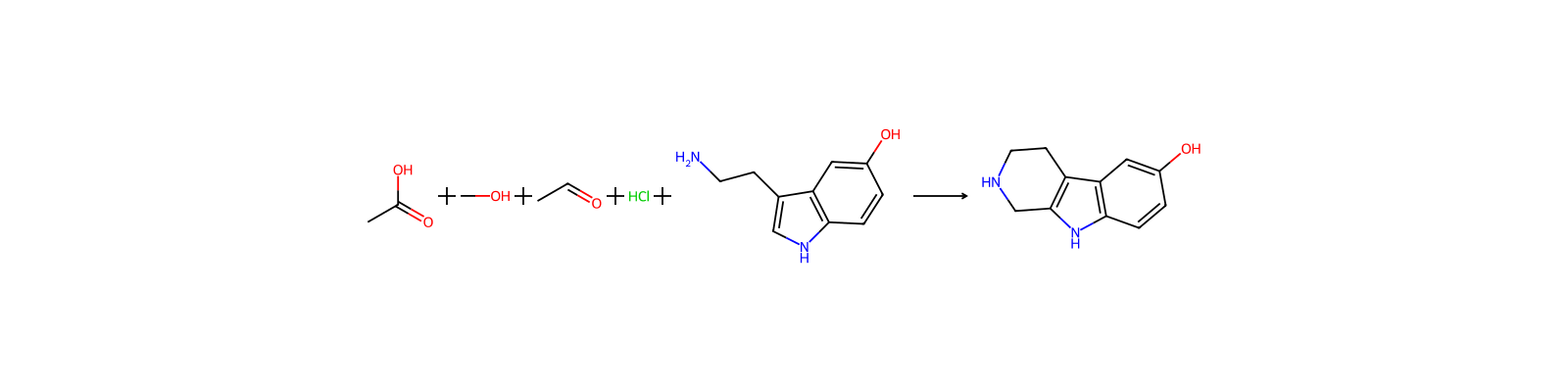


Notizen zur Verbindung
Wird geladen…