

Grundinformationen
- Standard-SMILES
[I-].[Na+]- InChIKey
FVAUCKIRQBBSSJ-UHFFFAOYSA-M- Summenformel
- INa
- Durchschnittliche Molmasse
- 149,8942 g/mol
- Monoisotopische Masse
- 149,89424
Namen und Bezeichner
- Bevorzugter Name
- Sodium Iodide
- IUPAC
- sodium iodide
- Lokaler Name
- Natriumiodid
- Englischer Name
- Sodium iodide
- Summenformel
- NaI
- Molmasse
- 149.89
Namen und Synonyme
sodium iodide7681-82-5Sodium monoiodideIodurilSoiodinIodure de sodiumNatrii iodidumJodid sodnySodium iodide (NaI)NatriumjodidDTXSID2041125Iodide (as sodium iodide)
Weitere Namen anzeigen
Sodium iodineHydriodic acid sodium saltAnayodinioduredesodiumSodium iodide hydrateanhydrous sodium iodide
NSC-77388Fdy-5301F5WR8N145CDTXCID0021125CHEBI:33167Sodium Iodide 20%RefChem:6238231-679-3
Datenbank-Bezeichner
- CAS
7681-82-5- PubChem CID
- 5238
- DTXSID
DTXSID2041125- ChEMBL
CHEMBL1644695- ChEBI
CHEBI:33167- UNII
- F5WR8N145C
- EC Number
- 231-679-3
- Nikkaji
- J44.031K
Eigenschaften
Berechnete Struktureigenschaften
- Polarare Oberfläche (TPSA)
- 0 Ų
- H-Brücken-Donoren
- 0
- H-Brücken-Akzeptoren
- 1
- Frei drehbare Bindungen
- 0
- Schwere Atome
- 2
- Formalladung
- 0
- Komplexität
- 2
Experimentelle und physikochemische Eigenschaften
pH8-9.5
OdorODORLESS
TasteSALINE, SOMEWHAT BITTER TASTE
Density
3.67
3.67 g/cm³
3.667 @25 °C
Color/Form
COLORLESS, CUBIC CRYSTALS
WHITE CRYSTALS OR GRANULES
WHITE POWDER
Solubility
Soluble
SOLUBILITY (G/100 CC SOLVENT): 184 G IN WATER @ 25 °C; 302 G IN WATER @ 100 °C; 42.57 G IN ALCOHOL @ 25 °C; 39.9 G IN ACETONE @ 25 °C
1 G SOL IN 1 ML GLYCEROL
Solubility in water, g/100ml at 25 °C: 184
Boiling Point
Decomposes
1304 °C
1304 °C
1304 °C @760 [mm Hg]
Melting Point
651
651 °C
660 °C
660 °C
Vapor Pressure
1 MM HG @ 767 °C
1 [mm Hg] @767 °C
Refractive IndexINDEX OF REFRACTION: 1.7745
Physical Description
Liquid; CBI; Dry Powder; Wet Solid
White odorless deliquescent solid; Turned brown by air; [Merck Index] Colorless to white hygroscopic solid; [ICSC] White odorless crystalline powder; [MSDSonline]
COLOURLESS-TO-WHITE HYGROSCOPIC CRYSTALS OR WHITE POWDER. TURNS BROWN ON EXPOSURE TO AIR.
Stability/Shelf LifeIT IS MADE SLIGHTLY ALKALINE TO RENDER IT MORE STABLE
Physikochemische Eigenschaften
- Schmelzpunkt
- 661 °C · 661 °C (lit.)
- Siedepunkt
- 1300 °C · 1300 °C
- Dichte
- 3.66 · 3.66
- Dampfdichte
- 1 · >1 (vs air)
- Dampfdruck
- 1 hPa · 1 hPa (767 °C)
- Brechungsindex
- 1.7745 · 1.7745
- Flammpunkt
- 1300 · 1300-1304°C
- storage temp.
- 5 °C · Store at +5°C to +30°C.
- Löslichkeit
- water: soluble(lit.)
- pka
- 0.067 · 0.067[at 20 ℃]
- Aggregatzustand
- beads
- Wichte
- 3.67 · 3.67
- Farbe
- White
- PH
- 6 · 6-9 (50g/l, H2O, 20℃)
- Wasserlöslichkeit
- 184 g/100 · 184 g/100 mL (25 ºC)
- Spezifische Wärmekapazität
- 0.35 J/ · Cp(crystal): 0.35 J/(g·K), at 25℃
- Merck
- 14 · 14,8631
- Dielectric constant
- 7.28 · 7.2800000000000002
- Stabilität
- hygroscopic
- Kosmetik-Inhaltsstoffe Funktionen
- ANTIMICROBIAL
- InChI
- 1S/HI.Na/h1H;/q;+1/p-1
- InChIKey
- FVAUCKIRQBBSSJ-UHFFFAOYSA-M
- SMILES
- [Na+].[I-]
- LogP
- -1.301 at · -1.301 at 25℃
- CAS Datenbank
- 7681 · 7681-82-5(CAS DataBase Reference)
- NIST chemische Informationen
- Sodium iodide(7681-82-5)
- EPA chemische Informationen
- Sodium iodide (7681-82-5)
Sicherheit und Regulatorisches
GHS-Klassifizierung
GHS Classification
This chemical does not meet GHS hazard criteria for 7.9% (39 of 495) of reports.
Danger
H315 (70.9%): Causes skin irritation [Warning Skin corrosion/irritation];H319 (72.7%): Causes serious eye irritation [Warning Serious eye damage/eye irritation];H335 (16.8%): May cause respiratory irritation [Warning Specific target organ toxicity, single exposure; Respiratory tract irritation];H372 (42.8%): Causes damage to organs through prolonged or repeated exposure [Danger Specific target organ toxicity, repeated exposure];H400 (61.8%): Very toxic to aquatic life [Warning Hazardous to the aquatic environment, acute hazard];H411 (10.1%): Toxic to aquatic life with long lasting effects [Hazardous to the aquatic environment, long-term hazard]
P260, P261, P264, P264+P265, P270, P271, P273, P280, P302+P352, P304+P340, P305+P351+P338, P319, P321, P332+P317, P337+P317, P362+P364, P391, P403+P233, P405, and P501 (click each P-code to see the statement)
Aggregated GHS information provided per 495 reports by companies from 36 notifications to the ECHA C&L Inventory. Each notification may be associated with multiple companies.;Reported as not meeting GHS hazard criteria per 39 of 495 reports by companies.;There are 35 notifications provided by 456 of 495 reports by companies with hazard statement code(s).;Information may vary between notifications depending on impurities, additives, and other factors. The percentage value in parenthesis indicates the notified classification ratio from companies that provide hazard codes. Only hazard codes with percentage values above 10% are shown. For more detailed information, please visit ECHA C&L website.
Gefahrenhinweise
Regulatory Information
Chemical: Sodium iodide (NaI)
Sodium iodide (NaI) is listed on the EPA's Chemical Data Reporting (CDR) system. Manufacturers and importers of Sodium iodide (NaI) are required to report information about their production and use of this chemical to the EPA under the Toxic Substances Control Act (TSCA). (40 eCFR Part 711)
Status: Active Update: 05-04-2023 https://echa.europa.eu/registration-dossier/-/registered-dossier/5959;Status: Active Update: 12-01-2023 https://echa.europa.eu/registration-dossier/-/registered-dossier/5847;Status: Active Update: 18-02-2020 https://echa.europa.eu/registration-dossier/-/registered-dossier/25025
Sodium iodide: Does not have an individual approval but may be used under an appropriate group standard
Other Safety InformationIMAP assessments - Sodium iodide (NaI): Human health tier I assessment;IMAP assessments - Sodium iodide (NaI): Environment tier I assessment
Fire HazardsNot combustible. Gives off irritating or toxic fumes (or gases) in a fire.
Fire PotentialPERCHLORIC ACID IGNITES IN CONTACT WITH SODIUM IODIDE.
Hazards Summary
A skin, eye, and respiratory tract irritant; If ingested: the substance may have effects on the thyroid and may cause systemic sensitization. Symptoms of systemic sensitization may include airway obstruction and various skin reactions or even anaphylactic shock. Exposure during pregnancy may affect the thyroid function of the newborn. [ICSC] An irritant; [MSDSonline] See Iodine for the TLV of Iodides.
Chemical DangersReacts violently with strong oxidants. This produces iodine fumes.
Hazard Classes and CategoriesSkin Irrit. 2 (70.9%);Eye Irrit. 2 (72.7%);STOT SE 3 (16.8%);STOT RE 1 (42.8%);Aquatic Acute 1 (61.8%);Aquatic Chronic 2 (10.1%)
State Drinking Water Guidelines(ME) MAINE 340 ug/l /Iodide ion/
Sicherheit und Schutzausrüstung
Fire FightingIn case of fire in the surroundings, use appropriate extinguishing media.
First Aid Measures
Fresh air, rest.
Remove contaminated clothes. Rinse skin with plenty of water or shower.
First rinse with plenty of water for several minutes (remove contact lenses if easily possible), then refer for medical attention.
Rinse mouth. Give one or two glasses of water to drink. Refer for medical attention .
Safe StorageSeparated from strong oxidants and food and feedstuffs. Dry. Well closed.
Storage ConditionsKEEP WELL CLOSED & PROTECTED FROM LIGHT.
Spillage DisposalPersonal protection: particulate filter respirator adapted to the airborne concentration of the substance. Sweep spilled substance into covered containers.
Eye PreventionWear safety goggles or eye protection in combination with breathing protection if powder.
Inhalation RiskA harmful concentration of airborne particles can be reached quickly , especially if powdered.
Skin PreventionProtective gloves.
Exposure PreventionPREVENT DISPERSION OF DUST! AVOID EXPOSURE OF (PREGNANT) WOMEN!
Ingestion PreventionDo not eat, drink, or smoke during work.
Inhalation PreventionUse ventilation (not if powder), local exhaust or breathing protection.
Threshold Limit Values (TLV)
0.01 [ppm], inhalable fraction and vapor (iodides)
0.01 ppm as TWA; A4 (not classifiable as a human carcinogen).
Toxikologische Informationen
Interactions...LITHIUM CARBONATE THEORETICALLY COULD INTERACT WITH...SODIUM IODIDE.
Exposure RoutesThe substance can be absorbed into the body by ingestion.
Signs and Symptoms
Cough. Sore throat. Headache.
Redness.
Redness.
Diarrhoea. Nausea. Vomiting.
Human Toxicity Excerpts
THE OCCASIONAL USE OF IODIDES FOR ASTHMA IN PREGNANCY HAS RESULTED IN FETAL DEATH, SEVERE GOITER & CRETINOID APPEARANCE OF THE NEWBORN. /IODIDE SALTS/
..."IODISM" RESULTS FROM CHRONIC IODIDE OVERDOSES... IODISM IS CHARACTERIZED BY SALIVATION, CORYZA, SNEEZING, CONJUNCTIVITIS, HEADACHE, FEVER, LARYNGITIS, BRONCHITIS, STOMATITIS, PAROTITIS...&...EDEMA OF GLOTTIS...HAS OCCURRED. /IODIDE SALTS/
TEN GRAMS OF SODIUM IODIDE HAVE BEEN GIVEN SLOWLY BY IV ROUTE WITHOUT ILL EFFECTS.
OCCASIONAL INDIVIDUALS SHOW...SENSITIVITY TO IODIDE OR TO ORG PREPN THAT CONTAIN IODINE WHEN...ADMIN IV. ONSET OF AN ACUTE REACTION MAY OCCUR IMMEDIATELY OR SEVERAL HR AFTER ADMIN. ANGIOEDEMA IS OUTSTANDING SYMPTOM, & SWELLING OF LARYNX MAY LEAD TO SUFFOCATION. MULTIPLE CUTANEOUS HEMORRHAGES MAY BE PRESENT. /IODIDE PREPN/
For more Human Toxicity Excerpts (Complete) data for SODIUM IODIDE (10 total), please visit the HSDB record page.
Regulatorische Informationen
Regulatory Information
Chemical: Sodium iodide (NaI)
Sodium iodide (NaI) is listed on the EPA's Chemical Data Reporting (CDR) system. Manufacturers and importers of Sodium iodide (NaI) are required to report information about their production and use of this chemical to the EPA under the Toxic Substances Control Act (TSCA). (40 eCFR Part 711)
Status: Active Update: 05-04-2023 https://echa.europa.eu/registration-dossier/-/registered-dossier/5959;Status: Active Update: 12-01-2023 https://echa.europa.eu/registration-dossier/-/registered-dossier/5847;Status: Active Update: 18-02-2020 https://echa.europa.eu/registration-dossier/-/registered-dossier/25025
Sodium iodide: Does not have an individual approval but may be used under an appropriate group standard
State Drinking Water Guidelines(ME) MAINE 340 ug/l /Iodide ion/
Sicherheitsdaten
- F
- 8
- wgk
- 1
- tsca
- TSCA listed
- ridadr
- UN 3077 9 / PGIII
- hs_code
- 28276000
- RTECS-Nr.
- WB6475000
- risk_code
- 36/38-36/37/38-50
- Toxizität
- MLD i.v. in rats: 1.3 g/kg, Loeser, Konwiser, J. Lab. Clin. Med. 15, 35 (1929)
- hazard_code
- Xi,N
- safety_code
- 26-61
- hazard_class
- 9
- Speicherklasse
- 13 - Non Combustible Solids
- Giftige Stoffe Daten
- 7681-82-5(Hazardous Substances Data)
- Hazard Classifications
- Eye Irrit. 2
Chemie und Industrie
Pharmakologische Informationen
PharmacodynamicsWhen intravenously administered for total parental nutrition, sodium iodide prevents the depletion of endogenous stores of iodine and subsequent deficiency symptoms.
Mechanism of Action
RESPONSE TO IODIDE IN HYPERTHYROIDISM: /IN THYROID GLAND/...VASCULARITY IS REDUCED, GLAND BECOMES MUCH FIRMER & EVEN HARD TO THE TOUCH, CELLS BECOME SMALLER, COLLOID REACCUMULATES IN FOLLICLES, & QUANTITY OF BOUND IODINE INCREASES. /IODIDES/
HIGH CONCN OF IODIDE APPEAR TO INFLUENCE ALL IMPORTANT ASPECTS OF IODINE METABOLISM BY THE THYROID GLAND. CAPACITY OF IODIDE TO LIMIT ITS OWN TRANSPORT... ACUTE INHIBITION OF SYNTHESIS OF IODOTYROSINE & IODOTHYRONINE BY IODIDE IS ALSO WELL KNOWN (THE WOLFF-CHAIKOFF EFFECT)... /IODIDES/
THIS INHIBITION /WOLFF-CHAIKOFF EFFECT/ IS OBSERVED ONLY ABOVE CRITICAL CONCN OF IODIDE, & THE INTRACELLULAR...CONCN OF ANION APPEARS TO BE MAJOR DETERMINANT. WITH TIME THERE IS "ESCAPE" FOR THIS INHIBITION...ASSOCIATED WITH AN ADAPTIVE DECR IN IODIDE TRANSPORT & LOWERED INTRACELLULAR IODIDE CONCN. /IODIDES/
THE MOST IMPORTANT CLINICAL EFFECT OF HIGH IODIDE CONCN IS AN INHIBITION OF THE RELEASE OF THYROID HORMONE. THIS ACTION IS RAPID & EFFICACIOUS IN SEVERE THYROTOXICOSIS. THE EFFECT IS EXERTED DIRECTLY ON THE THYROID GLAND, & IT CAN BE DEMONSTRATED IN EUTHYROID SUBJECT & EXPTL ANIMALS AS WELL AS IN HYPERTHYROID PT. /IODIDES/
IODIDE ANTAGONIZES THE ABILITY OF BOTH THYROTROPIN & CYCLIC AMP TO STIMULATE ENDOCYTOSIS OF COLLOID, PROTEOLYSIS, & HORMONE SECRETION. /REPORTEDLY/... IODIDE ATTENUATES THE EFFECT OF TSH ON CYCLIC AMP IN VIVO & IN ISOLATED TISSUES. /IODIDES/
Absorption, Distribution and Excretion
Iodide salts are readily absorbed in the gastrointestinal tract.
Iodides are expected to be renal excreted.
Iodides are distributed widely throughout extracellular fluid of thyroid gland.
Verwendung und Herstellung
Uses
Used in small amounts for wet extraction of silver; Also used in iodized salt and for various applications in human and veterinary medicine; [HSDB] Used in photography, cloud seeding, and as a solvent for iodine; [Hawley]
Photographic Processing [Category: Other];Metal Extraction and Refining [Category: Industry]
MEDICATION (VET)
MEDICATION
PHOTOGRAPHY; SOLVENT FOR IODINE; ORG CHEMICALS; REAGENT; ARTIFICIAL RAINMAKING; SCINTILLATION (THALLIUM-ACTIVATED FORM)
Small amount used in wet extraction of silver; iodized salt
U.S. Exports(1986) No Data
U.S. Imports(1986) No Data
U.S. Production
2023: 400,000 - <550,000 lb;2022: 400,000 - <550,000 lb;2021: 700,000 - <850,000 lb;2020: 550,000 - <700,000 lb
(1981) 2.96X10+7 g
Consumer UsesCleaning agent;Other
Industry UsesOther;Processing aids not otherwise specified;Photosensitive agent;Intermediate
Methods of Manufacturing
...FROM IODINE & SODIUM HYDROXIDE, OR BY METATHESIS BETWEEN FERROSOFERRIC IODIDE & SODIUM CARBONATE.
Reaction of sodium carbonate with an acidic iodide solution
Formulations/Preparations
USP SODIUM IODIDE IS AT LEAST 99% PURE.
GRADES: TECHNICAL; CP; USP; SINGLE CRYSTALS.
FORMULATIONS (VET): EACH 100 ML CONTAINS SODIUM IODIDE USP 20 G; INERT INGREDIENTS, FORMALDEHYDE (AS PRESERVATIVE) 0.2% WEIGHT/VOLUME, DISTILLED WATER 82.4% WEIGHT/WEIGHT. /SODIUM IODIDE 20%/
/Available in/ high purity, ultra-dry grades & 57% solution grades
NaI-USP XX contains 99-101.5% NaI calc on the anhydrous basis
Use ClassificationCosmetics -> Antimicrobial
General Manufacturing Information
All Other Basic Inorganic Chemical Manufacturing;Pharmaceutical and Medicine Manufacturing;Computer and Electronic Product Manufacturing;All Other Chemical Product and Preparation Manufacturing;All Other Basic Organic Chemical Manufacturing
Sodium iodide (NaI): ACTIVE
INCOMPATIBILITIES: SEE POTASSIUM IODIDE. ALKALOIDAL SALTS, CHLORAL HYDRATE, TARTARIC & OTHER ACIDS, CALOMEL, POTASSIUM CHLORATE, METALLIC SALTS. /POTASSIUM IODIDE/
Anwendungen
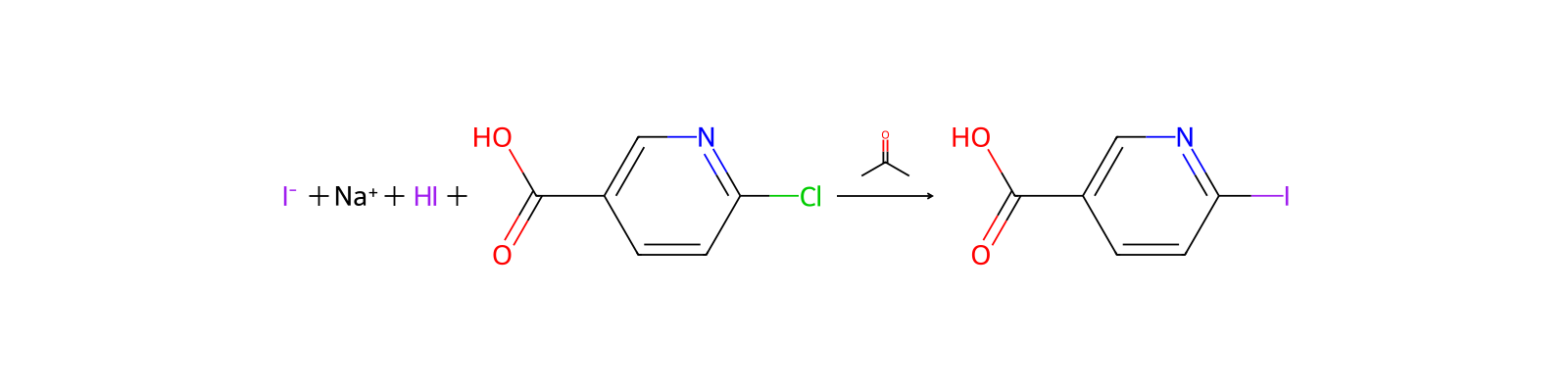
VerwendenSodium iodide is widely used for halide exchange (Finkelstein reaction), for example in the conversion of an alkyl chloride, allyl chloride and arylmethyl chloride into their respective iodides, which are precursors for pharmaceutical and fine chemical products. They are used to ehnance the efficiency of the formation of Wittig adducts from less reactive chlorides and bromides. Appropriate prepartions find use as a nutrient supplement. Sodium iodide is used as the precursor to the control agent in ab initio emulsion polymerization. Sodium iodide finds use in the determination of dissolved oxygen in the modified Winkler method, synthesis of the fluorescent dye coppersensor-1 (CS1) for imaging labile copper pools in biological samples, and the cleavage of esters, lactones, carbamates and ethers in combination with chlorotrimethylsilane.
Darstellung
synthetischeSodium iodide is prepared by adding hydriodic acid or an acidic iodide solution to a solution of sodium hydroxide or sodium carbonate, followed by evaporation and crystallization: NaOH + HI → NaI + H2OThe solution is filtered to remove any impurities prior to its evaporation and crystallization.
Vor- und nachgelagerte Produkte
Vorgelagerte Rohstoffe
Nachgelagerte Produkte
Anbieter50 Anbieter
国药集团化学试剂有限公司86-21-63210123 · [email protected]
梯希爱(上海)化成工业发展有限公司021-67121386 · [email protected]
衢州润东化工有限公司0570-8789886 18892685668 · [email protected]
上海阿拉丁生化科技股份有限公司400-6206333 13167063860 · [email protected]
上海森灏精细化工有限公司021-66058261,63812598,18301703451 · [email protected]
湖北常奥药业有限公司027-87058617 13419515565
青岛拓海碘制品有限公司18669835223 · [email protected]
韶远科技(上海)有限公司021-50795510 4000665055 · [email protected]
科瑞迪化学400-821-5857 021-64326257 · [email protected]
上海迈瑞尔生化科技有限公司4006356688 18621169109 · [email protected]
阿法埃莎(中国)化学有限公司400-6106006 · [email protected]
上海德默医药科技有限公司400-021-7337 2355568890 · [email protected]
安耐吉化学&3A(安徽泽升科技股份有限公司)400-0056266 · [email protected]
上海瀚鸿科技股份有限公司021-54306202 13764082696 · [email protected]
上海景颜化工科技有限公司13817811078 · [email protected]
嘉兴市艾森化工有限公司0573-85285100 18627885956 · [email protected]
池州捷峰生物科技有限公司0566-8928158 · [email protected]
上海泰坦科技股份有限公司400-6009262 15618770481 · [email protected]
武汉赛沃尔化工有限公司027-85613400 18707177243 · [email protected]
合肥天健化工有限公司551-65418679 15856988503;15837135945 · [email protected]
武汉丰泰威远科技有限公司027-87465837 19945049750 · [email protected]
孝感深远化工有限公司15527621225; 15527621225 · [email protected]
山东西亚化学有限公司13355009207 13355009207 · [email protected]
四川库利南科技有限公司400-1166-196 18981987031 · [email protected]
天津希恩思生化科技有限公司400 638 7771 · [email protected]
河南萬象化工有限公司(优势生产供应!)0371-56669001 13949088811 · [email protected]
湖南汇百侍生物科技有限公司0731-85526065 13308475853 · [email protected]
南京维奥化工有限公司Please Send Email 18652950785 · [email protected]
斯百全化学(上海)有限公司021-021-021-67601398-809-809-809 15221380277 · [email protected]
上海源叶生物科技有限公司13636370518 · [email protected]
赛默飞世尔科技(中国)有限公司800-810-5118 · [email protected]
北京伊诺凯科技有限公司400-810-7969 010-59572699 · [email protected]
江苏艾康生物医药研发有限公司025-66113011 13913916777 · [email protected]
TOKYO CHEMICAL INDUSTRY CO., LTD.03-36680489 · [email protected]
深圳康特腾科技有限公司86-0755-86635001 · [email protected]
山东新华制药股份有限公司0533- 2196801 18853385675 · [email protected]
宁波台康化工有限公司0574-87365517 18074210286 · [email protected]
北京环宇世纪化学科技有限公司hysj_bj.com
上海将来实业股份有限公司400-0066400 13621662912 · [email protected]
安徽科迪达化工有限公司0554-2106669 · [email protected]
HBCChem, Inc.+1-510-219-6317 · [email protected]
日照力德士化工有限公司010-51268198 · [email protected]
上海爱蝶实业有限公司021-58957966 18930537195 · [email protected]
成都零六生物科技有限公司400-1166-196 13458535857 · [email protected]
广拓化学(上海)有限公司021-60899189-8001 18918189673 · [email protected]
雷丁试剂0510-85629785 18013409632 · [email protected]
嘉兴氟博生物科技有限公司156-571-11153 18157018567
潍坊鲁泽新材料有限公司0536-7971999 13583611556 · [email protected]
上海御略医药科技有限公司021-60345187 13671753212 · [email protected]
上海麦克林生化科技股份有限公司15221275939 15221275939 · [email protected]
Ergänzende Hinweise
Definitionsodium iodide: A white crystallinesolid, NaI, very soluble in water andsoluble in both ethanol and ethanoicacid. It is known in both the anhydrousform (cubic; r.d. 3.67; m.p.661°C; b.p. 1304°C) and as the dihydrate(monoclinic; r.d. 2.45). It is preparedby the reaction of hydrogeniodide with sodium carbonate orsodium hydroxide in solution. Likepotassium iodide, sodium iodide inaqueous solution dissolves iodine toform a brown solution containingthe I3- ion. It finds applications inphotography and is also used in medicineas an expectorant and in the administrationof radioactive iodine for studies of thyroid function and fortreatment of diseases of the thyroid.
Zugehörige Reaktionen
8.300






Verknüpfte Notizen
Wird geladen…