
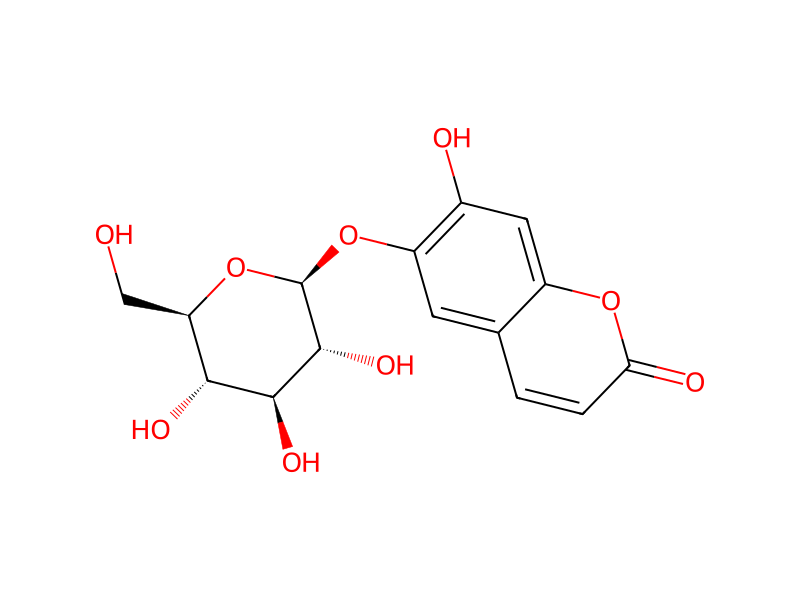
Grundinformationen
- Standard-SMILES
O=c1ccc2cc(O[C@@H]3O[C@H](CO)[C@@H](O)[C@H](O)[C@H]3O)c(O)cc2o1- InChIKey
XHCADAYNFIFUHF-TVKJYDDYSA-N- Summenformel
- C15H16O9
- Durchschnittliche Molmasse
- 340,28 g/mol
- Monoisotopische Masse
- 340,07943208
Namen und Bezeichner
- Bevorzugter Name
- Esculin
- IUPAC
- 7-hydroxy-6-[(2S,3R,4S,5S,6R)-3,4,5-trihydroxy-6-(hydroxymethyl)oxan-2-yl]oxychromen-2-one
- Lokaler Name
- Aesculin
- Englischer Name
- Esculin
- Summenformel
- C15H16O9
- Molmasse
- 340.28
Namen und Synonyme
Esculin531-75-9Esculetin 6-O-glucoside6,7-Dihydroxycoumarin 6-glucosideEsculetin 6-beta-D-glucoside6,7-Dihydroxycoumarin-6-O-glucoside7-Hydroxy-6-cumarinyl-glucosidDTXSID70453186-(beta-D-Glucopyranosyloxy)-7-hydroxy-cumarin1Y1L18LQAFCHEBI:4853NSC-26665
Weitere Namen anzeigen
EsculineEscosylBICOLOINAESCULINPOLYDROMBicolorinCrataeginPolychromvitaminc2
DTXCID50253187-hydroxy-6-[(2S,3R,4S,5S,6R)-3,4,5-trihydroxy-6-(hydroxymethyl)oxan-2-yl]oxychromen-2-one7-hydroxy-2-oxo-2H-chromen-6-yl beta-D-glucopyranoside2H-1-Benzopyran-2-one, 6-(beta-D-glucopyranosyloxy)-7-hydroxy-7-hydroxy-6-((2S,3R,4S,5S,6R)-3,4,5-trihydroxy-6-(hydroxymethyl)oxan-2-yl)oxychromen-2-oneRefChem:35731208-517-5686-183-3
Datenbank-Bezeichner
- CAS
531-75-9- PubChem CID
- 5281417
- DTXSID
DTXSID7045318- ChEMBL
CHEMBL482581- ChEBI
CHEBI:4853- UNII
- 1Y1L18LQAF
- EC Number
- 208-517-5、686-504-7
- Nikkaji
- J6.981G
Eigenschaften
Berechnete Struktureigenschaften
- XLogP
- -0,6
- Polarare Oberfläche (TPSA)
- 146 Ų
- H-Brücken-Donoren
- 5
- H-Brücken-Akzeptoren
- 9
- Frei drehbare Bindungen
- 3
- Schwere Atome
- 24
- Formalladung
- 0
- Komplexität
- 495
Experimentelle und physikochemische Eigenschaften
Melting Point205 °C
Physical DescriptionSolid
Collision Cross Section
174 Ų [M+H]+ [CCS Type: TW; Method: calibrated with polyalanine and drug standards]
193.73 Ų [M+K]+ [CCS Type: TW; Method: calibrated with polyalanine and drug standards];182.53 Ų [M+Na]+ [CCS Type: TW; Method: calibrated with polyalanine and drug standards];164.77 Ų [M+H-H2O]+ [CCS Type: TW; Method: calibrated with polyalanine and drug standards];172.99 Ų [M+H]+ [CCS Type: TW; Method: calibrated with polyalanine and drug standards]
Physikochemische Eigenschaften
- Schmelzpunkt
- 203 °C · 203 °C
- Siedepunkt
- 396.1 °C · 396.1°C (rough estimate)
- Dichte
- 0.791 g/mL · 0.791 g/mL at 20 °C
- Dampfdruck
- 0 Pa · 0Pa at 25℃
- Brechungsindex
- -79 ° · -79 ° (C=2.4, 50% Dioxane)
- Flammpunkt
- 15 °C · 15 °C
- storage temp.
- 2 · 2-8°C
- Löslichkeit
- 50 mg/mL · methanol: 50 mg/mL hot, clear to very faintly turbid, yellow-green fluoresc.
- pka
- 7 · 7.00±0.20(Predicted)
- Aggregatzustand
- Liquid
- Farbe
- Clear
- Wasserlöslichkeit
- MODERATELY SOLUBLE
- Merck
- 3698 · 3698
- Stabilität
- Stable. Incompatible with strong oxidizing agents.
- Kosmetik-Inhaltsstoffe Funktionen
- TONICLIGHT STABILIZER
- InChI
- 1S/C15H16O9.H2O/c16-5-10-12(19)13(20)14(21)15(24-10)23-9-3-6-1-2-11(18)22-8(6)4-7(9)17;/h1-4,10,12-17,19-21H,5H2;1H2/t10-,12-,13+,14-,15-;/m1./s1
- InChIKey
- YRABYCJKUBFWQY-FHXAZYNBSA-N
- SMILES
- O.OC[C@H]1O[C@@H](Oc2cc3C=CC(=O)Oc3cc2O)[C@H](O)[C@@H](O)[C@@H]1O || O.OC[C@H]1O[C@@H](Oc2cc3C=CC(=O)Oc3cc2O)[C@H](O)[C@@H](O)[C@@H]1O
- LogP
- -1.307 · -1.307 (est)
- CAS Datenbank
- 531 · 531-75-9(CAS DataBase Reference)
- NIST chemische Informationen
- 7 · 7-Hydroxy-2-oxo-2h-chromen-6-yl hexopyranoside(531-75-9)
- EPA chemische Informationen
- Esculin (531-75-9)
Sicherheit und Regulatorisches
GHS-Klassifizierung
GHS Classification
This chemical does not meet GHS hazard criteria for 100% (137 of 137) of all reports.
Not Classified;Reported as not meeting GHS hazard criteria by 137 of 137 companies. For more detailed information, please visit ECHA C&L website.
Aggregated GHS information provided per 137 reports by companies from 1 notifications to the ECHA C&L Inventory.;Reported as not meeting GHS hazard criteria per 137 of 137 reports by companies.;There are 0 notifications provided by 0 of 137 reports by companies with hazard statement code(s).;Information may vary between notifications depending on impurities, additives, and other factors. The percentage value in parenthesis indicates the notified classification ratio from companies that provide hazard codes. Only hazard codes with percentage values above 10% are shown. For more detailed information, please visit ECHA C&L website.
Not Classified;Reported as not meeting GHS hazard criteria by 1 of 1 companies. For more detailed information, please visit ECHA C&L website.
Gefahrenhinweise
Regulatory Information
Chemical: 2H-1-Benzopyran-2-one, 6-(.beta.-D-glucopyranosyloxy)-7-hydroxy-
Status: Active Update: 12-07-2018 https://echa.europa.eu/registration-dossier/-/registered-dossier/25090
2H-1-Benzopyran-2-one, 6-(.beta.-D-glucopyranosyloxy)-7-hydroxy-: Does not have an individual approval but may be used under an appropriate group standard
Hazard Classes and Categories
Not Classified
Not Classified
Regulatorische Informationen
Regulatory Information
Chemical: 2H-1-Benzopyran-2-one, 6-(.beta.-D-glucopyranosyloxy)-7-hydroxy-
Status: Active Update: 12-07-2018 https://echa.europa.eu/registration-dossier/-/registered-dossier/25090
2H-1-Benzopyran-2-one, 6-(.beta.-D-glucopyranosyloxy)-7-hydroxy-: Does not have an individual approval but may be used under an appropriate group standard
Sicherheitsdaten
- F
- 3-10-23
- wgk
- 3
- tsca
- TSCA listed
- ridadr
- UN 2924 3/PG 2
- hs_code
- 29389090
- RTECS-Nr.
- DJ3085000
- risk_code
- 11-20/21/22-34-68/20/21/22-36/37/38
- hazard_code
- F,C,Xi
- safety_code
- 26-36/37/39-45-24/25-36/37-16
- Speicherklasse
- 11 - Combustible Solids
Chemie und Industrie
Pharmakologische Informationen
PharmacodynamicsTopically applied Esculine increases the “capillary density” (the number of capillaries open to flow per surface unit) and improves the morphological aspect of the smallest blood vessels.
Mechanism of Action
The main activities of Esculine focus on capillary protection, as it improves capillary permeability and fragility. It is reported to inhibit catabolic enzymes such as hyaluronidase and collagenase, thus preserving the integrity of the perivascular connective tissue. Esculine also showed good antioxidant properties, protecting triglycerides against auto-oxidation at high temperatures . The antioxidant property might as well explain some of the anti-inflammatory activity of the product, making it a suitable product for after sun treatments, for example.
Biological Half-LifeAbsorption half life about 1 hour and elimination half life about 20 hours
Metabolism/Metabolites
After oral administration of esculin (100 mg/kg) for rats, plasma, urine, feces and bile samples were collected to screen metabolites. As a result, a total of 19 metabolites (10 phase I metabolites and 9 phase II metabolites) were found and identified. It was also found that after oral administration of esculin, the esculin could be metabolized to esculetin in vivo via deglycosylation, and esculetin was found in all biological samples.
Absorption, Distribution and ExcretionRarely, absorbed into the blood stream if used as a combination with other ingredients in suppository form. But, Applying cream or ointment form to open wound or skin may lead this drug to absorb and circulate into blood stream.
Cellular LocationsCytoplasm;Extracellular
Verwendung und Herstellung
Use ClassificationCosmetics -> Tonic
General Manufacturing Information2H-1-Benzopyran-2-one, 6-(.beta.-D-glucopyranosyloxy)-7-hydroxy-: ACTIVE
Anwendungen
Verwendenesculin is used as a skin protectant in ointments and creams. This is a glucoside compound originally obtained from the leaves and bark of the horse chestnut tree.
Anbieter50 Anbieter
国药集团化学试剂有限公司86-21-63210123 · [email protected]
北京华美互利生物化工010-56205725 · [email protected]
梯希爱(上海)化成工业发展有限公司021-67121386 · [email protected]
上海阿拉丁生化科技股份有限公司400-6206333 13167063860 · [email protected]
上海如吉生物科技发展有限公司+86-21-65211385-8001 36031160 · [email protected]
Shaanxi Huike Botanical Development Co., Ltd+86-29-62663046 · [email protected]
科瑞迪化学400-821-5857 021-64326257 · [email protected]
南京丙承生物科技有限公司18805194892
Syntechem Co.,Ltd[email protected]
上海迈瑞尔生化科技有限公司4006356688 18621169109 · [email protected]
大连美仑生物技术有限公司0411-62910999 13889544652 · [email protected]
安耐吉化学&3A(安徽泽升科技股份有限公司)400-0056266 · [email protected]
上海瀚鸿科技股份有限公司021-54306202 13764082696 · [email protected]
上海诗丹德标准技术服务有限公司021-021-57127007-6622-6622 17621252073 · [email protected]
天津万象恒远科技有限公司15722085254 · [email protected]
成都普菲德生物技术有限公司028-82610909 13388174823 · [email protected]
上海融禾医药科技发展有限公司17301719108 13341702378 · [email protected]
上海景颜化工科技有限公司13817811078 · [email protected]
深圳虹彩祥根生物科技有限公司+86-0755-89668383 · [email protected]
长沙上禾生物科技有限公司0731-84213302 18975842720 · [email protected]
杭州东帆化学有限公司86-0571-85151182
云南西力生物技术股份有限公司0871-65217109 · [email protected]
山东西亚化学有限公司13355009207 13355009207 · [email protected]
四川库利南科技有限公司400-1166-196 18981987031 · [email protected]
天津希恩思生化科技有限公司400 638 7771 · [email protected]
成都健腾生物技术有限公司86-28-85159085 · [email protected]
斯百全化学(上海)有限公司021-021-021-67601398-809-809-809 15221380277 · [email protected]
上海源叶生物科技有限公司13636370518 · [email protected]
艾科试剂4008-755-333 18080918076 · [email protected]
成都锦然生物科技有限公司028-83311324 1278112614 · [email protected]
上海思域化工科技有限公司86-21-34053660 · [email protected]
赛默飞世尔科技(中国)有限公司800-810-5118 · [email protected]
北京伊诺凯科技有限公司400-810-7969 010-59572699 · [email protected]
AdooQ BioScience, LLC+1 (866) 930-6790 · [email protected]
陕西帕尼尔生物科技有限公司13720616393;029-84385017-8003 13720616393 · [email protected]
成都瑞芬思德丹生物科技有限公司2355253622; 18981954830 · [email protected]
上海倍卓生物科技有限公司021-61119791,13386096464 · [email protected]
上海将来实业股份有限公司400-0066400 13621662912 · [email protected]
四川省维克奇生物科技有限公司028-81700200 18116577057 · [email protected]
成都零六生物科技有限公司400-1166-196 13458535857 · [email protected]
雷丁试剂0510-85629785 18013409632 · [email protected]
上海卓因生物科技有限公司021-61317773 · [email protected]
上海麦克林生化科技股份有限公司15221275939 15221275939 · [email protected]
上海永叶生物科技有限公司86-021-61559134 15921386130 · [email protected]
江苏艾康生物医药研发有限公司025-66028182 17714375163 · [email protected]
南京百鑫德诺生物科技有限公司025-58849295 · [email protected]
湖北巨胜科技有限公司027-59599241 18871490274 · [email protected]
池州凯隆进出口贸易有限公司[email protected]
Sigma-Aldrich西格玛奥德里奇(上海)贸易有限公司021-61415566 800-8193336 · [email protected]
AN PharmaTech Co Ltd86(21)68097365 · [email protected]
Ergänzende Hinweise
DefinitionChEBI: A hydroxycoumarin that is the 6-O-beta-D-glucoside of esculetin.
Zugehörige Reaktionen
6





Verknüpfte Notizen
Wird geladen…