
3-Hydroxy-alpha-((methylamino)-methyl)benzolethanol-hydro-chlorid, (R)
Phenylephrine Hydrochloride
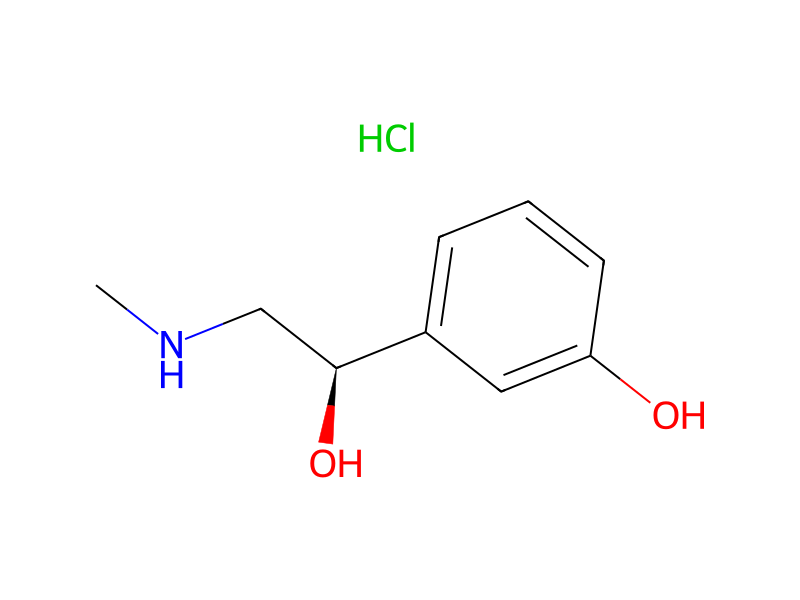
Grundinformationen
- CAS
61-76-7- Standard-SMILES
CNC[C@H](O)c1cccc(O)c1.Cl- InChIKey
OCYSGIYOVXAGKQ-FVGYRXGTSA-N- Summenformel
- C9H13NO2.ClH
- Durchschnittliche Molmasse
- 203,66 g/mol
- Monoisotopische Masse
- 203,0713064
Überblick
Phenylephrine hydrochloride is an odorless white microcrystalline powder. Bitter taste. pH (1% aqueous solution) about 5. (NTP, 1992)
Namen und Bezeichner
- Bevorzugter Name
- Phenylephrine Hydrochloride
- IUPAC
- 3-[(1R)-1-hydroxy-2-(methylamino)ethyl]phenol;hydrochloride
- Lokaler Name
- 3-Hydroxy-alpha-((methylamino)-methyl)benzolethanol-hydro-chlorid, (R)
- Englischer Name
- (R)-Phenylephrine Hydrochlorid
- Summenformel
- C9H13NO2.ClH
- Molmasse
- 203.67
Namen und Synonyme
PHENYLEPHRINE HYDROCHLORIDE61-76-7Phenylephrine HClNostril(R)-Phenylephrine hydrochlorideAlmefrinConsdrinFenilfarBiomydrinL-PHENYLEPHRINE HYDROCHLORIDEMydfrinNeo-Synephrine
Weitere Namen anzeigen
Phenylephrine Hydrochlorid(R)-(-)-PHENYLEPHRINE HYDROCHLORIDEPhenylephrine hydrochloride CRSL(-)-PHENYLEPHRINE HYDROCHLORIDE3-Hydroxy-alpha-(methylaminomethyl)benzyl alcoholuri
HistabidIdrianolNeophrynNeosympatolOftalfrinePhenistanPyristanStanephrin
Datenbank-Bezeichner
- CAS
61-76-7- PubChem CID
- 5284443
- DTXSID
DTXSID3021142- ChEMBL
CHEMBL1200339- UNII
- 04JA59TNSJ
- EC Number
- 200-517-3
Eigenschaften
Berechnete Struktureigenschaften
- Polarare Oberfläche (TPSA)
- 52,5 Ų
- H-Brücken-Donoren
- 4
- H-Brücken-Akzeptoren
- 3
- Frei drehbare Bindungen
- 3
- Schwere Atome
- 13
- Formalladung
- 0
- Komplexität
- 130
Experimentelle und physikochemische Eigenschaften
Solubilitygreater than or equal to 100 mg/mL at 70 °F (NTP, 1992)
Human Drugs
Breast Feeding; Lactation; Milk, Human; Adrenergic Agents; Adrenergic Alpha-Agonists; Antiglaucoma Agents; Sympathomimetics; Vasoconstrictor Agents; Nasal Decongestants
FDA approved drugs -> Active ingredient
FDA approved drugs -> Active ingredient
Melting Point284 to 293 °F (NTP, 1992)
Physical DescriptionPhenylephrine hydrochloride is an odorless white microcrystalline powder. Bitter taste. pH (1% aqueous solution) about 5. (NTP, 1992)
Collision Cross Section133 Ų [M+H-H2O]+ [CCS Type: TW; Method: calibrated with polyalanine and drug standards]
Physikochemische Eigenschaften
- Schmelzpunkt
- 143 · 143-145 °C(lit.)
- Dichte
- 1.2652 g/cm³ · 1.2652 g/cm³(Temp: 25 °C; Press: 750 Torr)
- Brechungsindex
- -45.5 ° · -45.5 ° (C=1, H2O)
- Flammpunkt
- 9 ℃ · 9℃
- storage temp.
- 2 · 2-8°C
- Löslichkeit
- Freely soluble in water and in ethanol (96 per cent).
- Aggregatzustand
- Crystalline Powder
- pka
- 1 · pK1 8.77; pK2 9.84(at 25℃)
- Farbe
- White to almost white
- PH
- pH (10g/L, 25℃) : 4.5~5.5
- Wasserlöslichkeit
- 10 g/100 · >=10 g/100 mL at 21 ºC
- Merck
- 14 · 14,7286
- BRN
- 4158948 · 4158948
- Stabilität
- Hygroscopic
- Major Application
- pharmaceutical (small molecule)
- InChI
- 1S/C9H13NO2.ClH/c1-10-6-9(12)7-3-2-4-8(11)5-7;/h2-5,9-12H,6H2,1H3;1H/t9-;/m0./s1
- InChIKey
- OCYSGIYOVXAGKQ-FVGYRXGTSA-N
- SMILES
- OC1=CC([C@H](CNC)O)=CC=C1.Cl
- LogP
- -0.31 · -0.310
- CAS Datenbank
- 61 · 61-76-7(CAS DataBase Reference)
- EPA chemische Informationen
- Phenylephrine hydrochloride (61-76-7)
Sicherheit und Regulatorisches
GHS-Klassifizierung
GHS Classification
This chemical does not meet GHS hazard criteria for 0.3% (1 of 387) of reports.
Warning
H302 (90.2%): Harmful if swallowed [Warning Acute toxicity, oral]
P261, P264, P264+P265, P270, P271, P272, P280, P301+P317, P302+P352, P304+P340, P305+P351+P338, P317, P319, P321, P330, P332+P317, P333+P317, P337+P317, P362+P364, P403+P233, P405, and P501 (click each P-code to see the statement)
Aggregated GHS information provided per 387 reports by companies from 20 notifications to the ECHA C&L Inventory. Each notification may be associated with multiple companies.
Gefahrenhinweise
Regulatory Information
REACH registered substance: Phenylephrine hydrochloride (EC: 200-517-3)
Phenylephrine hydrochloride: Does not have an individual approval but may be used under an appropriate group standard
Other Safety InformationIMAP assessments - Benzenemethanol, 3-hydroxy-.alpha.-[(methylamino)methyl]-, hydrochloride, (R)-: Environment tier I assessment
Fire HazardsFlash point data for this chemical are not available; however, it is probably combustible. (NTP, 1992)
Health Hazards
SYMPTOMS: Symptoms of exposure to this compound may include tremor, insomnia and palpitations. Other symptoms include excessive central nervous system stimulation resulting in excitement and restlessness; tachycardia, hypertension, pallor, mydriasis, hyperglycemia and urinary retention. Severe overdosage may cause tachypnea or hyperpnea, hallucinations, convulsions and delirium. In some cases it may cause central nervous system depression with somnolence, stupor and respiratory depression. Arrhythmias (including ventricular fibrillation) may lead to hypotension and circulatory collapse. Severe hypokalemia can occur. Other symptoms include blanching and a feeling of coolness of the skin, pressor response, anxiety, nervousness, weakness, headache, dizziness and vomiting. It has an adverse effect on intraocular pressure, corneas, conjunctiva and lids. Trembling and perspiration may occur. Exposure to this compound may cause peripheral vasoconstriction, an increase in arterial pressure, reflex bradycardia and a rise in blood pressure Extravasation of the injection may cause tissue necrosis. Exposure may also cause ventricular dysrrhythmias, a sensation of fullness in the head, tingling, irritation, local discomfort at the site of application, cardiac arrhythmia or cardiac arrests, and death. It has caused acute pulmonary edema with associated hypertension in infants. Hypersensitive persons may experience mild stinging (transient).
Reactive GroupAlcohols and Polyols
Reactivity ProfilePHENYLEPHRINE HYDROCHLORIDE is incompatible with acids, acid chlorides, acid anhydrides and oxidizing agents. It is also incompatible with butacaine, alkalis and ferric salts. (NTP, 1992)
Air and Water ReactionsMay be sensitive to prolonged exposure to air and light. Water soluble.
Hazard Classes and CategoriesAcute Tox. 4 (90.2%)
Sicherheit und Schutzausrüstung
Fire FightingFires involving this chemical can be controlled with a dry chemical, carbon dioxide or Halon extinguisher. (NTP, 1992)
First Aid
EYES: First check the victim for contact lenses and remove if present. Flush victim's eyes with water or normal saline solution for 20 to 30 minutes while simultaneously calling a hospital or poison control center. Do not put any ointments, oils, or medication in the victim's eyes without specific instructions from a physician. IMMEDIATELY transport the victim after flushing eyes to a hospital even if no symptoms (such as redness or irritation) develop.
Nonfire Spill Response
SMALL SPILLS AND LEAKAGE: If you spill this chemical, you should dampen the solid spill material with water, then transfer the dampened material to a suitable container. Use absorbent paper dampened with water to pick up any remaining material. Seal your contaminated clothing and the absorbent paper in a vapor-tight plastic bag for eventual disposal. Wash all contaminated surfaces with a soap and water solution. Do not reenter the contaminated area until the Safety Officer (or other responsible person) has verified that the area has been properly cleaned.
Personal Protective Equipment (PPE)
RECOMMENDED RESPIRATOR: Where the neat test chemical is weighed and diluted, wear a NIOSH-approved half face respirator equipped with an organic vapor/acid gas cartridge (specific for organic vapors, HCl, acid gas and SO2) with a dust/mist filter. (NTP, 1992)
Toxikologische Informationen
Carcinogen Classification
Phenylephrine Hydrochloride
TR-322: Toxicology and Carcinogenesis Studies of Phenylephrine Hydrochloride (CASRN 61-76-7) in F344/N Rats and B6C3F1 Mice (Feed Studies) (1987 )
03/26/86
No Evidence
No Evidence
No Evidence
Effects During Pregnancy and Lactation◉ Summary of Use during Lactation
Sicherheitsdaten
- wgk
- 3
- tsca
- TSCA listed
- ridadr
- 3249
- hs_code
- 29225090
- RTECS-Nr.
- DO7525000
- risk_code
- 22-36/37/38-39/23/24/25-23/24/25-11
- Toxizität
- LD50 in rats (mg/kg): 17 ±1.1 i.p.; 33 ±2.0 s.c. (Warren, Werner)
- hazard_code
- Xn,T,F
- safety_code
- 26-36-37/39-45-36/37-16-7
- hazard_class
- 6.1(b)
- packing_group
- III
- Speicherklasse
- 11 - Combustible Solids
- Hazard Classifications
- Acute Tox. 4 OralSkin Sens. 1B
Chemie und Industrie
Pharmakologische Informationen
FDA Pharmacological Classification
NASAL
Vasoconstriction [PE]; Imidazolines [CS]; Increased Sympathetic Activity [PE]; Vasoconstrictor [EPC]
NASAL PHENYLEPHRINE HYDROCHLORIDE
Adrenergic alpha1-Agonists [MoA]; alpha-1 Adrenergic Agonist [EPC]
PHENYLEPHRINE 10 MG
alpha-1 Adrenergic Agonist [EPC]; Adrenergic alpha1-Agonists [MoA]
MeSH Pharmacological Classification
Agents that have a strengthening effect on the heart or that can increase cardiac output. They may be CARDIAC GLYCOSIDES; SYMPATHOMIMETICS; or other drugs. They are used after MYOCARDIAL INFARCT; CARDIAC SURGICAL PROCEDURES; in SHOCK; or in congestive heart failure (HEART FAILURE).
Agents that dilate the pupil. They may be either sympathomimetics or parasympatholytics.
Drugs that mimic the effects of stimulating postganglionic adrenergic sympathetic nerves. Included here are drugs that directly stimulate adrenergic receptors and drugs that act indirectly by provoking the release of adrenergic transmitters.
Drugs used to cause constriction of the blood vessels.
Drugs designed to treat inflammation of the nasal passages, generally the result of an infection (more often than not the common cold) or an allergy related condition, e.g., hay fever. The inflammation involves swelling of the mucous membrane that lines the nasal passages and results in inordinate mucus production. The primary class of nasal decongestants are vasoconstrictor agents. (From PharmAssist, The Family Guide to Health and Medicine, 1993)
Compounds that bind to and activate ADRENERGIC ALPHA-1 RECEPTORS.
Verwendung und Herstellung
General Manufacturing InformationBenzenemethanol, 3-hydroxy-.alpha.-[(methylamino)methyl]-, hydrochloride (1:1), (.alpha.R)-: ACTIVE
Anwendungen
BeschreibungR-(-)-Phenylephrine is an adrenergic α1A receptor agonist (Ki = 1.4 μM) that demonstrates selectivity against the α1B and α1C receptor subtypes (Kis = 23.9 and 47.8 μM, respectively). By stimulating adrenergic α1 receptors, L-phenylephrine can induce aortic smooth muscle contractions, although reported relative affinity and potency values in rabbit are 5-fold weaker compared to that of L-norepinephrine . This compound is frequently used to precontract smooth muscle in preparations designed to study the properties of various vasodilator agents.
Verwenden(R)-Phenylephrine Hydrochloride is an α-Adrenergic agonist. Mydriatic; decongestant.
Vor- und nachgelagerte Produkte
Vorgelagerte Rohstoffe
Nachgelagerte Produkte
Anbieter100 Anbieter
国药集团化学试剂有限公司86-21-63210123 · [email protected]
梯希爱(上海)化成工业发展有限公司021-67121386 · [email protected]
上海阿拉丁生化科技股份有限公司400-6206333 13167063860 · [email protected]
INTATRADE GmbH+49 3493/605464 · [email protected]
T&W GROUP021-61551611 13296011611 · [email protected]
Jai Radhe Sales+(91)-(79)-26431096/65255722 · [email protected]
科瑞迪化学400-821-5857 021-64326257 · [email protected]
LGM Pharma1-(800)-881-8210 · [email protected]
Syntechem Co.,Ltd[email protected]
上海迈瑞尔生化科技有限公司4006356688 18621169109 · [email protected]
武汉易泰科技有限公司上海分公司18930552037 · [email protected]
安耐吉化学&3A(安徽泽升科技股份有限公司)400-0056266 · [email protected]
上海隆盛化工有限公司58099637 13585536065 · [email protected]
MedChemexpress LLC021-58955995 · [email protected]
合肥天健化工有限公司551-65418679 15856988503;15837135945 · [email protected]
孝感深远化工有限公司15527621225; 15527621225 · [email protected]
玛雅试剂+86 (573) 82222445 (0)18006601000 452520369 · [email protected]
天津希恩思生化科技有限公司400 638 7771 · [email protected]
上海迪外化工科技有限公司021-61551100
斯百全化学(上海)有限公司021-021-021-67601398-809-809-809 15221380277 · [email protected]
上海源叶生物科技有限公司13636370518 · [email protected]
艾科试剂4008-755-333 18080918076 · [email protected]
上海思域化工科技有限公司86-21-34053660 · [email protected]
赛默飞世尔科技(中国)有限公司800-810-5118 · [email protected]
北京伊诺凯科技有限公司400-810-7969 010-59572699 · [email protected]
AdooQ BioScience, LLC+1 (866) 930-6790 · [email protected]
Wuhan NCE Biomedical Co.,Ltd.4000-027-021 |24 +86-13986109188 | +86-15623472865 | +81-08033611988
TCI AMERICA800-4238616 · [email protected]
TOKYO CHEMICAL INDUSTRY CO., LTD.03-36680489 · [email protected]
TCI Europe320-37350700 · [email protected]
上海贤鼎生物科技有限公司4009209199 · [email protected]
尚科生物医药(上海)有限公司021-68187180 13681683526 · [email protected]
越林试剂021-62960152 · [email protected]
Clearsynth Labs Limited+91-22-26355700 · [email protected]
广州爱纯医药科技有限公司020-39119399 18927568969 · [email protected]
南京生利德生物科技有限公司025-57798810 18652991625 · [email protected]
上海将来实业股份有限公司021-61552785 · [email protected]
上海石洋化工有限公司021-56795766 · [email protected]
四川省维克奇生物科技有限公司028-81700200 18116577057 · [email protected]
成都零六生物科技有限公司400-1166-196 13458535857 · [email protected]
上海御略医药科技有限公司021-60345187 13671753212 · [email protected]
天津安浩生物科技有限公司[email protected]
杭州杰恒化工有限公司0571-87396432 · [email protected]
上海纳谦化学科技有限公司13598610367 13598610367 · [email protected]
南京百鑫德诺生物科技有限公司025-58849295 · [email protected]
上海孚一生物科技有限公司+86 (21) 61124340
成都润泽本土化工有限公司13096311329 028-88469284 616445927 · [email protected]
凯试(上海)科技有限公司021-50135380 · [email protected]
池州凯隆进出口贸易有限公司[email protected]
Sigma-Aldrich西格玛奥德里奇(上海)贸易有限公司021-61415566 800-8193336 · [email protected]
Ergänzende Hinweise
DefinitionChEBI: A hydrochloride that is the monohydrochloride salt of phenylephrine.
Zugehörige Reaktionen
12


Notizen zur Verbindung
Wird geladen…