Lacidipine
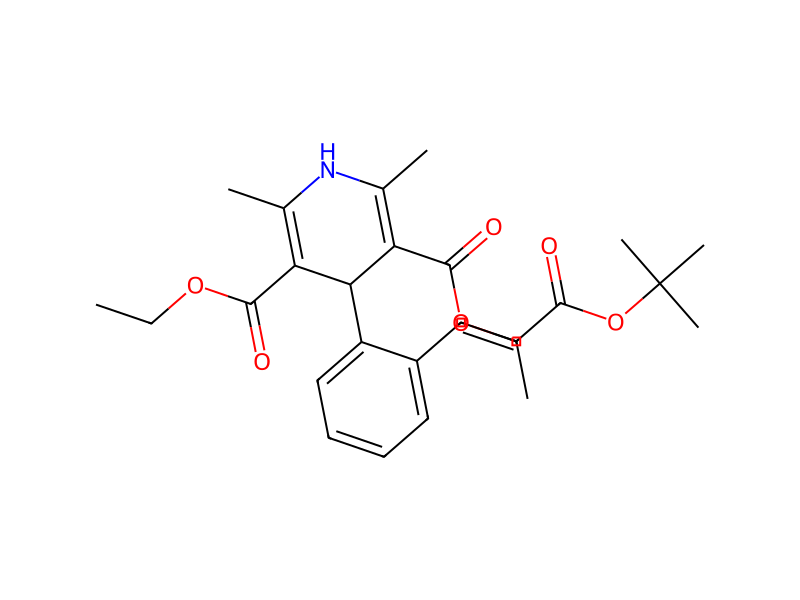
Grundinformationen
- CAS
103890-78-4- Standard-SMILES
CCOC(=O)C1=C(C)NC(C)=C(C(=O)OCC)C1c1ccccc1/C=C/C(=O)OC(C)(C)C- InChIKey
GKQPCPXONLDCMU-CCEZHUSRSA-N- Summenformel
- C26H33NO6
- Durchschnittliche Molmasse
- 455,5 g/mol
- Monoisotopische Masse
- 455,23078778
Überblick
Lacidipine is a tert-butyl ester and a cinnamate ester.
Namen und Bezeichner
- Bevorzugter Name
- Lacidipine
- IUPAC
- diethyl 2,6-dimethyl-4-[2-[(E)-3-[(2-methylpropan-2-yl)oxy]-3-oxoprop-1-enyl]phenyl]-1,4-dihydropyridine-3,5-dicarboxylate
- Englischer Name
- Lacidipine
- Summenformel
- C26H33NO6
- Molmasse
- 455.54
Namen und Synonyme
Weitere Namen anzeigen
Datenbank-Bezeichner
- CAS
103890-78-4- PubChem CID
- 5311217
- DTXSID
DTXSID1046429- ChEMBL
CHEMBL1728809、CHEMBL460291- ChEBI
CHEBI:135737- UNII
- 260080034N
- EC Number
- 638-759-0
- Nikkaji
- J325.878E
Eigenschaften
Berechnete Struktureigenschaften
- XLogP
- 4,5
- Polarare Oberfläche (TPSA)
- 90,9 Ų
- H-Brücken-Donoren
- 1
- H-Brücken-Akzeptoren
- 7
- Frei drehbare Bindungen
- 11
- Schwere Atome
- 33
- Formalladung
- 0
- Komplexität
- 805
Experimentelle und physikochemische Eigenschaften
Physikochemische Eigenschaften
- Schmelzpunkt
- 174 · 174-175°C
- Siedepunkt
- 558.4 · 558.4±50.0 °C(Predicted)
- Dichte
- 1.127 · 1.127±0.06 g/cm3(Predicted)
- storage temp.
- 2 · 2-8°C
- Löslichkeit
- 20 mg/mL, · DMSO: soluble20mg/mL, clear
- Aggregatzustand
- powder
- pka
- 3 · 3.00±0.70(Predicted)
- Farbe
- white to beige
- Merck
- 14 · 14,5331
- InChI
- InChI=1S/C26H33NO6/c1-8-31-24(29)21-16(3)27-17(4)22(25(30)32-9-2)23(21)19-13-11-10-12-18(19)14-15-20(28)33-26(5,6)7/h10-15,23,27H,8-9H2,1-7H3/b15-14+
- InChIKey
- GKQPCPXONLDCMU-CCEZHUSRSA-N
- SMILES
- C1(C)NC(C)=C(C(OCC)=O)C(C2=CC=CC=C2/C=C/C(OC(C)(C)C)=O)C=1C(OCC)=O
- CAS Datenbank
- 103890 · 103890-78-4(CAS DataBase Reference)
Sicherheit und Regulatorisches
GHS-Klassifizierung
GHS Classification
Warning
H302 (97.9%): Harmful if swallowed [Warning Acute toxicity, oral]
P264, P270, P301+P317, P330, and P501 (click each P-code to see the statement)
Aggregated GHS information provided per 48 reports by companies from 5 notifications to the ECHA C&L Inventory.
Gefahrenhinweise
Sicherheitsdaten
- wgk
- 3
- RTECS-Nr.
- US7970200
- risk_code
- 22
- Toxizität
- mouse,LD50,intraperitoneal,80200ug/kg (80.2mg/kg),SKIN AND APPENDAGES (SKIN): HAIR: OTHERSENSE ORGANS AND SPECIAL SENSES: PTOSIS: EYEBEHAVIORAL: SOMNOLENCE (GENERAL DEPRESSED ACTIVITY),Yakuri to Chiryo. Pharmacology and Therapeutics. Vol. 22, Pg. 335, 1994.
- hazard_code
- Xn
- Speicherklasse
- 11 - Combustible Solids
- Hazard Classifications
- Acute Tox. 4 Oral
Chemie und Industrie
Pharmakologische Informationen
ATC Code
C - Cardiovascular system
QC - Cardiovascular system
Pharmacodynamics
acidipine is a specific and potent calcium antagonist with a predominant selectivity for calcium channels in the vascular smooth muscle. Its main action is to dilate predominantly peripheral and coronary arteries, reducing peripheral vascular resistance and lowering blood pressure. Following the oral administration of 4 mg lacidipine to volunteer subjects, a minimal prolongation of QTc interval has been observed (mean QTcF increase between 3.44 and 9.60 ms in young and elderly volunteers).
Mechanism of Action
By blocking the voltage-dependent L-type calcium channels, it prevents the transmembrane calcium influx. Normally, calcium ions serve as intracellular messengers or activators in exictable cells including vascular smooth muscles. The influx of calcium ultimately causes the excitation and depolarization of the tissues. Lacidipine inhibits the contractile function in the vascular smooth muscle and reduce blood pressure. Due to its high membrane partition coefficient, some studies suggest that lacidipine may reach the receptor via a two-step process; it first binds and accumulates in the membrane lipid bilayer and then diffuses within the membrane to the calcium channel receptor. It is proposed that lacidipine preferentially blocks the inactivated state of the calcium channel. Through its antioxidant properties shared amongst other dihydropyridine calcium channel blockers, lacidipine demonstrates an additional clinical benefit. Its antiatherosclerotic effects are mediated by suppressing the formation of reactive oxygen species (ROS) and subsequent inflammatory actions by chemokines, cytokines and adhesion molecules, thus reducing atherosclerotic lesion formation. Lacidipine may also suppress cell proliferation and migration in smooth muscle cells and suppress the expression of matrix metalloproteinases, which affects the stability of atheromatous plaques.
MeSH Pharmacological Classification
Drugs used in the treatment of acute or chronic vascular HYPERTENSION regardless of pharmacological mechanism. Among the antihypertensive agents are DIURETICS; (especially DIURETICS, THIAZIDE); ADRENERGIC BETA-ANTAGONISTS; ADRENERGIC ALPHA-ANTAGONISTS; ANGIOTENSIN-CONVERTING ENZYME INHIBITORS; CALCIUM CHANNEL BLOCKERS; GANGLIONIC BLOCKERS; and VASODILATOR AGENTS.
A class of drugs that act by selective inhibition of calcium influx through cellular membranes.
Absorption, Distribution and Excretion
Since it is a highly lipophilic compound, lacidpine is rapidly absorbed from the gastrointestinal tract following oral administration with the peak plasma concentrations reached between 30 and 150 minutes of dosing. The peak plasma concentrations display large interindividual variability, with the values ranging from 1.6 to 5.7 μg/L following single-dose oral administration of lacidipine 4mg in healthy young volunteers. Absolute bioavailability is less than 10% due to extensive first-pass metabolism in the liver.
Approximately 70% of the administered dose is eliminated as metabolites in the faeces and the remainder as metabolites in the urine.
Anwendungen
BeschreibungLacidipine is a new second-generation dihydropyridine calcium antagonist introduced as a once a day treatment for mild to moderate hypertension. It is reported to have high selectivity for vascular smooth muscle and also a long duration of action. The use of lacidipine as an antiatherosclerotic agent is currently under investigation.
Vor- und nachgelagerte Produkte
Vorgelagerte Rohstoffe
Anbieter100 Anbieter
Zugehörige Reaktionen
Keine Reaktionsaufzeichnungen unter den aktuellen Filterkriterien.
Notizen zur Verbindung
Wird geladen…