
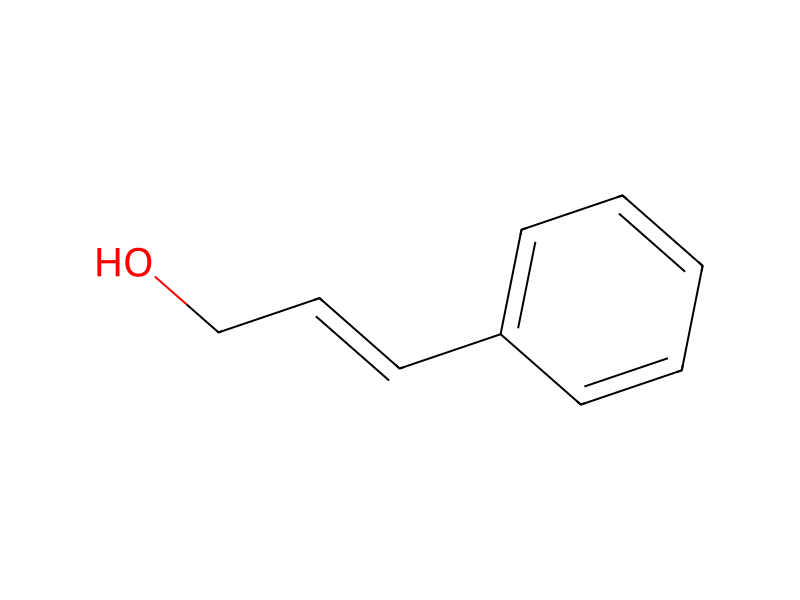
Grundinformationen
- Standard-SMILES
OC/C=C/c1ccccc1- InChIKey
OOCCDEMITAIZTP-QPJJXVBHSA-N- Summenformel
- C9H10O
- Durchschnittliche Molmasse
- 134,17 g/mol
- Monoisotopische Masse
- 134,07316494
Überblick
Cinnamyl alcohol is a primary alcohol comprising an allyl core with a hydroxy substituent at the 1-position and a phenyl substituent at the 3-position (geometry of the C=C bond unspecified). It has a role as a plant metabolite.
Namen und Bezeichner
- Bevorzugter Name
- Cinnamyl Alcohol
- IUPAC
- (E)-3-phenylprop-2-en-1-ol
- Englischer Name
- 3-Phenyl-2-propen-1-ol
- Summenformel
- C9H10O
- Molmasse
- 134.18
Namen und Synonyme
cinnamyl alcohol104-54-1cinnamic alcohol3-PHENYL-2-PROPEN-1-OL(E)-3-phenylprop-2-en-1-ol(E)-cinnamyl alcoholStyryl carbinolStyrone3-Phenylallyl alcoholStyryl alcoholZimtalcohol(E)-3-Phenyl-2-propen-1-ol
Weitere Namen anzeigen
Cinnamyl Alcohol >2-Propen-1-ol, 3-phenyl-, (2E)-C11667500 trans-Cinnamyl-alcohol(E)-3-Phenylprop-2-en-1-ol (Cinnamyl alcohol)
2-Propen-1-ol, 3-phenyl-StyrylcarbinolFEMA No. 2294Alkohol skoricovyNSC-8775SS8YOP444FNSC-623440CHEBI:33227
Datenbank-Bezeichner
- CAS
104-54-1、4407-36-7- PubChem CID
- 5315892
- DTXSID
DTXSID301314144- ChEMBL
CHEMBL324794- ChEBI
CHEBI:17177- UNII
- SS8YOP444F
- EC Number
- 203-212-3、689-359-8
- Nikkaji
- J106.769I、J9.304A
Eigenschaften
Berechnete Struktureigenschaften
- XLogP
- 1,9
- Polarare Oberfläche (TPSA)
- 20,2 Ų
- H-Brücken-Donoren
- 1
- H-Brücken-Akzeptoren
- 1
- Frei drehbare Bindungen
- 2
- Schwere Atome
- 10
- Formalladung
- 0
- Komplexität
- 101
Experimentelle und physikochemische Eigenschaften
Chemical ClassesOther Classes -> Other Aromatic Compounds
DrugsPharmaceuticals -> Listed in ZINC15
Cosmetics
Cosmetics ingredient -> Base; Flavor; Fragrance; Other (Specify)
Cosmetic ingredients (Cinnamyl Alcohol) -> CIR (Cosmetic Ingredient Review)
Masking
SpringerMaterials PropertiesOptical coefficient
Fragrances
Fragrance substance (Cinnamic alcohol) -> IFRA amendment 49
Fragrance Ingredient (Cinnamyl alcohol) -> IFRA transparency List
LogP
1.700
1.95
Odor
ODOR OF HYACINTH
PLEASANT, FLORAL ODOR
TasteBITTER TASTE
Food AdditivesFLAVORING AGENT OR ADJUVANT -> FDA Substance added to food
Density1.0397 @ 35 °C/35 °C
Flavoring AgentsEU Flavoring substances
Color/Form
NEEDLES OR CRYSTAL MASS
WHITE TO YELLOWISH SOLID
WHITE NEEDLES FROM PETROLEUM ETHER
Physikochemische Eigenschaften
- Schmelzpunkt
- 34 °C · 34°C
- Siedepunkt
- 250 °C · 250°C(lit.)
- Dichte
- 1.044 · 1.0440
- Brechungsindex
- 1.5819 · 1.5819
- storage temp.
- Sealed in dry,Room Temperature
- Wasserlöslichkeit
- Practically insoluble in water
- Löslichkeit
- Soluble in Chloroform,Dichloromethane,Ethyl Acetate,DMSO,Acetone,etc.
- Aggregatzustand
- powder to lump to clear liquid
- pka
- 14.61 · 14.61±0.10(Predicted)
- Farbe
- White or Colorless to Light yellow
- Geruch (Odor)
- 100 % · at 100.00 %. sweet balsam hyacinth spicy green powdery cinnamyl
- Geruchsart
- balsamic
- Merck
- 14 · 14,2302
- InChI
- InChI=1S/C9H10O/c10-8-4-7-9-5-2-1-3-6-9/h1-7,10H,8H2/b7-4+
- InChIKey
- OOCCDEMITAIZTP-QPJJXVBHSA-N
- SMILES
- C(O)/C=C/C1=CC=CC=C1
- LogP
- 1.7 · 1.700
Sicherheit und Regulatorisches
GHS-Klassifizierung
GHS Classification
This chemical does not meet GHS hazard criteria for < 0.1% (1 of 2033) of reports.
Warning
H302 (15.5%): Harmful if swallowed [Warning Acute toxicity, oral]
P261, P264, P270, P272, P280, P301+P317, P302+P352, P321, P330, P333+P317, P362+P364, and P501 (click each P-code to see the statement)
Aggregated GHS information provided per 2033 reports by companies from 21 notifications to the ECHA C&L Inventory. Each notification may be associated with multiple companies.
Warning
Gefahrenhinweise
Regulatory Information
Chemical: 2-Propen-1-ol, 3-phenyl-
Hazard Traits - Fragrance Allergen
Regulation (EC) No 1831/2003 (amended)
2-Propen-1-ol, 3-phenyl- is listed on the EPA's Chemical Data Reporting (CDR) system. Manufacturers and importers of 2-Propen-1-ol, 3-phenyl- are required to report information about their production and use of this chemical to the EPA under the Toxic Substances Control Act (TSCA). (40 eCFR Part 711)
Status: Active Update: 25-04-2023 https://echa.europa.eu/registration-dossier/-/registered-dossier/12023
Cinnamyl alcohol: Does not have an individual approval but may be used under an appropriate group standard
Other Safety InformationIMAP assessments - 2-Propen-1-ol, 3-phenyl-: Human health tier II assessment
Hazards Summary
Cinnamic alcohol was an allergen in 15 of 20 perfume-sensitive patients patch tested. [HSDB] An irritant; [MSDSonline] Positive patch tests reported in perfume industry and food handlers; One of the chemicals in the fragrance mix; [Kanerva, p. 1771] Included in list of established contact allergens in humans; [EC: Scientific Committee on Consumer Safety: Fragrance allergens in cosmetic products (2011)] Danger of skin sensitization; [MAK]
FDA Requirements121.1164
Hazard Classes and Categories
Acute Tox. 4 (15.5%)
Acute Tox. 4 (100%)
Skin sensitisation - category 1
Toxikologische Informationen
Adverse EffectsSkin Sensitizer - An agent that can induce an allergic reaction in the skin.
Human Toxicity ExcerptsPATCH TESTS TO SEVERAL SCREENING SETS OF FRAGRANCE MATERIALS WERE PERFORMED ON 20 PERFUME-SENSITIVE PT. MOST COMMON ALLERGEN WAS CINNAMIC ALC (15 OF 20 PT).
Regulatorische Informationen
FDA Requirements121.1164
Sicherheitsdaten
- hs_code
- 2906.29.6000
- RTECS-Nr.
- GE2200000
Chemie und Industrie
Pharmakologische Informationen
Metabolism/Metabolites
In general, esters containing an aromatic ring system are expected to be hydrolyzed in vivo. Cinnamyl alcohol is hydrolyzed to [DB14184].
ACIDIC & NEUTRAL URINARY METABOLITE OF CINNAMYL ALC WAS IDENTIFIED THROUGH A COMMON METABOLIC SCHEME.
Cinnamyl alcohol is a known human metabolite of beta-methylstyrene.
FDA Pharmacological Classification
SS8YOP444F
CINNAMYL ALCOHOL
Established Pharmacologic Class [EPC] - Standardized Chemical Allergen
Physiologic Effects [PE] - Increased Histamine Release
Physiologic Effects [PE] - Cell-mediated Immunity
Chemical Structure [CS] - Allergens
Absorption, Distribution and Excretion
Cinnamyl alcohol is 66% absorbed through the skin and shown to be rapidly absorbed from the gut.
Cinnamyl alcohol is metabolized and excreted primarily in the urine and, to a minor extent, in the feces. After oral or intraperitoneal administration to rats and mice, 76–77% of the dose of cinnamyl alcohol was recovered in the urine and feces within 24 h.
CINNAMYL ALC IS EXCRETED UNCHANGED IN NEUTRAL EXTRACT WHEN GIVEN TO RATS.
Cellular LocationsCytoplasm
Verwendung und Herstellung
Uses
CIR ingredient: Cinnamyl Alcohol
Used as a fragrance, flavoring agent, deodorant, and chemical intermediate (chemical resistant coatings, photosensitive polymers, and lithographic plates); [HSDB]
AS DEODORANT IN 12.5% SOLN IN GLYCEROL
FRAGRANCE, EG, FOR COLOGNES, SOAPS, AND LOTIONS; FIXATIVE FOR PERFUME BLENDS; IN MFR OF CHEM RESISTANT COATINGS; FLAVORING AGENT FOR FOOD (EG, CANDY, GUM, BEVERAGES); CHEM INTERMEDIATE FOR CINNAMYL ESTERS USED IN PERFUMERY; IN MFG OF PHOTOSENSITIVE POLYMERS & LITHOGRAPHIC PLATES
U.S. Exports
(1977) No Data
(1979) No Data
U.S. Imports
(1977) 6.74X10+5 GRAMS (PRINCPL CUSTMS DISTS)
(1979) 5.00X10+5 GRAMS (PRINCPL CUSTMS DISTS)
U.S. Production
2023: <75,000 lb
(1974) 6.81X10+7 G-CONSUMPTION IN FRAGRANCES
(1979) PROBABLY GREATER THAN 9.08X10+5 GRAMS
Industry UsesFixing agent (mordant)
IFRA Fragrance Standards
Cinnamic alcohol
Cinnamyl alcohol; 3-Phenylallyl alcohol; 3-Phenyl-2-propen-1-ol; 2-Propen-1-ol, 3-phenyl-; Styrone; Styryl alcohol; Zimtalcohol; Styryl carbinol
IFRA_STD_017.pdf
49
IFRA 51st Amendment - Guidance for the use of IFRA Standards
Restriction: This material should be used only in the limited quantity as stated in the Standard
Methods of Manufacturing
MEERWEIN-PONNDORF REDUCTION OF CINNAMALDEHYDE WITH ALUMINUM ISOPROPYLATE OR ETHYLATE; ALKALINE HYDROLYSIS OF STORAX; REDUCTION OF CINNAMAL DIACETATE WITH ACETIC ACID AND IRON FILINGS
OBTAINED ORIGINALLY BY SAPONIFICATION OF CINNAMYL CINNAMATE (STYRACIN). THIS METHOD OF EXTRACTION FROM STORAX IS STILL USABLE. SYNTHETICALLY, BY REDUCTION OF CINNAMALDEHYDE WITH SODIUM OR POTASSIUM HYDROXIDE.
Formulations/PreparationsASSAY: 98% MIN
Household Products
Cosmetics product ingredient: Cinnamyl alcohol
Information on 67 consumer products that contain Cinnamyl Alcohol in the following categories is provided:
Use Classification
Fragrance Ingredients
Flavouring Agent -> FLAVOURING_AGENT -> JECFA Functional Classes
Flavoring Agents -> JECFA Flavorings Index
Flavouring Agent -> FLAVOURING_AGENT -> JECFA Functional Classes
Flavouring Agent -> FLAVOURING_AGENT -> JECFA Functional Classes
Cosmetics -> Masking
General Manufacturing Information
All Other Chemical Product and Preparation Manufacturing
2-Propen-1-ol, 3-phenyl-: ACTIVE
WHEN SMALL AMT OF IMPURITIES ARE PRESENT AS IN NATURAL ARTICLE (CINNAMYL ALC FROM STORAX), IT REMAINS FLUID AT LOWER TEMPERATURES THAN THE MELTING POINT.
REPORTED USES: NON-ALCOHOLIC BEVERAGES 8.8 PPM; ALCOHOLIC BEVERAGES 5.0 PPM; ICE CREAM, ICES, ETC 8.7 PPM; CANDY 17 PPM; BAKED GOODS 33 PPM; GELATINS & PUDDINGS 22 PPM; CHEWING GUM 720 PPM.
FLAVOR USEFUL IN APRICOT, PEACH, RASPBERRY, PLUM FLAVORS.
OCCURS (IN ESTERIFIED FORM) IN STORAX & IN BALSAM PERU, CINNAMON LEAVES, HYACINTH OIL. OBTAINED BY ALKALINE HYDROLYSIS OF STORAX.
Restriction Limits in the Finished Product (%)
0.22 [Products applied to the lips]
0.067 [Products applied to the axillae]
0.25 [Products applied to the face/body using fingertips]
1.2 [Products related to fine fragrances]
0.32 [Products applied to the body using the hands (palms), primarily leave-on (Body lotion)]
0.25 [Products applied to the face using the hands (palms), primarily leave-on (Face moisturizer)]
Anwendungen
Verwenden3-Phenylprop-2-en-1-ol is a reactant in the preparation of isobenzofuranones.
Vor- und nachgelagerte Produkte
Vorgelagerte Rohstoffe
Nachgelagerte Produkte
Anbieter50 Anbieter
梯希爱(上海)化成工业发展有限公司021-67121386 · [email protected]
成都超九八生物科技有限公司13348960310 13348960310 · [email protected]
郑州汇聚化工有限公司0371-53399770 18037166334 · [email protected]
上海麦克林生化科技股份有限公司021-50706066 15221275939 · [email protected]
武汉欣扬瑞和化学科技有限公司13720274133 · [email protected]
河南赢创生物科技有限公司16650615803 · [email protected]
上海腾准生物科技有限公司19821570922 · [email protected]
普善实业(陕西)有限公司029-81310890 18165209495 · [email protected]
Suzhou ARTK Medchem Co., Ltd.+86-18168183658 · [email protected]
武汉众志诚生物技术有限公司13628624121 13628604890 · [email protected]
上海仲因实业有限公司2537653158 16621191650 · [email protected]
Syntechem Co.,Ltd[email protected]
United Life Science020-82099279 18988941402 · [email protected]
湖北广奥生物科技有限公司027-02702759223056 18162699093 · [email protected]
佛山宝诺生物科技有限公司0757-85921206 18520245316 · [email protected]
云南西力生物技术股份有限公司0871-65217109 · [email protected]
上海健超生物科技有限公司15021035486 18081542813 · [email protected]
TargetMol 中国(陶术生物)400-821-0310 15002144251 · [email protected]
TCI AMERICA800-4238616 · [email protected]
TOKYO CHEMICAL INDUSTRY CO., LTD.03-36680489 · [email protected]
TCI Europe320-37350700 · [email protected]
雷丁试剂0510-85629785 18013409632 · [email protected]
天津普西唐生物医药科技有限公司010-60605840 · [email protected]
上海永叶生物科技有限公司86-021-61559134 15921386130 · [email protected]
青岛海智微元生物科技有限公司18317699790 18317699790 · [email protected]
ALB Technology Limited702-983-3769 · [email protected]
武汉天植生物技术有限公司18607101326 15172504745 · [email protected]
HANGZHOU LEAP CHEM CO., LTD.+86-571-87711850 +86-15355479329 · [email protected]
上海超岚化工科技中心(原宁波市超明生物科技有限公司)13301662590 · [email protected]
上海阿拉丁生化科技股份有限公司6206333 13167063860 · [email protected]
EMMX Biotechnology LLC888-539-0666 · [email protected]
上海源叶生物科技有限公司13636370518 · [email protected]
上海澄绍生物科技有限公司021-61847300 13341622919 · [email protected]
武汉卡诺斯科技有限公司18064039730 · [email protected]
上海贤鼎生物科技有限公司021-021-52271985 17721149837 · [email protected]
南京尚书生物科技有限公司18266960953 · [email protected]
Shaanxi Dideu New Materials Co. Ltd18192503167 · [email protected]
Shanghai Acmec Biochemical Technology Co., Ltd.+86-18621343501 · [email protected]
北京索莱宝科技有限公司010-50973130 17801761073 · [email protected]
江苏艾康生物医药研发有限公司025-58851090 13913916777 · [email protected]
武汉赢元贝商贸有限公司86-13349903920 13349903920 · [email protected]
上海吉至生化科技有限公司021-4009004166/18616739031 18616739031 · [email protected]
career henan chemical co+86-0371-86658258 · [email protected]
北京迈瑞达科技有限公司010-82387566 · [email protected]
南京狄尔格医药科技有限公司025-025-51191215 18013836722 · [email protected]
深圳聚合生化科技有限公司+86-400-002-6226 · [email protected]
TCI Chemicals (India) Pvt. Ltd.[email protected]
海蔚化学86-21-51086038 · [email protected]
浙江联硕生物科技有限公司18616526224 · [email protected]
上海迈讯生物科技有限公司13162884212 · [email protected]
Zugehörige Reaktionen
13


Verknüpfte Notizen
Wird geladen…