
Andrographolide
Daten werden ergänzt – lade die Seite später neu, um den aktuellen Stand zu sehen
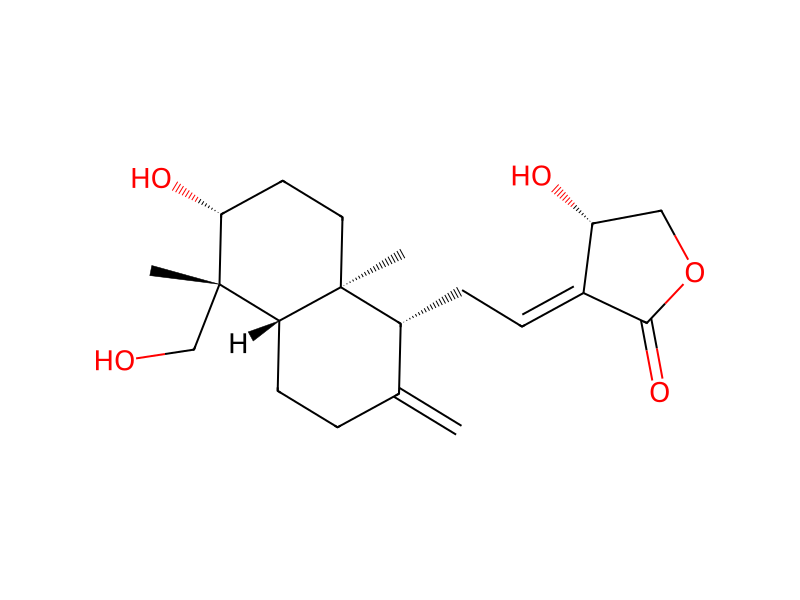
Grundinformationen
- CAS
5508-58-7- Standard-SMILES
C=C1CC[C@@H]2[C@](C)(CO)[C@H](O)CC[C@@]2(C)[C@@H]1C/C=C1/C(=O)OC[C@H]1O- InChIKey
BOJKULTULYSRAS-OTESTREVSA-N- Summenformel
- C20H30O5
- Durchschnittliche Molmasse
- 350,4 g/mol
- Monoisotopische Masse
- 350,20932406
Überblick
Andrographolide is a labdane diterpenoid isolated from the leaves and roots of Andrographis paniculata that exhibits anti-HIV, anti-inflammatory and antineoplastic properties. It has a role as a metabolite, an anti-inflammatory drug, an antineoplastic agent and an anti-HIV agent. It is a primary alcohol, a secondary alcohol, a labdane diterpenoid, a carbobicyclic compound and a gamma-lactone.
Namen und Bezeichner
- Bevorzugter Name
- Andrographolide
- IUPAC
- (3E,4S)-3-[2-[(1R,4aS,5R,6R,8aS)-6-hydroxy-5-(hydroxymethyl)-5,8a-dimethyl-2-methylidene-3,4,4a,6,7,8-hexahydro-1H-naphthalen-1-yl]ethylidene]-4-hydroxyoxolan-2-one
- Lokaler Name
- Andrographolide
- Englischer Name
- Andrographolide
- Summenformel
- C20H30O5
- Molmasse
- 350.45
Namen und Synonyme
Andrographolide5508-58-7DTXSID3045980HMPL004CHEBI:65408410105JHGRNSC-383468DTXCID10259803alpha,14,15,18-tetrahydroxy-5b,9bH,10a-labda-8(20),12-dien-16-oic acid gamma-Lactone(3E,4S)-3-[2-[(1R,4aS,5R,6R,8aS)-6-hydroxy-5-(hydroxymethyl)-5,8a-dimethyl-2-methylidene-3,4,4a,6,7,8-hexahydro-1H-naphthalen-1-yl]ethylidene]-4-hydroxyoxolan-2-one3-(2-(Decahydro-6-hydroxy-5-(hydroxymethyl)-5,8a-dimethyl-2-methylenenaphthyl)ethylidene)dihydro-4-hydroxyfuran-2(3H)-one(3E,4S)-4-hydroxy-3-{2-[(1R,4aS,5R,6R,8aS)-6-hydroxy-5-(hydroxymethyl)-5,8a-dimethyl-2-methylidenedecahydronaphthalen-1-yl]ethylidene}dihydrofuran-2(3H)-one
Weitere Namen anzeigen
ANDROANDROGRAPHISAndrographolid(S,E)-4-Hydroxy-3-(2-((1R,4aS,5R,6R,8aS)-6-hydroxy-5-(hydroxyMethyl)-5,8a-diMethyl-2-Methylenedecahydronaphthalen-1-yl)ethylidene)dihydrofuran-2(3H)-oneAndrographent-(3β,12E,14R)-3,14,19-Trihydroxy-8(17),12-labdadien-16,15-olide
Eigenschaften
Berechnete StruktureigenschaftenWird ergänzt
- XLogP
- 2,2
- Polarare Oberfläche (TPSA)
- 87 Ų
- H-Brücken-Donoren
- 3
- H-Brücken-Akzeptoren
- 5
- Frei drehbare Bindungen
- 3
- Schwere Atome
- 25
- Formalladung
- 0
- Komplexität
- 597
Experimentelle und physikochemische Eigenschaften
DrugsPharmaceuticals -> Listed in ZINC15
Dietary IngredientsAndrographis
Physikochemische Eigenschaften
- Schmelzpunkt
- 229 · 229-232 °C (lit.)
- Siedepunkt
- 557.3 · 557.3±50.0 °C(Predicted)
- Dichte
- 421 · d421 1.2317
- storage temp.
- 2 · 2-8°C
- Löslichkeit
- Soluble in DMSO (up to 25 mg/ml) or in Ethanol (up to 8 mg/ml).
- pka
- 12.36 · 12.36±0.20(Predicted)
- Aggregatzustand
- Off-white solid
- Farbe
- Off-white
- Merck
- 14 · 14,633
- BRN
- 42762 · 42762
- Stabilität
- 2 years · Stable for 2 years from date of purchsae as supplied. Solutions in DMSO or ethanol may be stored at -20°C for up to 3 months.
Sicherheit und Regulatorisches
Sicherheitsangaben dienen nur zur Orientierung und ersetzen weder das Sicherheitsdatenblatt (SDB) des Lieferanten noch geltende Vorschriften oder eine fachliche Bewertung.
GHS-Klassifizierung
GHS Classification
Warning
H315 (100%): Causes skin irritation [Warning Skin corrosion/irritation]
P261, P264, P264+P265, P271, P280, P302+P352, P304+P340, P305+P351+P338, P319, P321, P332+P317, P337+P317, P362+P364, P403+P233, P405, and P501 (click each P-code to see the statement)
Aggregated GHS information provided per 31 reports by companies from 2 notifications to the ECHA C&L Inventory. Each notification may be associated with multiple companies.
Gefahrenhinweise
Regulatory Information
2(3H)-Furanone, 3-2-(1R,4aS,5R,6R,8aS)-decahydro-6-hydroxy-5-(hydroxymethyl)-5,8a-dimethyl-2-methylene-1-naphthalenylethylidenedihydro-4-hydroxy-, (3E,4S)-: Does not have an individual approval but may be used as a component in a product covered by a group standard. It is not approved for use as a chemical in its own right.
Hazard Classes and CategoriesSkin Irrit. 2 (100%)
Sicherheitsdaten
- wgk
- 3
- hs_code
- 29322980
- RTECS-Nr.
- LU3490750
- risk_code
- 20/21/22-36/37/38
- hazard_code
- Xn
- safety_code
- 22-24/25-36-26
- Speicherklasse
- 11 - Combustible Solids
Chemie und Industrie
Pharmakologische Informationen
Mechanism of Action
HMPL-004 acts on multiple cellular targets in the inflammatory signal transduction pathways resulting in suppressed inflammation cytokine expression including TNF-α, IL-1β and IL-6. HMPL-004 was demonstrated to inhibit TNF-α and IL-1β production in cell-based assays. HMPL-004 is also able to inhibit NF-kB activation. NF-kB is a family of transcriptional factors that regulate a wide spectrum of genes critically involved in host defence and inflammation. The mechanism of action of HMPL-004 was further supported in laboratory IBD animal models. Treatment of IBD rats with HMPL-004 caused a significant drop in plasma cytokine concentrations, including TNF-α and IL-1β.
MeSH Pharmacological Classification
Substances that reduce or suppress INFLAMMATION.
Anti-inflammatory agents that are non-steroidal in nature. In addition to anti-inflammatory actions, they have analgesic, antipyretic, and platelet-inhibitory actions. They act by blocking the synthesis of prostaglandins by inhibiting cyclooxygenase, which converts arachidonic acid to cyclic endoperoxides, precursors of prostaglandins. Inhibition of prostaglandin synthesis accounts for their analgesic, antipyretic, and platelet-inhibitory actions; other mechanisms may contribute to their anti-inflammatory effects.
Substances that are destructive to protozoans.
Agents used in the prophylaxis or therapy of VIRUS DISEASES. Some of the ways they may act include preventing viral replication by inhibiting viral DNA polymerase; binding to specific cell-surface receptors and inhibiting viral penetration or uncoating; inhibiting viral protein synthesis; or blocking late stages of virus assembly.
Drugs or agents which antagonize or impair any mechanism leading to blood platelet aggregation, whether during the phases of activation and shape change or following the dense-granule release reaction and stimulation of the prostaglandin-thromboxane system.
Verwendung und Herstellung
Household ProductsInformation on 1 consumer products that contain Andrographolide in the following categories is provided:
Zugehörige Reaktionen
3


Notizen zur Verbindung
Wird geladen…