3-Decen-2-on
3-Decen-2-one, (3E)-
HCID 5363233
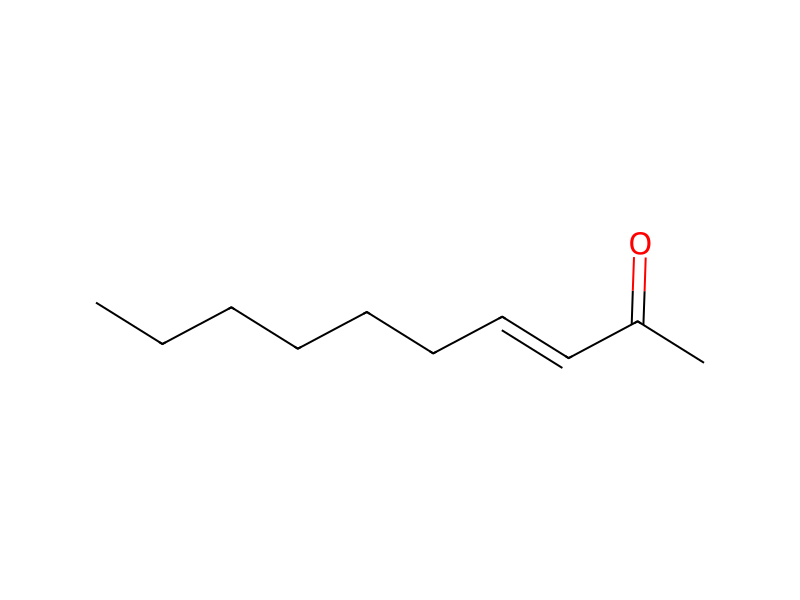
Grundinformationen
- CAS
10519-33-2- Standard-SMILES
CCCCCC/C=C/C(C)=O- InChIKey
JRPDANVNRUIUAB-CMDGGOBGSA-N- Summenformel
- C10H18O
- Durchschnittliche Molmasse
- 154,25 g/mol
- Monoisotopische Masse
- 154,13576519
Namen und Bezeichner
- Bevorzugter Name
- 3-Decen-2-one, (3E)-
- IUPAC
- (E)-dec-3-en-2-one
- Lokaler Name
- 3-Decen-2-on
- Englischer Name
- 3-DECEN-2-ONE
- Summenformel
- C10H18O
- Molmasse
- 154.25
Namen und Synonyme
3-Decen-2-one10519-33-2dec-3-en-2-oneHeptylidene acetone(E)-dec-3-en-2-oneOenanthylidene acetone(3E)-Dec-3-en-2-oneTrans-3-decen-2-one18402-84-1(E)-3-Decen-2-oneEnanthylidene acetone3-Decen-2-one, (E)-
Weitere Namen anzeigen
FEMA 3532Decenone3-Decen-3-one3-Decen-2-one>(3E)-3-Decen-2-one3-Decen-2-one, ≥ 90.0%
FEMA No. 35323-Decen-2-one, (3E)-Z22804BQXDEINECS 234-059-0(3E)-3-Decen-2-one3-DECEN-2-ONE [FHFI]DTXSID201315551(3E)-3-DECEN-2-ONE [MI]
Datenbank-Bezeichner
- CAS
10519-33-2、18402-84-1- PubChem CID
- 5363233
- DTXSID
DTXSID201315551- ChEMBL
CHEMBL206566- UNII
- Z22804BQXD
- EC Number
- 234-059-0、701-234-2
- Nikkaji
- J24.203I、J409.409C
Eigenschaften
Berechnete Struktureigenschaften
- XLogP
- 3,4
- Polarare Oberfläche (TPSA)
- 17,1 Ų
- H-Brücken-Donoren
- 0
- H-Brücken-Akzeptoren
- 1
- Frei drehbare Bindungen
- 6
- Schwere Atome
- 11
- Formalladung
- 0
- Komplexität
- 125
Experimentelle und physikochemische Eigenschaften
Pesticides
Agrochemicals -> Pesticide active substances
Active substance -> EU Pesticides database: Pending
Food AdditivesFLAVORING AGENT OR ADJUVANT -> FDA Substance added to food
Density0.809-0.813
Flavoring AgentsEU Flavoring substances
Solubility
almost insoluble in water; soluble in purfume oils
Miscible at room temperature (in ethanol)
Boiling Point125-126 °C
Refractive Index1.446-1.452
Physical DescriptionColourless liquid; fruity floral jasmine-like aroma
Physikochemische Eigenschaften
Sicherheit und Regulatorisches
Sicherheitsangaben dienen nur zur Orientierung und ersetzen weder das Sicherheitsdatenblatt (SDB) des Lieferanten noch geltende Vorschriften oder eine fachliche Bewertung.
GHS-Klassifizierung
GHS Classification
Danger
H304: May be fatal if swallowed and enters airways [Danger Aspiration hazard]
P261, P264, P271, P273, P280, P301+P316, P302+P352, P304+P340, P317, P321, P331, P332+P317, P362+P364, P391, P405, and P501 (click each P-code to see the statement)
This chemical does not meet GHS hazard criteria for 69% (89 of 129) of all reports.
Warning
H319 (31%): Causes serious eye irritation [Warning Serious eye damage/eye irritation]
Gefahrenhinweise
Regulatory Information
Chemical: 3-Decen-2-one
Commission Regulation (EC) No 1565/2000 (Repealed by Com. Implementing Reg. (EU) No 872/2012)
Reg. (EU) 2016/138
REACH registered substance: (3E)-dec-3-en-2-one (EC: 701-234-2)
3-Decen-2-one: Does not have an individual approval but may be used under an appropriate group standard
Hazard Classes and Categories
Eye Irrit. 2 (31%)
Acute Tox. 4
Sicherheitsdaten
- wgk
- 3
- tsca
- TSCA listed
- hs_code
- 2914.19.0000
- risk_code
- 36-52
- hazard_code
- Xi
- safety_code
- 23-24/25-26
- Speicherklasse
- 10 - Combustible liquids
- Hazard Classifications
- Eye Irrit. 2
Chemie und Industrie
Verwendung und Herstellung
Use Classification
Flavouring Agent -> FLAVOURING_AGENT -> JECFA Functional Classes
Flavoring Agents -> JECFA Flavorings Index
Flavouring Agent -> FLAVOURING_AGENT -> JECFA Functional Classes
Flavouring Agent -> FLAVOURING_AGENT -> JECFA Functional Classes
General Manufacturing Information3-Decen-2-one: ACTIVE
Anwendungen
OccurrenceReported found in Boletus edulis mushrooms.
VerwendenThis ketone has found a little use in perfume compositions as component of certain types of Jasmin bases. It may also find some use in other florals, since it blends well with the lonones and with woody as well as certainCitrus complexes. It is quite powerful and relatively stable towards alkali and other chemical reactants commonly encountered in cosmetic preparations.
Darstellung
synthetischeFrom acetone and heptyl alcohol in 1% sodium hydroxide solution; by dehydration upon heating of 4-decanol-2-one over pumice or clay; also by condensation of heptaldehyde and acetone.
Vor- und nachgelagerte Produkte
Vorgelagerte Rohstoffe
Zugehörige Reaktionen
0
Noch keine zugehörigen Reaktionen