
3-Aminoacrolein

Grundinformationen
- CAS
25186-34-9- Standard-SMILES
NC=CC=O- InChIKey
UCRYVFBKCBUURB-UHFFFAOYSA-N- Summenformel
- C3H5NO
- Durchschnittliche Molmasse
- 71,08 g/mol
Namen und Bezeichner
- Bevorzugter Name
- 3-Aminoacrolein
- IUPAC
- 3-aminoprop-2-enal
- Englischer Name
- 3-Aminoacrolein
- Summenformel
- C3H5NO
- Molmasse
- 71.08
Namen und Synonyme
3-Aminoacrolein3-aminoprop-2-enal25186-34-9(Z)-3-Amino-propenal3-aminoacrylaldehyde3-aminopropenal3-amino acrolein3-amino-prop-2-enal3-aminoprop-2-en-1-oneSCHEMBL1449289SCHEMBL3051609SCHEMBL9071468
Weitere Namen anzeigen
Z-3-Amino-propel3-Amino-2-propenalZ-3-Amino-propenal(Z)-b-Aminoacrolein2-Propenal, 3-amino- (9CI)
UCRYVFBKCBUURB-UHFFFAOYSA-NSB36187DB-082915
Datenbank-Bezeichner
- CAS
25186-34-9- PubChem CID
- 53977912
- EC Number
- 182-571-7
Eigenschaften
Berechnete Struktureigenschaften
- XLogP
- -0,2
- Polarare Oberfläche (TPSA)
- 43,1 Ų
- H-Brücken-Donoren
- 1
- H-Brücken-Akzeptoren
- 2
- Frei drehbare Bindungen
- 1
- Schwere Atome
- 5
- Formalladung
- 0
- Komplexität
- 48,9
Physikochemische Eigenschaften
- Schmelzpunkt
- 104 · 104-105℃
- Siedepunkt
- 295 ℃ · 295℃
- Dichte
- 0.978 · 0.978
- Flammpunkt
- 132 ℃ · 132℃
- Löslichkeit
- sol alcohol and water.
- pka
- 5.5 · 5.50±0.70(Predicted)
- Aggregatzustand
- yellow solid
Sicherheit und Regulatorisches
GHS-Klassifizierung
GHS Classification
Danger
H301 (100%): Toxic if swallowed [Danger Acute toxicity, oral]
P260, P261, P262, P264, P270, P271, P273, P280, P301+P316, P301+P330+P331, P302+P352, P302+P361+P354, P304+P340, P305+P354+P338, P316, P319, P321, P330, P361+P364, P363, P403+P233, P405, and P501 (click each P-code to see the statement)
The GHS information provided by 1 company from 1 notification to the ECHA C&L Inventory.
Gefahrenhinweise
Hazard Classes and CategoriesAcute Tox. 3 (100%)
Chemie und Industrie
Darstellung
synthetische3-Aminoacrolein is highly reactive towards self-condensation and is best when freshly prepared. One method of preparation involves the reaction of Ammonia with Propargyl Aldehyde (propynal) in the presence of ethanol in a sealed tube. This method is somewhat erratic, propargaldehyde is not commercially available, and the stereochemistry of the resulting double bond is most likely trans. A modified route, proceeding through 1,1,3,3-tetraethoxypropane, has also been reported. The most satisfactory preparation of β-aminoacrolein involves the partial hydrogenation of isoxazole.3,4 A solution of commercially available isoxazole (5 g, 0.073 mol) in anhyd MeOH (100 mL) containing 1.0 g of Raney Nickel was hydrogenated at 40 psi until one equivalent of hydrogen had been absorbed and hydrogen uptake had ceased (eq 1). The mixture was filtered to remove the catalyst and the solvent was evaporated to give 4.2 g (82%) of a yellow solid, mp 96-97 °C. Recrystallization from chloroform-petroleum ether (1:1) gave crystals, mp 104-105 °C.
Anbieter6 Anbieter
常州琬瑶生物科技有限公司051989185693 15312551983 · [email protected]
杰达维(上海)医药科技发展有限公司/J & W PharmLab021-64340559 · [email protected]
上海卡洛化学有限公司21-33526724 18930996265 · [email protected]
HANGZHOU LEAP CHEM CO., LTD.+86-571-87711850 +86-15355479329 · [email protected]
上海智乾生物科技有限公司[email protected]
Richest Group Ltd18017061086 · [email protected]
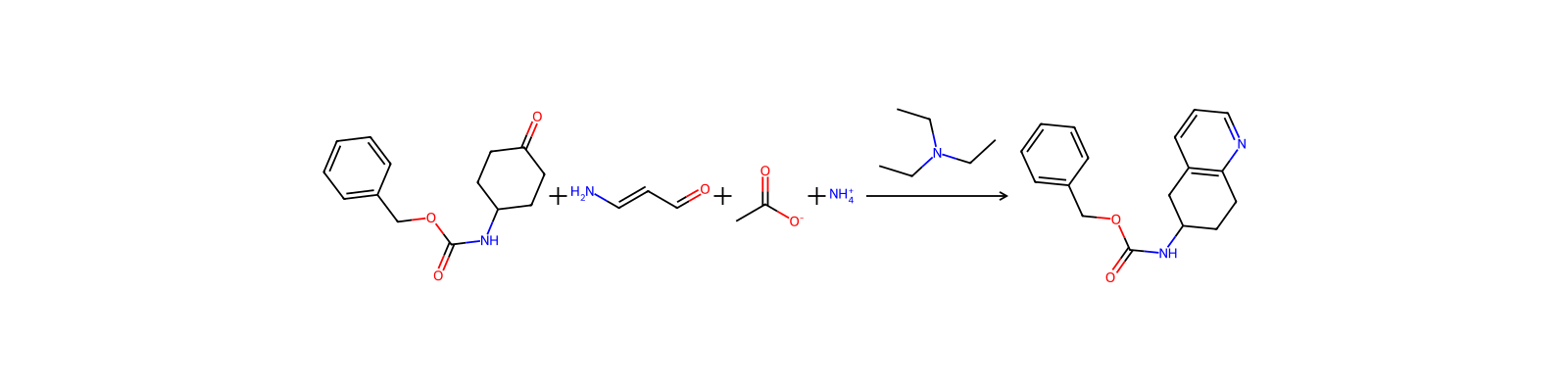
Zugehörige Reaktionen
5


Notizen zur Verbindung
Wird geladen…