Terazosin
Daten werden ergänzt – lade die Seite später neu, um den aktuellen Stand zu sehen
Grundinformationen
- CAS
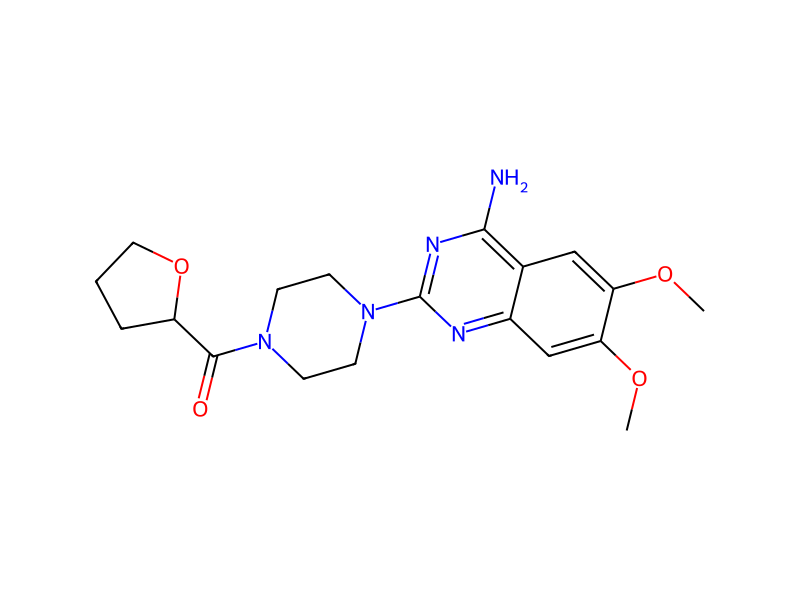
63590-64-7- Standard-SMILES
COc1cc2nc(N3CCN(C(=O)C4CCCO4)CC3)nc(N)c2cc1OC- InChIKey
VCKUSRYTPJJLNI-UHFFFAOYSA-N- Summenformel
- C19H25N5O4
- Durchschnittliche Molmasse
- 387,4 g/mol
- Monoisotopische Masse
- 387,1906543
Überblick
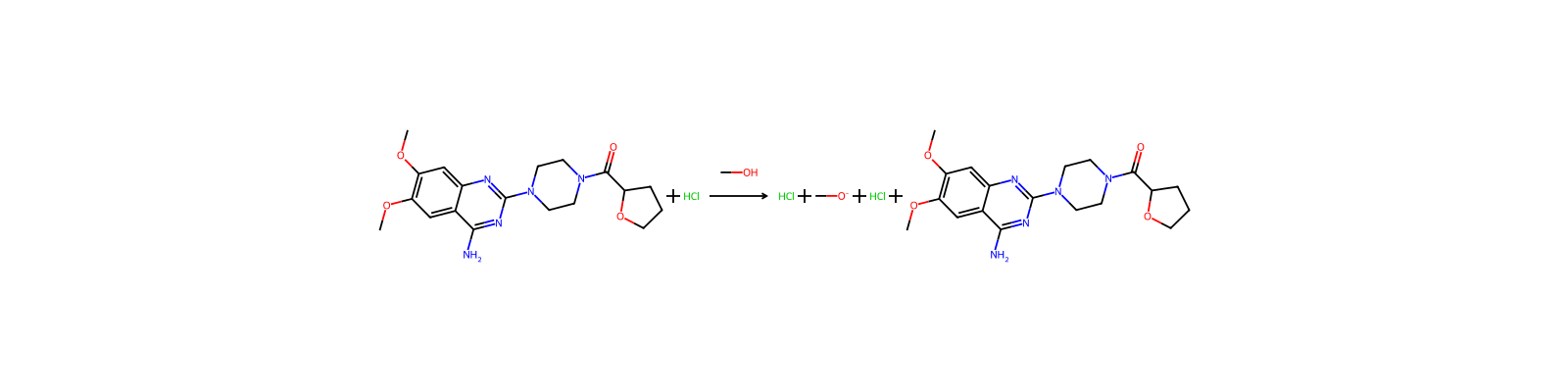
Terazosin is a member of furans, a member of piperazines, a member of quinazolines and a primary amino compound. It has a role as an antineoplastic agent, an antihypertensive agent and an alpha-adrenergic antagonist.
Namen und Bezeichner
- Bevorzugter Name
- Terazosin
- IUPAC
- [4-(4-amino-6,7-dimethoxyquinazolin-2-yl)piperazin-1-yl]-(oxolan-2-yl)methanone
- Englischer Name
- Terazosin
- Summenformel
- C19H25N5O4
- Molmasse
- 387.43
Namen und Synonyme
terazosin63590-64-7TerazosineFosfomicTerazosinaBlavinFlumarcTerazosinumTerazosabbHytrinexVicard1-(4-Amino-6,7-dimethoxy-2-quinazolinyl)-4-((tetrahydro-2-furanyl)carbonyl)piperazine
Weitere Namen anzeigen
TERAZOSIN HCLUrodieHYTRINerazosinarbonyl)-CID 663211Vasomet:VicardHytrin:Hytrinex
8L5014XET7CHEBI:9445DTXSID3023639Piperazine, 1-(4-amino-6,7-dimethoxy-2-quinazolinyl)-4-((tetrahydro-2-furanyl)carbonyl)-6,7-dimethoxy-2-(4-((oxolan-2-yl)carbonyl)piperazin-1-yl)quinazolin-4-amine6,7-dimethoxy-2-(4-(oxolane-2-carbonyl)piperazin-1-yl)-3,4-dihydroquinazolin-4-imine6,7-dimethoxy-2-[4-(oxolane-2-carbonyl)piperazin-1-yl]-3,4-dihydroquinazolin-4-imine6,7-dimethoxy-2-{4-[(oxolan-2-yl)carbonyl]piperazin-1-yl}quinazolin-4-amine
Datenbank-Bezeichner
- CAS
63590-64-7- PubChem CID
- 5401
- DTXSID
DTXSID3023639
Eigenschaften
Berechnete StruktureigenschaftenWird ergänzt
- XLogP
- 1,4
- Polarare Oberfläche (TPSA)
- 103 Ų
- H-Brücken-Donoren
- 1
- H-Brücken-Akzeptoren
- 8
- Frei drehbare Bindungen
- 4
- Schwere Atome
- 28
- Formalladung
- 0
- Komplexität
- 544
Experimentelle und physikochemische Eigenschaften
Drugs
Pharmaceuticals
Pharmaceuticals -> Antihypertensives
LogP
1
1.14
Solubility1.50e+00 g/L
Human Drugs
Breast Feeding; Lactation; Milk, Human; Adrenergic alpha-Antagonists; Antihypertensive Agents
Pharmaceuticals
Melting Point
271-274
273 °C
Physical DescriptionSolid
Collision Cross Section194.24 Ų [M+H]+ [CCS Type: TW; Method: calibrated with polyalanine and drug standards]
Physikochemische Eigenschaften
- Schmelzpunkt
- 281 · 281-283°C
Sicherheit und Regulatorisches
Sicherheitsangaben dienen nur zur Orientierung und ersetzen weder das Sicherheitsdatenblatt (SDB) des Lieferanten noch geltende Vorschriften oder eine fachliche Bewertung.
GHS-Klassifizierung
GHS Classification
This chemical does not meet GHS hazard criteria for 2.3% (1 of 44) of reports.
Warning
H302 (97.7%): Harmful if swallowed [Warning Acute toxicity, oral]
P264, P270, P301+P317, P330, and P501 (click each P-code to see the statement)
Aggregated GHS information provided per 44 reports by companies from 3 notifications to the ECHA C&L Inventory.
Gefahrenhinweise
Regulatory InformationREACH registered substance: 6,7-dimethoxy-2-[4-(oxolane-2-carbonyl)piperazin-1-yl]quinazolin-4-amine (EC: 613-265-8)
Hazard Classes and CategoriesAcute Tox. 4 (97.7%)
Toxikologische Informationen
Treatment
Should overdosage of Terazosin lead to hypotension, support of the cardiovascular system is of first importance. Restoration of blood pressure and normalization of heart rate may be accomplished by keeping the patient in the supine position. If this measure is inadequate, shock should first be treated with volume expanders. If necessary, vasopressors should then be used and renal function should be monitored and supported as needed. Laboratory data indicate that Terazosin is highly protein bound; therefore, dialysis may not be of benefit. (L1712)
Health EffectsHypotension, palpitations, postural hypotension, syncope, peripheral edema, weight gain, dyspnea, nasal congestion/rhinitis, impotence.
Hepatotoxicity
Terazosin has been associated with a low rate of serum aminotransferase elevations that in controlled trials was no higher than with placebo therapy. These elevations were transient and did not require dose modification. Instances of serum enzyme elevations, but no instances of clinically apparent acute liver injury with jaundice due to terazosin, have been published. Furthermore, product labels do not include discussion of hepatic toxicity. Cholestatic hepatitis and jaundice have been reported with other alpha-adrenergic blockers. Thus, acute symptomatic liver injury due to terazosin must be exceedingly rare if it occurs at all.
Chemie und Industrie
Pharmakologische Informationen
ATC Code
G04CA03
G - Genito urinary system and sex hormones
Protein Binding90-94%.
PharmacodynamicsTerazosin is a quinazoline derivative alpha-1-selective adrenergic blocker.
Mechanism of Action
Terazosin is selective for alpha-1-adrenoceptors but not their individual subtypes. Inhibition of these alpha-1-adrenoceptors results in relaxation of smooth muscle in blood vessels and the prostate, lowering blood pressure and improving urinary flow. Smooth muscle cells accounts for roughly 40% of the volume of the prostate and so their relaxation reduces pressure on the urethra. It has also been shown that catecholamines induce factors responsible for mitogenesis and alpha-1-adrenergic receptor blockers inhibit this effect. A final long term mechanism of terazosin and other alpha-1-adrenergic receptor blockers is the induction of apoptosis of prostate cells. Treatment with terazosin enhances the expression of transforming growth factor beta-1 (TGF-beta1), which upregulates p27kip1, and the caspase cascade.
Biological Half-LifeTerazosin has a mean half life 12 hours though this can be as high as 14 hours in patients over 70 years and as low as 11.4 hours in patients 20 to 39 years old.
Metabolism/Metabolites
The majority of terazosin is hepatically metabolized. The metabolites recovered include 6-O-demethyl terazosin, 7-O-methyl terazosin, a piperozine derivative, and a diamine derivative.
Hepatic. One of the four metabolites identified (piperazine derivative of terazosin) has antihypertensive activity. Route of Elimination: Approximately 10% of an orally administered dose is excreted as parent drug in the urine and approximately 20% is excreted in the feces. Half Life: 12 hours
FDA Pharmacological Classification
8L5014XET7
TERAZOSIN
Mechanisms of Action [MoA] - Adrenergic alpha-Antagonists
Zugehörige Reaktionen
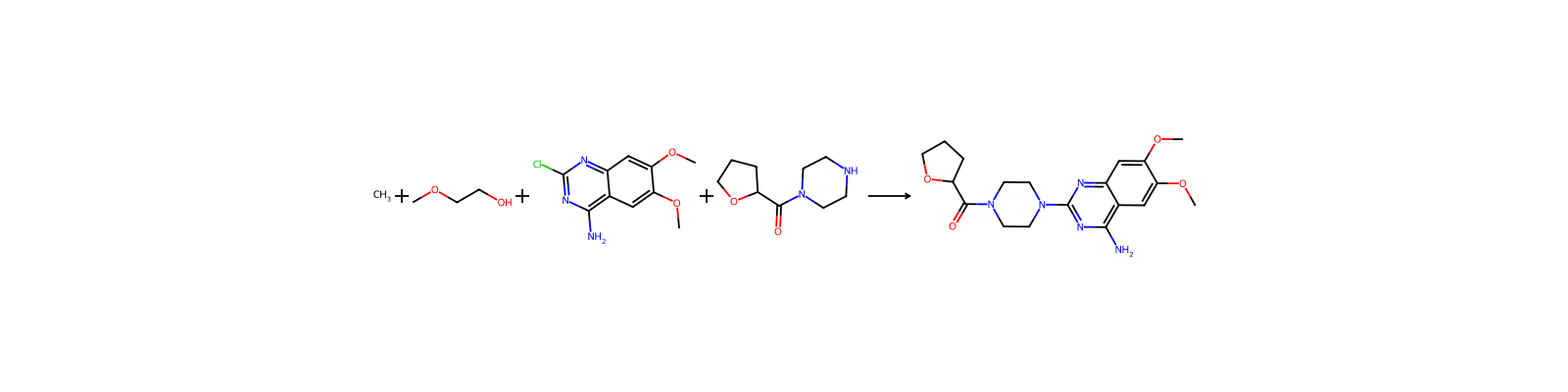
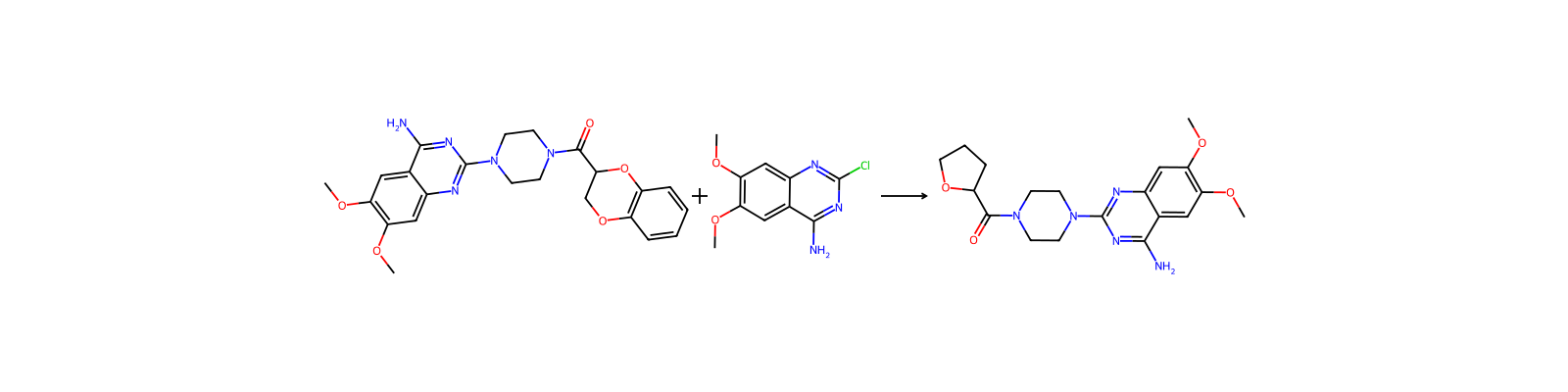
24




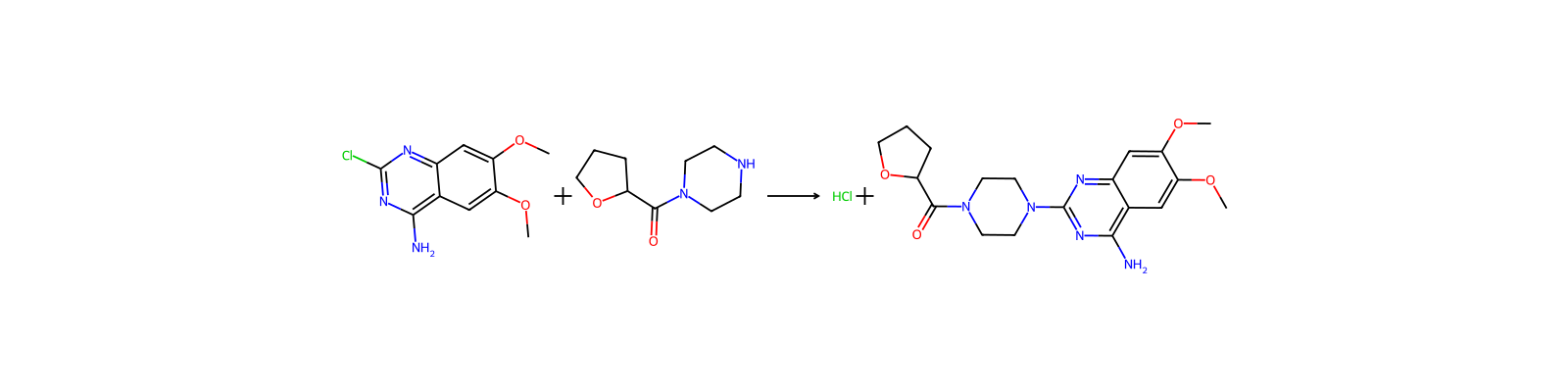
Notizen zur Verbindung
Wird geladen…