
1,1-Dibromo-3,3,3-trifluoroacetone

Grundinformationen
- CAS
431-67-4- Standard-SMILES
O=C(C(Br)Br)C(F)(F)F- InChIKey
HEPPAPZASXFWTB-UHFFFAOYSA-N- Summenformel
- C3HBr2F3O
- Durchschnittliche Molmasse
- 269,84 g/mol
- Monoisotopische Masse
- 267,83462
Namen und Bezeichner
- Bevorzugter Name
- 1,1-Dibromo-3,3,3-trifluoroacetone
- IUPAC
- 3,3-dibromo-1,1,1-trifluoropropan-2-one
- Englischer Name
- 1,1-Dibromo-3,3,3-trifluoroacetone
- Summenformel
- C3HBr2F3O
- Molmasse
- 269.84
Namen und Synonyme
1,1-Dibromo-3,3,3-trifluoroacetone431-67-4DTXSID003386581,1-Dibromo-3,3,3-tetrafluoromethyl-2-propanoneRefChem:71014DTXCID90289741638-897-1HEPPAPZASXFWTB-UHFFFAOYSA-N3,3-dibromo-1,1,1-trifluoropropan-2-one3,3-Dibromo-1,1,1-trifluoroacetoneMFCD00041362C3HBr2F3O
Weitere Namen anzeigen
Dibromotrifluoroacetone1,1-Dibromo-3,3,3-trifL1,1-Dibromo-3,3,3-trifluoroacetone97%3,3-Dibromo-1,1,1-trifluoroacetone 97%1,1-Dibromo-3,3,3-trifluoroacetone 97%1,1-Dibromo-3,3,3-trifluoropropan-2-one
3,3-Dibromo-1,1,1-trifluoro-2-propanone3,3-dibromo-1,1,1-trifluoro-propan-2-one2-Propanone, 3,3-dibromo-1,1,1-trifluoro-dibromotrifluoroaceton1,1,1-trifluoro-3,3-dibromoacetone3,3-dibromotrifluoroacetoneSCHEMBL216366l,l-dibromo-3,3,3-trifluoroacetone
Datenbank-Bezeichner
- CAS
431-67-4- PubChem CID
- 550523
- DTXSID
DTXSID00338658- EC Number
- 638-897-1
- Nikkaji
- J488.368C
Eigenschaften
Berechnete Struktureigenschaften
- XLogP
- 2,7
- Polarare Oberfläche (TPSA)
- 17,1 Ų
- H-Brücken-Donoren
- 0
- H-Brücken-Akzeptoren
- 4
- Frei drehbare Bindungen
- 1
- Schwere Atome
- 9
- Formalladung
- 0
- Komplexität
- 119
Physikochemische Eigenschaften
- Siedepunkt
- 111 °C · 111 °C
- Dichte
- 1.98 · 1.98
- Brechungsindex
- 1.4305 · 1.4305
- Flammpunkt
- 111 · 111-113°C
- storage temp.
- 2 · Inert atmosphere,2-8°C
- Löslichkeit
- Chloroform
- Aggregatzustand
- Light-Orange Liquid
- Farbe
- Colorless to Red to Green
- Wasserlöslichkeit
- Soluble in Chloroform. Not miscible or difficult to mix in water.
- BRN
- 636645 · 636645
- InChI
- InChI=1S/C3HBr2F3O/c4-2(5)1(9)3(6,7)8/h2H
- InChIKey
- HEPPAPZASXFWTB-UHFFFAOYSA-N
- SMILES
- C(F)(F)(F)C(=O)C(Br)Br
- CAS Datenbank
- 431 · 431-67-4(CAS DataBase Reference)
Sicherheit und Regulatorisches
GHS-Klassifizierung
GHS Classification
Danger
H290 (18.2%): May be corrosive to metals [Warning Corrosive to Metals];H302 (18.2%): Harmful if swallowed [Warning Acute toxicity, oral];H312 (18.2%): Harmful in contact with skin [Warning Acute toxicity, dermal];H314 (100%): Causes severe skin burns and eye damage [Danger Skin corrosion/irritation];H318 (18.2%): Causes serious eye damage [Danger Serious eye damage/eye irritation];H332 (18.2%): Harmful if inhaled [Warning Acute toxicity, inhalation]
P234, P260, P261, P264, P264+P265, P270, P271, P280, P301+P317, P301+P330+P331, P302+P352, P302+P361+P354, P304+P340, P305+P354+P338, P316, P317, P321, P330, P362+P364, P363, P390, P405, P406, and P501 (click each P-code to see the statement)
Aggregated GHS information provided per 11 reports by companies from 5 notifications to the ECHA C&L Inventory. Each notification may be associated with multiple companies.;Information may vary between notifications depending on impurities, additives, and other factors. The percentage value in parenthesis indicates the notified classification ratio from companies that provide hazard codes. Only hazard codes with percentage values above 10% are shown. For more detailed information, please visit ECHA C&L website.
Gefahrenhinweise
Hazard Classes and CategoriesMet. Corr. 1 (18.2%);Acute Tox. 4 (18.2%);Acute Tox. 4 (18.2%);Skin Corr. 1B (100%);Eye Dam. 1 (18.2%);Acute Tox. 4 (18.2%)
Sicherheitsdaten
- ridadr
- 2922
- hs_code
- 2914790090
- risk_code
- 20/21/22-34
- hazard_code
- T,Xi
- hazard_note
- Toxic
- safety_code
- 23-26-36/37/39-45
- hazard_class
- 8
- packing_group
- III
Chemie und Industrie
Anwendungen
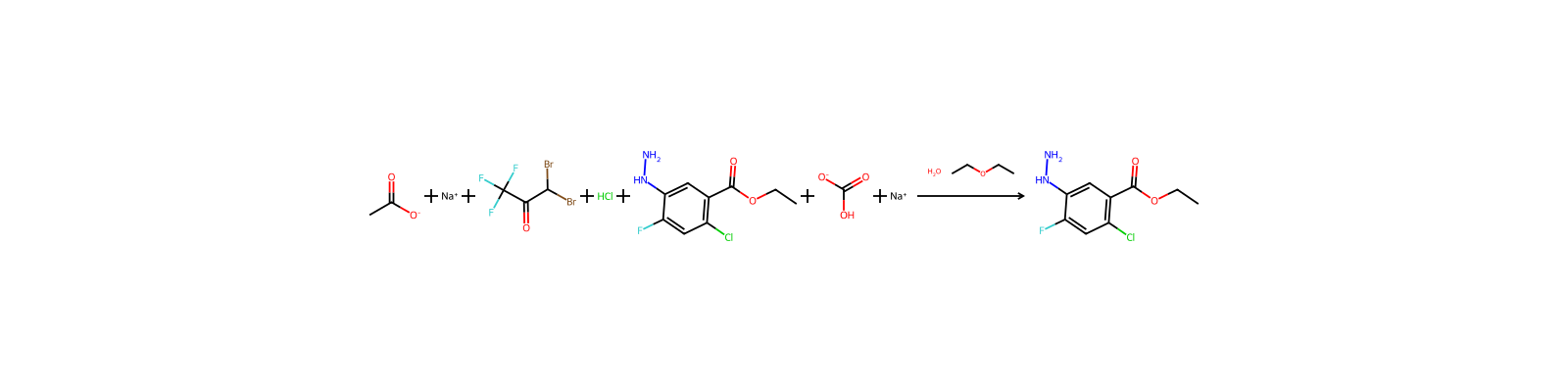
Verwenden1,1-Dibromo-3,3,3-trifluoroacetone readily forms trifluoropyruvaldehyde hydrate in the presence of aqueous NaOAc, which is a useful intermediate, e.g. in the synthesis of a fused pyrazine derivative.
Vor- und nachgelagerte Produkte
Vorgelagerte Rohstoffe
Nachgelagerte Produkte
Anbieter100 Anbieter
湖北永阔科技有限公司027-59223108 15972152991 · [email protected]
上海阿拉丁生化科技股份有限公司400-6206333 13167063860 · [email protected]
常州新氟化学有限公司13275212658 · [email protected]
武汉欣扬瑞和化学科技有限公司13720274133 · [email protected]
Dayang Chem (Hangzhou) Co.,Ltd.+86-0571-88938639 17705817739 · [email protected]
韶远科技(上海)有限公司021-50795510 4000665055 · [email protected]
科瑞迪化学400-821-5857 021-64326257 · [email protected]
Hangzhou Verychem Science And Technology Co.Ltd+86-86-57188162785 +8613606544505 · [email protected]
Syntechem Co.,Ltd[email protected]
阿法埃莎(中国)化学有限公司400-6106006 · [email protected]
安耐吉化学&3A(安徽泽升科技股份有限公司)400-0056266 · [email protected]
武汉凯威斯科技有限公司86-027-67849912 · [email protected]
Allfluoro Pharmaceutical Company Limited+86-400-0216110 +86-15958047586 · [email protected]
上海瀚鸿科技股份有限公司021-54306202 13764082696 · [email protected]
上海相辉医药科技有限公司13761987713 · [email protected]
上海景颜化工科技有限公司13817811078 · [email protected]
嘉兴市艾森化工有限公司0573-85285100 18627885956 · [email protected]
杭州安嘉睿科技有限公司571-89189769 15168342188
西氟科技有限公司0531-85906692 15588812394
上海瑞一医药科技股份有限公司021-54711706
天津希恩思生化科技有限公司400 638 7771 · [email protected]
Xiamen AmoyChem Co., Ltd+86-86-5926051114 · [email protected]
南京维奥化工有限公司Please Send Email 18652950785 · [email protected]
南京化学试剂股份有限公司025-58369808 17895012682 · [email protected]
泰州志诚化工科技有限公司0523-82837785 13914525028 · [email protected]
上海健超生物科技有限公司150-2103-5486 18017383231 · [email protected]
TCI AMERICA800-4238616 · [email protected]
TOKYO CHEMICAL INDUSTRY CO., LTD.03-36680489 · [email protected]
TCI Europe320-37350700 · [email protected]
上氟科技021-65170832 15601903708
Clearsynth Labs Limited+91-22-26355700 · [email protected]
东晟凯瑞(上海)医药科技有限公司15800326364 18051538752
上海将来实业股份有限公司400-0066400 13621662912 · [email protected]
上海毕得医药科技股份有限公司400-164-7117 18317119277 · [email protected]
成都零六生物科技有限公司400-1166-196 13458535857 · [email protected]
上海御略医药科技有限公司021-60345187 13671753212 · [email protected]
上海马氏化学科技有限公司19916721580 · [email protected]
杭州杰恒化工有限公司0571-87396432 · [email protected]
上海寰川实业有限公司021-61478794 · [email protected]
上海永叶生物科技有限公司86-021-61559134 15921386130 · [email protected]
济南朗化化工有限公司0531-85906691 18660816586 · [email protected]
上海嵩爰化工科技有限公司010-1234567 18521000990 · [email protected]
上海兴鲁化工科技有限公司02120970332 · [email protected]
凯试(上海)科技有限公司021-50135380 · [email protected]
池州凯隆进出口贸易有限公司[email protected]
AN PharmaTech Co Ltd86(21)68097365 · [email protected]
诺尔凯立科技有限公司86-(0)21-31261262 373522135 · [email protected]
九鼎化学(上海)科技有限公司4009209199 · [email protected]
厦门志信化学有限公司+86-5922680277 +86-13806087780 · [email protected]
郑州阿尔法化工有限公司0371-53765687 18937137882 · [email protected]
Zugehörige Reaktionen
74




Notizen zur Verbindung
Wird geladen…