StartseiteMCPWorkbenchSkills
StartseiteWorkbenchBenachrichtigungenMein Bereich
llms.txt · MCP-AnleitungDatenschutz · Nutzungsbedingungen · Supportv1.8.0
  1. Startseite
  2. /Verbindung

6-Aminohexanoic Acid

HCID 564
Neue NotizNeue ReaktionAnfrage stellen
Druckvorschau

Daten werden ergänzt – lade die Seite später neu, um den aktuellen Stand zu sehen

GrundinformationenÜberblickNamen und BezeichnerEigenschaftenSicherheit und RegulatorischesChemie und IndustrieZugehörige ReaktionenNotizen zur Verbindung
TeilstruktursucheÄhnliche Strukturen suchen

Grundinformationen

CAS
1319-82-0
Standard-SMILES
NCCCCCC(=O)O
InChIKey
SLXKOJJOQWFEFD-UHFFFAOYSA-N
Summenformel
C6H13NO2
Durchschnittliche Molmasse
131,17 g/mol
Monoisotopische Masse
131,09462866

Überblick

6-aminohexanoic acid is an -amino acid comprising hexanoic acid carrying an amino substituent at position C-6. Used to control postoperative bleeding, and to treat overdose effects of the thrombolytic agents streptokinase and tissue plasminogen activator. It has a role as a metabolite, an antifibrinolytic drug and a hematologic agent. It is an epsilon-amino acid and an omega-amino fatty acid. It is functionally related to a hexanoic acid. It is a conjugate acid of a 6-aminohexanoate. It is a tautomer of a 6-aminohexanoic acid zwitterion.

Namen und Bezeichner

Bevorzugter Name
6-Aminohexanoic Acid
IUPAC
6-aminohexanoic acid
Englischer Name
Aminocaproic Acid
Summenformel
C6H13NO2
Molmasse
0

Namen und Synonyme

6-aminohexanoic acid6-Aminocaproic acidaminocaproic acid60-32-2Hexanoic acid, 6-amino-AcepramineEpsicapronEpsilcapraminCapramolCaprolisinAcepraminHemopar
Weitere Namen anzeigen
Aminohexanoic acidAcido aminocaproicoAcidum aminocaproicumHexanoic acid, amino-Aminohexanoic acid USP/EP/BPAcidum aminocaproicum [inn-latin]Acido aminocaproico [inn-spanish]Acide aminocaproique [inn-french]
IpsilonRespraminAmikarEACAAminokapronAfibrinCaplaminAtsemin

Datenbank-Bezeichner

CAS
1319-82-0、60-32-2
PubChem CID
564
DTXSID
DTXSID0020070
ChEMBL
CHEMBL1046

Eigenschaften

Berechnete StruktureigenschaftenWird ergänzt

XLogP
-3
Polarare Oberfläche (TPSA)
63,3 Ų
H-Brücken-Donoren
2
H-Brücken-Akzeptoren
3
Frei drehbare Bindungen
5
Schwere Atome
9
Formalladung
0
Komplexität
83,1

Experimentelle und physikochemische Eigenschaften

Chemical ClassesNitrogen Compounds -> Amino Carboxylic Acids
DrugsPharmaceuticals -> Listed in ZINC15
LipidsFatty Acyls [FA] -> Fatty Acids and Conjugates [FA01] -> Amino fatty acids [FA0110]
LogP-2.95
OdorODORLESS, OR NEARLY SO
TasteTASTELESS
Color/Form · 2 Einträge

FINE, WHITE, CRYSTALLINE POWDER

LEAVES FROM ETHER

Solubility · 3 Einträge

1 G IN 3 ML OF WATER; SLIGHTLY SOL IN ALCOHOL; PRACTICALLY INSOL IN CHLOROFORM & ETHER

505.0 mg/mL at 25 °C

0.9 [ug/mL] (The mean of the results at pH 7.4)

Human Drugs · 2 Einträge

FDA approved drugs -> Active ingredient

FDA approved drugs -> Active ingredient

Sicherheit und Regulatorisches

Sicherheitsangaben dienen nur zur Orientierung und ersetzen weder das Sicherheitsdatenblatt (SDB) des Lieferanten noch geltende Vorschriften oder eine fachliche Bewertung.

GHS-Klassifizierung

GHS Classification · 5 Einträge

This chemical does not meet GHS hazard criteria for 78.6% (206 of 262) of all reports.

Warning

H315 (20.6%): Causes skin irritation [Warning Skin corrosion/irritation]

P261, P264, P264+P265, P271, P280, P302+P352, P304+P340, P305+P351+P338, P319, P321, P332+P317, P337+P317, P362+P364, P403+P233, P405, and P501 (click each P-code to see the statement)

Aggregated GHS information provided per 262 reports by companies from 11 notifications to the ECHA C&L Inventory. Each notification may be associated with multiple companies.

Gefahrenhinweise

Regulatory Information · 4 Einträge

Chemical: Hexanoic acid, 6-amino-

Hexanoic acid, 6-amino- is listed on the EPA's Chemical Data Reporting (CDR) system. Manufacturers and importers of Hexanoic acid, 6-amino- are required to report information about their production and use of this chemical to the EPA under the Toxic Substances Control Act (TSCA). (40 eCFR Part 711)

Status: Active Update: 24-10-2022 https://echa.europa.eu/registration-dossier/-/registered-dossier/22890

Hexanoic acid, 6-amino-: Does not have an individual approval but may be used under an appropriate group standard

Other Safety InformationIMAP assessments - Hexanoic acid, 6-amino-: Environment tier I assessment
Hazards Summary · 1 Eintrag

Possible side effects in long-term therapy greater than 2 weeks include seizures, myopathy, renal failure, and kidney failure; [HSDB] May cause irritation; Effects in high-dose animal studies include convulsions or effect on seizure threshold and changes in the renal tubules; [MSDSonline] Not teratogenic in rabbits; [REPROTOX]

Special Reports · 1 Eintrag

Chemie und Industrie

Pharmakologische Informationen

ATC CodeB - Blood and blood forming organs
Pharmacodynamics · 1 Eintrag

Aminocaproic acid works as an antifibrinolytic. It is a derivative of the amino acid lysine. The fibrinolysis-inhibitory effects of aminocaproic acid appear to be exerted principally via inhibition of plasminogen activators and to a lesser degree through antiplasmin activity. Aminocaproic acid may be a possible prophylactic for vascular disease, as it may prevent formation of lipoprotein (a), a risk factor for vascular disease.

Mechanism of Action · 3 Einträge

Aminocaproic acid binds reversibly to the kringle domain of plasminogen and blocks the binding of plasminogen to fibrin and its activation to plasmin. With NO activation of plasmin, there is a reduction in fibrinolysis. This consequently will reduce the amount of bleeding post surgery. Elevated plasma levels of lipoprotein(a) have been shown to increase the risk of vascular disease. Lipoprotein 9a)a has two components, apolipoprotein B-100, linked to apolipoprotein (a). Aminocaproic acid may change the conformation of apoliprotein (a), changing its binding properties and potentially preventing the formation of lipoprotein (a).

A COMPETITIVE INHIBITOR OF ACTIVATORS OF PROFIBRINOLYSIN &, TO LESSER EXTENT, OF FIBRINOLYSIN. AS A CONSEQUENCE, IT SUPPRESSES FORMATION OF FIBRINOLYSIN, AN ENZYME WHICH DESTROYS FIBRINOGEN, FIBRIN, & OTHER CLOTTING COMPONENTS.

MICROCALORIMETRY AND UV AND IR SPECTROSCOPY WERE USED TO STUDY THE INTERMOLECULAR INTERACTIONS OF PLASMINOGEN AND PLASMIN WITH EPSILON-AMINOCAPROIC ACID (I) TO DETERMINE THE MECHANISM OF FIBRINOLYSIS INHIBITION. AT LOW DOSES, THE INHIBITORY EFFECT WAS DUE MAINLY TO BLOCKADE OF THE STAGE OF ACTIVATION OF PLASMINOGEN, WHEREAS THE EFFECTIVENESS OF HIGH CONCENTRATIONS OF I WAS ACHIEVED ALSO BY INACTIVATION OF THE ENZYMIC ACTIVITY OF PLASMIN.

Biological Half-LifeThe terminal elimination half-life is approximately 2 hours.
Metabolism/MetabolitesSixty-five percent of the dose is recovered in the urine as unchanged drug and 11% of the dose appears as the metabolite adipic acid.

Zugehörige Reaktionen

228
Reaktionsaufzeichnung erstellen
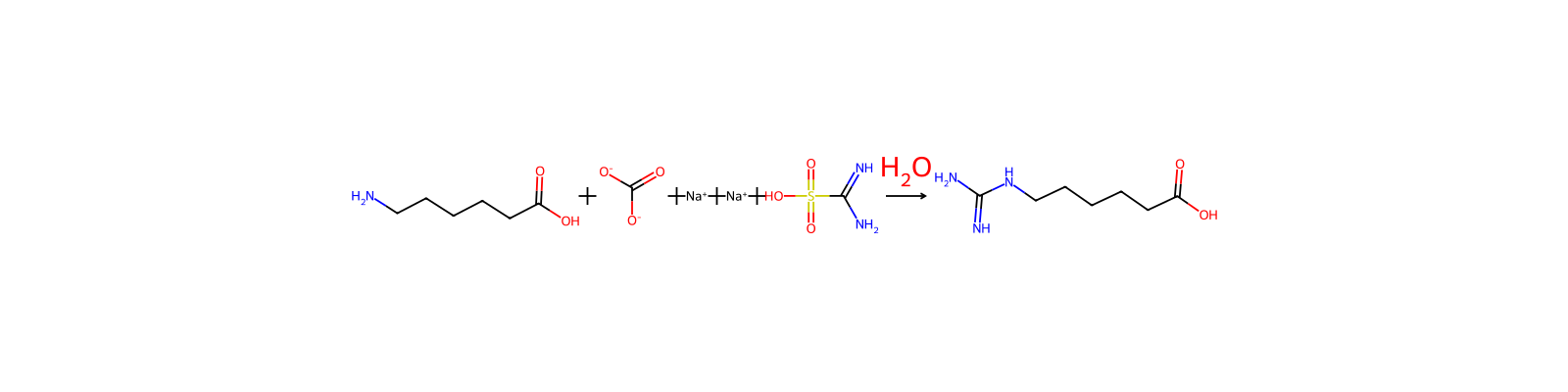
Reaktionsgleichung von HRID 7207
HRID 7207als Produktuspto-grants-2006_08
Reaktionsgleichung von HRID 11905
HRID 11905als Eduktuspto-grants-2006_08
Reaktionsgleichung von HRID 14366
HRID 14366als Eduktuspto-grants-2010_06
Reaktionsgleichung von HRID 20904
HRID 20904als Eduktuspto-grants-2010_06
Reaktionsgleichung von HRID 35797
HRID 35797als Eduktuspto-grants-1995_05
Reaktionsgleichung von HRID 60413
HRID 60413als Eduktuspto-grants-2016_09
Reaktionsgleichung von HRID 78681
HRID 78681als Produktuspto-grants-2014_09
Reaktionsgleichung von HRID 116949
HRID 116949als EduktTraining data from https://doi.org/10.1039/C8SC04228D (2/10)
Seite 1 von 29

Notizen zur Verbindung

Wird geladen…

Auf dieser SeiteGrundinformationenÜberblickNamen und BezeichnerEigenschaftenSicherheit und RegulatorischesChemie und IndustrieZugehörige ReaktionenNotizen zur Verbindung
Weitere Aktionen
Neue NotizNeue ReaktionAnfrage stellen
ChEBI
CHEBI:16586
UNII
U6F3787206
EC Number
200-469-3
Nikkaji
J1.398F
Animal Drugs
Pharmaceuticals -> Animal Drugs -> Approved in Taiwan
Melting Point · 2 Einträge

202-203 °C

205 °C

Physical Description · 3 Einträge

Wet Solid

White solid; [HSDB] White crystalline solid; [MSDSonline]

Solid

Physikochemische Eigenschaften

Schmelzpunkt
205 · 205-207 °C

REVIEW: A PROFILE OF THE PHARMACOLOGY, THERAPEUTIC INDICATIONS, THE PREPARATIONS AND STRENGTHS AVAILABLE, THE DOSAGE, CONTRAINDICATIONS, TOXICITY, INTERACTIONS, PHARMACOKINETICS AND OTHER PHYSICAL PROPERTIES OF EPSILON-AMINOCAPROIC ACID.[PROFILE ON EPSILON AMINOCAPROIC ACID; AUST J PHARM 62(JUN) 403 (1981)]

Hazard Classes and CategoriesSkin Irrit. 2 (20.6%)

Toxikologische Informationen

InteractionsPLASMINOGEN ACTIVATORS SUCH AS STREPTOKINASE & UROKINASE ARE USED TO TREAT THROMBOEMBOLIC DISORDERS. ...AMINOCAPROIC ACID COUNTERACTS THE THROMBOLYTIC EFFECT OF THESE DRUGS...
Adverse Effects · 2 Einträge

Neurotoxin - Other CNS neurotoxin

Although aminocaproic acid is generally well tolerated in patients, reported adverse effects of the drug include malaise, myalgias, renal impairment, seizures, hypotension, bradycardia, thrombosis, edemas, and injection site reactions. Less frequently, aminocaproic acid may also lead to gastrointestinal symptoms, such as nausea and diarrhea. In addition, there have been reports of nasal congestion and conjunctival suffusion with the usage of aminocaproic acid.

Toxicity Summary · 1 Eintrag

Aminocaproic acid is associated with a low acute toxicity risk. Research on teratogenic in vitro studies has revealed no fetal abnormalities when administering aminocaproic acid dosages up to 5000 mcg/kg/d. Retinal changes have been reported in dogs after receiving aminocaproic acid orally over 1 year at doses approximately 7 times higher than the maximum recommended dose for in vivo use. A significant concern regarding aminocaproic acid treatment is whether this drug can increase patients' risk of thrombosis and intravascular coagulation. Although there are isolated reports of arterial or venous thrombosis, it is noteworthy that the underlying thrombotic comorbidity is present in each reported case.

Human Toxicity Excerpts · 3 Einträge

CARDIAC & HEPATIC NECROSES WERE FOUND @ POSTMORTEM EXAMINATION IN ONE PT WHO HAD RECEIVED THERAPEUTIC DOSES OF THE DRUG.

AMINOCAPROIC ACID MAY CAUSE ITCHING, ERYTHEMA, SKIN RASH, DIURESIS, HEARTBURN, NAUSEA, & DIARRHEA. ...HAS ANTIADRENERGIC EFFECT SIMILAR TO GUANETHIDINE, SO THAT NASAL STUFFINESS, CONJUNCTIVAL SUFFUSION, & HYPOTENSION MAY OCCUR. ...MAY ENHANCE THROMBOTIC PROCESSES BY SUPPRESSION OF REACTIVE FIBRINOLYSIS...

AMICAR HAS BEEN USED IN SUBARACHNOID HEMORRHAGE TO PROMOTE CLOTTING, BUT CEREBRAL THROMBOSIS HAS BEEN REPORTED IN VARIOUS VASCULAR COMPARTMENTS FOLLOWING ITS USE. TWO PATIENTS ARE DESCRIBED WHO HAD CEREBRAL ANGIOGRAPHY AFTER AMICAR THERAPY WHICH DEMONSTRATED THROMBOSIS UNRELATED TO VASCULAR SPASM OR TO TECHNICAL COMPLICATIONS OF ANGIOGRAPHY.

Drug Induced Liver Injury · 6 Einträge

Drug Induced Liver Injury Rank (DILIrank 2.0)

Aminocaproic acid

vNo-DILI-concern

0

No match

DOI:10.1016/j.drudis.2016.02.015

Non-Human Toxicity Excerpts · 3 Einträge

/AMINOCAPROIC ACID/...IS TERATOGENIC IN ANIMALS...

SUBENDOCARDIAL HEMORRHAGES & MYOCARDIAL DEPRESSION HAVE BEEN ASSOCIATED WITH ADMIN OF AMINOCAPROIC ACID IN SEVERAL ANIMAL SPECIES. DRUG MAY TRANSIENTLY ALTER PROTEIN METABOLISM BY INHIBITING UTILIZATION OF LYSINE.

...WHEN GIVEN IV TO CATS HAS SYMPATHOMIMETIC EFFECTS, INCL DILATED PUPILS & EXOPHTHALMOS ATTRIBUTABLE PARTLY TO RELEASE OF CATECHOLAMINES. ...CHRONICALLY BY MOUTH IT OCCASIONALLY CAUSES NASAL CONGESTION & CONJUNCTIVAL HYPEREMIA.

FDA Pharmacological Classification · 6 Einträge

U6F3787206

AMINOCAPROIC ACID

Established Pharmacologic Class [EPC] - Antifibrinolytic Agent

Physiologic Effects [PE] - Decreased Fibrinolysis

Aminocaproic acid is an Antifibrinolytic Agent. The physiologic effect of aminocaproic acid is by means of Decreased Fibrinolysis.

AMINOCAPROIC ACID

MeSH Pharmacological ClassificationAgents that prevent fibrinolysis or lysis of a blood clot or thrombus. Several endogenous antiplasmins are known. The drugs are used to control massive hemorrhage and in other coagulation disorders.
Absorption, Distribution and Excretion · 5 Einträge

Absorbed rapidly following oral administration. In adults, oral absorption appears to be a zero-order process with an absorption rate of 5.2 g/hr. The mean lag time in absorption is 10 minutes. After a single oral dose of 5 g, absorption was complete (F=1).

Renal excretion is the primary route of elimination, whether aminocaproic acid is administered orally or intravenously.

23.1 ± 6.6 L

169 mL/min

AMINOCAPROIC ACID IS WELL ABSORBED ORALLY... THIS DRUG IS EXCRETED RAPIDLY IN URINE, LARGELY UNCHANGED, & PEAK PLASMA LEVELS ARE OBTAINED ABOUT 2 HR AFTER A SINGLE ORAL DOSE.

Tissue LocationsEpidermis
Cellular LocationsExtracellular
Metabolite PathwaysAminocaproic Acid Action Pathway

Verwendung und Herstellung

Uses · 4 Einträge

Used as a captive chemical intermediate in the production of nylon 6; [HSDB] Used as a hemostatic; [Merck Index] An inhibitor of fibrinolysis and sold as Amicar; [REPROTOX]

ANTIDOTE FOR OVERDOSAGE IN FIBRINOLYTIC THERAPY; CAPTIVE CHEM INT IN PRODUCTION OF NYLON 6

MEDICATION

MEDICATION (VET):

U.S. Exports · 2 Einträge

(1972) No Data

(1975) No Data

U.S. Imports · 2 Einträge

(1975) 3.8X10+6 GRAMS (PRINCPL CUSTMS DISTS)

(1976) 5.50X10+6 GRAMS (PRINCPL CUSTMS DISTS)

U.S. Production · 3 Einträge

2023: 50,000 - <250,000 lb

(1974) GREATER THAN 4.54X10+5 GRAMS

(1975) No Data

Consumption PatternsEXCLUDING CAPTIVE USE IN NYLON 6 PRODUCTION FROM CAPROLACTAM, PROBABLY 100% IS USED AS A FIBRINOLYTIC INHIBITOR (1976)
Industry UsesOther
Methods of Manufacturing · 2 Einträge

HEATING OF AN AQUEOUS SOLUTION OF CAPROLACTAM WITH CALCIUM HYDROXIDE TO GIVE CALCIUM AMINOCAPROATE, FOLLOWED BY REACTION WITH SULFURIC ACID

...FROM EPSILON-BENZOYLAMINOCAPRONITRILE: RUZICKA, HUGOSON, HELV CHIM ACTA 4, 472 (1921); FROM EPSILON CAPROLACTAM...SULZBACHER, MFR CHEMIST 33, 463 (1963); FROM 1-HYDROXYCYCLOHEXYLHYDROPEROXIDE: MINISCI, PORTOLANI; GAZZ CHIM ITAL 89, 1941 (1959).

Formulations/Preparations...AVAILABLE AS INJECTION (250 MG/ML), SYRUP (250 MG/ML) & TABLETS (500 MG).
Use ClassificationPharmaceuticals -> Animal Drugs -> Approved in Taiwan
General Manufacturing Information · 2 Einträge

All Other Basic Organic Chemical Manufacturing

Hexanoic acid, 6-amino-: ACTIVE