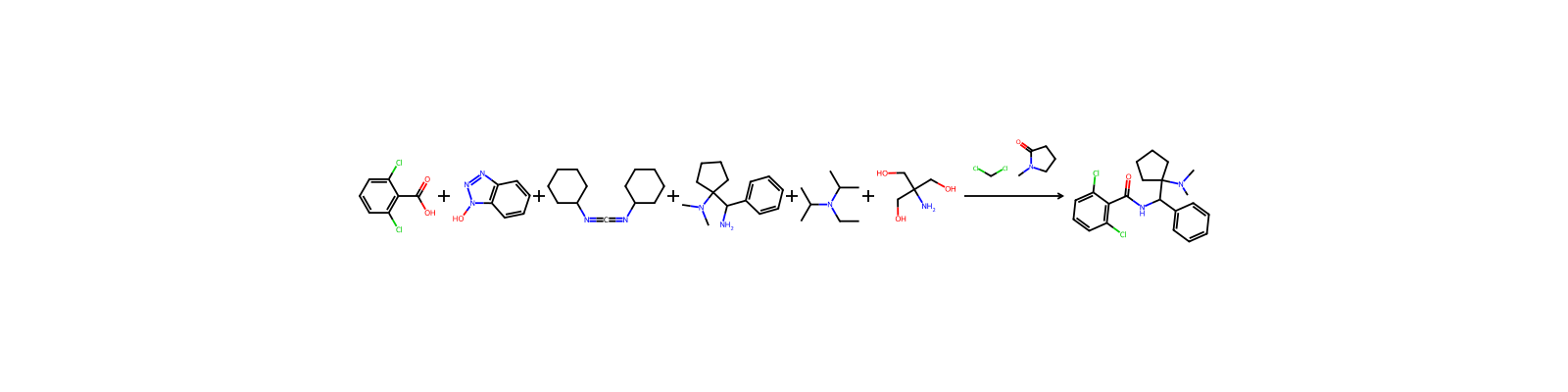
2,6-Dichlorbenzoesure
2,6-Dichlorobenzoic acid
Daten werden ergänzt – lade die Seite später neu, um den aktuellen Stand zu sehen

Grundinformationen
- CAS
50-30-6- Standard-SMILES
O=C(O)c1c(Cl)cccc1Cl- InChIKey
MRUDNSFOFOQZDA-UHFFFAOYSA-N- Summenformel
- C7H4Cl2O2
- Durchschnittliche Molmasse
- 191,01 g/mol
- Monoisotopische Masse
- 189,9588348
Überblick
2,6-dichlorobenzoic acid appears as needles (from ethanol) or white solid. (NTP, 1992)
Namen und Bezeichner
- Bevorzugter Name
- 2,6-Dichlorobenzoic acid
- IUPAC
- 2,6-dichlorobenzoic acid
- Lokaler Name
- 2,6-Dichlorbenzoesure
- Englischer Name
- 2,6-Dichlorobenzoic acid
- Summenformel
- C7H4Cl2O2
- Molmasse
- 191.01
Namen und Synonyme
2,6-DICHLOROBENZOIC ACIDBenzoic acid, 2,6-dichloro-EINECS 200-025-9DTXSID0024979NSC 76599UNII-634RI764QTBRN 0973858CCRIS 8610AI3-33337634RI764QTNSC-76599DTXCID904979
Weitere Namen anzeigen
2,6-Dichlorobe2,6-dichlorobenzoicRARECHEM AL BO 0023TIMTEC-BB SBB0076942,6-dichlorobenzoate2,6-Dichlorbenzoesure
CHEBI:486234-09-00-01005 (Beilstein Handbook Reference)RefChem:83182BENZOIC ACID,2,6-DICHLORO MFC7 H4 O2 CL2200-025-9InChI=1/C7H4Cl2O2/c8-4-2-1-3-5(9)6(4)7(10)11/h1-3H,(H,10,11MRUDNSFOFOQZDA-UHFFFAOYSA-N50-30-6
Datenbank-Bezeichner
- CAS
50-30-6- PubChem CID
- 5758
- DTXSID
DTXSID0024979- ChEMBL
CHEMBL114828- ChEBI
CHEBI:48623- UNII
- 634RI764QT
- EC Number
Eigenschaften
Berechnete StruktureigenschaftenWird ergänzt
- XLogP
- 2,2
- Polarare Oberfläche (TPSA)
- 37,3 Ų
- H-Brücken-Donoren
- 1
- H-Brücken-Akzeptoren
- 2
- Frei drehbare Bindungen
- 1
- Schwere Atome
- 11
- Formalladung
- 0
- Komplexität
- 151
Experimentelle und physikochemische Eigenschaften
SpringerMaterials PropertiesNuclear quadrupole resonance spectroscopy
LogP2.23
Solubility1 to 10 mg/mL at 66 °F (NTP, 1992)
Boiling PointSublimes (NTP, 1992)
Melting Point291 °F (NTP, 1992)
Physical Description2,6-dichlorobenzoic acid appears as needles (from ethanol) or white solid. (NTP, 1992)
Physikochemische Eigenschaften
- Schmelzpunkt
- 139 · 139-142 °C (lit.)
- Siedepunkt
- 273.68 °C · 273.68°C (rough estimate)
- Dichte
- 1.441 · 1.4410 (rough estimate)
- Brechungsindex
- 1.459 · 1.4590 (estimate)
- storage temp.
- Sealed in dry,Room Temperature
Sicherheit und Regulatorisches
Sicherheitsangaben dienen nur zur Orientierung und ersetzen weder das Sicherheitsdatenblatt (SDB) des Lieferanten noch geltende Vorschriften oder eine fachliche Bewertung.
GHS-Klassifizierung
GHS Classification
Warning
H315 (98.1%): Causes skin irritation [Warning Skin corrosion/irritation]
P261, P264, P264+P265, P271, P280, P302+P352, P304+P340, P305+P351+P338, P319, P321, P332+P317, P337+P317, P362+P364, P403+P233, P405, and P501 (click each P-code to see the statement)
Aggregated GHS information provided per 53 reports by companies from 11 notifications to the ECHA C&L Inventory. Each notification may be associated with multiple companies.
Gefahrenhinweise
Regulatory Information
Chemical: Benzoic acid, 2,6-dichloro-
PMN - indicates a commenced PMN (Pre-Manufacture Notices) substance.
2,6-Dichlorobenzoic acid: Does not have an individual approval but may be used under an appropriate group standard
Fire HazardsFlash point data for this chemical are not available; however, it is probably combustible. (NTP, 1992)
Health HazardsSYMPTOMS: Symptoms of exposure to this compound may include irritation.
Reactive GroupAcids, Carboxylic
Reactivity Profile
2,6-DICHLOROBENZOIC ACID is a halogenated carboxylic acid. Carboxylic acids donate hydrogen ions if a base is present to accept them. They react in this way with all bases, both organic (for example, the amines) and inorganic. Their reactions with bases, called "neutralizations", are accompanied by the evolution of substantial amounts of heat. Neutralization between an acid and a base produces water plus a salt. Carboxylic acids with six or fewer carbon atoms are freely or moderately soluble in water; those with more than six carbons are slightly soluble in water. Soluble carboxylic acid dissociate to an extent in water to yield hydrogen ions. The pH of solutions of carboxylic acids is therefore less than 7.0. Many insoluble carboxylic acids react rapidly with aqueous solutions containing a chemical base and dissolve as the neutralization generates a soluble salt. Carboxylic acids in aqueous solution and liquid or molten carboxylic acids can react with active metals to form gaseous hydrogen and a metal salt. Such reactions occur in principle for solid carboxylic acids as well, but are slow if the solid acid remains dry. Even "insoluble" carboxylic acids may absorb enough water from the air and dissolve sufficiently in it to corrode or dissolve iron, steel, and aluminum parts and containers. Carboxylic acids, like other acids, react with cyanide salts to generate gaseous hydrogen cyanide. The reaction is slower for dry, solid carboxylic acids. Insoluble carboxylic acids react with solutions of cyanides to cause the release of gaseous hydrogen cyanide. Flammable and/or toxic gases and heat are generated by the reaction of carboxylic acids with diazo compounds, dithiocarbamates, isocyanates, mercaptans, nitrides, and sulfides. Carboxylic acids, especially in aqueous solution, also react with sulfites, nitrites, thiosulfates (to give H2S and SO3), dithionites (SO2), to generate flammable and/or toxic gases and heat. Their reaction with carbonates and bicarbonates generates a harmless gas (carbon dioxide) but still heat. Like other organic compounds, carboxylic acids can be oxidized by strong oxidizing agents and reduced by strong reducing agents. These reactions generate heat. A wide variety of products is possible. Like other acids, carboxylic acids may initiate polymerization reactions; like other acids, they often catalyze (increase the rate of) chemical reactions.
Chemie und Industrie
Verwendung und Herstellung
Use ClassificationMETABOLITES
General Manufacturing InformationBenzoic acid, 2,6-dichloro-: ACTIVE
Anwendungen
Verwenden2,6-Dichlorobenzoic Acid is an di-halogenated benzoic acid derivative and is used in the synthesis of Lux-S enzyme inhibitor.
Darstellung
synthetische2,6-Dichlorobenzoic Acid can be prepared through several synthetic routes. One common method is the chlorination of benzoic acid in the presence of a catalyst such as phosphorus pentachloride or thionyl chloride. The reaction takes place under reflux in anhydrous conditions, resulting in the substitution of two chlorine atoms at positions 2 and 6 of the benzene ring. The resulting product is then isolated and purified through recrystallization from a suitable solvent. Another method involves the chlorination of the methyl ester of 2,6-dichlorobenzoic acid, followed by hydrolysis to yield the desired compound. Alternatively, it can also be synthesized through the oxidation of 2,6-dichlorotoluene using potassium permanganate or other oxidizing agents.
Vor- und nachgelagerte Produkte
Vorgelagerte Rohstoffe
Nachgelagerte Produkte
Zugehörige Reaktionen
82


Notizen zur Verbindung
Wird geladen…