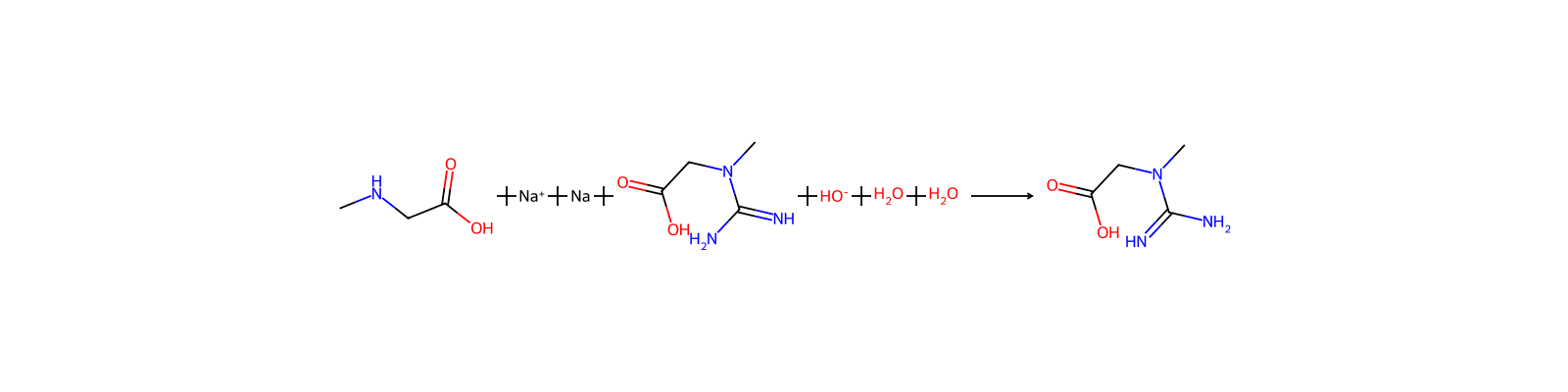
N-Amidinosarkosin
Creatine
Daten werden ergänzt – lade die Seite später neu, um den aktuellen Stand zu sehen

Grundinformationen
- CAS
57-00-1- Standard-SMILES
CN(CC(=O)O)C(=N)N- InChIKey
CVSVTCORWBXHQV-UHFFFAOYSA-N- Summenformel
- C4H9N3O2
- Durchschnittliche Molmasse
- 131,13 g/mol
- Monoisotopische Masse
- 131,06947654
Überblick
Creatine is a glycine derivative having methyl and amidino groups attached to the nitrogen. It has a role as a geroprotector, a nutraceutical, a neuroprotective agent, a mouse metabolite and a human metabolite. It is a glycine derivative and a member of guanidines. It is a conjugate acid of a creatinate. It is a tautomer of a creatine zwitterion.
Namen und Bezeichner
- Bevorzugter Name
- Creatine
- IUPAC
- 2-[carbamimidoyl(methyl)amino]acetic acid
- Lokaler Name
- N-Amidinosarkosin
- Englischer Name
- Creatine
- Summenformel
- C4H9N3O2
- Molmasse
- 131.13
Namen und Synonyme
creatine57-00-1CreatinN-amidinosarcosineKreatinKrebiozonmethylglycocyamineN-methyl-N-guanylglycineGlycine, N-(aminoiminomethyl)-N-methyl-Pyrolysate(alpha-Methylguanido)acetic acidN-carbamimidoyl-N-methylglycine
Weitere Namen anzeigen
N-GUANYL-N-METHYLGLYCINEMONOHYDRATE CREATINEN-Methyl-N-amidinoglycinecretineCreatine HMBCreatineAnhydrousNutrition Creatinecreatine zwitterion
Cosmocair C 100KreatinumNeotine2-(1-methylcarbamimidamido)acetic acidN-(aminoiminomethyl)-N-methylglycinealpha-Methylguanidino acetic acid2-[carbamimidoyl(methyl)amino]acetic acidNSC-8752
Datenbank-Bezeichner
- CAS
57-00-1、6020-87-7- PubChem CID
- 586
- DTXSID
DTXSID1040451- ChEMBL
CHEMBL283800- ChEBI
CHEBI:16919- UNII
- MU72812GK0
- EC Number
- 200-306-6
- Nikkaji
- J9.321A
Eigenschaften
Berechnete StruktureigenschaftenWird ergänzt
- XLogP
- -1,2
- Polarare Oberfläche (TPSA)
- 90,4 Ų
- H-Brücken-Donoren
- 3
- H-Brücken-Akzeptoren
- 3
- Frei drehbare Bindungen
- 3
- Schwere Atome
- 9
- Formalladung
- 0
- Komplexität
- 134
Experimentelle und physikochemische Eigenschaften
Chemical ClassesBiological Agents -> Amino Acids and Derivatives
DrugsPharmaceuticals -> Listed in ZINC15
pHNeutral reaction to litmus
Density1.33 at 25 °C
Solubility
Slightly soluble in water, insoluble in ether
Slightly soluble in ether and ethanol
In water, 1.33X10+4 mg/L at 18 °C
13.3 mg/mL at 18 °C
Dietary IngredientsCreatine
Human DrugsBreast Feeding; Lactation; Milk, Human; Amino Acids; Complementary Therapies
Melting Point
Decomposes at 303 °C
303 °C
Vapor Pressure0.00079 [mmHg]
Physical Description
Solid; [Merck Index] White powder; [Alfa Aesar MSDS]
Solid
Dissociation Constants
pKa1 = 3.8 (carboxylic acid); pKa2 = 12.7 (amine)
pKb = 11.02 at 20 °C
Collision Cross Section
126.0 Ų [M+H]+ [CCS Type: DT; Buffer gas: N2; Ionization: ESI+; Dataset: TOXCAST; Source Identifier: DTXSID1040451]
126 Ų [M+H]+ [CCS Type: DT; Method: single field calibrated with ESI Low Concentration Tuning Mix (Agilent)]
125.9 Ų [M+H]+ [CCS Type: DT; Method: single field calibrated with Agilent tune mix (Agilent)]
126 Ų [M+H]+
Physikochemische Eigenschaften
- Schmelzpunkt
- 295 °C · ~295 °C (dec.)
- Siedepunkt
- 242.43 °C · 242.43°C (rough estimate)
- Dichte
- 1 · 1,33 g/cm3
- Brechungsindex
- 1.57 · 1.5700 (estimate)
- storage temp.
- Keep in dark place,Inert atmosphere,Room temperature
- Löslichkeit
- Water (Slightly, Heated)
- Aggregatzustand
- Solid
- pka
- 2.63 · 2.63(at 25℃)
- Farbe
- White to Off-White
- Wasserlöslichkeit
- Soluble in water.
- Merck
- 14 · 14,2568
- BRN
- 907175 · 907175
- Major Application
- food and beveragespersonal carepharmaceutical
- Kosmetik-Inhaltsstoffe Funktionen
- SKIN CONDITIONING
- InChI
- 1S/C4H9N3O2/c1-7(4(5)6)2-3(8)9/h2H2,1H3,(H3,5,6)(H,8,9)
- InChIKey
- CVSVTCORWBXHQV-UHFFFAOYSA-N
- SMILES
- CN(CC(O)=O)C(N)=N
- LogP
- -1.258 · -1.258 (est)
- CAS Datenbank
- 57 · 57-00-1(CAS DataBase Reference)
- NIST chemische Informationen
- Glycine, N-(aminoiminomethyl)-N-methyl-(57-00-1)
- EPA chemische Informationen
- Glycine, N-(aminoiminomethyl)-N-methyl- (57-00-1)
- CAS Number Unlabeled
- 57 · 57-00-1
Sicherheit und Regulatorisches
Sicherheitsangaben dienen nur zur Orientierung und ersetzen weder das Sicherheitsdatenblatt (SDB) des Lieferanten noch geltende Vorschriften oder eine fachliche Bewertung.
GHS-Klassifizierung
GHS Classification
This chemical does not meet GHS hazard criteria for 72.3% (149 of 206) of all reports.
Warning
H315 (27.7%): Causes skin irritation [Warning Skin corrosion/irritation]
P261, P264, P264+P265, P271, P280, P302+P352, P304+P340, P305+P351+P338, P319, P321, P332+P317, P337+P317, P362+P364, P403+P233, P405, and P501 (click each P-code to see the statement)
Aggregated GHS information provided per 206 reports by companies from 13 notifications to the ECHA C&L Inventory. Each notification may be associated with multiple companies.
Gefahrenhinweise
Regulatory Information
Chemical: Glycine, N-(aminoiminomethyl)-N-methyl-
REACH registered substance: N-amidinosarcosine (EC: 200-306-6)
Glycine, N-(aminoiminomethyl)-N-methyl-: Does not have an individual approval but may be used under an appropriate group standard
Creatine: Does not have an individual approval but may be used under an appropriate group standard
Other Safety InformationEvaluation - Chemicals that are unlikely to require further regulation to manage risks to environment
Hazards SummaryA skin and strong eye irritant; [Alfa Aesar MSDS]
Hazard Classes and CategoriesSkin Irrit. 2 (27.7%)
Sicherheit und Schutzausrüstung
Disposal Methods
SRP: The most favorable course of action is to use an alternative chemical product with less inherent propensity for occupational exposure or environmental contamination. Recycle any unused portion of the material for its approved use or return it to the manufacturer or supplier. Ultimate disposal of the chemical must consider: the material's impact on air quality; potential migration in soil or water; effects on animal, aquatic, and plant life; and conformance with environmental and public health regulations.
Toxikologische Informationen
Body Burden
The mean creatine level in the urine of 50 patients with muscular dystrophy was 3.56 mmol/L which is much higher than that of the controls 0.24 mmol/L(1). The mean level of creatine in the blood of patients with uremia was 0.1 mmol/L which is over twice that of the controls blood level of 0.04 mmol/L(1).
Environmental Fate
TERRESTRIAL FATE: Based on a classification scheme(1), an estimated Koc value of 24(SRC), determined from a water solubility of 1.33X10+4 mg/L(2) and a regression-derived equation(3), indicates that creatine is expected to have very high mobility in soil(SRC). The pKa values for the amino and carboxylic acid moieties of creatine are estimated to be 12.7 and 3.8(4), respectively, indicating that this compound will primarily exist as a zwitter ion and zwitter ions do not volatilize from moist soil surfaces. Creatine is not expected to volatilize from dry soil surfaces(SRC) based upon an estimated vapor pressure of 7.9X10⁻⁴ mm Hg(SRC), determined from a fragment constant method(5). Creatine has been reported to be degraded by activated sludge(6).
AQUATIC FATE: Based on a classification scheme(1), an estimated Koc value of 24(SRC), determined from a water solubility of 1.33X10+4 mg/L(2) and a regression-derived equation(3), indicates that creatine is not expected to adsorb to suspended solids and sediment(SRC). The pKa values for the amino and carboxylic acid moieties of creatine are estimated to be 12.7 and 3.8, respectively(4), indicating that this compound will primarily exist as a zwitter ion and zwitter ions do not volatilize from water surfaces. According to a classification scheme(5), an estimated BCF of 3(SRC), determined from its water solubility(2) and a regression-derived equation(3), suggests the potential for bioconcentration in aquatic organisms is low(SRC). Creatine has been shown to be degraded by activated sludge(7).
ATMOSPHERIC FATE: According to a model of gas/particle partitioning of semivolatile organic compounds in the atmosphere(1), creatine, which has an estimated vapor pressure of 7.9X10⁻⁴ mm Hg at 25 °C(SRC), determined from a fragment constant method(2), will exist solely in the vapor phase in the atmosphere. Vapor-phase creatine is degraded in the atmosphere by reaction with photochemically-produced hydroxyl radicals(SRC); the half-life for this reaction in air is estimated to be 4 hours(SRC), calculated from its rate constant of 9.5x10⁻¹¹ cu cm/molecule-sec at 25 °C(SRC) that was derived using a structure estimation method(3). Creatine does not absorb light at wavelengths >290 nm(4) and therefore is not expected to be susceptible to direct photolysis by sunlight(SRC).
Sicherheitsdaten
- wgk
- 3
- tsca
- TSCA listed
- hs_code
- 29252900
- risk_code
- 36/37/38
- Toxizität
- A compound that is phosphorylated to phosphocreatine, which represents a store of high-energy phosphoryl groups in muscle that can be transferred to ADP, yielding ATP for muscle contraction. The enzyme involved in phosphate transfer between them is creatine phosphokinase that catalyzes the reaction Phosphocreatine+ADP→ATP+creatine An increase in serum creatine phosphokinase may be indicative of damage to non-hepatic tissue but not to the liver.
- hazard_code
- Xi
- safety_code
- 26-36
- Speicherklasse
- 11 - Combustible Solids
- Giftige Stoffe Daten
- 57-00-1(Hazardous Substances Data)
Chemie und Industrie
Pharmakologische Informationen
Bionecessity
Creatine is a non-protein amino acid found in animals, in much lesser amounts, plants. Creatine is synthesized in the kidney, liver and pancreas from the amino acids L-arginine, glycine and L methionine. Following its biosynthesis, creatine is transported to the skeletal muscle, heart, brain and other tissues. Most of the creatine in these tissues is metabolized to phosphocreatine (creatine phosphate). Phosphocreatine is a major energy storage form in the body.
Pharmacodynamics
Creatine is a essential, non-proteinaceous amino acid derivative found in all animals. It is synthesized in the kidney, liver, and pancreas from L-arginine, glycine and L-methionine. Following its biosynthesis, creatine is transported to the skeletal muscle, heart, brain and other tissues. Most of the creatine is metabolized in these tissues to phosphocreatine (creatine phosphate). Phosphocreatine is a major energy storage form in the body. Supplemental creatine may have an energy-generating action during anaerobic exercise and may also have neuroprotective and cardioprotective actions.
Mechanism of Action
In the muscles, a fraction of the total creatine binds to phosphate - forming creatine phosphate. The reaction is catalysed by creatine kinase, and the result is phosphocreatine (PCr). Phosphocreatine binds with adenosine diphosphate to convert it back to ATP (adenosine triphosphate), an important cellular energy source for short term ATP needs prior to oxidative phosphorylation.
Supplemental creatine may have an energy-generating action during anaerobic exercise and may also have neuroprotective and cardioprotective actions.
Creatine, creatine kinase and phosphocreatine make up an intricate cellular enegy buffering and transport system connecting sites of energy production in the mitochondria with sites of energy consumption. CK is a key enzyme in involved in cellular energy homeostasis. It reversibly catalyzes the transfer of the high-energy phosphate bond in PCr to adenosine diphosphate (ADP) to form adenosine triphosphate (ATP), and it catalyzes the transfer of the high-energy phosphate bond in ATP to creatine to form PCr. During periods of intense exercise and skeletal muscle contraction, bioenergetic metabolism switches from one in which oxidative phosphorylation is the major pathway of ATP production to one in which so-called anaerobic glycolysis becomes dominant.
Biological Half-Life3 hours
Metabolism/Metabolites
Within muscle and nerve cells, about 60 to 67% of the creatine entering the cells gets converted to phosphocreatine via the enzyme creatine kinase. About 2% of creatine is converted to creatinine, and both creatine and creatinine are excreted by the kidneys.
Half Life: 3 hours
Absorption, Distribution and Excretion
In muscle and nerve, most of the creatine is phosphorylated to phosphocreatine (pCr) in a reaction that is catalyzed by the enezyme creatine kinase (CK), there are three isoforms of (isoenzymes) of CK. CK-MM is the skeletal muscle isoform; CK-BB, the brain isoform, and CK-MB, the isoform found in cardiac muscle. Most of the PCr in the body is in skeletal muscle.
Creatine is absorbed from the small intestines and enters the portal circulation and is transported to the liver. The ingested creatine, and the creatine made in the liver, is then transported into the systemic circulation and distributed into various tissues of the body, including muscle and nerves, by crossing the cell membrane via a specific creatine-transported system against a 200:1 gradient.
Tissue LocationsAdipose Tissue
Cellular LocationsCytoplasm
Metabolite Pathways3-Phosphoglycerate dehydrogenase deficiency
Verwendung und Herstellung
Uses
An amino acid found mainly in skeletal and cardiac muscle; Involved in the transfer of high energy phosphate in muscle cells; [Merck Index] Used in the diagnosis of myocardial dysfunction and as a dietary supplement to enhance athletic performance; [HSDB]
Used in diagnosis of myocardial disfunction; dietary supplement for exercise performance
For nutritional supplementation, also for treating dietary shortage or imbalance
Methods of ManufacturingMonosubstituted and N,N-disubstituted compounds, including guanidinocarboxylic acids (eg, creatine), are produced industrially by the reaction of cyanamide with the corresponding amines or aminocarboxylic acids.
Household ProductsInformation on 3 consumer products that contain Creatine in the following categories is provided:
General Manufacturing Information
Glycine, N-(aminoiminomethyl)-N-methyl-: ACTIVE
The literature suggests that some pharmaceutically active compounds originating from human and veterinary therapy are not eliminated completely in municipal sewage treatment plants and are therefore discharged into receiving waters(1). Wastewater treatment processes often were not designed to remove them from the effluent(2). Selected organic waste compounds may be degrading to new and more persistent compounds that may be released instead of or in addition to the parent compound(2).
Commercially isolated from meat extracts
Anwendungen
OccurrenceCreatine is an amino acid that occurs naturally in dairy products, seafood, and beef. It is manufactured by the body in the liver, kidney, and pancreas.
VerwendenCreatine is used for gyrate atrophy, McArdle's disease, muscular dystrophy, amyotrophic lateral sclerosis, and rheumatoid arthritis. It is used in congestive heart disease to improve exercise tolerance and to enhance athletic performance.
Vor- und nachgelagerte Produkte
Nachgelagerte Produkte
Zugehörige Reaktionen
58


Notizen zur Verbindung
Wird geladen…