
HRID 962918als Edukt
Aminopyrine
Daten werden ergänzt – lade die Seite später neu, um den aktuellen Stand zu sehen
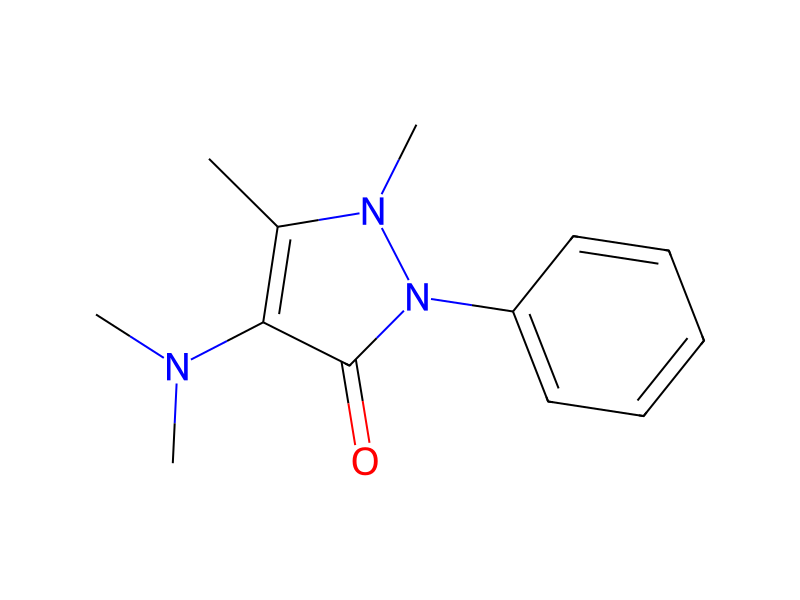
58-15-1Cc1c(N(C)C)c(=O)n(-c2ccccc2)n1CRMMXTBMQSGEXHJ-UHFFFAOYSA-NSmall colorless crystals or white crystalline powder. Aqueous solution slightly alkaline to litmus. pH (5% water solution) 7.5-9. Odorless. Slightly bitter taste. (NTP, 1992)
58-15-1、83-07-8DTXSID7020504CHEMBL288470CHEBI:160246DEA NFLIS-Drug Category -> Analgesics
Pharmaceuticals -> Metabolite of Metamizole
Pharmaceuticals -> Listed in ZINC15
1.00
0.89
LEAFLETS FROM LIGROIN
COLORLESS LEAFLETS
PRISM OR PLATELETS FROM PETROLEUM ETHER OR ETHYL ACETATE
greater than or equal to 100 mg/mL at 72 °F (NTP, 1992)
IN PRESENCE OF WATER, READILY ATTACKED BY MILD OXIDIZING AGENTS; ADDITION OF SODIUM BENZOATE TO WATER INCR SOLUBILITY
1 G SOL IN 1.5 ML ALC, 12 ML BENZENE, 1 ML CHLOROFORM, 13 ML ETHER, 18 ML WATER
SOL IN PETROLEUM ETHER
2.25e+01 g/L
Sicherheitsangaben dienen nur zur Orientierung und ersetzen weder das Sicherheitsdatenblatt (SDB) des Lieferanten noch geltende Vorschriften oder eine fachliche Bewertung.
Danger
H301 (96.5%): Toxic if swallowed [Danger Acute toxicity, oral]
P261, P264, P264+P265, P270, P271, P280, P301+P316, P302+P352, P304+P340, P305+P351+P338, P319, P321, P330, P332+P317, P337+P317, P362+P364, P403+P233, P405, and P501 (click each P-code to see the statement)
Aggregated GHS information provided per 57 reports by companies from 9 notifications to the ECHA C&L Inventory. Each notification may be associated with multiple companies.
Chemical: 3H-Pyrazol-3-one, 4-(dimethylamino)-1,2-dihydro-1,5-dimethyl-2-phenyl-
3H-Pyrazol-3-one, 4-(dimethylamino)-1,2-dihydro-1,5-dimethyl-2-phenyl-: Does not have an individual approval but may be used as a component in a product covered by a group standard. It is not approved for use as a chemical in its own right.
SYMPTOMS: Symptoms of exposure to this compound include allergic reactions, strong spasmolytic effect on smooth muscle of peripheral blood vessels, irritability, palsy, copious sweating, dilated pupils, sharp drop then rise in body temperature, dysuria, dyspnea, anxiety, tenesmus, urinary frequency, intermittent fever, fatty infiltration of the liver, heart muscle degeneration and death due to circulatory failure following cardiovascular collapse. Agranulocytosis often occurs. Ingestion may cause central nervous system stimulation, vomiting, convulsions, cyanosis, tinnitus, leukopenia, kidney damage and coma. Ingestion may also lead to nausea, mental disturbances, methemoglobinemia, chocolate-colored blood, dizziness, epigastric pain, difficulty in hearing, thready pulse and liver damage. Other symptoms reported via ingestion include hemolytic anemia, porphyria and severe gastrointestinal bleeding. Bone marrow depression also occurs. Rare eye effects include acute transient myopia. Chronic symptoms include anorexia, edema, oliguria, urticaria, hypersensitivity, aplastic anemia, sore throat, fever, pharyngeal membrane, jaundice enlargement of the liver and spleen, exfoliative dermatitis, gastric or duodenal erosion with perforation or bleeding, adrenal necrosis, thrombocytopenic purpura and acute leukemia.
N02BB03
N - Nervous system
QN - Nervous system
Aminophenazone is metabolized very slowly by normal newborn babies. In older infants, a higher amount of exhaled 13-CO2 is observed.
VET: AMIDOPYRINE IS KNOWN TO CAUSE AGRANULOCYTOSIS IN MAN, BUT IT HAS BEEN FOUND IMPOSSIBLE TO REPRODUCE THIS EFFECT IN THE DOG & OTHER LABORATORY ANIMALS.
...URINARY METABOLITE OF AMINOPYRINE HAS BEEN IDENTIFIED AS 4-ACETYLAMINO-3-METHYL-1-PHENYLPYRAZOLONE IN TREATED SUCKLINGS, INFANTS, & ADULT. ... FORMATION.../OF THIS METABOLITE/ IMPLICATES EXHAUSTIVE OXIDATIVE N-DEALKYLATION OF.../AMINOPYRINE/ FOLLOWED BY ACETYLATION OF RELEASED AMINO-GROUP.
...BIOTRANSFORMATION OF AMINOPYRINE. MAN & DOG EXCRETE RUBAZONIC ACID...& N-METHYLRUBAZONIC ACID...WHOSE FORMATION INVOLVES NUMBER OF METABOLIC STEPS. FOLLOWING FORMATION OF 4-HYDROXYANTIPYRINE, THIS METABOLITE IS N-DEMETHYLATED... & DEHYDROGENATED TO HYPOTHETICAL DIKETO INTERMEDIATE...LATTER CMPD...UNDERGOES FINAL COUPLING...WITH ANOTHER METABOLITE, 4-AMINOANTIPYRINE...
CIRCADIAN RHYTHMS...OFTEN SEEN WITHIN A GIVEN ANIMAL SPECIES. VARIATION IN RATE OF METABOLISM IS OFTEN CORRELATED WITH VARIATIONS IN ENDOCRINE FUNCTION AS INFLUENCED BY THE LIGHT-DARK CYCLE TO WHICH THE ANIMAL IS EXPOSED. ...IN VITRO METABOLISM OF...AMINOPYRINE...BY THE HEPATIC CYTOCHROME P450 MONOOXYGENASE SYSTEM OF RATS IS VARIABLE DEPENDING ON THE TIME OF DAY OF SACRIFICE OF THE ANIMAL.
AMINOPHENAZONE AND ITS METABOLITES; 4-AMINOANTIPYRINE, N-ACETYLAMINOANTIPYRINE AND 4-FORMYLAMINOANTIPYRINE WERE DETECTED IN STUDIES ON HEALTHY SUBJECTS.
IT IS ABSORBED RAPIDLY FOLLOWING ORAL ADMIN...EXCRETED IN URINE UNCHANGED OR CONJUGATED WITH GLUCURONIC & SULFURIC ACIDS.
...SLIGHTLY BOUND TO PLASMA PROTEIN...
THREE METABOLITES OF AMINOPYRINE WERE DETECTED IN THE URINE, SERUM, AND SALIVA OF HEALTH SUBJECTS AFTER INGESTION OF AMINOPYRINE.
225 to 228 °F (NTP, 1992)
107-109 °C
134.5 °C
Small colorless crystals or white crystalline powder. Aqueous solution slightly alkaline to litmus. pH (5% water solution) 7.5-9. Odorless. Slightly bitter taste. (NTP, 1992)
Solid
Manufacturers, packers, and distributors of drug and drug products for human use are responsible for complying with the labeling, certification, and usage requirements as prescribed by the Federal Food, Drug, and Cosmetic Act, as amended (secs 201-902, 52 Stat. 1040 et seq., as amended; 21 U.S.C. 321-392).
4-DIMETHYLAMINOANTIPYRINE is sensitive to exposure to light. This chemical is readily attacked by mild oxidizing agents in the presence of water. It is incompatible with acacia, apomorphine, aspirin, chloral hydrate, iodine and tannic acid. (NTP, 1992)
EYES: First check the victim for contact lenses and remove if present. Flush victim's eyes with water or normal saline solution for 20 to 30 minutes while simultaneously calling a hospital or poison control center. Do not put any ointments, oils, or medication in the victim's eyes without specific instructions from a physician. IMMEDIATELY transport the victim after flushing eyes to a hospital even if no symptoms (such as redness or irritation) develop.
...MATERIALS WHICH...CAN DECOMP INTO TOXIC COMPONENTS DUE TO CONTACT WITH HEAT...STORED IN COOL, WELL-VENTILATED PLACE, OUT OF...RAYS OF SUN, AWAY FROM AREAS OF HIGH FIRE HAZARD...PERIODICALLY INSPECTED & MONITORED. INCOMPATIBLE MATERIALS...ISOLATED FROM EACH OTHER.
SMALL SPILLS AND LEAKAGE: If you spill this chemical, you should dampen the solid spill material with water, then transfer the dampened material to a suitable container. Use absorbent paper dampened with water to pick up any remaining material. Seal your contaminated clothing and the absorbent paper in a vapor-tight plastic bag for eventual disposal. Wash all contaminated surfaces with a soap and water solution. Do not reenter the contaminated area until the Safety Officer (or other responsible person) has verified that the area has been properly cleaned.
SRP: At the time of review, criteria for land treatment or burial (sanitary landfill) disposal practices are subject to significant revision. Prior to implementing land disposal of waste residue (including waste sludge), consult with environmental regulatory agencies for guidance on acceptable disposal practices.
SRP: Local exhaust ventilation should be applied wherever there is an incidence of point source emissions or dispersion of regulated contaminants in the work area. Ventilation control of the contaminant as close to its point of generation is both the most economical and safest method to minimize personnel exposure to airborne contaminants.
RECOMMENDED RESPIRATOR: Where the neat test chemical is weighed and diluted, wear a NIOSH-approved half face respirator equipped with an organic vapor/acid gas cartridge (specific for organic vapors, HCl, acid gas and SO2) with a dust/mist filter. (NTP, 1992)
ELEVATED URINARY LEVELS OF GLUCARIC ACID...OBSERVED IN RAT & GUINEA PIG FOLLOWING...AMINOPYRINE PRETREATMENT... SIMILARLY, PRETREATMENT OF HUMAN SUBJECTS...INCR URINARY...EXCRETIONS...
.../TETRAHYDROCANNABINOL/ INHIBITED MICROSOMAL OXIDN OF AMINOPYRINE...
/FENFLURAMINE/ HAS BEEN SHOWN TO INHIBIT THE METABOLISM OF AMINOPYRINE...AND TO DECREASE THE DISTRIBUTION VOLUME OF ANTIPYRINE IN RATS.
PRETREATMENT OF RATS WITH THE AMINOPYRINE DEMETHYLATED METABOLITE 4-(METHYLAMINO)ANTIPYRINE DECREASED THE RATE OF AMINOPYRINE METABOLISM, THAT IS, IT PROLONGED THE ELIMINATION HALF-TIME FOR AMINOPYRINE BINDING SITES ON CYTOCHROME P450.
For more Interactions (Complete) data for AMINOPYRINE (6 total), please visit the HSDB record page.
MOST TOXICITY REPORTED FOR THIS DRUG SEEMS TO BE DUE TO HYPERSENSITIVITY, NOTABLY OCCASIONAL FATAL AGRANULOCYTOSIS & ANGIONEUROTIC EDEMA. NO EFFECT ON RED BLOOD CELLS OR HEMOGLOBIN. LARGE DOSES ARE SAID TO CAUSE CONVULSIONS.
THERE IS SEVERE INFLAMMATION OF THROAT OFTEN LEADING TO SLOUGHING, FEVER, MALAISE OR PROSTRATION, & MARKED LEUKOPENIA.
CASE HISTORY OF FEMALE PATIENT WITH CHEMICALLY INDUCED AGRANULOCYTOSIS.
THE FORMATION & POTENTIAL TOXICITY OF THE N-NITROSAMINES ARE DISCUSSED, INCL THE NITROSATION OF DIFFERENT CLASSES OF ORALLY ADMIN DRUGS, SUCH AS AMINOPYRINE, RESULTING IN THE POSSIBLE FORMATION OF CARCINOGENS IN THE BODY.
For more Human Toxicity Excerpts (Complete) data for AMINOPYRINE (6 total), please visit the HSDB record page.
...EXPT DESIGNED TO PRODUCE /AGRANULOCYTOSIS/...IN DOGS & OTHER LAB ANIMALS FOLLOWING BOTH ORAL & PARENTERAL USE HAVE BEEN UNSUCCESSFUL. ORAL DAILY DOSAGE IN DOG IS 0.13-0.4 G GIVEN IN DIVIDED DOSES.
AMINOPYRINE WAS AMONG COMPOUNDS PRODUCING CHROMOSOME ABERRATIONS AND SISTER CHROMATID EXCHANGES IN CHINESE HAMSTER CELLS.
...NO DELETERIOUS EFFECTS IN PREGNANT RATS (150 MG/KG), RABBITS (90 MG/KG) & MICE (180 MG/KG) TREATED DAILY DURING MOST OF THEIR GESTATION.
...FOUND THAT AMINOPYRINE CAUSED EXCITEMENT, INCOORDINATION AND MUSCULAR WEAKNESS IN CATTLE...TOXICITY DUE TO FORMALDEHYDE LIBERATED AS THE DRUG WAS METABOLIZED.
For more Non-Human Toxicity Excerpts (Complete) data for AMINOPYRINE (6 total), please visit the HSDB record page.
Manufacturers, packers, and distributors of drug and drug products for human use are responsible for complying with the labeling, certification, and usage requirements as prescribed by the Federal Food, Drug, and Cosmetic Act, as amended (secs 201-902, 52 Stat. 1040 et seq., as amended; 21 U.S.C. 321-392).
IMMEDIATELY AFTER INJECTION OF AMINOPYRINE-(14)C INTO RATS A UNIFORM DISTRIBUTION OF RADIOACTIVITY IN THE BODY WAS RECORDED. AFTER 30 MINUTES, A PREFERENTIAL LOCALIZATION OF RADIOACTIVITY WAS FOUND IN THE NASAL MUCOSA AND LIVER.
MEDICATION (VET)
MEDICATION
(1972) 1.5X10+6 GRAMS (PRINCPL CUSTMS DISTS)
(1975) 6.51X10+5 GRAMS (PRINCPL CUSTMS DISTS)
Pharmaceuticals -> Nervous System -> Analgesics -> Pyrazolones
Pharmaceuticals
3H-Pyrazol-3-one, 4-(dimethylamino)-1,2-dihydro-1,5-dimethyl-2-phenyl-: ACTIVE
"OVER-THE-COUNTER" SALE OF AMINOPYRINE IN US...PROHIBITED SINCE 1938, & FED REGULATIONS REQUIRE THAT PREPN...BEAR WARNING ON LABELS STATING THAT DRUG MAY CAUSE FATAL AGRANULOCYTOSIS.
INCOMPATIBILITIES: IS INCOMPATIBLE WITH MANY ALKALOIDAL PRECIPITANTS, OXIDIZING AGENTS & MERCURY SALTS...
CRYSTAL AMIDOPHEN UV IRRADIATED FOR 300 HR CHANGED TO AN ORANGE-BROWN PRODUCT FROM WHICH 3 YELLOW DEGRADATION PRODUCTS WERE ISOLATED.
THE PERMEATION OF AMINOPYRINE THROUGH AN ARTIFICIAL INTESTINAL MEMBRANE WAS HIGHER THAN THAT THROUGH AN ARTIFICIAL GASTRIC MEMBRANE.
THE TRANSFER RATE OF BARBITAL FROM AQUEOUS TO BENZENE PHASE WAS ACCELERATED BY THE ADDITION OF AMINOPYRINE.
VerwendenAminopyrine is used as an antipyretic and analgesic drug. It belongs to the pyrazolone derivatives having a most toxic and most dangerous analgesic effect and it is a non-narcotic drug. Due to strong adverse effects, its single medicine preparation is gradually replaced by compound preparation.
synthetischeAminopyrine is synthesized from 4-Aminoantipyrine by catalytic hydrogenation (alkylation). Water is firstly added to the dissolving tank, heated to 50-60°C, put into 4-Aminoantipyrine under stirring, and poured into the hydrogenation tank after complete dissolving. Wash the dissolving tank with water, mix it with the nickel catalyst, and then add it to the hydrogenation tank. The hydrogenation tank was evacuated, then the vacuum valve was closed, hydrogen was introduced, and stirring was started. When the pressure rose to 0.245MPa, the hydrogen was stopped. Add formaldehyde and continue to feed hydrogen. The speed of adding formaldehyde is based on the standard of 1.8-2 cubic meters of hydrogen absorption per 5L of formaldehyde, and the reaction temperature is controlled at 60-85°C. After passing the test, filter by pressure, cool the filtrate to below 25°C, and separate out crystals, which are then filtered to obtain the crude aminopyrine. The crude aminopyrine, ethanol, and activated carbon were heated to 75-80°C, stirred for 1 hour, and filtered under pressure. The filtrate was cooled to 10°C, crystals were precipitated, filtered, washed with ethanol, and air-dried to obtain aminopyrine.
DefinitionChEBI: Aminopyrine is a pyrazolone that is 1,2-dihydro-3H-pyrazol-3-one substituted by a dimethylamino group at position 4, methyl groups at positions 1 and 5 and a phenyl group at position 2. It exhibits analgesic, anti-inflammatory, and antipyretic properties. It has a role as a non-steroidal anti-inflammatory drug, a non-narcotic analgesic, an antipyretic, an environmental contaminant and a xenobiotic. It is a tertiary amino compound and a pyrazolone.