
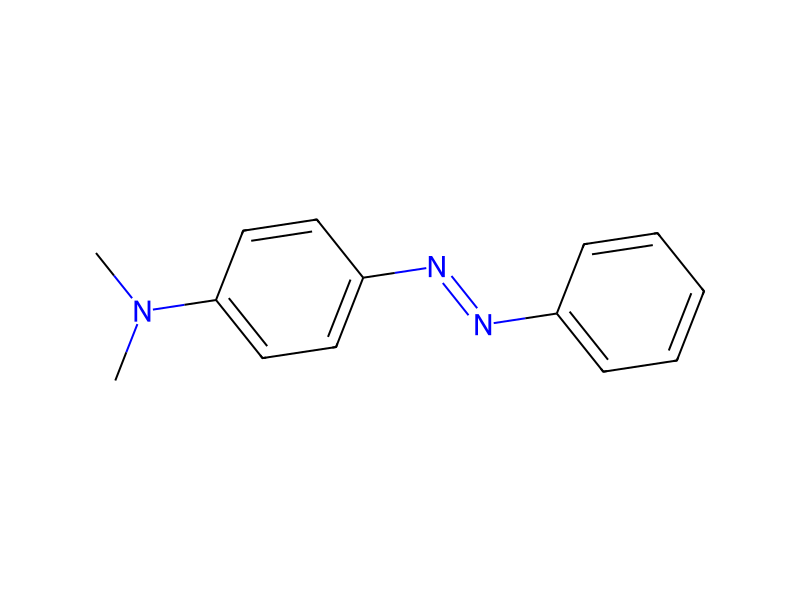
Grundinformationen
- Standard-SMILES
CN(C)c1ccc(N=Nc2ccccc2)cc1- InChIKey
JCYPECIVGRXBMO-UHFFFAOYSA-N- Summenformel
- C14H15N3
- Durchschnittliche Molmasse
- 225,29 g/mol
- Monoisotopische Masse
- 225,12659748
Überblick
4-Dimethylaminoazobenzene can cause cancer according to an independent committee of scientific and health experts.
Namen und Bezeichner
- Bevorzugter Name
- C.I. Solvent Yellow 2
- IUPAC
- N,N-dimethyl-4-phenyldiazenylaniline
- Lokaler Name
- N,N-Dimethyl-p-phenyl-azoanilin
- Englischer Name
- Solvent Yellow 2
- Summenformel
- C14H15N3
- Molmasse
- 225.29
Namen und Synonyme
60-11-74-(Dimethylamino)azobenzeneSolvent Yellow 24-DimethylaminoazobenzeneC.I. Solvent Yellow 2Sudan Yellow GGSudan Yellow GGAResinol Yellow GRN,N-dimethyl-4-(phenyldiazenyl)anilineFat YellowN,N-Dimethyl-4-aminoazobenzeneStear Yellow JB
Weitere Namen anzeigen
METHYL YELLOWDimethylaminoazobenzeneDIMETHYL YELLOWN,N-DIMETHYL-4-(PHENYLAZO)ANILINEBUTTER YELLOWBenzenamine, N,N-dimethyl-4-(phenylazo)-OIL YELLOWFAST YELLOW
Somalia Yellow AFat Yellow AFat Yellow RSudan GGEnial Yellow 2GFat Yellow ESOleal Yellow 2GDAB (carcinogen)
Datenbank-Bezeichner
- CAS
60-11-7- PubChem CID
- 6053
- DTXSID
DTXSID5020491- ChEMBL
CHEMBL1090440、CHEMBL263116- ChEBI
CHEBI:17903- UNII
- A49L8E13FD
- EC Number
- 200-455-7
- Nikkaji
- J1.922D、J2.203.933D、J2.203.934B
Eigenschaften
Berechnete Struktureigenschaften
- XLogP
- 4,6
- Polarare Oberfläche (TPSA)
- 28 Ų
- H-Brücken-Donoren
- 0
- H-Brücken-Akzeptoren
- 3
- Frei drehbare Bindungen
- 3
- Schwere Atome
- 17
- Formalladung
- 0
- Komplexität
- 236
Experimentelle und physikochemische Eigenschaften
Chemical Classes
Hazardous Air Pollutants (HAPs)
Dyes -> Azo Dyes
Carcinogens
SpringerMaterials Properties15N nuclear magnetic resonance spectrum
LogP
log Kow= 4.58
4.58
4.05
Color/Form
YELLOW CRYSTALLINE LEAFLETS
Yellow, leaf-shaped crystals.
Solubility
less than 1 mg/mL at 72 °F (NTP, 1992)
SOL IN ALCOHOL, BENZENE, CHLOROFORM; SOL IN ETHER, PETROLEUM ETHER, MINERAL ACIDS, OILS.
VERY SOL IN PYRIDINE.
Water solubility of 13.6 ppm.
Solubility in water: none
0.001%
Boiling Point
Sublimes (NIOSH, 2024)
sublimes
Sublimes
Melting Point
232 °F (decomposes) (NTP, 1992)
114-117 °C
114-117 °C
232 °F
117 °C
237 °F
Vapor Density
7.78 (NTP, 1992) - Heavier than air; will sink (Relative to Air)
7.78
Vapor Pressure
3e-07 mmHg (est.) (NIOSH, 2024)
0.0000003 [mmHg]
0.0000003 mmHg (est.)
0.0000003 mmHg (est.)
Henry's Law ConstantHenry's Law constant= 7.1X10⁻⁹ atm-cu m/mol (calculated).
Physical Description
4-dimethylaminoazobenzene appears as yellow crystalline leaflets or an orange powder. (NTP, 1992)
Yellow, leaf-shaped crystals; [NIOSH]
YELLOW CRYSTALS.
Yellow, leaf-shaped crystals.
Yellow, leaf-shaped crystals.
Physikochemische Eigenschaften
- Schmelzpunkt
- 111 °C · 111 °C (dec.)(lit.)
- Siedepunkt
- 356.8 °C · 356.8°C (rough estimate)
- Dichte
- 1.1303 · 1.1303 (rough estimate)
- Dampfdruck
- 3 x · 3 x 10-7 mmHg (estimated, NIOSH, 1997)
- Brechungsindex
- 1.577 · 1.5770 (estimate)
- storage temp.
- Store at RT.
- Löslichkeit
- Insoluble in water; soluble in ethanol, benzene, ether, chloroform,petroleum ether, mineralacids, oils
- pka
- 3.226 · 3.226(at 25℃)
- Aggregatzustand
- Powder
- Farbe
- Yellow
- PH
- 2.9 · 2.9-4.0
- Wasserlöslichkeit
- 13.6 mg/L · 13.6 mg/L
- Merck
- 14 · 14,3229
- BRN
- 746016 · 746016
- Henry's Law Constant
- 1.4 · 1.4×103 mol/(m3Pa) at 25℃, HSDB (2015)
- Stabilität
- Stable, but heat and light sensitive. Incompatible with strong oxidizing agents, strong acids.
- Major Application
- Electrochromic materials, sol-gel coatings, display device, inks, gasdetection apparatus, status assessment indetection apparatus, nematocides, hair dyes, diapers, food storage, status assessment inbreast cancer, detecting carbohydrates, bacteria, diagnosing cervical disease, wound dressing materials
- InChI
- 1S/C14H15N3/c1-17(2)14-10-8-13(9-11-14)16-15-12-6-4-3-5-7-12/h3-11H,1-2H3
- InChIKey
- JCYPECIVGRXBMO-UHFFFAOYSA-N
- SMILES
- CN(C)c1ccc(cc1)N=Nc2ccccc2
- CAS Datenbank
- 60 · 60-11-7(CAS DataBase Reference)
- NIST chemische Informationen
- -4 · Benzenamine, N,N-dimethyl-4-(phenylazo)-(60-11-7)
- EPA chemische Informationen
- 4 · 4-Dimethylaminoazobenzene (60-11-7)
Sicherheit und Regulatorisches
GHS-Klassifizierung
GHS Classification
Danger
H301 (100%): Toxic if swallowed [Danger Acute toxicity, oral]
P203, P264, P270, P280, P301+P316, P318, P321, P330, P405, and P501 (click each P-code to see the statement)
Aggregated GHS information provided per 52 reports by companies from 6 notifications to the ECHA C&L Inventory. Each notification may be associated with multiple companies.
Warning
H315: Causes skin irritation [Warning Skin corrosion/irritation]
Gefahrenhinweise
Regulatory Information
Chemical: Benzenamine, N,N-dimethyl-4-(phenylazo)-
Hazard Traits - Carcinogenicity; Dermatotoxicity
Regulation (EC) No 178/2002 (amended)
C.I. Solvent Yellow 2: Does not have an individual approval but may be used under an appropriate group standard
The New Jersey Worker and Community Right to Know Act requires public and private employers to provide information about hazardous substances at their workplaces. (N.J.S.A. 34:5A-1 et. seq.)
Other Safety InformationIMAP assessments - Benzenamine, N,N-dimethyl-4-(phenylazo)-: Environment tier I assessment
DOT LabelPoison
Fire Hazards
Flash point data for this chemical are not available. It is probably combustible. (NTP, 1992)
Not combustible.
Health HazardsExcerpt from NIOSH Pocket Guide for 4-Dimethylaminoazobenzene:
Hazards Summary
4-Dimethylaminoazobenzene is used as a dye for coloring polishes, wax products, and soap. Acute (short- term) dermal exposure to 4-dimethylaminoazobenzene may result in contact dermatitis in humans. No information is available on the chronic (long-term), reproductive, developmental, or carcinogenic effects of 4-dimethylaminoazobenzene in humans. Animal studies have reported birth defects in the offspring of mice exposed to 4-dimethylaminoazobenzene and tumors of the lung, liver, and bladder from oral exposure to 4-dimethylaminoazobenzene. EPA has not classified 4-dimethylaminoazobenzene for carcinogenicity. The International Agency for Research on Cancer (IARC) has classified 4- dimethylaminoazobenzene as a Group 2B, possibly carcinogenic to humans.
In animal studies: liver injury; In feeding studies of dogs: bladder cancer; [HSDB]
Reactive GroupAmines, Phosphines, and Pyridines
UN ClassificationUN Hazard Class: 6.1; UN Pack Group: III
Special Reports
Toxicology Review: L'alimentation et la Vie 50: 77 (1962)
Toxicology Review: British Journal of Cancer 6: 270 (1952)
Toxicology Review: Advances in Chemistry Series 13: 271 (1970)
Toxicology Review: Journal of Nutrition 44: 345 (1951)
For more Special Reports (Complete) data for 4-(DIMETHYLAMINO)AZOBENZENE (6 total), please visit the HSDB record page.
RCRA Requirements
U093; As stipulated in 40 CFR 261.33, when p-dimethylaminoazobenzene, as a commercial chemical product or manufacturing chemical intermediate or an off-specification commercial chemical product or a manufacturing chemical intermediate, becomes a waste, it must be managed according to Federal and/or State hazardous waste regulations. Also defined as a hazardous waste is any residue, contaminated soil, water, or other debris resulting from the cleanup of a spill, into water or on dry land, of this waste. Generators of small quantities of this waste may qualify for partial exclusion from hazardous waste regulations (40 CFR 261.5).
Reactivity AlertsExplosive
OSHA Standards
Workers' exposure to 4-dimethylaminoazobenzene is to be controlled through the required use of engineering controls, work practices, & personal protective equipment, incl respirators. Identified as an occupational carcinogen without establishing a PEL.
Sicherheit und Schutzausrüstung
Fire Fighting
Fires involving this material can be controlled with a dry chemical, carbon dioxide or Halon extinguisher. (NTP, 1992)
In case of fire in the surroundings, use appropriate extinguishing media.
First Aid Measures
Fresh air, rest.
Remove contaminated clothes. Rinse and then wash skin with water and soap.
First rinse with plenty of water for several minutes (remove contact lenses if easily possible), then refer for medical attention.
Give one or two glasses of water to drink.
First Aid
EYES: First check the victim for contact lenses and remove if present. Flush victim's eyes with water or normal saline solution for 20 to 30 minutes while simultaneously calling a hospital or poison control center. Do not put any ointments, oils, or medication in the victim's eyes without specific instructions from a physician. IMMEDIATELY transport the victim after flushing eyes to a hospital even if no symptoms (such as redness or irritation) develop.
(General first aid procedures)
Storage Conditions
PRECAUTIONS FOR "CARCINOGENS": Storage site should be as close as practical to lab in which carcinogens are to be used, so that only small quantities required for ... expt need to be carried. Carcinogens should be kept in only one section of cupboard, an explosion-proof refrigerator or freezer (depending on chemicophysical properties ...) that bears appropriate label. An inventory ... should be kept, showing quantity of carcinogen & date it was acquired ... . Facilities for dispensing ... should be contiguous to storage area. /Chemical Carcinogens/
Cleanup Methods
PRECAUTIONS FOR "CARCINOGENS": A high-efficiency particulate arrestor (HEPA) or charcoal filters can be used to minimize amt of carcinogen in exhausted air ventilated safety cabinets, lab hoods, glove boxes or animal rooms ... . Filter housing that is designed so that used filters can be transferred into plastic bags without contaminating maintenance staff is avail commercially. Filters should be placed in plastic bags immediately after removal ... . The plastic bag should be sealed immediately ... . The sealed bag should be labelled properly ... . Waste liquids ... should be placed or collected in proper containers for disposal. The lid should be secured & the bottles properly labelled. Once filled, bottles should be placed in plastic bags, so that outer surface ... is not contaminated ... . The plastic bag should also be sealed & labelled. ... Broken glassware ... should be decontaminated by solvent extraction, by chemical destruction, or in specially designed incinerators. /Chemical Carcinogens/
Nonfire Spill Response
SMALL SPILLS AND LEAKAGE: If a spill of this chemical occurs, FIRST REMOVE ALL SOURCES OF IGNITION, then you should dampen the solid spill material with acetone and transfer the dampened material to a suitable container. Use absorbent paper dampened with acetone to pick up any remaining material. Seal your contaminated clothing and the absorbent paper in a vapor-tight plastic bag for eventual disposal. Solvent wash all contaminated surfaces with acetone followed by washing with a soap and water solution. Do not reenter the contaminated area until the Safety Officer (or other responsible person) has verified that the area has been properly cleaned.
Disposal Methods
Generators of waste (equal to or greater than 100 kg/mo) containing this contaminant, EPA hazardous waste number U093, must conform with USEPA regulations in storage, transportation, treatment and disposal of waste.
A potential candidate for rotary kiln incineration at a temperature range of 820 to 1,600 °C and residence times of seconds for liquids and gases, and hours for solids. A potential candidate for fluidized bed incineration at a temperature range of 450 to 980 °C and residence times of seconds for liquids and gases, and longer for solids.
PRECAUTIONS FOR "CARCINOGENS": There is no universal method of disposal that has been proved satisfactory for all carcinogenic compounds & specific methods of chem destruction ... published have not been tested on all kinds of carcinogen-containing waste. ... Summary of avail methods & recommendations ... /given/ must be treated as guide only. /Chemical Carcinogens/
PRECAUTIONS FOR "CARCINOGENS": ... Incineration may be only feasible method for disposal of contaminated laboratory waste from biological expt. However, not all incinerators are suitable for this purpose. The most efficient type ... is probably the gas-fired type, in which a first-stage combustion with a less than stoichiometric air:fuel ratio is followed by a second stage with excess air. Some ... are designed to accept ... aqueous & organic-solvent solutions, otherwise it is necessary ... to absorb soln onto suitable combustible material, such as sawdust. Alternatively, chem destruction may be used, esp when small quantities ... are to be destroyed in laboratory. /Chemical Carcinogens/
For more Disposal Methods (Complete) data for 4-(DIMETHYLAMINO)AZOBENZENE (7 total), please visit the HSDB record page.
Spillage DisposalPersonal protection: particulate filter respirator adapted to the airborne concentration of the substance. Sweep spilled substance into covered containers. If appropriate, moisten first to prevent dusting.
Preventive Measures
Clothing & equipment after use should be placed in an impervious container for decontamination or disposal.
PRECAUTIONS FOR "CARCINOGENS": Smoking, drinking, eating, storage of food or of food & beverage containers or utensils, & the application of cosmetics should be prohibited in any laboratory. All personnel should remove gloves, if worn, after completion of procedures in which carcinogens have been used. They should ... wash ... hands, preferably using dispensers of liq detergent, & rinse ... thoroughly. Consideration should be given to appropriate methods for cleaning the skin, depending on nature of the contaminant. No standard procedure can be recommended, but the use of organic solvents should be avoided. Safety pipettes should be used for all pipetting. /Chemical Carcinogens/
PRECAUTIONS FOR "CARCINOGENS": In animal laboratory, personnel should remove their outdoor clothes & wear protective suits (preferably disposable, one-piece & close-fitting at ankles & wrists), gloves, hair covering & overshoes. ... Clothing should be changed daily but ... discarded immediately if obvious contamination occurs ... /also,/ workers should shower immediately. In chemical laboratory, gloves & gowns should always be worn ... however, gloves should not be assumed to provide full protection. Carefully fitted masks or respirators may be necessary when working with particulates or gases, & disposable plastic aprons might provide addnl protection. If gowns are of distinctive color, this is a reminder that they should not be worn outside of lab. /Chemical Carcinogens/
PRECAUTIONS FOR "CARCINOGENS": ... Operations connected with synth & purification ... should be carried out under well-ventilated hood. Analytical procedures ... should be carried out with care & vapors evolved during ... procedures should be removed. ... Expert advice should be obtained before existing fume cupboards are used ... & when new fume cupboards are installed. It is desirable that there be means for decreasing the rate of air extraction, so that carcinogenic powders can be handled without ... powder being blown around the hood. Glove boxes should be kept under negative air pressure. Air changes should be adequate, so that concn of vapors of volatile carcinogens will not occur. /Chemical Carcinogens/
For more Preventive Measures (Complete) data for 4-(DIMETHYLAMINO)AZOBENZENE (14 total), please visit the HSDB record page.
Isolation and EvacuationExcerpt from ERG Guide 154 [Substances - Toxic and/or Corrosive (Non-Combustible)]:
Eye PreventionWear safety goggles or eye protection in combination with breathing protection.
Inhalation RiskEvaporation at 20 °C is negligible; a harmful concentration of airborne particles can, however, be reached quickly when dispersed.
Toxikologische Informationen
Cancer Sites[in animals: liver & bladder tumors]
InteractionsDIETS HIGH IN RIBOFLAVIN OR SUPPLEMENTED WITH POLYCYCLIC HYDROCARBONS, WHICH REDUCED TUMOR INDUCTION BY AZO DYES, ALSO LOWERED BINDING OF DYES TO PROTEIN FRACTIONS.
Target OrgansSkin, respiratory system, liver, kidneys, bladder
Environmental Fate
TERRESTRIAL FATE: If N,N-dimethyl-p(phenylazo)aniline is released to soil it may bind to the soil based on an estimated Koc of 7390 and therefore should not leach to the groundwater. However, since N,N-dimethyl-p-(phenylazo)aniline has a pKa of 3.226(1) at 25 °C, it exists partially as a cation and the extent of its adsorption to soils and sediments should be affected by the pH of the medium. It should not hydrolyze in soils. No information was found on biodegradation in soils(SRC).
AQUATIC FATE: If N,N-dimethyl-p-(phenylazo)aniline is released to water it may bioconcentrate in aquatic organisms, adsorb to sediment and may be subject to direct photolysis. It should not hydrolyze or evaporate from water. Based on a laboratory screening test using an inoculum from settled domestic wastewater, it may be subject to biodegradation. (SRC)
ATMOSPHERIC FATE: If N,N-dimethyl-p-(phenylazo)aniline is released to the atmosphere, it may be subject to direct photolysis and the estimated vapor phase half-life in the atmosphere is 7.04 hrs as a result of photochemically produced hydroxyl radicals adding to the aromatic rings; however, it may exist primarily adsorbed onto particulate matter due to its very low vapor pressure. (SRC)
Adverse EffectsOccupational hepatotoxin - Secondary hepatotoxins: the potential for toxic effect in the occupational setting is based on cases of poisoning by human ingestion or animal experimentation.
Exposure Routes
The substance can be absorbed into the body by ingestion.
inhalation, skin absorption, ingestion, skin and/or eye contact
Signs and Symptoms
Cough. Sore throat.
Redness. Pain.
Redness. Pain.
Enlarged liver; liver, kidney disturbance; contact dermatitis; cough, wheezing, dyspnea (breathing difficulty); bloody sputum; bronchial secretions; frequent urination, hematuria (blood in the urine), dysuria; [potential occupational carcinogen]
ICSC Environmental DataEnvironmental effects from the substance have not been investigated adequately.
Medical Surveillance
Employment & periodical examinations should focus on liver function.
PRECAUTIONS FOR "CARCINOGENS": Whenever medical surveillance is indicated, in particular when exposure to a carcinogen has occurred, ad hoc decisions should be taken concerning ... /cytogenetic and/or other/ tests that might become useful or mandatory. /Chemical Carcinogens/
Soil Adsorption/Mobility
Using a reported log octanol/water partition coefficient of 4.58(1), an estimated Koc of 7390 was calculated(2,SRC). Based on this estimated Koc, N,N-dimethyl-p-(phenylazo)aniline should adsorb to soils and sediment. Since N,N-dimethyl-p-(phenylazo)aniline has a pKa of 3.226 at 25 °C(3), and it exists partially as a cation, the extent of its adsorption to soils and sediments may be affected by the pH of the medium.
Natural Pollution SourcesN,N-Dimethyl-p-(phenylazo)aniline is not known to occur in nature(1).
Human Toxicity Excerpts
IN USA, IT WAS WITHDRAWN FROM APPROVED LIST OF FOOD ADDITIVES IN 1918, 6 MO AFTER ITS ADDITION TO LIST, BECAUSE CONTACT DERMATITIS WAS OBSERVED IN UP TO 90% OF FACTORY WORKERS HANDLING IT.
N-DIMETHYL-P-AMINOAZOBENZENE WAS ACTIVE IN INDUCING UNSCHEDULED DNA SYNTHESIS IN HELA HUMAN CERVICAL CANCER CELLS TESTED IN PRESENCE OR ABSENCE OF RAT LIVER MIXED-FUNCTION OXIDASE PREPARATION.
The only occupational health observation in man was of contact dermatitis in factory workers handling /4-(Dimethylamino)azobenzene/.
Regulatorische Informationen
RCRA Requirements
U093; As stipulated in 40 CFR 261.33, when p-dimethylaminoazobenzene, as a commercial chemical product or manufacturing chemical intermediate or an off-specification commercial chemical product or a manufacturing chemical intermediate, becomes a waste, it must be managed according to Federal and/or State hazardous waste regulations. Also defined as a hazardous waste is any residue, contaminated soil, water, or other debris resulting from the cleanup of a spill, into water or on dry land, of this waste. Generators of small quantities of this waste may qualify for partial exclusion from hazardous waste regulations (40 CFR 261.5).
Atmospheric Standards
Listed as a hazardous air pollutant (HAP) generally known or suspected to cause serious health problems. The Clean Air Act, as amended in 1990, directs EPA to set standards requiring major sources to sharply reduce routine emissions of toxic pollutants. EPA is required to establish and phase in specific performance based standards for all air emission sources that emit one or more of the listed pollutants. 4-(Dimethylamino)azobenzene is included on this list.
CERCLA Reportable Quantities
Persons in charge of vessels or facilities are required to notify the National Response Center (NRC) immediately, when there is a release of this designated hazardous substance, in an amount equal to or greater than its reportable quantity of 10 lb or 4.54 kg. The toll free number of the NRC is (800) 424-8802; In the Washington D.C. metropolitan area (202) 426-2675. The rule for determining when notification is required is stated in 40 CFR 302.4 (section IV. D.3.b).
Sicherheitsdaten
- wgk
- 3
- tsca
- TSCA listed
- ridadr
- UN 2811 6.1/PG 3
- hs_code
- 29270000
- RTECS-Nr.
- BX7350000
- risk_code
- 25-40-68-45-23/24/25
- Toxizität
- Acute oral LD50 for mice 300 mg/kg, rats 200 mg/kg (quoted, RTECS, 1985).
- hazard_code
- T
- safety_code
- 36/37-45-53-22
- hazard_class
- 6.1
- packing_group
- III
- Speicherklasse
- 6.1C - Combustible acute toxic Cat.3toxic compounds or compounds which causing chronic effects
- Giftige Stoffe Daten
- 60-11-7(Hazardous Substances Data)
- Hazard Classifications
- Acute Tox. 3 OralCarc. 2
Chemie und Industrie
Pharmakologische Informationen
Mechanism of Action
4-Dimethylaminoazobenzene (or butter yellow) has been used as a laboratory hepatocarcinogen to study the mode of action of this class of compounds, including structure activity relationships. Because of its characteristic color change as a function of pH, it was the first carcinogen that demonstrated binding to cellular macromolecules. Because of the flavin-dependent azo dye reductase, it was also one of the first carcinogens with a clear-cut nutritional modulation of its activity. Substitution with polar groups such as sulfonic acid in simple azo dyes usually abolishes carcinogenicity and mutagenicity. Thus, molecules such as FD and C Red No. 2 (amaranth) are not mutagenic or carcinogenic. On the other hand, tetra-azo dyes such as direct black 38 or direct blue 6, which are not mutagenic and are quite polar, can release the mutagenic carcinogenic benzidine upon reduction of the azo link by bacteria. Such dyes are highly carcinogenic.
Biological Half-LifeNo reports found; [TDR, p. 547]
Metabolism/Metabolites
YIELDS 4'-DIMETHYLAMINO-4-HYDROXYAZOBENZENE & 4-METHYLAMINOAZOBENZENE IN RAT. /FROM TABLE/
DAB IS METABOLIZED VIA FOLLOWING PATHWAYS: 1) REDUCTION & CLEAVAGE OF AZO GROUP; 2) DEMETHYLATION; 3) RING HYDROXYLATION; 4) N-HYDROXYLATION; 5) N-ACETYLATION & O-CONJUGATION OF METABOLITES.
IN RATS & MICE, CARCINOGENIC AROMATIC AZO-DYES UNDERGO N-HYDROXYLATION, & FOR EXAMPLE, N-HYDROXY-N-ACETYL-4-AMINOAZOBENZENE IS URINARY METABOLITE OF HEPATOCARCINOGENIC 4-DIMETHYLAMINOAZOBENZENE ... .
A study was made of the azoreduction of dimethylaminoazobenzene (DAB) in-vitro by purified rat liver NADPH cytochrome p450-reductase and by a partially purified reconstituted cytochrome p450 system. Male Wistar rats were induced with clofibrate, nafenopin, phenobarbital, or beta-naphthoflavone prior to liver microsomal isolation. ... Both purified NADPH cytochrome p450 reductase and the reconstituted system reduced dimethylaminoazobenzene, with a more than five fold greater rate for the latter. A ratio of 2:1 azoreductase to cytochrome p450 was optimal for dimethylaminoazobenzene reduction. Clofibrate was the only inducer of azoreductase. Reaction with the suicide inhibitor 10-undecynoic acid distinguished laurate hydroxylase from the azoreductase. The reconstituted system was active in air and carbon monoxide, while purified NADPH cytochrome p450 reductase was inhibited in air. In both systems, nearly 50 fold acceleration of dimethylaminoazobenzene azoreduction occurred in the presence of flavin adenine dinucleotide or flavin mononucleotide, but only under anaerobic conditions, indicating facilitation of electron flow to dimethylaminoazobenzene onlhy from NADPH cytochrome p450-reductase and not from cytochrome p450 itself. This was confirmed with the use of cytochrome p450 inhibitors. ... There appears to be an obilgatory electron flow through cytochrome p450 to dimethylaminozaobenzene, bypassing an oxygen sensitive step, and dietary riboflavin probably attenuates dimethylaminoazobenzene hepatocarcinogenicity solely by its effect on intestinal bacteria.
For more Metabolism/Metabolites (Complete) data for 4-(DIMETHYLAMINO)AZOBENZENE (7 total), please visit the HSDB record page.
Absorption, Distribution and Excretion
MORE THAN HALF OF BOUND DYE IN ALL LIVER-CELL FRACTIONS IS ASSOC WITH SOL PROTEINS; OF THIS, 80% IS BOUND TO FRACTION WHICH ACCOUNTS FOR ONLY 15% OF SOL PROTEINS.
BILIARY EXCRETION OF THE AZO DYE CARCINOGEN, N,N-DIMETHYL-4-AMINOAZO(C-14)BENZENE (DAB) WAS STUDIED IN MALE RATS. AFTER A SINGLE IV DOSE OF CARCINOGEN, 20-25% OF THE INJECTED RADIOACTIVITY APPEARS IN THE BILE WITHIN 1 HR, ENTIRELY AS METABOLITES.
IT WAS ADMIN IP TO WISTAR RATS & FOUND TO HAVE THE TENDENCY TO BIND TO LIVER TISSUES, NUCLEI & CHROMATIN WITH SPECIFIC BINDING AFFINITY TO NUCLEAR NONHISTONE PROTEIN.
Verwendung und Herstellung
Uses
4-Dimethylaminoazobenzene was used as a dye for coloring polishes and other wax products, polystyrene, soap, and as a pH indicator.
Used as a reagent for chemical analysis; Used in the past as a yellow hair dye in Scandinavian countries; [HSDB]
See Carcinogens in 29CFR1910.1003 (Code of Federal Regulations)
Pulp and Paper Processing [Category: Industry]
FOR DETERMINATION OF FREE HYDROCHLORIC ACID IN GASTRIC JUICE; SPOT TEST IDENTIFICATION OF PEROXIDIZED FATS; PH INDICATOR (RED 2.9, YELLOW 4.0).
Substance listed with specific concentration in tattoo ink and/or permanent make up according to EU Commission Regulation 2020/2081. The concentration limit (by weight) is 0.1%.
U.S. Production
(1978) NOT PRODUCED COMMERCIALLY IN USA
(1982) NOT PRODUCED COMMERCIALLY IN USA
Consumption PatternsNOT USED COMMERCIALLY IN USA
Methods of Manufacturing
PREPD BY ACTION OF BENZENEDIAZONIUM CHLORIDE ON DIMETHYLANILINE.
NOT PRODUCED COMMERCIALLY IN USA
Use ClassificationFood Additives -> COLOUR -> JECFA Functional Classes
General Manufacturing Information
Benzenamine, N,N-dimethyl-4-(2-phenyldiazenyl)-: ACTIVE
... WAS USED TO GIVE YELLOW COLOR TO HAIR CREAMS IN SCANDINAVIA.
... NOT APPROVED FOR GENERAL FOOD USE IN ANY OF THE COUNTRIES SURVEYED.
... IS NOT USED IN FOODS, DRUGS OR COSMETICS; THUS ITS MFR & TESTING DO NOT CONFORM TO RIGID CHEMICAL SPECIFICATIONS, & ITS COMPOSITION VARIES TO MEET CUSTOMER SHADE & INTENSITY REQUIREMENTS.
Anwendungen
Beschreibung4-N,N-Dimethylaminobenzene diazonium chloride is a diazo compound found in diazo copy paper. It is allergenic only when unexposed.
VerwendenFor determination of free HCl in gastric juice; spot test identification of peroxidized fats; pH indicator (red 2.9, yellow 4.0).
Darstellung
synthetischeaniline diazotization, and N,N-dimethylaniline coupling.
Vor- und nachgelagerte Produkte
Vorgelagerte Rohstoffe
Nachgelagerte Produkte
Anbieter50 Anbieter
国药集团化学试剂有限公司86-21-63210123 · [email protected]
梯希爱(上海)化成工业发展有限公司021-67121386 · [email protected]
上海阿拉丁生化科技股份有限公司400-6206333 13167063860 · [email protected]
湖北万得化工有限公司15377098680 15377098680 · [email protected]
上海康朗生物科技有限公司021-61998208 18217752821 · [email protected]
湖北宥澄新材料科技有限公司17764017698 13163370568 · [email protected]
衢州明锋化工有限公司0570-3062502 13819002126;13819008176 · [email protected]
上海迈瑞尔生化科技有限公司4006356688 18621169109 · [email protected]
上海晶抗生物工程有限公司021-54721350 13524668266 · [email protected]
大连美仑生物技术有限公司0411-62910999 13889544652 · [email protected]
阿法埃莎(中国)化学有限公司400-6106006 · [email protected]
安耐吉化学&3A(安徽泽升科技股份有限公司)400-0056266 · [email protected]
上海瀚鸿科技股份有限公司021-54306202 13764082696 · [email protected]
山东洛克化工有限公司17653113209 13065062079 · [email protected]
山东西亚化学有限公司13355009207 13355009207 · [email protected]
玛雅试剂+86 (573) 82222445 (0)18006601000 452520369 · [email protected]
四川库利南科技有限公司400-1166-196 18981987031 · [email protected]
天津希恩思生化科技有限公司400 638 7771 · [email protected]
南京化学试剂股份有限公司025-58369808 17895012682 · [email protected]
斯百全化学(上海)有限公司021-021-021-67601398-809-809-809 15221380277 · [email protected]
上海思域化工科技有限公司86-21-34053660 · [email protected]
赛默飞世尔科技(中国)有限公司800-810-5118 · [email protected]
TCI AMERICA800-4238616 · [email protected]
TOKYO CHEMICAL INDUSTRY CO., LTD.03-36680489 · [email protected]
TCI Europe320-37350700 · [email protected]
南京杜莱生物技术有限公司025-84699383-8003;025-846993838003-8003 18013301590 · [email protected]
上海倍卓生物科技有限公司021-61119791,13386096464 · [email protected]
北京环宇世纪化学科技有限公司hysj_bj.com
上海将来实业股份有限公司400-0066400 13621662912 · [email protected]
上海将来实业股份有限公司021-61552785 · [email protected]
天津阿尔塔科技有限公司022-65378550-8551 · [email protected]
成都零六生物科技有限公司400-1166-196 13458535857 · [email protected]
上海麦克林生化科技股份有限公司15221275939 15221275939 · [email protected]
杭州杰恒化工有限公司0571-87396432 · [email protected]
成都润泽本土化工有限公司13096311329 028-88469284 616445927 · [email protected]
Sigma-Aldrich西格玛奥德里奇(上海)贸易有限公司021-61415566 800-8193336 · [email protected]
康迪斯化工(湖北)有限公司13343438265 · [email protected]
天津阿尔塔科技有限公司022-6537-8550 15522853686 · [email protected]
TargetMol中国(陶术生物)021-021-33632979 15002134094 · [email protected]
北京诺其雅盛生物科技有限公司4000-819-385 010-62329685 13718666987
九鼎化学(上海)科技有限公司4009209199 · [email protected]
山东智尚新材料有限公司+8617653113209 · [email protected]
浙江珲达生物科技有限公司0571-89903022 18679456698 · [email protected]
成都润泽本土化工有限公司028-88469284 18000562381 · [email protected]
北京华威锐科化工科技有限公司89508211 18501085097 · [email protected]
上海西陇生化科技有限公司021-52907766-8042
沈阳伊默克化工产品有限公司13998106873 · [email protected]
上海源叶生物科技有限公司13636370518 · [email protected]
武汉市承天精细化工有限公司18164098996 · [email protected]
武汉克米克生物医药技术有限公司027-13163388153 13163388153 · [email protected]
Ergänzende Hinweise
DefinitionA banned food coloring.
Zugehörige Reaktionen
1
Verknüpfte Notizen
Wird geladen…