
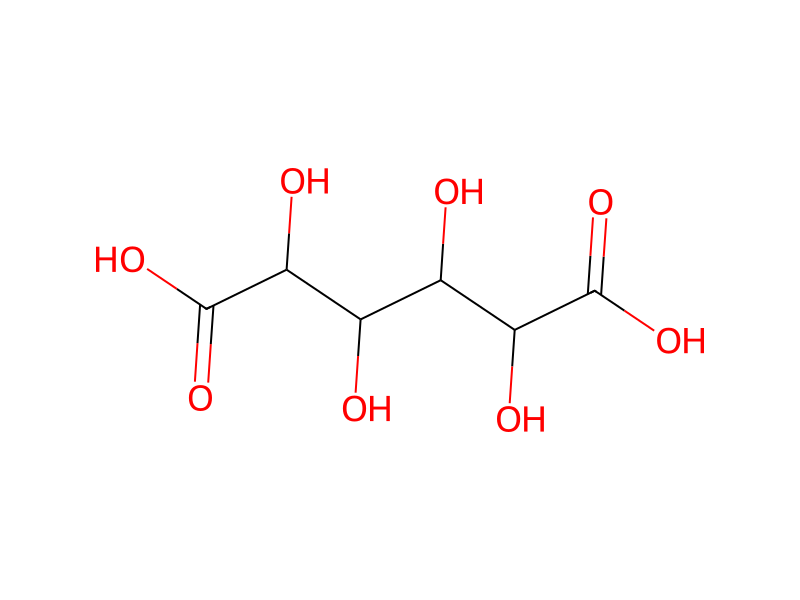
Grundinformationen
- CAS
526-99-8- Standard-SMILES
O=C(O)C(O)C(O)C(O)C(O)C(=O)O- InChIKey
DSLZVSRJTYRBFB-UHFFFAOYSA-N- Summenformel
- C6H10O8
- Durchschnittliche Molmasse
- 210,14 g/mol
Überblick
See also: Galactaric acid (annotation moved to).
Namen und Bezeichner
- Bevorzugter Name
- GlyTouCan:G89531FI
- IUPAC
- 2,3,4,5-tetrahydroxyhexanedioic acid
- Lokaler Name
- Galaktarsure
- Englischer Name
- Mucic acid
- Summenformel
- C6H10O8
- Molmasse
- 210.14
Namen und Synonyme
RefChem:552956GlyTouCan:G89531FIG89531FIGalactaric acid, D-Galactaric-acid-NSC8127ObetrolGalactaric acid; Galactosaccharic acid; Saccharolactic acidNCGC00096080-01d-Galactaric acid #Spectrum_000129SpecPlus_000412
Weitere Namen anzeigen
GALACTARIC ACID2,3,4,5-TETRAHYDROXYHEXANEDIOIC ACIDmeso-galactaric acidD-Mucic acidL-Galactaric acidTETRAHYDROXYHEXANEDIOIC ACID(2R,3S,4R,5S)-2,3,4,5-tetrahydroxyhexanedioic acidMucicMucus acidMucic acid
WLN: QVYQYQYQYQVQSpectrum2_001454Spectrum4_001910Spectrum5_000600Glucuronic Acid Impurity 1SCHEMBL5497KBioGR_002506KBioSS_000589
Datenbank-Bezeichner
- CAS
526-99-8- PubChem CID
- 607
- ChEMBL
Eigenschaften
Berechnete Struktureigenschaften
- XLogP
- -2,5
- Polarare Oberfläche (TPSA)
- 156 Ų
- H-Brücken-Donoren
- 6
- H-Brücken-Akzeptoren
- 8
- Frei drehbare Bindungen
- 5
- Schwere Atome
- 14
- Formalladung
- 0
- Komplexität
- 202
Experimentelle und physikochemische Eigenschaften
Collision Cross Section137.5 Ų [M-2H+Na]-
Physikochemische Eigenschaften
- Schmelzpunkt
- 220 · 220-225 °C (dec.)(lit.)
- Siedepunkt
- 269.65 °C · 269.65°C (rough estimate)
- Dichte
- 1.5274 · 1.5274 (rough estimate)
- Brechungsindex
- 1.58 · 1.5800 (estimate)
- storage temp.
- Store at RT.
- Löslichkeit
- 3.3 g/l · 3.3g/l soluble
- Aggregatzustand
- Solid
- pka
- 2.99 · 2.99±0.35(Predicted)
- Farbe
- White to Off-White
- Wasserlöslichkeit
- Soluble in water.
- Merck
- 14 · 14,4331
- BRN
- 1728117 · 1728117
- Kosmetik-Inhaltsstoffe Funktionen
Sicherheit und Regulatorisches
Sicherheitsangaben dienen nur zur Orientierung und ersetzen weder das Sicherheitsdatenblatt (SDB) des Lieferanten noch geltende Vorschriften oder eine fachliche Bewertung.
Sicherheitsdaten
- wgk
- 2
- tsca
- TSCA listed
- hs_code
- 29181990
- RTECS-Nr.
- LW5180000
- risk_code
- 22-40
- hazard_code
- Xi,Xn
- safety_code
- 22-24/25-36/37
- Speicherklasse
- 11 - Combustible Solids
- Giftige Stoffe Daten
- 526-99-8(Hazardous Substances Data)
Chemie und Industrie
Anwendungen
BeschreibungSchleimsäure bildet farblose Kristalle, welche bei 213 ℃ unter Zersetzung schmelzen, und sich nur schlecht in Wasser lösen. Die Verbindung wurde 1780 von Carl Wilhelm Scheele bei der Oxidation von Milchzucker durch Salpetersäure entdeckt und später von Liebig und Pelouze genauer untersucht. Die trockene Destillation von Ammoniummucat liefert Pyrrol.
BeschreibungMucic acid,C6H10O8 or HOOC-(CHOH)4-COOH, (also known as galactaric or meso - galactaric acid) is an aldaric acid obtained by nitric acid oxidation of galactose or galactose - containing compounds like lactose, dulcite, quercite, and most varieties of gum. It forms a crystalline powder, which melts at 230°C. It is insoluble in alcohol, and nearly insoluble in cold water. Due to the symmetry in the molecule, it is optically inactive even though it has chiral carbon atoms (i.e., it is a meso compound). When heated with pyridine to 140°C, it is converted into allommic acid. When digested with fuming hydrochloric acid for some time it is converted into a furfural dicarboxylic acid while on heating with barium sulfide it is transformed into athiophene carboxylic acid. The ammonium salt yields on dry distillation carbon dioxide, ammonia, pyrrol and other substances. The acid when fused with caustic alkalis yields oxalic acid. With potassium bisulfate mucic acid forms 3-hydroxy-2-pyrone by dehydration and decarboxylation.
VerwendenMucic acid can be used to replace tartaric acid in self-rising flour or fizzies.
Vor- und nachgelagerte Produkte
Nachgelagerte Produkte
Anbieter101 Anbieter
国药集团化学试剂有限公司86-21-63210123 · [email protected]
梯希爱(上海)化成工业发展有限公司021-67121386 · [email protected]
Zugehörige Reaktionen
1
Notizen zur Verbindung
Wird geladen…