Atorvastatin
ATORVASTATIN CA · Atorvastatin (Subject to Patent free) · ATORVASTATIN CALCIUM SALT · Atorvastatin acid · ATORVASTATIN DIPROTECTED · Atorvastatin CalciuM Tablets · (3r,5r)-7-[2-(4-fluorophenyl)-3-phenyl-4-(phenylcarbamoyl)-5-propan-2-yl-pyrrol-1-yl]-3,5-dihydroxy-heptanoic acid · Cardyl
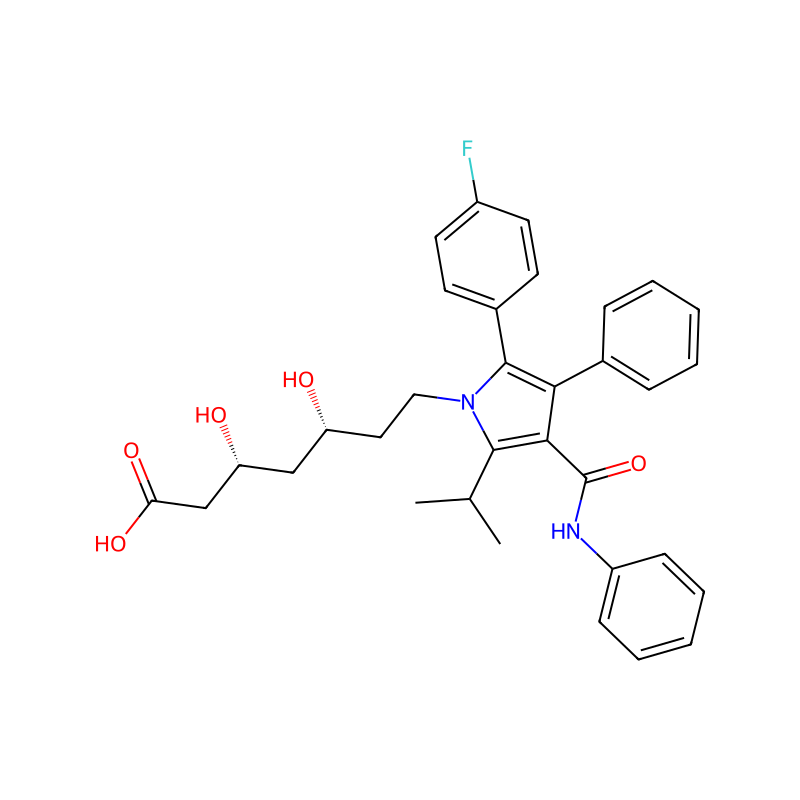
Identifikatoren & physikalische Daten
| CAS No. | 134523-00-5 |
|---|---|
| Summenformel | C33H35FN2O5 |
| Durchschnittliche Molmasse | 558,6 g/mol |
| Monoisotopische Masse | 558,25300038 g/mol |
| SMILES | CC(C)c1c(C(=O)Nc2ccccc2)c(-c2ccccc2)c(-c2ccc(F)cc2)n1CC[C@@H](O)C[C@@H](O)CC(=O)O |
| InChIKey | XUKUURHRXDUEBC-KAYWLYCHSA-N |
| PubChem CID | 60823 |
| ChEMBL | CHEMBL1487 |
| ChEBI | CHEBI:39548 |
| EC No. | 806-698-0 |
| DTXSID | DTXSID8029868 |
Chemische & physikalische Eigenschaften
| XLogP | 5 |
|---|---|
| Polarare Oberfläche (TPSA) | 112 |
| H-Brücken-Donoren | 4 |
| H-Brücken-Akzeptoren | 6 |
| Frei drehbare Bindungen | 12 |
| Schwere Atome | 41 |
| Formalladung | 0 |
| Komplexität | 822 |
| LogP (Verteilungskoeffizient) | 6.36 |
| Löslichkeit | Practically insolubleDMSO: 100 mg/mL (179.01 mM) |
| Siedepunkt | 722722.2±60.0 °C(Predicted) |
| Schmelzpunkt | 176159.1 - 190.6 °C176-178°C |
| Optical Rotation | White to off-white crystalline powder. Specific optical rotation at 25 °C for D (sodium) line = -7.4 deg (c = 1 in DMSO). Freely soluble in methanolslightly soluble in ethanolvery slightly soluble in acetonitrile, distilled water, phosphate buffer (pH 7.4). Insoluble in aqueous solutions of pH 4 and below. /Atorvastatin calcium salt trihydrate/ |
| Physical Description | Solid |
| Stability/Shelf Life | Stable under recommended storage conditions. /Atorvastatin calcium salt trihydrate/ |
| Dissociation Constants | 4.464.54 |
| Collision Cross Section | 224.3 Ų [M]+ [CCS Type: DTBuffer gas: N2Ionization: APCI+Dataset: TOXCASTSource Identifier: DTXSID6044303]231.4 Ų [M+Na]+ [CCS Type: DTIonization: ESI+Source Identifier: DTXSID8029868]229.7 Ų [M+H]+ [CCS Type: DT232.2 Ų [M+Na]+ [CCS Type: DT229.1 Ų [M+H]+ [CCS Type: DT228.4 Ų [M-H]- [CCS Type: DTIonization: ESI-228.6 Ų [M-H]- [CCS Type: DT229.8 Ų [M+H]+ [CCS Type: DT230.3 Ų [M+H]+ [CCS Type: DT213.25 Ų [M+H-H2O]+ [CCS Type: TWMethod: calibrated with polyalanine and drug standards]229.87 Ų [M+Na]+ [CCS Type: TW231.37 Ų [M+K]+ [CCS Type: TW231.29 Ų [M+H]+ [CCS Type: TW233 Ų [M+H]+ [CCS Type: TWMethod: Major Mix IMS/Tof Calibration Kit (Waters)]233.34 Ų [M+H]+231.92 Ų [M-H]-233.2 Ų [M+Na]+ |
| Other Experimental Properties | pKa= 4.46. Solubility in water (30 °C) = 20.4 ug/mL (pH 2.1)1.23 mg/mL (pH 6.0) /Atorvastatin sodium salt/MP: 159.2-160.7 °C. Specific optical rotation: +26.05 deg at 25 °C/D (c = 1 in chloroform) /Atorvastatin lactone/ |
| Dichte | 1.23±0.1 g/cm3(Predicted) |
| Lagerbedingungen | 2-8°C |
| Aggregatzustand | Solid |
| pKa (Säurekonstante) | pKa 4.46(H2O t=30 Iuncontrolled) (Uncertain) |
| Farbe | White to light yellow |
| Hauptanwendungen | pharmaceutical |
| InChIKey | XUKUURHRXDUEBC-FQWVHLSFNA-N |
| SMILES | C(C1=C(N(CC[C@@H](O)C[C@@H](O)CC(=O)O)C(C2C=CC(F)=CC=2)=C1C1C=CC=CC=1)C(C)C)(=O)NC1C=CC=CC=1 |&1:6,9,r| |
| CAS Datenbank | 134523-00-5(CAS DataBase Reference) |
| EPA chemische Informationen | 1H-Pyrrole-1-heptanoic acid, 2-(4-fluorophenyl)-?,?-dihydroxy-5-(1-methylethyl)-3-phenyl-4-[(phenylamino)carbonyl]-, (?R,?R)- (134523-00-5) |
Sicherheit & Vorschriften
| GHS-Einstufung | WarningH315 (66.7%): Causes skin irritation [Warning Skin corrosion/irritation]H319 (66.7%): Causes serious eye irritation [Warning Serious eye damage/eye irritation]H335 (66.7%): May cause respiratory irritation [Warning Specific target organ toxicity, single exposureRespiratory tract irritation]H361 (33.3%): Suspected of damaging fertility or the unborn child [Warning Reproductive toxicity]H361f (33.3%): Suspected of damaging fertility [Warning Reproductive toxicity]H361fd (33.3%): Suspected of damaging fertilitySuspected of damaging the unborn child [Warning Reproductive toxicity]H362 (66.7%): May cause harm to breast-fed children [Reproductive toxicity, effects on or via lactation]P203, P260, P261, P263, P264, P264+P265, P270, P271, P280, P302+P352, P304+P340, P305+P351+P338, P318, P319, P321, P332+P317, P337+P317, P362+P364, P403+P233, P405, and P501 (click each P-code to see the statement)Aggregated GHS information provided per 3 reports by companies from 3 notifications to the ECHA C&L Inventory. Each notification may be associated with multiple companies.Information may vary between notifications depending on impurities, additives, and other factors. The percentage value in parenthesis indicates the notified classification ratio from companies that provide hazard codes. Only hazard codes with percentage values above 10% are shown. For more detailed information, please visit ECHA C&L website. |
|---|---|
| FDA-Anforderungen | The Approved Drug Products with Therapeutic Equivalence Evaluations identifies currently marketed prescription drug products, including atorvastatin calcium, approved on the basis of safety and effectiveness by FDA under sections 505 of the Federal Food, Drug, and Cosmetic Act. /Atorvastatin calcium/ |
| Toxic Combustion Products | Special hazards arising from the substance or mixture: Carbon oxides, nitrogen oxides (NOx), hydrogen fluoride, calcium oxide /Atorvastatin calcium salt trihydrate/ |
| Hazard Classes and Categories | Skin Irrit. 2 (66.7%)Eye Irrit. 2 (66.7%)STOT SE 3 (66.7%)Repr. 2 (33.3%)Lact. (66.7%) |
Anwendungen & Verwendung
History
Parke-Davis's Lipitor (Atorvastatin) was discovered in the mid- to late 1980s and brought to market in 1997. Already ahead of it were four statins: Merck's Mevacor and Zocor, Bristol-Myers Squibb's Pravachol, and Sandoz's Lescol. Despite the competition, by 2006 Lipitor had become the best-selling drug in history, with one-year sales totaling $12.9 billion, more than the net worth of the 10th biggest drug company in the world.
Verwenden
antihyperlipoproteimic;HMG-CoA reductase inhibition