
Butyllithium
n-Butyl lithium
Daten werden ergänzt – lade die Seite später neu, um den aktuellen Stand zu sehen
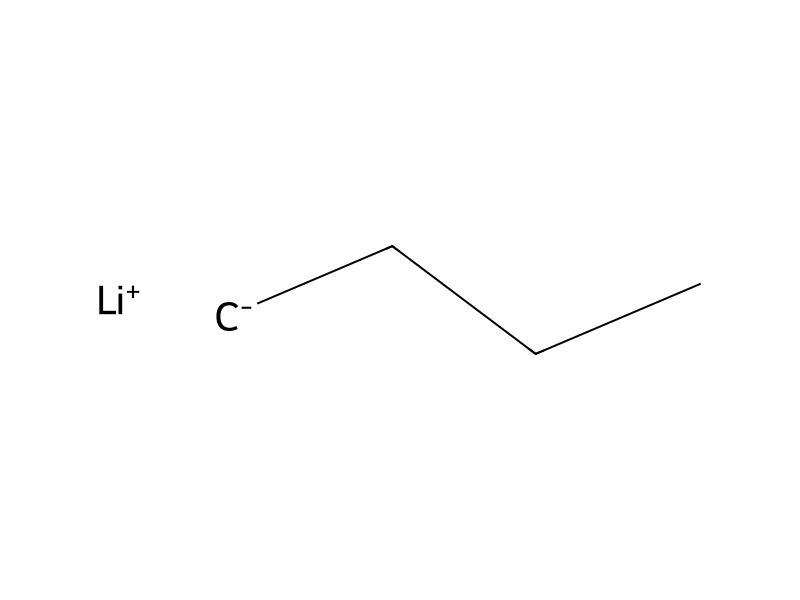
Grundinformationen
- CAS
109-72-8- Standard-SMILES
[CH2-]CCC.[Li+]- InChIKey
DLEDOFVPSDKWEF-UHFFFAOYSA-N- Summenformel
- C4H9Li
- Durchschnittliche Molmasse
- 64,1 g/mol
Überblick
Butyllithium is an alkyllithium compound.
Namen und Bezeichner
- Bevorzugter Name
- n-Butyl lithium
- IUPAC
- lithium butane
- Lokaler Name
- Butyllithium
- Englischer Name
- n-Butyllithium
- Summenformel
- C4H9Li
- Molmasse
- 64.06
Namen und Synonyme
lithium;butanen-Butyl lithiumC4H9LiLiBun-butyllitiumMFCD00009414BuLibutyilithiumbutyllitiumUNII-09W9A6B8ZCbutyl-lithiumn-butyllithiurn
Weitere Namen anzeigen
N-BULIBUTYLLITHIUMLithiumn-butylButyllithium solutionn-ButyllithiuM(BULI)ButyllithiuminhexaneMn-BuLi, Lithium-1-butaniden-Butyllithium, 1.6M solution in hexanesbutyl-lithiu
n-butyllithumn-Buyllithiumn- butyllithiumn-butyl-lithiumnButLi1-butyllithiumn-buty lithiumn-butyl lithum
Datenbank-Bezeichner
- CAS
109-72-8- PubChem CID
- 61028
- ChEBI
CHEBI:51469- UNII
- 09W9A6B8ZC
- Nikkaji
- J370K
Eigenschaften
Berechnete StruktureigenschaftenWird ergänzt
- Polarare Oberfläche (TPSA)
- 0 Ų
- H-Brücken-Donoren
- 0
- H-Brücken-Akzeptoren
- 1
- Frei drehbare Bindungen
- 1
- Schwere Atome
- 5
- Formalladung
- 0
- Komplexität
- 7,6
Physikochemische Eigenschaften
- Schmelzpunkt
- -95 °C · -95 °C
- Siedepunkt
- 80 °C · 80 °C
- Dichte
- 0.68 g/mL · 0.68 g/mL at 20 °C
- Dampfdruck
- 163 hPa · 163 hPa ( 20 °C)
- Flammpunkt
- 10 °F · 10 °F
- storage temp.
- 2 · 2-8°C
- Löslichkeit
- Miscible with diethyl ether and cyclohexane.
- Aggregatzustand
- liquid
- Farbe
- yellow
- Wichte
- 0.695 · 0.695
- Geruch (Odor)
- Odor of the solvent
- Explosionsgrenze
- 1.2 · 1.2-7.8% (v/v)
- Wasserlöslichkeit
- vigorous reaction
- BRN
- 1209227 · 1209227
- InChI
- 1S/C4H9.Li/c1-3-4-2;/h1,3-4H2,2H3;
- InChIKey
- MZRVEZGGRBJDDB-UHFFFAOYSA-N
- SMILES
- [Li]CCCC
Sicherheit und Regulatorisches
Sicherheitsangaben dienen nur zur Orientierung und ersetzen weder das Sicherheitsdatenblatt (SDB) des Lieferanten noch geltende Vorschriften oder eine fachliche Bewertung.
Gefahrenhinweise
CSL Reaction Information
CSL00127
Perfluorethyllithium + Phosphorus Trichloride,Phosphorus + N-BUTYLLITHIUM + CHLOROPENTAFLUOROETHANE
Avoid temperatures below -90 C
Substitution
Several times in our laboratory, we have experienced a violent decomposition of the ethereal C2F5Cl/n-BuLi solution after the addition of just a few drops of (R)nPCl3=n. In each of these cases, the metal-halogen exchange temperature was maintained below -90 C. We believe that this problem is due to a buildup of starting reagents at low temperatures.
C&EN
Sicherheitsdaten
- F
- 3-10
- wgk
- 3
- tsca
- TSCA listed
- ridadr
- UN 3399 4.3/PG 1
- hs_code
- 29319090
- risk_code
- 14/15-17-34-48/20-51/53-62-65-67-63-35-11-15-50/53-66
- Toxizität
- There is little toxicity data available for the butyllithiums; for data on ether and hydrocarbon solvents, see the appropriate LCSSs.
- hazard_code
- F,C,N
- safety_code
- 6-9-16-26-36/37/39-45-61-62-6A-46-43B-43-60-33-29-5
- hazard_class
- 4.3
- packing_group
- I
- Speicherklasse
- 4.2 - Pyrophoric and self-heating hazardous materials
- Hazard Classifications
- Aquatic Chronic 2Asp. Tox. 1Eye Dam. 1Flam. Liq. 2Pyr. Liq. 1Skin Corr. 1BSTOT SE 3Water-react 1
- Selbstentzündungstemperatur
- 240°C
Chemie und Industrie
Anwendungen
Verwendenn-Butyllithium is used as a polymerization initiator in the production of elastomers like polybutadiene and styrene- butadiene- styrene. As a strong base, it is utilized in the synthesis of organic compounds. It undergoes thermal decomposition to prepare 1-butene.
Darstellung
synthetischeIndustrially, n-butyllithium is produced by the reaction of n-butyl chloride with lithium metal dispersion in various hydrocarbon solvents. Hexane is the most commonly used solvent. Up to one-half of the lithium is replaced with sodium in order to lower the cost of the butyllithium and increase the reactivity of the dispersion. The reaction is carried out below the boiling point of the solvent.The laboratory procedure is essentially the same except that pentane and diethyl ether are two of the more popular solvents. The preparation runs smoothly in ether at lower temperatures but the product must either be used immediately or kept refrigerated due to the rapid cleavage of ether by n-butyllithium.
Vor- und nachgelagerte Produkte
Vorgelagerte Rohstoffe
Nachgelagerte Produkte
Zugehörige Reaktionen
205


Notizen zur Verbindung
Wird geladen…