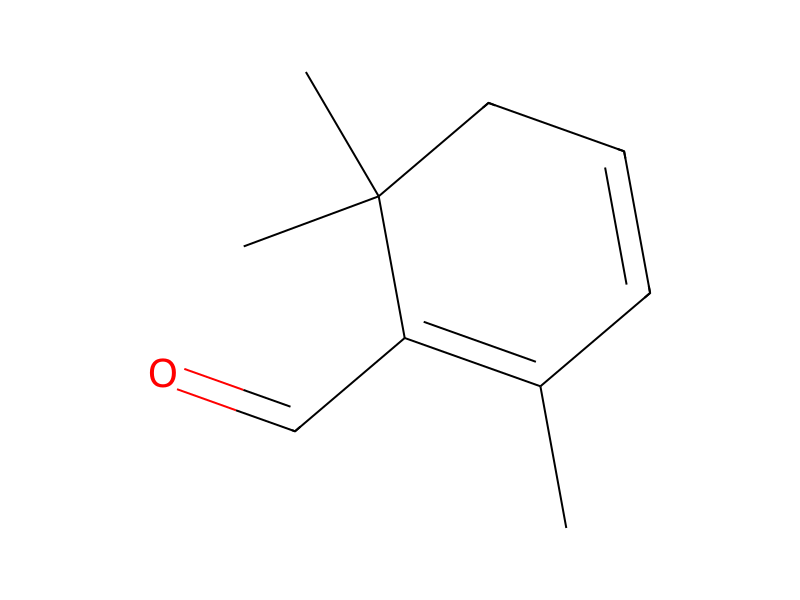
Safranal
Grundinformationen
- CAS
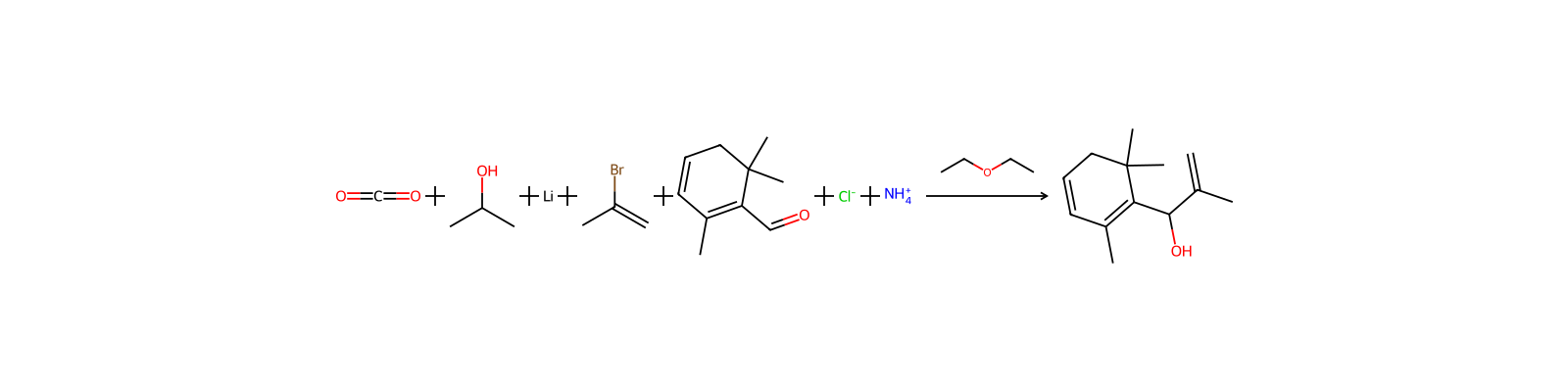
116-26-7- Standard-SMILES
CC1=C(C=O)C(C)(C)CC=C1- InChIKey
SGAWOGXMMPSZPB-UHFFFAOYSA-N- Summenformel
- C10H14O
- Durchschnittliche Molmasse
- 150,22 g/mol
- Monoisotopische Masse
- 150,10446507
Überblick
Safranal is a monoterpenoid formally derived from beta-cyclocitral by dehydrogenation. It is the major volatile component of saffron responsible for the characteristic aroma of saffron. It has a role as an antineoplastic agent, a radical scavenger, a neuroprotective agent, an anti-inflammatory agent, a nephroprotective agent and a plant metabolite. It is functionally related to a beta-cyclocitral.
Namen und Bezeichner
- Bevorzugter Name
- Safranal
- IUPAC
- 2,6,6-trimethylcyclohexa-1,3-diene-1-carbaldehyde
- Englischer Name
- SAFRANAL
- Summenformel
- C10H14O
- Molmasse
- 150.22
Namen und Synonyme
Safranal116-26-72,3-Dihydro-2,2,6-trimethylbenzaldehyde2,6,6-trimethylcyclohexa-1,3-diene-1-carbaldehyde1,3-CYCLOHEXADIENE-1-CARBOXALDEHYDE, 2,6,6-TRIMETHYL-2,6,6-trimethyl-1,3-cyclohexadiene-1-carboxaldehydeDehydro-beta-cyclocitral2,6,6-Trimethyl-1,3-cyclohexadienal(2,6,6-Trimethylcyclohexa-1,3-dienyl)methanalFEMA No. 3389DTXSID70493981,1,3-Trimethyl-2-formylcyclohexa-2,4-diene
Weitere Namen anzeigen
FEMA 33892,3-Dihydro-2,2,6-trimethylbenzalhydeSAFRANAL 88+%Safranal (>80%)
2,6,6-Trimethylcyclohexa-1,3-dienyl methanalCHEBI:531694393FR07EADTXCID4029357RefChem:884355204-133-72,6,6-trimethylcyclohexa-1,3-dienecarbaldehydeMFCD00209531
Datenbank-Bezeichner
- CAS
116-26-7- PubChem CID
Eigenschaften
Berechnete Struktureigenschaften
- XLogP
- 2,1
- Polarare Oberfläche (TPSA)
- 17,1 Ų
- H-Brücken-Donoren
- 0
- H-Brücken-Akzeptoren
- 1
- Frei drehbare Bindungen
- 1
- Schwere Atome
- 11
- Formalladung
- 0
- Komplexität
- 231
Experimentelle und physikochemische Eigenschaften
Fragrances
Fragrance substance (2,6,6-Trimethylcyclohex-1,3-dienyl methanal) -> IFRA amendment 49
Fragrance Ingredient (2,6,6-Trimethylcyclohexa-1,3-dienyl methanal) -> IFRA transparency List
Food AdditivesFLAVORING AGENT OR ADJUVANT -> FDA Substance added to food
Density0.968-0.980 (20 °C)
Flavoring AgentsEU Flavoring substances
Solubility
Insoluble in water; soluble in oils
Miscible at room temperature (in ethanol)
Boiling Point
70.00 °C. @ 1.00 mm Hg
70 °C (1 mm Hg);
Melting Point< 25 °C
Refractive Index1.525-1.533
Physical Description
Solid
Pale yellowish oily liquid; powerful, sweet green-floral and somewh/ tobacco-herbaceous odour.
Sicherheit und Regulatorisches
Sicherheitsangaben dienen nur zur Orientierung und ersetzen weder das Sicherheitsdatenblatt (SDB) des Lieferanten noch geltende Vorschriften oder eine fachliche Bewertung.
GHS-Klassifizierung
GHS Classification
Warning
H302 (80.4%): Harmful if swallowed [Warning Acute toxicity, oral]
P261, P264, P264+P265, P270, P272, P273, P280, P301+P317, P302+P352, P305+P351+P338, P321, P330, P332+P317, P333+P317, P337+P317, P362+P364, and P501 (click each P-code to see the statement)
Aggregated GHS information provided per 1700 reports by companies from 11 notifications to the ECHA C&L Inventory. Each notification may be associated with multiple companies.
Gefahrenhinweise
Regulatory Information
Chemical: 1,3-Cyclohexadiene-1-carboxaldehyde, 2,6,6-trimethyl-
Commission Regulation (EC) No 1565/2000 (Repealed by Com. Implementing Reg. (EU) No 872/2012)
Status: Active Update: 01-12-2021 https://echa.europa.eu/registration-dossier/-/registered-dossier/17302
1,3-Cyclohexadiene-1-carboxaldehyde, 2,6,6-trimethyl-: Does not have an individual approval but may be used under an appropriate group standard
Other Safety InformationIMAP assessments - 1,3-Cyclohexadiene-1-carboxaldehyde, 2,6,6-trimethyl-: Environment tier I assessment
Hazard Classes and CategoriesAcute Tox. 4 (80.4%)
Sicherheitsdaten
- wgk
- 3
- tsca
- TSCA listed
- risk_code
- 36/37/38
- hazard_code
- Xi
- safety_code
- 26-36
- Speicherklasse
- 10 - Combustible liquids
Chemie und Industrie
Pharmakologische Informationen
Cellular LocationsExtracellular
Verwendung und Herstellung
IFRA Fragrance Standards
2,6,6-Trimethylcyclohex-1,3-dienyl methanal
2,6,6-Trimethylcyclohexa-1,3-diene-1-carbaldehyde; 2,6,6-Trimethyl-1,3-cyclohexadienal; 2,6,6-Trimethyl-1,3-cyclohexadien-1-carboxaldehyde; 1,1,3-Trimethyl-2-formylcyclohexa-2,4-diene; Dehydro-β-cyclocitral; Safranal (commercial name)
IFRA_STD_082.pdf
49
IFRA 51st Amendment - Guidance for the use of IFRA Standards
Restriction: This material should be used only in the limited quantity as stated in the Standard
Use Classification
Fragrance Ingredients
Flavouring Agent -> FLAVOURING_AGENT -> JECFA Functional Classes
Flavoring Agents -> JECFA Flavorings Index
Flavouring Agent -> FLAVOURING_AGENT -> JECFA Functional Classes
Flavouring Agent -> FLAVOURING_AGENT -> JECFA Functional Classes
Flavouring Agent -> FLAVOURING_AGENT -> JECFA Functional Classes
General Manufacturing Information1,3-Cyclohexadiene-1-carboxaldehyde, 2,6,6-trimethyl-: ACTIVE
Restriction Limits in the Finished Product (%)
0.0022 [Products applied to the lips]
0.00066 [Products applied to the axillae]
0.013 [Products applied to the face/body using fingertips]
0.012 [Products related to fine fragrances]
0.0032 [Products applied to the body using the hands (palms), primarily leave-on (Body lotion)]
0.0032 [Products applied to the face using the hands (palms), primarily leave-on (Face moisturizer)]
Anwendungen
Zugehörige Reaktionen
14


Notizen zur Verbindung
Wird geladen…