
Lipoic acid
Daten werden ergänzt – lade die Seite später neu, um den aktuellen Stand zu sehen
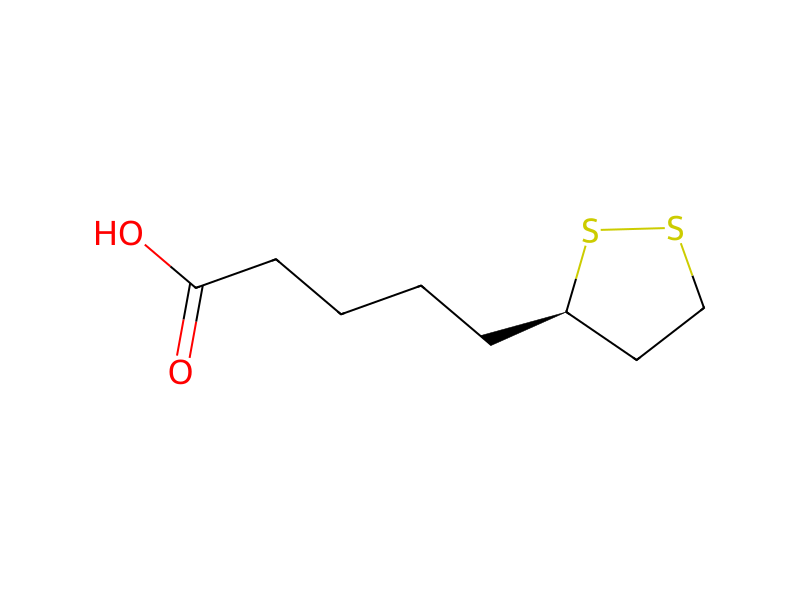
Grundinformationen
- CAS
1200-22-2- Standard-SMILES
O=C(O)CCCC[C@@H]1CCSS1- InChIKey
AGBQKNBQESQNJD-SSDOTTSWSA-N- Summenformel
- C8H14O2S2
- Durchschnittliche Molmasse
- 206,3 g/mol
- Monoisotopische Masse
- 206,04352169
Überblick
(R)-lipoic acid is the (R)-enantiomer of lipoic acid. A vitamin-like, C8 thia fatty acid with anti-oxidant properties. It has a role as a cofactor, a prosthetic group and a nutraceutical. It is a lipoic acid, a member of dithiolanes, a heterocyclic fatty acid and a thia fatty acid. It is functionally related to an octanoic acid. It is a conjugate acid of a (R)-lipoate. It is an enantiomer of a (S)-lipoic acid.
Namen und Bezeichner
- Bevorzugter Name
- Lipoic acid
- IUPAC
- 5-[(3R)-dithiolan-3-yl]pentanoic acid
- Englischer Name
- (R)-Lipoic acid
- Summenformel
- C8H14O2S2
- Molmasse
- 206.33
Namen und Synonyme
lipoic acid(R)-lipoic acid(R)-5-(1,2-Dithiolan-3-yl)pentanoic acid(R)-alpha-Lipoic acidD-Thioctic acid(R)-(+)-1,2-Dithiolane-3-pentanoic acidR-(+)-Thioctic acid(+)-alpha-Lipoic acid1,2-Dithiolane-3-pentanoic acid, (3R)-R-alpha-Lipoic acidThioctic acid d-form5-[(3R)-dithiolan-3-yl]pentanoic acid
Weitere Namen anzeigen
ipoic acidTiobe(R)-(+)-α
BerlitionThiogammaLipoecTiobec5-[(3R)-1,2-dithiolan-3-yl]pentanoic acidR-Lipoic acid(R)-(+)-lipoic acid(R)-1,2-Dithiolane-3-pentanoic acid
Datenbank-Bezeichner
- CAS
1200-22-2、62-46-4- PubChem CID
- 6112
- DTXSID
DTXSID20152651- ChEBI
CHEBI:30314- UNII
- VLL71EBS9Z
- Nikkaji
- J9.331I
Eigenschaften
Berechnete StruktureigenschaftenWird ergänzt
- XLogP
- 1,7
- Polarare Oberfläche (TPSA)
- 87,9 Ų
- H-Brücken-Donoren
- 1
- H-Brücken-Akzeptoren
- 4
- Frei drehbare Bindungen
- 5
- Schwere Atome
- 12
- Formalladung
- 0
- Komplexität
- 150
Experimentelle und physikochemische Eigenschaften
DrugsPharmaceuticals -> Listed in ZINC15
LipidsFatty Acyls [FA] -> Fatty Acids and Conjugates [FA01] -> Thia fatty acids [FA0113]
SpringerMaterials PropertiesCrystal structure
SolubilityInsoluble
Melting Point60.5 °C
Physical DescriptionSolid
Physikochemische Eigenschaften
- Schmelzpunkt
- 48 · 48-52 °C(lit.)
- Siedepunkt
- 185 · 185-195 °C(Press: 0.5 Torr)
- Dichte
- 1.218 · 1.218±0.06 g/cm3(Predicted)
- Brechungsindex
- 114 ° · 114 ° (C=1, EtOH)
- Flammpunkt
- 230 °F · >230 °F
- storage temp.
- -20 °C · -20°C
Sicherheit und Regulatorisches
Sicherheitsangaben dienen nur zur Orientierung und ersetzen weder das Sicherheitsdatenblatt (SDB) des Lieferanten noch geltende Vorschriften oder eine fachliche Bewertung.
Sicherheitsdaten
- wgk
- 3
- hs_code
- 29349990
- risk_code
- 22-36/38
- safety_code
- 20-36-26-35
- Speicherklasse
- 11 - Combustible Solids
Chemie und Industrie
Pharmakologische Informationen
Pharmacodynamics
Lipoic acid (or α-lipoic acid) is able to pass the blood-brain barrier and is putatively used for detoxification of mercury attached to the brain cells. It can mobilise bound mercury into the blood stream as it is a mercaptan (sulfur compound which readily binds to the mercury). In the blood stream, another chelator such as dimercaptosuccinic acid (DMSA) or methylsulfonylmethane (MSM) is used to transfer mercury safely into the urine for excretion. Since DMSA cannot cross the blood-brain barrier, both lipoic acid and DMSA tend to be used together. It is hypothesized that this treatment-along with carnitine, dimethylglycine (DMG), Vitamin B6, folic acid, and magnesium—could be used to treat autism and amalgam poisoning. In this hypothesis, the reason why autism is difficult to treat is that mercury is attached to the brain cells and most medicines and vitamin supplements do not penetrate the blood-brain barrier. However, α-lipoic acid and perhaps vitamin B12 could making it possible for other chelators to remove mercury safely out of the body and could perhaps one day be used as a treatment for autism. Because lipoic acid is related to cellular uptake of glucose and it is both soluble in water and fat, it is being used for treatment in diabetes. It may be helpful for people with Alzheimer's disease or Parkinson's disease.
Mechanism of Action
Lipoic Acid is generally involved in oxidative decarboxylations of keto acids and is presented as a growth factor for some organisms. Lipoic acid exists as two enantiomers, the R-enantiomer and the S-enantiomer. Normally only the R-enantiomer of an amino acid is biologically active, but for lipoic acid the S-enantiomer assists in the reduction of the R-enantiomer when a racemic mixture is given. Some recent studies have suggested that the S-enantiomer in fact has an inhibiting effect on the R-enantiomer, reducing its biological activity substantially and actually adding to oxidative stress rather than reducing it. Furthermore, the S-enantiomer has been found to reduce the expression of GLUT-4s in cells, responsible for glucose uptake, and hence reduce insulin sensitivity.
Tissue LocationsKidney
Cellular LocationsCytoplasm
Zugehörige Reaktionen
49


Notizen zur Verbindung
Wird geladen…