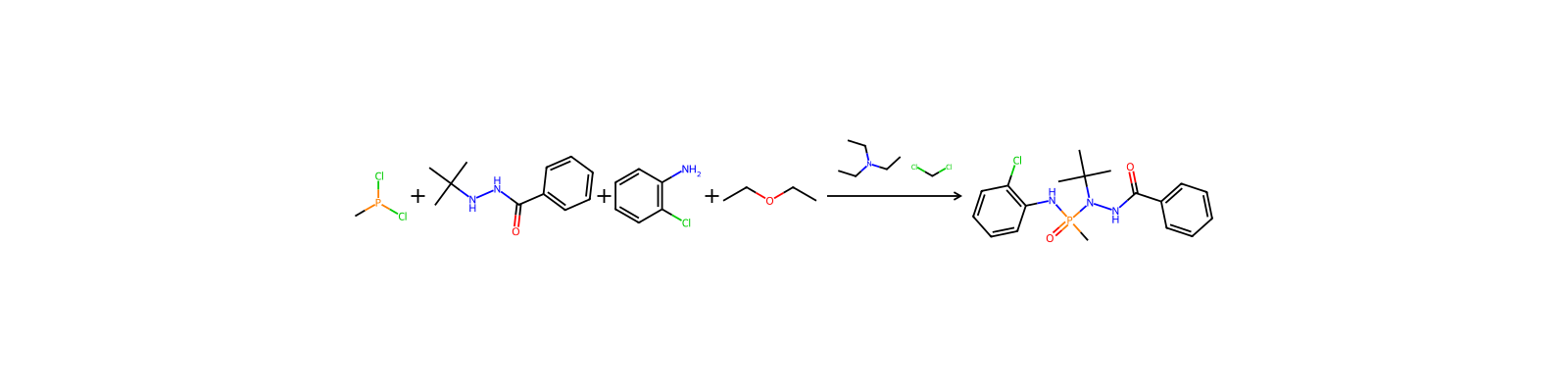

Grundinformationen
- Standard-SMILES
CP(Cl)Cl- InChIKey
CDPKWOKGVUHZFR-UHFFFAOYSA-N- Summenformel
- CH3Cl2P
- Durchschnittliche Molmasse
- 116,91 g/mol
- Monoisotopische Masse
- 115,93494209
Überblick
Methyl phosphonous dichloride appears as a colorless liquid with a pungent odor. Very toxic by inhalation. Denser than water.
Namen und Bezeichner
- Bevorzugter Name
- Methyl phosphonous dichloride
- IUPAC
- dichloro(methyl)phosphane
- Lokaler Name
- methylphosphoniges Saeuredichlorid
- Englischer Name
- Methyldichlorophosphine
- Summenformel
- CH3Cl2P
- Molmasse
- 116.91
Namen und Synonyme
676-83-5Methylphosphonous dichlorideMethyl phosphonous dichlorideMethylphosphorus dichloridePHOSPHONOUS DICHLORIDE, METHYL-Phosphonous dichloride, P-methyl-EINECS 211-631-8DTXSID1060978EC 211-631-8Phosphine, dichloromethylRefChem:818046methylphosphinic dichloride
Weitere Namen anzeigen
DICHLOROMETHYLPHOSPHINEAURORA KA-1256Methyldichlorophosphanemethylphosphonousdichloridemethyl-phosphonousdichloridMETHYLDICHLOROPHOSPHINE,97%
DTXCID6044931METHYLPHOSPHINOUS DICHLORIDE211-631-8Methyldichlorophosphinedichloro(methyl)phosphaneCH3PCl2dichloro(methyl)phosphinePhosphine, dichloromethyl-
Datenbank-Bezeichner
- CAS
676-83-5- PubChem CID
- 61194
- DTXSID
DTXSID1060978- EC Number
- 211-631-8
- Nikkaji
- J34.671C
Eigenschaften
Berechnete Struktureigenschaften
- XLogP
- 1,5
- Polarare Oberfläche (TPSA)
- 0 Ų
- H-Brücken-Donoren
- 0
- H-Brücken-Akzeptoren
- 0
- Frei drehbare Bindungen
- 0
- Schwere Atome
- 4
- Formalladung
- 0
- Komplexität
- 13,5
Experimentelle und physikochemische Eigenschaften
Chemical Classes
Toxic Gases & Vapors -> Acid Halides
Flammable agents - 3rd degree
SpringerMaterials PropertiesSchoenflies notation
Density1.3 @25 °C
Vapor Pressure75.0 [mmHg]
Physical Description
Methyl phosphonous dichloride appears as a colorless liquid with a pungent odor. Very toxic by inhalation. Denser than water.
Colorless liquid with a pungent odor; [CAMEO]
Physikochemische Eigenschaften
- Schmelzpunkt
- 81.5 °C · 81.5 °C
- Siedepunkt
- 81 · 81-82 °C
- Dichte
- 1.3 · 1.3
- Brechungsindex
- 1.4944 · 1.4944-1.4964
- Flammpunkt
- 48 °C · 48 °C
- storage temp.
- Flammables area
- Aggregatzustand
- Liquid
- Farbe
- Colorless
- Wasserlöslichkeit
- Reacts with water.
- InChI
- 1S/CH3Cl2P/c1-4(2)3/h1H3
- InChIKey
- CDPKWOKGVUHZFR-UHFFFAOYSA-N
- SMILES
- CP(Cl)Cl
- EPA chemische Informationen
- Methylphosphonous dichloride (676-83-5)
Sicherheit und Regulatorisches
GHS-Klassifizierung
GHS Classification
Danger
H226 (29.1%): Flammable liquid and vapor [Warning Flammable liquids]
P210, P222, P231, P233, P240, P241, P242, P243, P260, P261, P262, P264, P264+P265, P270, P271, P280, P301+P316, P301+P317, P301+P330+P331, P302+P335+P334, P302+P352, P302+P361+P354, P303+P361+P353, P304+P340, P305+P354+P338, P316, P317, P321, P330, P361+P364, P363, P370+P378, P403+P233, P403+P235, P405, and P501 (click each P-code to see the statement)
Aggregated GHS information provided per 148 reports by companies from 5 notifications to the ECHA C&L Inventory. Each notification may be associated with multiple companies.
Gefahrenhinweise
Hazards IdentificationToxic/poison by inhalation (TIH/PIH)
Regulatory Information
Chemical: Phosphonous dichloride, methyl-
Status: Active Update: 25-04-2018 https://echa.europa.eu/registration-dossier/-/registered-dossier/12194
The New Jersey Worker and Community Right to Know Act requires public and private employers to provide information about hazardous substances at their workplaces. (N.J.S.A. 34:5A-1 et. seq.)
DOT LabelPoison Inhalation Hazard Spontaneously Combustible
Fire Hazards
Excerpt from ERG Guide 135 [Substances - Spontaneously Combustible]:
· Flammable/combustible material.
Health Hazards
Excerpt from ERG Guide 135 [Substances - Spontaneously Combustible]:
· Fire will produce irritating, corrosive and/or toxic gases.
Hazards Summary
Reacts with water to generate hydrogen chloride, a reaction that may be violent and ignite nearby combustible materials; May cause burns; Very toxic by inhalation; [CAMEO] Corrosive; Highly flammable; Reacts violently with water; Inhalation may cause chemical pneumonitis; [MSDSonline]
DOT ID and Guide2845 135
Reactive GroupAcyl Halides, Sulfonyl Halides, and Chloroformates
Reactivity AlertsWater-Reactive
Reactivity Profile
METHYL PHOSPHONOUS DICHLORIDE is water reactive. Incompatible with strong oxidizing agents, alcohols, bases (including amines). May react vigorously or explosively if mixed with diisopropyl ether or other ethers in the presence of trace amounts of metal salts [J. Haz. Mat., 1981, 4, 291].
Air and Water ReactionsHighly flammable. Forms fumes containing HCl in moist air. Can spontaneously ignite on contact with moist air. Reacts with water to form hydrochloric acid, reaction may be violent and ignite unreacted material.
Hazard Classes and Categories
Flam. Liq. 3 (29.1%)
Flammable agents - 3rd degree, Reactive agents - 3rd degree
Sicherheit und Schutzausrüstung
Fire FightingExcerpt from ERG Guide 135 [Substances - Spontaneously Combustible]:
Accidental Release Measures
· CALL 911. Then call emergency response telephone number on shipping paper. If shipping paper not available or no answer, refer to appropriate telephone number listed on the inside back cover.
· ELIMINATE all ignition sources (no smoking, flares, sparks or flames) from immediate area.
First Aid
Excerpt from ERG Guide 135 [Substances - Spontaneously Combustible]:
General First Aid:
Exposure Control and Personal Protection
· Wear positive pressure self-contained breathing apparatus (SCBA).
TIH (Toxic Inhalation Hazard) - Term used to describe gases and volatile liquids that are toxic when inhaled. Some are TIH materials themselves, e.g., chlorine, and some release TIH gases when spilled in water, e.g., chlorosilanes. [ERG 2016].
Nonfire Spill ResponseExcerpt from ERG Guide 135 [Substances - Spontaneously Combustible]:
Isolation and Evacuation
Excerpt from ERG Guide 135 [Substances - Spontaneously Combustible]:
Immediate precautionary measure
Small spill:
Small spill:
Protective Action Criteria (PAC)
2.5 [mg/m3]
27 [mg/m3]
160 [mg/m3]
Personal Protective Equipment (PPE)Excerpt from ERG Guide 135 [Substances - Spontaneously Combustible]:
Emergency Response Planning Guidelines· DO NOT USE WATER, CO2 OR FOAM ON MATERIAL ITSELF.
Toxikologische Informationen
Adverse EffectsDermatotoxin - Skin burns.
Sicherheitsdaten
- wgk
- 3
- tsca
- TSCA listed
- ridadr
- 2845
- hs_code
- 29310099
- risk_code
- 34-29-23/24/25-17-14-10
- hazard_code
- T-F,T,F
- safety_code
- 8-45-43-36/37/39-33-26-16-23
- hazard_class
- 6.1
- packing_group
- I
- Speicherklasse
- 4.2 - Pyrophoric and self-heating hazardous materials
- Hazard Classifications
- Acute Tox. 4 InhalationAcute Tox. 4 OralEye Dam. 1Pyr. Liq. 1Skin Corr. 1B
Chemie und Industrie
Verwendung und Herstellung
General Manufacturing InformationPhosphonous dichloride, P-methyl-: ACTIVE
Anwendungen
VerwendenMethyldichlorophosphine is used to prepare difunctional phosphonoamidite coupling reagents in nucleoside chemistry and "phospha-Wittig"reagents.
Vor- und nachgelagerte Produkte
Nachgelagerte Produkte
Anbieter20 Anbieter
VladaChem GmbH+49-7246-3082843 +86-18411632868 · [email protected]
Guangzhou Xijia New Materials Co.,Ltd13650882421 · [email protected]
阿法埃莎(中国)化学有限公司400-6106006 · [email protected]
上海瀚鸿科技股份有限公司021-54306202 13764082696 · [email protected]
赛默飞世尔科技(中国)有限公司800-810-5118 · [email protected]
天津安浩生物科技有限公司[email protected]
Sigma-Aldrich西格玛奥德里奇(上海)贸易有限公司021-61415566 800-8193336 · [email protected]
西安美川生物科技有限公司029-89275612 +8618991951683 · [email protected]
山东西亚化学有限公司4009903999 13395398332 · [email protected]
广州市金华大化学试剂有限公司020-84383047 · [email protected]
上海炎泽化工有限公司19901447308 19962611955 · [email protected]
广州喜嘉新材料有限公司02082180286 13650882421 · [email protected]
河南天孚化工有限公司+86-0371-55170693 +86-19937530512 · [email protected]
赫德瑞意(上海)新材料有限公司021-34202258 19391107643 · [email protected]
陕西缔都医药化工有限公司029-88380327 17691182729 · [email protected]
XIAMEN AMITY INDUSTRY AND TRADE CO., LTD.+8618950047208 · [email protected]
陕西缔都医药化工有限公司+86-29-81139210 17389186172 · [email protected]
Capot Chemical Co., Ltd+86 (0) 571 85 58 67 18
北京百灵威科技有限公司18210857532 18210857532 · [email protected]
上海珅桔化工有限公司13167128868 13248068001 · [email protected]
Zugehörige Reaktionen
7


Verknüpfte Notizen
Wird geladen…