
Dinatriummolybdat
Sodium Molybdate
Daten werden ergänzt – lade die Seite später neu, um den aktuellen Stand zu sehen
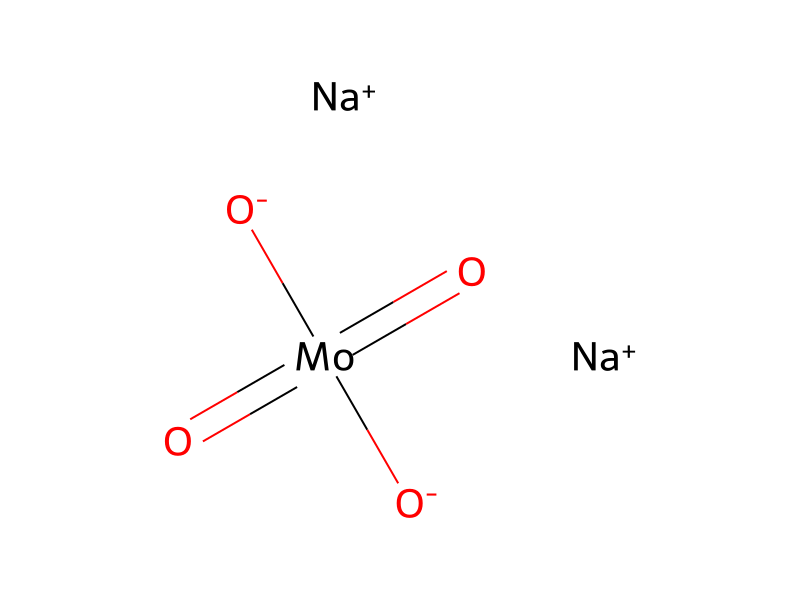
Grundinformationen
- CAS
13466-16-5- Standard-SMILES
[Na+].[Na+].[O]=[Mo](=[O])([O-])[O-]- InChIKey
TVXXNOYZHKPKGW-UHFFFAOYSA-N- Summenformel
- MoO4.2Na
- Durchschnittliche Molmasse
- 205,93 g/mol
Überblick
Sodium molybdate (anhydrous) is an inorganic sodium salt having molybdate as the counterion. It has a role as a NMR chemical shift reference compound and a poison. It contains a molybdate.
Namen und Bezeichner
- Bevorzugter Name
- Sodium Molybdate
- IUPAC
- disodium;dioxido(dioxo)molybdenum
- Lokaler Name
- Dinatriummolybdat
- Englischer Name
- Sodium molybdate
- Summenformel
- MoNa2O4
- Molmasse
- 205.91714
Namen und Synonyme
Sodium molybdateDisodium molybdateSodium molybdate(VI)Natriummolybdatsodium molybdenum oxideMolybdic acid, disodium saltsodium molybdate (anhydrous)Na2MoO4Anhydric sodium molybdate948QAQ08I1Molybdate (MoO42-), disodium, (T-4)-Molybdenum (as sodium)
Weitere Namen anzeigen
molybdicAnhydrous sodium molybdateSodium molybdatdisodiummolybdateSodiumMolybdateGrSodamidemolybdate
CHEBI:75215NSC-77389RefChem:887699231-551-77631-95-0Molybdate disodiumNatriummolybdat [German]Sodium molybdate (VAN)
Datenbank-Bezeichner
- CAS
13466-16-5、7631-95-0- PubChem CID
- 61424
- ChEBI
CHEBI:75215- UNII
- 948QAQ08I1
- EC Number
- 231-551-7
Eigenschaften
Berechnete StruktureigenschaftenWird ergänzt
- Polarare Oberfläche (TPSA)
- 80,3 Ų
- H-Brücken-Donoren
- 0
- H-Brücken-Akzeptoren
- 4
- Frei drehbare Bindungen
- 0
- Schwere Atome
- 7
- Formalladung
- 0
- Komplexität
- 62,2
Experimentelle und physikochemische Eigenschaften
Chemical ClassesMetals -> Metals, Inorganic Compounds
Density
3.78 g/cm³
~3.5 @25 °C
SolubilitySolubility in water, g/100ml at 100 °C: 84
Melting Point
687 °C
686 °C
Physical Description
Large Crystals; Dry Powder; Liquid; Liquid; Other Solid
White solid; [ICSC] Colorless crystalline solid; [Sigma-Aldrich MSDS]
WHITE POWDER.
Physikochemische Eigenschaften
- Schmelzpunkt
- 687 °C · 687 °C (lit.)
- Dichte
- 3.78 g/mL · 3.78 g/mL at 25 °C (lit.)
- Brechungsindex
- 1.714 · 1.714
- storage temp.
- 4 °C, · Store at 4°C, protect from light, stored under nitrogen
- Löslichkeit
- 20.6 mg/mL · insoluble in EtOH; insoluble in DMSO; ≥20.6 mg/mL in H2O
Sicherheit und Regulatorisches
Sicherheitsangaben dienen nur zur Orientierung und ersetzen weder das Sicherheitsdatenblatt (SDB) des Lieferanten noch geltende Vorschriften oder eine fachliche Bewertung.
GHS-Klassifizierung
GHS Classification
This chemical does not meet GHS hazard criteria for 64.5% (493 of 764) of all reports.
Warning
H315 (33.1%): Causes skin irritation [Warning Skin corrosion/irritation]
P261, P264, P264+P265, P271, P280, P302+P352, P304+P340, P305+P351+P338, P317, P319, P321, P332+P317, P337+P317, P362+P364, P403+P233, P405, and P501 (click each P-code to see the statement)
Aggregated GHS information provided per 764 reports by companies from 13 notifications to the ECHA C&L Inventory. Each notification may be associated with multiple companies.
Danger
Gefahrenhinweise
Regulatory Information
Chemical: Molybdic acid (H2MoO4), disodium salt
Molybdate (MoO42-), sodium (1:2), (T-4)- is listed on the EPA's Chemical Data Reporting (CDR) system. Manufacturers and importers of Molybdate (MoO42-), sodium (1:2), (T-4)- are required to report information about their production and use of this chemical to the EPA under the Toxic Substances Control Act (TSCA). (40 eCFR Part 711)
Status: Active Update: 03-03-2023 https://echa.europa.eu/registration-dossier/-/registered-dossier/15826
Sodium molybdate: Non hazardous
Other Safety InformationIMAP assessments - Molybdic acid (H2MoO4), disodium salt: Human health tier I assessment
Fire HazardsCombustible under specific conditions. Risk of fire and explosion on contact with magnesium.
Hazards Summary
No developmental toxicity reported in 1972 study of hamsters; Molybdenum accumulation in reproductive tissues and histopathological testicular changes observed in male rats exposed to high doses for 60 days; [REPROTOX] Oral LD50 (rat) = 250 mg/kg also reported; Causes fatty liver degeneration, and changes in renal tubules in oral lethal-dose studies of dogs, guinea pigs, and rats; Causes abnormal liver function tests, kidney changes, weight loss, normocytic anemia, and other musculoskeletal changes in oral studies of rats; [RTECS] Aerosol causes eye and respiratory tract irritation; Chronic exposure may have effects on the respiratory tract; Possible human carcinogen; [ICSC] A skin and strong eye irritant; Toxic by inhalation; [Sigma-Aldrich MSDS] See Molybdenum.
Chemie und Industrie
Verwendung und Herstellung
Uses
Used to make pigments; Also used as a corrosion inhibitor, bath additive for finishing metals, reagent for alkaloids, and micronutrient; [Merck Index] Permitted for use as an inert ingredient in non-food pesticide products; [EPA]
Electroplating [Category: Plate]
U.S. Production2023: 7,000,000 - <8,500,000 lb
Consumer UsesOther
Industry UsesPigment
Household ProductsInformation on 65 consumer products that contain Sodium molybdate in the following categories is provided:
General Manufacturing Information
Utilities
Molybdate (MoO42-), sodium (1:2), (T-4)-: ACTIVE
Anwendungen
VerwendenSodium Molybdate is used in method for preparing fermentation medium with reduced color and viscosity.
Vor- und nachgelagerte Produkte
Vorgelagerte Rohstoffe
Nachgelagerte Produkte
Zugehörige Reaktionen
21


Notizen zur Verbindung
Wird geladen…