
Nickel nitrate hexahydrate
Grundinformationen
- CAS
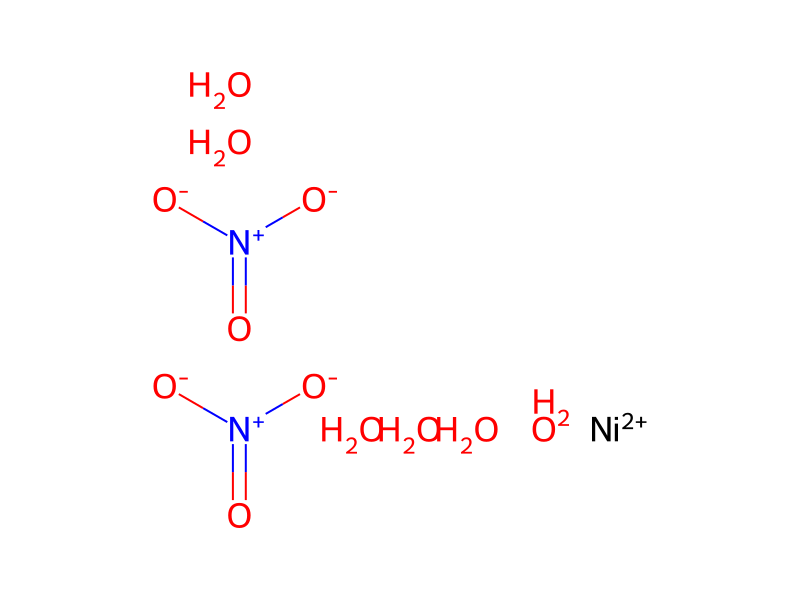
13478-00-7- Standard-SMILES
O.O.O.O.O.O.O=[N+]([O-])[O-].O=[N+]([O-])[O-].[Ni+2]- InChIKey
AOPCKOPZYFFEDA-UHFFFAOYSA-N- Summenformel
- H12N2NiO12
- Durchschnittliche Molmasse
- 290,8 g/mol
- Monoisotopische Masse
- 289,97436672
Namen und Bezeichner
- Bevorzugter Name
- Nickel nitrate hexahydrate
- IUPAC
- nickel(2+);dinitrate;hexahydrate
- Englischer Name
- Nickel(II) nitrate hexahydrate
- Summenformel
- H12N2NiO12
- Molmasse
- 290.79
Namen und Synonyme
13478-00-7Nickel nitrate hexahydrateNickel(II) nitrate hexahydrateNickel dinitrate hexahydrateNickelous nitrate hexahydrateNickel(2+) dinitrate hexahydrateNickel(2+) nitrate, hexahydrateXBT61WLT1JNitric acid, nickel(2+) salt, hexahydrateNickel(II) nitrate, hexahydrate (1:2:6)DTXSID70158941RefChem:165673
Weitere Namen anzeigen
NICKEL NITRATENICKEL(II) NITRATENICKEL(II) NITRATE 6-HYDRATENitric acid nickel(II) salt hexahydrateNickel (II) nitrate hexahydrate≥ 97% (Titration)NickelNitrateArNickelousnitrate,NNickel Nitrate (Ous)
DTXCID4081432603-868-4nickel (II) nitrate hexahydrateMFCD00149805H12N2NiO12Ni(NO3)2.6H2Onickel(2+);dinitrate;hexahydrateNitric acid (dinitrate hexahydrate)
Datenbank-Bezeichner
- CAS
13478-00-7- PubChem CID
- 61630
- DTXSID
DTXSID70158941- UNII
- XBT61WLT1J
- EC Number
- 603-868-4
Eigenschaften
Berechnete Struktureigenschaften
- Polarare Oberfläche (TPSA)
- 132 Ų
- H-Brücken-Donoren
- 6
- H-Brücken-Akzeptoren
- 12
- Frei drehbare Bindungen
- 0
- Schwere Atome
- 15
- Formalladung
- 0
- Komplexität
- 18,8
Experimentelle und physikochemische Eigenschaften
Chemical Classes
Metals -> Nickel Compounds, Inorganic
Carcinogens
Density2.05 @25 °C
Boiling Point136.7 °C @760 [mm Hg]
Physical DescriptionGreen, deliquescent crystals; [Merck Index] Water soluble; [ACGIH]
Physikochemische Eigenschaften
- Schmelzpunkt
- 56 °C · 56 °C(lit.)
- Siedepunkt
- 137 °C · 137 °C
- Dichte
- 2.05 g/mL · 2.05 g/mL at 25 °C(lit.)
- Flammpunkt
- 137 °C · 137°C
- storage temp.
- 5 °C · Store at +5°C to +30°C.
- Löslichkeit
- 940 g/l · 940g/l
- Aggregatzustand
- flakes
- Farbe
- Green to blue
- Wichte
- 2.05 · 2.05
Sicherheit und Regulatorisches
Sicherheitsangaben dienen nur zur Orientierung und ersetzen weder das Sicherheitsdatenblatt (SDB) des Lieferanten noch geltende Vorschriften oder eine fachliche Bewertung.
GHS-Klassifizierung
GHS Classification
Danger
H272 (99.5%): May intensify fire; oxidizer [Danger Oxidizing liquids; Oxidizing solids]
P203, P210, P220, P233, P260, P261, P264, P264+P265, P270, P271, P272, P273, P280, P284, P301+P317, P302+P352, P304+P340, P305+P354+P338, P317, P318, P319, P321, P330, P332+P317, P333+P317, P342+P316, P362+P364, P370+P378, P391, P403, P405, and P501 (click each P-code to see the statement)
Aggregated GHS information provided per 219 reports by companies from 11 notifications to the ECHA C&L Inventory. Each notification may be associated with multiple companies.
Danger
H302: Harmful if swallowed [Warning Acute toxicity, oral]
Gefahrenhinweise
Regulatory Information
Chemical: Nitric acid, nickel(2+) salt, hexahydrate
Nickel (II) nitrate, hexahydrate: Does not have an individual approval but may be used under an appropriate group standard
The New Jersey Worker and Community Right to Know Act requires public and private employers to provide information about hazardous substances at their workplaces. (N.J.S.A. 34:5A-1 et. seq.)
Other Safety InformationIMAP assessments - Water soluble nickel(2+) salts: Environment tier II assessment
Hazards SummarySee NITRATES and NITRITES. See Nickel and linked occupational diseases.
Hazard Classes and Categories
Ox. Sol. 2 (99.5%)
Acute toxicity - category 4
Carcinogens
Sicherheit und Schutzausrüstung
Chemie und Industrie
Verwendung und Herstellung
Uses
Used in nickel plating and to make brown ceramic colors; [Merck Index] Used to make nickel catalysts; [Hawley] Also used in nickel-cadmium battery manufacturing; [Ullmann]
Battery Manufacturing [Category: Industry]
Ceramics making [Category: Hobbies]
Anwendungen
BeschreibungNickel (II) nitrate hexahydrate appears as green crystals and substantially soluble in water. It is stable, a strong oxidiser, and incompatible with reducing agents. It has wide industrial applications in nickel plating as catalysts and is indirectly associated with other industries of nickel alloy manufacturers, nickel miners, smelters and refiners, nickel platers, and exposure to alloys, for example, in coinage.
VerwendenNickel plating, manufacturing of ceramic colorsNickel(II) nitrate hexahydrate is used as a precursor in the manufacturing of other nickel salts and supported nickel catalysts. It finds use as a catalyst in organic synthesis. Further it is used in electroplating and as a mordent in textile dyeing. It is a precursor for preparing nickel sulfide-reduced graphene oxide (RGO) composite powders with high initial capacities and good cycling performance. It can be employed in the preparation of nickel and nickel oxide nanocrystals impregnated O-MWCNTs (oxygen-functionalized multi-walled carbon nanotubes) with potential applications in semiconductor industries. It finds use in improving cycling stability ad rate capability of Li2MnO3.
Darstellung
synthetischeEmerald green crystals of the hexahydrate Ni(N03)26H20 crystallize from aqueous solutions at room temperature. These are isomorphous with the corresponding cobalt(II) salt containing the regular octahedral [Ni(H20)6]2+ ions with Ni-O distances = 2.03 A. The tetrahydrate crystallize above 54° and the dihydrate above 85.4°. The pale green anhydrous nitrate can be obtained by dehydration of the hydrate with dinitrogen pentoxide in fuming nitric acid or by the liquid phase reaction of dinitrogen tetroxide with nickel carbonyl [the gas phase reaction gives the nitrite Ni(N02)2] Ni(CO)4+2N2O4 -* Ni(N03)2+2NO+4CO The first product of this latter rather violent reaction is the adduct Ni(NO3)2N2O4 from which the nitrogen tetroxide is removed by heating in vacuo. It can also be prepared by the reaction of dinitrogen tetroxide-ethyl acetate mixtures with nickel(II) chloride. The infrared spectrum shows it to be a typical covalent nitrate. It is involatile and decomposes upon heating in nitrogen to give the nitrite Ni(NO2)2 above 260°.
Zugehörige Reaktionen
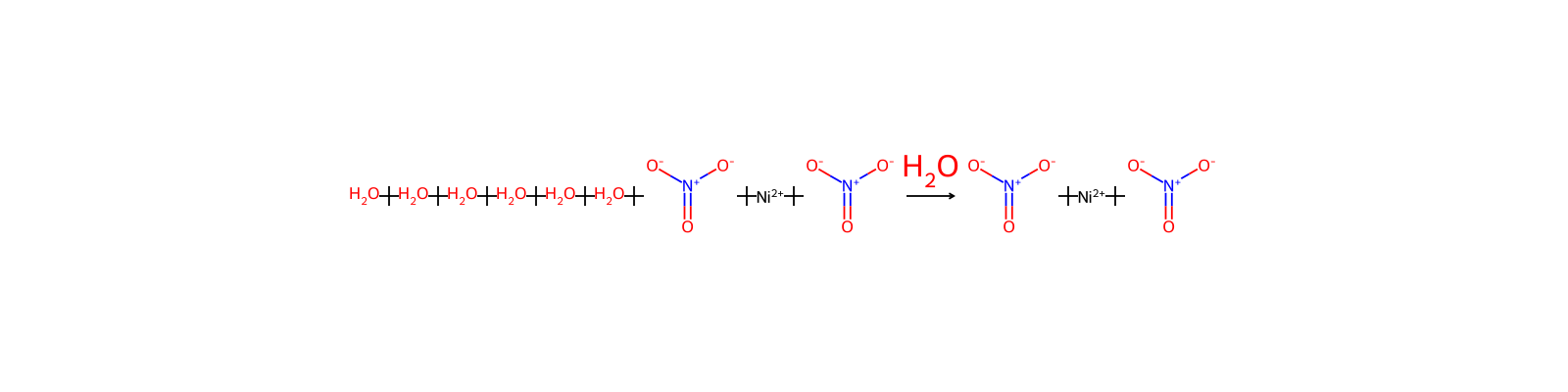
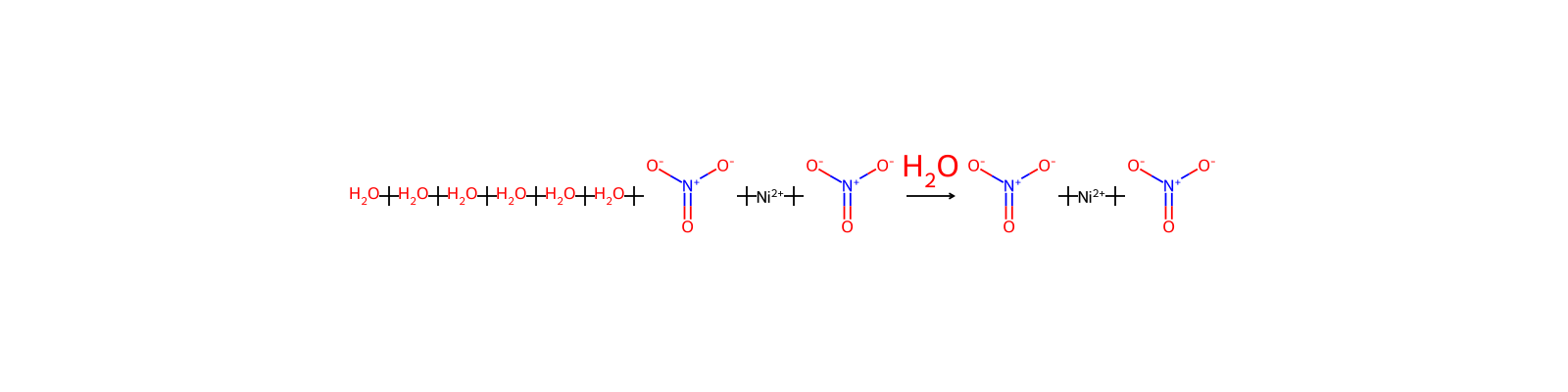
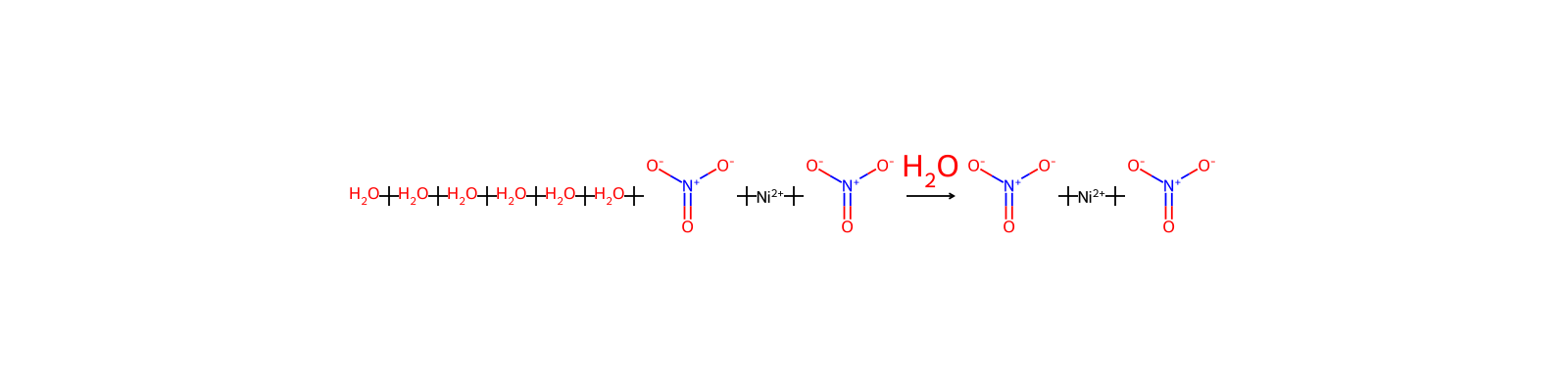
6


Notizen zur Verbindung
Wird geladen…