
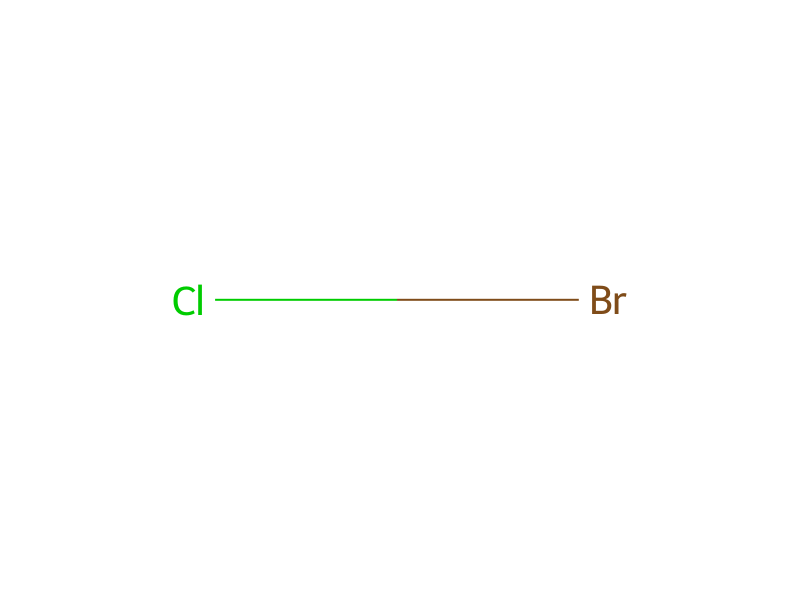
Grundinformationen
- Standard-SMILES
ClBr- InChIKey
CODNYICXDISAEA-UHFFFAOYSA-N- Summenformel
- BrCl
- Durchschnittliche Molmasse
- 115,36 g/mol
- Monoisotopische Masse
- 113,88718978
Überblick
Bromine chloride appears as a reddish-yellow mobile liquid with an irritating odor. Toxic by ingestion or inhalation, and an irritant to skin, eyes and mucous membranes. Prolonged exposure of the containers to intense heat may result in their violent rupturing and rocketing. Used as an industrial disinfectant.
Namen und Bezeichner
- Bevorzugter Name
- BROMINE CHLORIDE (BrCl)
- Lokaler Name
- Bromchlorid
- Englischer Name
- Bromine chloride
- Summenformel
- BrCl
- Molmasse
- 115.36
Namen und Synonyme
BROMINE CHLORIDEBromine chloride (BrCl)bromochlorideBromine monochloride13863-41-7UN29017G62XY5724DTXSID4035259UN-2901RefChem:121518DTXCID2015259237-601-4
Weitere Namen anzeigen
Chloro bromideBromo chlorideChlorine bromide
BrClCaswell No. 112AAEINECS 237-601-4EPA Pesticide Chemical Code 020504chlorobrominebromo-chlorineUNII-7G62XY5724HSDB 7820
Datenbank-Bezeichner
- CAS
13863-41-7- PubChem CID
- 61697
- DTXSID
DTXSID4035259- UNII
- 7G62XY5724
- EC Number
- 237-601-4
- Nikkaji
- J95.101C
Eigenschaften
Berechnete Struktureigenschaften
- XLogP
- 1,8
- Polarare Oberfläche (TPSA)
- 0 Ų
- H-Brücken-Donoren
- 0
- H-Brücken-Akzeptoren
- 0
- Frei drehbare Bindungen
- 0
- Schwere Atome
- 2
- Formalladung
- 0
- Komplexität
- 2
Experimentelle und physikochemische Eigenschaften
Chemical ClassesToxic Gases & Vapors -> Oxidizers
DensityDensity (at 25 °C): 2.32 g/ml
Color/Form
Dark red liquid (<5 °C)
Reddish-yellow, mobile liquid
Solubility
Soluble in ethanol and carbon disulfide
Soluble in ether
Reacts with water
Soluble in water
Solubility in water, g/100ml at 25 °C: (good)
Boiling Point
5 °C (decomposes)
5 °C (decomposes)
5 °C
Decomposition
Decomposes partly at room temperature to chlorine and bromine. The substance decomposes on contact with moisture producing toxic gases including chlorine and bromine.
Decomposes above 50 °F to produce highly toxic chlorine gas.
Melting Point
-66 °C
-66 °C
Vapor PressureVapor pressure, kPa at 25 °C: 2.368
Food Contact SubstancesFCS -> FDA Inventory of Effective Food Contact Substance (FCS) Notifications
Physical Description
Bromine chloride appears as a reddish-yellow mobile liquid with an irritating odor. Toxic by ingestion or inhalation, and an irritant to skin, eyes and mucous membranes. Prolonged exposure of the containers to intense heat may result in their violent rupturing and rocketing. Used as an industrial disinfectant.
Dark red liquid (<5 deg C); [HSDB] Dark liquid with harsh, penetrating odor; [CHEMINFO MSDS]
GAS WITH PUNGENT ODOUR.
Other Experimental Properties
Heat of formation: 14.6 kJ/mol; molar entropy: 240.1 J/mol-K; heat capacity: 35.0 J/mol-K
Ionization energy: 11.01 eV
Physikochemische Eigenschaften
- Schmelzpunkt
- -66 ℃ · -66℃ [HAW93]
- Siedepunkt
- 2 at · decomposes evolving Cl2 at 10℃ [HAW93]
- Dichte
- 5.062 g/L · 5.062g/L [LID94]
- Löslichkeit
- 2 O; · reacts with H2O; soluble in ethyl ether,CS
- Aggregatzustand
- unstable red-brown gas
- Farbe
- dark red liquid (<5C)
- Wasserlöslichkeit
- 2 O · soluble H2O with ready hydrolysis, soluble carbon disulfide, ether [HAW93]
- Spezifische Wärmekapazität
- 0.3 J/ · Cp(gas): 0.3 J/(g·K), at 25℃
- Henry's Law Constant
- 9.7 · 9.7×10-3 mol/(m3Pa) at 25℃, Burkholder et al. (2019)
- EPA chemische Informationen
- Bromine chloride (13863-41-7)
Sicherheit und Regulatorisches
GHS-Klassifizierung
GHS Classification
Danger
H272 (50%): May intensify fire; oxidizer [Danger Oxidizing liquids; Oxidizing solids]
P210, P220, P234, P260, P261, P264, P271, P273, P280, P301+P330+P331, P302+P361+P354, P304+P340, P305+P354+P338, P316, P317, P321, P363, P370+P378, P390, P391, P403+P233, P405, P406, and P501 (click each P-code to see the statement)
Aggregated GHS information provided per 2 reports by companies from 2 notifications to the ECHA C&L Inventory. Each notification may be associated with multiple companies.
Gefahrenhinweise
Hazards IdentificationToxic/poison by inhalation (TIH/PIH)
Regulatory Information
Chemical: Bromine chloride (BrCl)
Bromine chloride (BrCl): Does not have an individual approval but may be used as a component in a product covered by a group standard. It is not approved for use as a chemical in its own right.
The New Jersey Worker and Community Right to Know Act requires public and private employers to provide information about hazardous substances at their workplaces. (N.J.S.A. 34:5A-1 et. seq.)
DOT LabelPoison Gas Corrosive Oxidizer
Fire Hazards
Excerpt from ERG Guide 124 [Gases - Toxic and/or Corrosive - Oxidizing]:
· Substance does not burn but will support combustion.
Not combustible but enhances combustion of other substances. Many reactions may cause fire or explosion. Gives off irritating or toxic fumes (or gases) in a fire. Risk of fire and explosion. See Chemical Dangers.
Fire PotentialNoncombustible, but is an oxidizer which may react with combustible materials and generate enough heat to start and support combustion.
Health Hazards
Excerpt from ERG Guide 124 [Gases - Toxic and/or Corrosive - Oxidizing]:
· TOXIC and/or CORROSIVE; may be fatal if inhaled or absorbed through skin.
Hazards Summary
Corrosive to eyes, skin, and respiratory tract; [CHEMINFO MSDS] Decomposes above 50 degrees F with release of chlorine gas; [Hawley] Contact with liquefied gas may cause frostbite; [CAMEO] Causes lachrymation. Inhalation of high concentration may cause pneumonitis and pulmonary edema; [ICSC] See Bromine.
DOT ID and Guide2901 124
Reactive GroupOxidizing Agents, Strong
UN ClassificationUN Hazard Class: 2.3; UN Subsidiary Risks: 5.1 and 8
FIFRA Requirements
New Active Ingredients ... includes chemicals not previously registered as pesticides, as well as pesticide active ingredients initially registered after November 1, 1984 and that currently have active product registrations. By law, these pesticides must meet new safety standards, such as those described in the Food Quality Protection Act of 1996 and, if new safety standards are met, will be reviewed again on a 15-year cycle. Bromine chloride is designated by EPA as a New Pesticide Active Ingredient. Active Ingredient Number: 020504; Type of Pesticide: conventional - antimicrobial; Use Site: water cooling, sewage systems; Year: 1987.
Reactivity AlertsStrong Oxidizing Agent
Sicherheit und Schutzausrüstung
Fire Fighting
Excerpt from ERG Guide 124 [Gases - Toxic and/or Corrosive - Oxidizing]:
In case of fire in the surroundings, use appropriate extinguishing media. In case of fire: keep cylinder cool by spraying with water. NO direct contact with water.
First Aid Measures
Fresh air, rest. Half-upright position. Refer immediately for medical attention. Artificial respiration may be needed.
First rinse with plenty of water for at least 15 minutes, then remove contaminated clothes and rinse again. Refer immediately for medical attention.
Rinse with plenty of water (remove contact lenses if easily possible). Refer immediately for medical attention.
Accidental Release Measures
· CALL 911. Then call emergency response telephone number on shipping paper. If shipping paper not available or no answer, refer to appropriate telephone number listed on the inside back cover.
· Do not touch or walk through spilled material.
First Aid
Excerpt from ERG Guide 124 [Gases - Toxic and/or Corrosive - Oxidizing]:
General First Aid:
Safe StorageFireproof if in building. Provision to contain effluent from fire extinguishing. Separated from food and feedstuffs. See Chemical Dangers. Cool. Dry. Keep in a well-ventilated room. Store in an area without drain or sewer access.
Exposure Control and Personal Protection
· Wear positive pressure self-contained breathing apparatus (SCBA).
TIH (Toxic Inhalation Hazard) - Term used to describe gases and volatile liquids that are toxic when inhaled. Some are TIH materials themselves, e.g., chlorine, and some release TIH gases when spilled in water, e.g., chlorosilanes. [ERG 2016].
Fire Fighting Procedures
If material involved in fire: extinguish fire using agent suitable for type of surrounding fire (material itself does not burn or burns with difficulty). Cool all affected containers with flooding quantities of water. Apply water from as far a distance as possible. Do not use water on material itself. Keep run-off water out of sewers and water sources. Do not apply water to point of leak in tank car or container.
Wear positive pressure self-contained breathing apparatus when fighting fires involving this material.
Storage Conditions
Fireproof if in building. Provision to contain effluent from fire extinguishing. Separated from food and feedstuffs ... Cool. Dry. Keep in a well-ventilated room. Store in an area without drain or sewer access.
When dry bromine chloride is stored in a pressurized cylinder (a closed system), no product composition change can occur.
Cleanup Methods
Evacuate danger area! Consult an expert! Personal protection: gas-tight chemical protection suit including self-contained breathing apparatus. Do NOT let this chemical enter the environment. Ventilation. Remove gas with fine water spray. Shut off cylinder if possible. Isolate the area until the gas has dispersed. NEVER direct water jet on liquid.
Nonfire Spill ResponseExcerpt from ERG Guide 124 [Gases - Toxic and/or Corrosive - Oxidizing]:
Disposal Methods
SRP: The most favorable course of action is to use an alternative chemical product with less inherent propensity for occupational harm/injury/toxicity or environmental contamination. Recycle any unused portion of the material for its approved use or return it to the manufacturer or supplier. Ultimate disposal of the chemical must consider: the material's impact on air quality; potential migration in soil or water; effects on animal and plant life; and conformance with environmental and public health regulations.
Spillage Disposal
Evacuate danger area! Consult an expert! Personal protection: gas-tight chemical protection suit including self-contained breathing apparatus. Do NOT let this chemical enter the environment. Ventilation. Remove gas with fine water spray. Shut off cylinder if possible. Isolate the area until the gas has dispersed. NEVER direct water jet on liquid.
Toxikologische Informationen
Treatment
EYES: irrigate opened eyes for several minutes under running water. INGESTION: do not induce vomiting. Rinse mouth with water (never give anything by mouth to an unconscious person). Seek immediate medical advice. SKIN: should be treated immediately by rinsing the affected parts in cold running water for at least 15 minutes, followed by thorough washing with soap and water. If necessary, the person should shower and change contaminated clothing and shoes, and then must seek medical attention. INHALATION: supply fresh air. If required provide artificial respiration.
Health Effects
Bromine vapour causes irritation and direct damage to the mucous membranes. Elemental bromine also burns the skin. The bromide ion is a central nervous system depressant and chronic exposure produces neuronal effects. This is called bromism and can result in central reactions reaching from somnolence to coma, cachexia, exicosis, loss of reflexes or pathologic reflexes, clonic seizures, tremor, ataxia, loss of neural sensitivity, paresis, papillar edema of the eyes, abnormal speech, cerebral edema, delirium, aggressiveness, and psychoses. (L625, L626, L627)
Ecotoxicity Values
LC50; Species: Lepomis macrochirus (Bluegill sunfish); Concentration: 0.52 ppm for 96 hr; Conditions: static
LC50; Species: Salmo gairdneri (Rainbow trout); Concentration: 0.31 ppm for 96 hr; Conditions: static
LC50; Species: Daphnia magna (Water flea); Concentration: 1.07 ppm for 48 hr; Conditions; static
Adverse EffectsDermatotoxin - Skin burns.
Exposure Routes
Serious local effects by all routes of exposure.
Oral (L626) ; inhalation (L626) ; dermal (L626)
Toxicity Summary
Bromine is a powerful oxidizing agent and is able to release oxygen free radicals from the water in mucous membranes. These free radicals are also potent oxidizers and produce tissue damage. In additon, the formation of hydrobromic and bromic acids will result in secondary irritation. The bromide ion is also known to affect the central nervous system, causing bromism. This is believed to be a result of bromide ions substituting for chloride ions in the in actions of neurotransmitters and transport systems, thus affecting numerous synaptic processes. (L626, L627, A543)
Signs and Symptoms
Cough. Sore throat. Shortness of breath. Wheezing. Laboured breathing. Symptoms may be delayed.
Redness. Burning sensation. Pain. Serious skin burns.
Watering of the eyes. Redness. Blurred vision. Pain. Burns.
Bromine vapour causes irritation and direct damage to the mucous membranes. Symptoms include lacrimation, rhinorrhoea, eye irritation with mucous secretions from the oropharyngeal and upper airways, coughing, dyspnoea, choking, wheezing, epistaxis, and headache. The bromide ion is a central nervous system depressant producing ataxia, slurred speech, tremor, nausea, vomiting, lethargy, dizziness, visual disturbances, unsteadiness, headaches, impaired memory and concentration, disorientation and hallucinations. This is called bromism. (L626, L627)
ICSC Environmental DataThe substance is very toxic to aquatic organisms. It is strongly advised not to let the chemical enter into the environment.
Human Toxicity Excerpts
/SIGNS AND SYMPTOMS/ Short-term exposure: Lachrymation. The substance is corrosive to the eyes, the skin and the respiratory tract. Inhalation may cause asthma-like reactions. Inhalation may cause pneumonitis. Inhalation may cause lung edema, but only after initial corrosive effects on eyes and/or airways have become manifest. The symptoms of lung edema often do not become manifest until a few hours have passed, and they are aggravated by physical effort. Exposure may result in death. Long-term exposure: The substance may have effects on the respiratory tract and lungs , resulting in chronic inflammation and impaired functions.
/SIGNS AND SYMPTOMS/ Irritant to skin, eyes, and mucous membranes.
Carcinogen ClassificationNo indication of carcinogenicity to humans (not listed by IARC).
Antidote and Emergency Treatment
Immediate first aid: Ensure that adequate decontamination has been carried out. If patient is not breathing, start artificial respiration, preferably with a demand-valve resuscitator, bag-valve-mask device, or pocket mask, as trained. Perform CPR as necessary. Immediately flush contaminated eyes with gently flowing water. Do not induce vomiting. If vomiting occurs, lean patient forward or place on left side (head-down position, if possible) to maintain an open airway and prevent aspiration. Keep patient quiet and maintain normal body temperature. Obtain medical attention. /Bromine, methyl bromide, and related compounds/
Basic treatment: Establish a patent airway (oropharyngeal or nasopharyngeal airway, if needed). Suction if necessary. Watch for signs of respiratory insufficiency and assist ventilations if necessary. Administer oxygen by nonrebreather mask at 10 to 15 L/min. Monitor for pulmonary edema and treat if necessary ... . Monitor for shock and treat if necessary ... . Anticipate seizures and treat if necessary ... . For eye contamination, flush eyes immediately with water. Irrigate each eye continuously with 0.9% saline (NS) during transport ... . Do not use emetics. For ingestion, rinse mouth and administer 5 ml/kg up to 200 ml of water for dilution if the patient can swallow, has a strong gag reflex, and does not drool. Administer activated charcoal ... . Cover skin burns with dry sterile dressings after decontamination ... . /Bromine, methyl bromide, and related compounds/
Advanced treatment: Consider orotracheal or nasotracheal intubation for airway control in the patient who is unconscious, has severe pulmonary edema, or is in severe respiratory distress. Positive-pressure ventilation techniques with a bag valve mask device may be beneficial. Consider drug therapy for pulmonary edema ... . Consider administering a beta agonist such as albuterol for severe bronchospasm ... . Monitor cardiac rhythm and treat arrhythmias if necessary ... . Start IV administration of D5W /SRP: "To keep open", minimal flow rate/. Use 0.9% saline (NS) or lactated Ringer's (LR) if signs of hypovolemia are present. For hypotension with signs of hypovolemia, administer fluid cautiously. Consider vasopressors if patient is hypotensive with a normal fluid volume. Watch for signs of fluid overload ... . Treat seizures with diazepam or lorazepam ... . Use proparacaine hydrochloride to assist eye irrigation ... . /Bromine, methyl bromide, and related compounds/
Regulatorische Informationen
FIFRA Requirements
New Active Ingredients ... includes chemicals not previously registered as pesticides, as well as pesticide active ingredients initially registered after November 1, 1984 and that currently have active product registrations. By law, these pesticides must meet new safety standards, such as those described in the Food Quality Protection Act of 1996 and, if new safety standards are met, will be reviewed again on a 15-year cycle. Bromine chloride is designated by EPA as a New Pesticide Active Ingredient. Active Ingredient Number: 020504; Type of Pesticide: conventional - antimicrobial; Use Site: water cooling, sewage systems; Year: 1987.
DHS Chemicals of Interest (COI)
Bromine chloride
9.67
45
Weapons of Mass Effect chemical material that, if stolen or diverted, can be converted into weapons using simple chemistry, equipment, or techniques.
Sicherheitsdaten
- tsca
- TSCA listed
- ridadr
- UN 2901
- hazard_class
- 2.3
- Giftige Stoffe Daten
- 13863-41-7(Hazardous Substances Data)
Chemie und Industrie
Pharmakologische Informationen
Metabolism/Metabolites
Bromine is mainly absorbed via inhalation, but may also enter the body through dermal contact. Bromine salts can be ingested. Due to its reactivity, bromine quickly forms bromide and may be deposited in the tissues, displacing other halogens. (L626)
Verwendung und Herstellung
Uses
Used as a disinfectant and for wastewater treatment; [Hawley]
Using Disinfectants or Biocides [Category: Clean]
For bromine chloride (USEPA/OPP Pesticide Code: 020504) ACTIVE products with label matches. /SRP: Registered for use in the U.S. but approved pesticide uses may change periodically and so federal, state and local authorities must be consulted for currently approved uses./
Disinfectant, fungicide, algaecide and slimicide in recirculating and once-through cooling and process water systems, heat transfer systems, air washers and industrial scrubbing systems, containerized ponds and decorative fountains, industrial once-through cooling water systems, pulp and paper mills, wastewater systems ... Pests controlled are algae, bacteria, and fungal slime.
When bromine chloride dissolves in water, hypobromous acid is formed ... Therefore, hypobromous acid is the actual microbiocide.
Industrial disinfectant, especially for wastewaters
U.S. ProductionProduction volumes for non-confidential chemicals reported under the Inventory Update Rule. [Table#7512]
Methods of Manufacturing
... Prepared by mixing bromine and chlorine in equimolar quantities. The reaction is exothermic and provision should be made for heat removal during production. At room temperature about 60 % of the mixed halogen is present as bromine chloride.
Formulations/Preparations
Albemarle S909 Biocide (Albemarle Corp) bromine chloride 11%
Bromine Chloride (Great Lakes Chemical Corp) bromine chloride 99.5%
Bromine Chloride Disinfectant (Albemarle Corp) bromine chloride 99.1%
Maxxis Biocide (Albemarle Corp) bromine chloride 15%
Starbrom Plus Biocide (Albemarle Corp) bromine chloride 13.2%
General Manufacturing InformationBromine chloride (BrCl): ACTIVE
Anwendungen
VerwendenBromine chloride (BrCl) is an irritating red, smelly liquid used to treat industrial and sewage wastes.
Vor- und nachgelagerte Produkte
Vorgelagerte Rohstoffe
Nachgelagerte Produkte
Anbieter6 Anbieter
Shaanxi Didu New Materials Co. Ltd+86-86-17392712779 +86-13289823923 · [email protected]
河南天孚化工有限公司+86-0371-55170693 +86-19937530512 · [email protected]
厦门盈融达化工有限公司+86-0592-6210733 · [email protected]
XIAMEN AMITY INDUSTRY AND TRADE CO., LTD.+8618950047208 · [email protected]
上海宝杨宝欣生物科技有限公司021-56698539 19921169802 · [email protected]
山东众泰合化工有限公司13223931914 13864082898 · [email protected]
Zugehörige Reaktionen
48


Verknüpfte Notizen
Wird geladen…