Trichlormethan
CHCl3 · TRICHLOROMETHANE · TCM · Fisher Chemical · Chloroforme · r20 · Trichlormethan · Chloroform 5g [67-66-3]
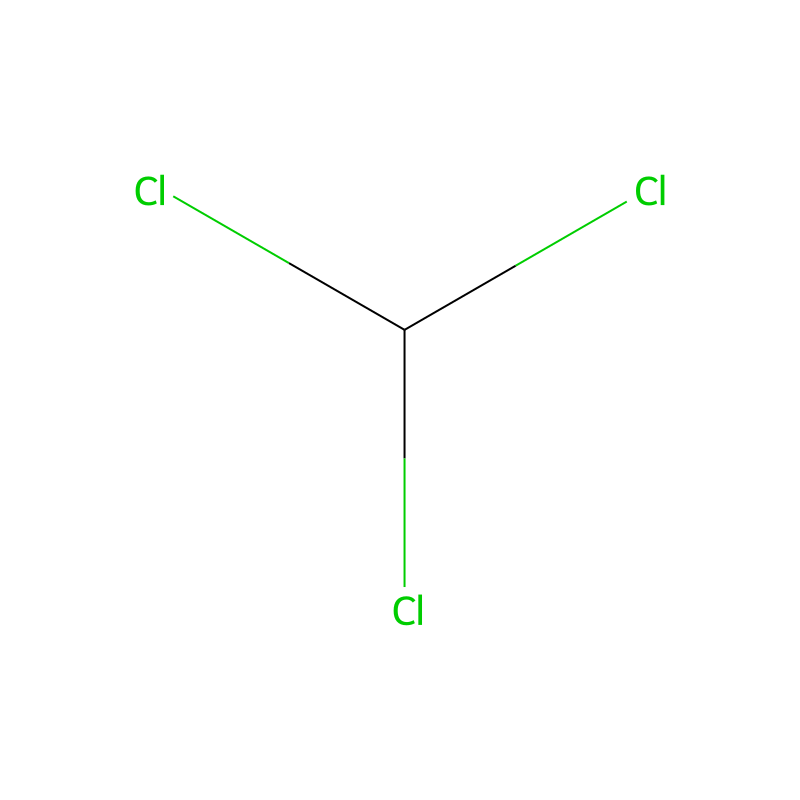
Identifikatoren & physikalische Daten
| CAS No. | 67-66-3 |
|---|---|
| Summenformel | CHCl3 |
| Durchschnittliche Molmasse | 119,37 g/mol |
| Monoisotopische Masse | 117,914383 g/mol |
| SMILES | ClC(Cl)Cl |
| InChIKey | HEDRZPFGACZZDS-UHFFFAOYSA-N |
| PubChem CID | 6212 |
| ChEMBL | CHEMBL44618 |
| ChEBI | CHEBI:35255 |
| EC No. | 200-663-8 |
| DTXSID | DTXSID1020306 |
| Lokaler Name | Trichlormethan |
Chemische & physikalische Eigenschaften
| XLogP | 2,3 |
|---|---|
| Polarare Oberfläche (TPSA) | 0 |
| H-Brücken-Donoren | 0 |
| H-Brücken-Akzeptoren | 0 |
| Frei drehbare Bindungen | 0 |
| Schwere Atome | 4 |
| Formalladung | 0 |
| Komplexität | 8 |
| Stoffklassen | Hazardous Air Pollutants (HAPs)Urban Hazardous Air Pollutants (HAPs) - EPA specified greatest potential health threat in urban areasCarcinogens |
| Solvents | Solvents -> Chlorinated Aliphatics |
| SpringerMaterials Properties | Coriolis coupling |
| Pestizide | Pesticide -> EPA IRISVolatile Organic Compound (VOC) (Pesticide/Volatile Organic Compound (VOC)) |
| LogP (Verteilungskoeffizient) | log Kow = 1.97 |
| Geruch | Pleasant, etheric, nonirritatingPleasant odorOdor threshold: 205-307 ppmCharacteristic odor |
| Geschmack | Sweet taste |
| Lebensmittelzusatzstoffe | PROCESSING AID -> FDA Substance added to food |
| Dichte | 1.4832 at 68 °F (EPA, 1998) - Denser than waterwill sink1.4788 g/cu cm at 25 °CDensity: 1.484 at 20 °C/20 °CAn alcholic solution of chloroform containing 6% by volume of chloroform, corresponding to 10.5% by weight and approximately 89% absolute alcohol by volume. Colorless, clear liquid. Chloroform odor. Density: approximately 0.85 /Spirit of chloroform/Density (at 20 °C): 1.48 g/mlRelative density of the vapour/air-mixture at 20 °C (air = 1): 1.71.492 g/mL at 25 °C(lit.) |
| Viscosity | 5.63 millipoises at 20 °C5.10 millipoises at 30 °C |
| Color/Form | Highly refractive, nonflammable, heavy, very volatile liquidClear, colorless liquidColorless, highly refractive, heavy volatile liquid. |
| Löslichkeit | less than 1 mg/mL at 66 °F (NTP, 1992)In water, 7.95X10+3 mg/L at 25 °CHighly soluble in waterOne mL dissolves in about 200 mL water at 25 °CMiscible with alcohol, benzene, ether, petroleum ether, carbon tetrachloride, carbon disulfide, oilsFor more Solubility (Complete) data for Chloroform (6 total), please visit the HSDB record page.Miscible with diethyl ether, oils, ligroin, alcohol, carbon tetrachloride and carbon disulfide.8 g/L (20 ºC) |
| Schmelzpunkt | -63 °C |
| Siedepunkt | 61 °C |
| Dampfdichte | 4.1 (vs air) |
| Dampfdruck | 160 mm Hg ( 20 °C) |
| Brechungsindex | n20/D 1.445(lit.) |
| Flammpunkt | 60.5-61.5°C |
| Lagerbedingungen | 2-8°C |
| pKa (Säurekonstante) | 15,5(at 25℃) |
| Aggregatzustand | Liquid |
| Farbe | ≤10(APHA) |
| Geruch | Ethereal, sweet odor detectable at 133 to 276 ppm (mean = 192 ppm) |
| Geruchsschwelle | 3.8ppm |
| Spezifische Wärmekapazität | Cp(liquid): 0.96 J/(g·K)Cp(gas): 0.55 J/(g·K), at 25℃ |
| Merck | 14,2141 |
| BRN | 1731042 |
| Henry-Konstante | 1.07 at 2 °C, 1.49 at 6 °C, 1.79 at 10 °C, 3.02 at 18 °C, 4.02 at 25 °C, 5.20 at 30 °C, 7.60 at 40 °C, 11.1 at 50 °C, 14.8 at 60 °C (EPICS-SPME-GC, Grgényi et al., 2002)) |
| Dielektrizitätskonstante | 5.5(0℃) |
| Stabilität | Volatile |
| Kosmetik-Inhaltsstoffe Funktionen | SOLVENT |
| InChI | 1S/CHCl3/c2-1(3)4/h1H |
| InChIKey | HEDRZPFGACZZDS-UHFFFAOYSA-N |
| SMILES | ClC(Cl)Cl |
| LogP (Verteilungskoeffizient) | 1.970 |
| Oberflächenspannung | 27.5mN/m at 20°C |
| CAS Datenbank | 67-66-3(CAS DataBase Reference) |
| NIST chemische Informationen | Chloroform(67-66-3) |
| EPA chemische Informationen | Chloroform (67-66-3) |
Sicherheit & Vorschriften
| GHS-Einstufung | DangerH302: Harmful if swallowed [Warning Acute toxicity, oral]P203, P260, P261, P264, P264+P265, P270, P271, P280, P301+P317, P302+P352, P304+P340, P305+P351+P338, P316, P318, P319, P321, P330, P332+P317, P337+P317, P362+P364, P403+P233, P405, and P501 (click each P-code to see the statement)This chemical does not meet GHS hazard criteria for < 0.1% (1 of 1499) of reports.H302 (94.8%): Harmful if swallowed [Warning Acute toxicity, oral] |
|---|---|
| Regulatorische Informationen | Chemical: Methane, trichloro-Hazard Traits - CarcinogenicityCardiovascular ToxicityDevelopmental ToxicityHepatotoxicity and Digestive System ToxicityNephrotoxicity and Other Toxicity to the Urinary SystemNeurotoxicityReproductive ToxicityRespiratory ToxicityMethane, trichloro- is listed on the EPA's Chemical Data Reporting (CDR) system. Manufacturers and importers of Methane, trichloro- are required to report information about their production and use of this chemical to the EPA under the Toxic Substances Control Act (TSCA). (40 eCFR Part 711)REACH registered substance: Chloroform (EC: 200-663-8)Restricted substance: ChloroformChloroform: HSNO Approval: HSR002937 Approved with controls |
| Weitere Sicherheitsinformationen | IMAP assessments - Methane, trichloro-: Human health tier II assessment |
| DOT-Kennzeichnung | Poison |
| Brandgefahren | Container may explode in the heat of fire. When heated it liberates phosgene, hydrogen chloride, chlorine and toxic and corrosive oxides of carbon and chlorine. Chloroform explodes when in contact with aluminum powder or magnesium powder or with alkali metals (e.g., lithium, sodium, and potassium) and dinitrogen tetroxide. It reacts vigorously with acetone in the presence of potassium hydroxide or calcium hydroxide. It is oxidized by strong oxidizers such as chromic acid forming phosgene and chlorine. It reacts vigorously with triisopropylphosphine. It develops acidity from prolonged exposure to air and light. (EPA, 1998)· Non-combustible, substance itself does not burn but may decompose upon heating to produce corrosive and/or toxic fumes. |
Anwendungen & Verwendung
Beschreibung
Chloroform is a trichlorinated organic substance with the chemical formula of CHCl3. It is a clear liquid at room temperature and has a pleasant, sweet odor. Chloroform is only slightly soluble in water and evaporates quickly into surrounding air, increasing the risk of inhalation exposure. In addition, chloroform persists for a long time in both water and air. There are no natural sources of chloroform, but this contaminant enters the environment through a variety of industrial operations, including the chlorination of water. Humans can be exposed to chloroform through inhalation, ingestion, and dermal contact. Chloroform has a relatively narrow margin of safety and has been replaced by better inhalation anesthetics. In addition, it is believed to be toxic to the liver and kidneys and may cause liver cancer. Chloroform was once widely used as a solvent, but safety and environmental concerns have reduced this use as well. Nevertheless, chloroform has remained an important industrial chemical.
History
Chloroform (CHCl3) was first discovered in 1831 by American physician Samuel Guthrie; and independently a few months later by Frenchman Eugène Soubeiran and Justus von Liebig in Germany. Chloroform was named and chemically characterised in 1834 by Jean-Baptiste Dumas. Its anaesthetic properties were noted early in 1847 by Marie-Jean-Pierre Flourens. Unlike ether, chloroform's characteristically sweet odour isn't irritating, although inhalation of concentrated chloroform vapour may cause irritation of exposed mucous surfaces. Chloroform is a more effective anaesthetic than nitrous oxide. In 1864, the Report of Chloroform Committee of Royal Medical and Chirurgical Society endorsed chloroform as Britain's favourite anaesthetic. But ether was safer for patients. In 1871, leading anaesthetic manufacturer Edward E. Squibb of Brooklyn estimated [New York Medical Journal (April 1871) 13;389] that of 400,000 administrations of anaesthesia in the USA in 1870, chloroform was the agent used in some 50%, ether for 40%, and other gases and mixtures accounted for the rest.
Verwenden
Chloroform is a widely used industrial and laboratory solvent. It is a volatile chlorinated organic solvent whose vapors have a narcotic effect.Due to its light sensitivity, it may undergo degradation with time. This can be suppressed by adding ethanol as a stabilizer. The addition will increase the polarity of the solvent and potentially impact certain applications. Chloroform has been used as a solvent for dissolving lipids and also as a cleansing agent. It may also be used in solvent extraction process and also for recrystallization. Suitable for HPLC, spectrophotometry, environmental testing Facilitates recovery of the aqueous phase of PCRs which have been overlaid with mineral oil. Meets ACS specifications.