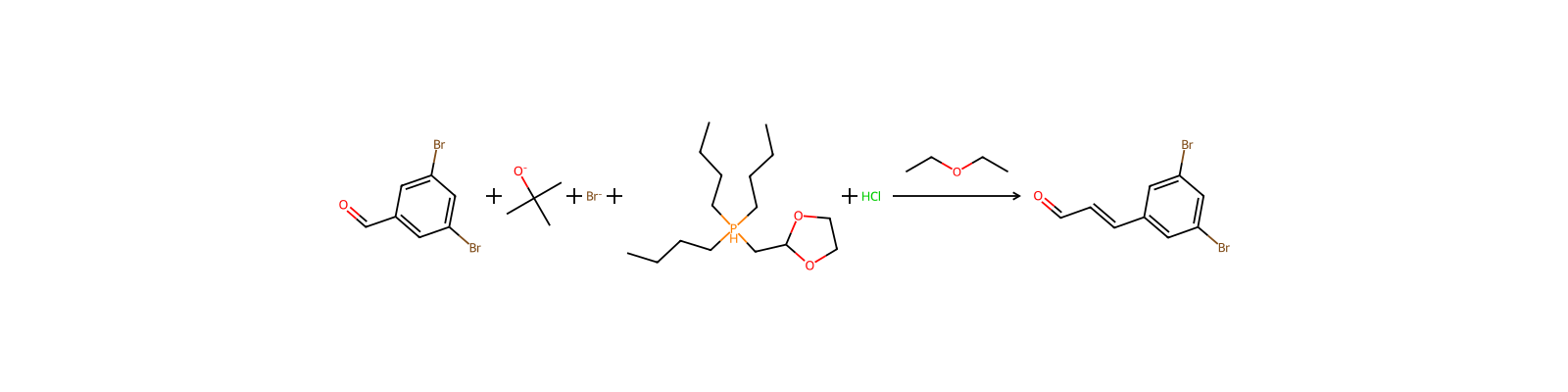
3,5-Dibromobenzaldehyde

Grundinformationen
- CAS
56990-02-4- Standard-SMILES
O=Cc1cc(Br)cc(Br)c1- InChIKey
ZLDMZIXUGCGKMB-UHFFFAOYSA-N- Summenformel
- C7H4Br2O
- Durchschnittliche Molmasse
- 263,91 g/mol
- Monoisotopische Masse
- 261,86289
Namen und Bezeichner
- Bevorzugter Name
- 3,5-Dibromobenzaldehyde
- IUPAC
- 3,5-dibromobenzaldehyde
- Englischer Name
- 3,5-Dibromobenzaldehyde
- Summenformel
- C7H4Br2O
- Molmasse
- 263.91
Namen und Synonyme
3,5-Dibromobenzaldehyde56990-02-4DTXSID80347485RefChem:91440DTXCID10298557611-441-9ZLDMZIXUGCGKMB-UHFFFAOYSA-NMFCD001568873,5-Dibromo-benzaldehydeBenzaldehyde, 3,5-dibromo-SCHEMBL708554(3,5-dibromo-phenyl)-methanone
Weitere Namen anzeigen
DBBA3,5-Dibromobenzaldehyde>3,5-Dibromobenzaldehyde,98%3,5-DIBROMOBENZALDEHYDE 98%3,5-Dibromobenzaldehyde//DBBA3,5-dibromophenylformaldehydeMETHYL3,5-DIBROMOPHENYLACETATE3,5-Dibromobenzaldehyde97%MinByG.C
CS-W001128PS-7344SY014041D2832Z12691392713,5-DibromobenzaldehydAM20040736FT-0614507
Datenbank-Bezeichner
- CAS
56990-02-4- PubChem CID
- 622077
- DTXSID
DTXSID80347485- EC Number
- 611-441-9
- Nikkaji
- J1.799.188D
Eigenschaften
Berechnete Struktureigenschaften
- XLogP
- 2,8
- Polarare Oberfläche (TPSA)
- 17,1 Ų
- H-Brücken-Donoren
- 0
- H-Brücken-Akzeptoren
- 1
- Frei drehbare Bindungen
- 1
- Schwere Atome
- 10
- Formalladung
- 0
- Komplexität
- 117
Physikochemische Eigenschaften
- Schmelzpunkt
- 84 · 84-88 °C (lit.)
- Siedepunkt
- 287.2 · 287.2±20.0 °C(Predicted)
- Dichte
- 1.977 · 1.977±0.06 g/cm3(Predicted)
- storage temp.
- Keep in dark place,Inert atmosphere,Room temperature
- Löslichkeit
- soluble in DMSO, Ethyl Acetate, Methanol
- Aggregatzustand
- Powder or Crystals
- Farbe
- White to light beige
- Wasserlöslichkeit
- insoluble
- BRN
- 2573432 · 2573432
- InChI
- InChI=1S/C7H4Br2O/c8-6-1-5(4-10)2-7(9)3-6/h1-4H
- InChIKey
- ZLDMZIXUGCGKMB-UHFFFAOYSA-N
- SMILES
- C(=O)C1=CC(Br)=CC(Br)=C1
- CAS Datenbank
- 56990 · 56990-02-4(CAS DataBase Reference)
Sicherheit und Regulatorisches
GHS-Klassifizierung
GHS Classification
Danger
H314 (85.1%): Causes severe skin burns and eye damage [Danger Skin corrosion/irritation];H315 (12.8%): Causes skin irritation [Warning Skin corrosion/irritation];H319 (12.8%): Causes serious eye irritation [Warning Serious eye damage/eye irritation];H335 (10.6%): May cause respiratory irritation [Warning Specific target organ toxicity, single exposure; Respiratory tract irritation]
P260, P261, P264, P264+P265, P271, P280, P301+P330+P331, P302+P352, P302+P361+P354, P304+P340, P305+P351+P338, P305+P354+P338, P316, P319, P321, P332+P317, P337+P317, P362+P364, P363, P403+P233, P405, and P501 (click each P-code to see the statement)
Aggregated GHS information provided per 47 reports by companies from 4 notifications to the ECHA C&L Inventory. Each notification may be associated with multiple companies.;Information may vary between notifications depending on impurities, additives, and other factors. The percentage value in parenthesis indicates the notified classification ratio from companies that provide hazard codes. Only hazard codes with percentage values above 10% are shown. For more detailed information, please visit ECHA C&L website.
Gefahrenhinweise
Hazard Classes and CategoriesSkin Corr. 1B (85.1%);Skin Irrit. 2 (12.8%);Eye Irrit. 2 (12.8%)
Sicherheitsdaten
- wgk
- 3
- ridadr
- UN 3261 8/PG 2
- hs_code
- 29130000
- risk_code
- 34
- hazard_code
- C
- safety_code
- 26-36/37/39-45
- hazard_class
- 8
- packing_group
- Ⅱ
- Speicherklasse
- 8A - Combustible corrosive hazardous materials
- Hazard Classifications
- Skin Corr. 1B
Chemie und Industrie
Anwendungen
Verwenden3,5-Dibromobenzaldehyde is a dibrominated benzaldehyde that is a very useful building block for the preparation of a wide range of biologically active compounds such as a antibacterials. The non-AIE active compound 3,5-dibromobenzaldehyde (DBB) could be used as the core to synthesize AIE luminogens, which differs from the traditional synthetic methods that are heavily dependent on the AIE active core. The three obtained DBB derivatives (S1, S2 and S3) displayed typical AIE features in which the quantum efficiencies of the solid film state were much higher than their solution state. The emission of these DBB derivatives could be fine-tuned by varying the substituents on the DBB rings[1].
Vor- und nachgelagerte Produkte
Vorgelagerte Rohstoffe
Nachgelagerte Produkte
Anbieter100 Anbieter
梯希爱(上海)化成工业发展有限公司021-67121386 · [email protected]
衢州润东化工有限公司0570-8789886 18892685668 · [email protected]
上海阿拉丁生化科技股份有限公司400-6206333 13167063860 · [email protected]
T&W GROUP021-61551611 13296011611 · [email protected]
韶远科技(上海)有限公司021-50795510 4000665055 · [email protected]
科瑞迪化学400-821-5857 021-64326257 · [email protected]
常州沃研化工有限公司0510-83782303 13771177691 · [email protected]
上海迈瑞尔生化科技有限公司4006356688 18621169109 · [email protected]
阿法埃莎(中国)化学有限公司400-6106006 · [email protected]
安耐吉化学&3A(安徽泽升科技股份有限公司)400-0056266 · [email protected]
石家庄斯迪亚诺精细化工有限公司0311-89250318 13582355795 · [email protected]
常州安轩化工有限公司13912302692 · [email protected]
上海瀚鸿科技股份有限公司021-54306202 13764082696 · [email protected]
上海相辉医药科技有限公司13761987713 · [email protected]
嘉兴市艾森化工有限公司0573-85285100 18627885956 · [email protected]
上海隆盛化工有限公司58099637 13585536065 · [email protected]
武汉丰泰威远科技有限公司027-87465837 19945049750 · [email protected]
山东西亚化学有限公司13355009207 13355009207 · [email protected]
唐山默内德贸易有限公司0315-8309571 15633399667 · [email protected]
玛雅试剂+86 (573) 82222445 (0)18006601000 452520369 · [email protected]
瀚商化工科技有限公司021-50521775 15800962688
四川库利南科技有限公司400-1166-196 18981987031 · [email protected]
天津希恩思生化科技有限公司400 638 7771 · [email protected]
南京维奥化工有限公司Please Send Email 18652950785 · [email protected]
百盛HK进出口有限公司+86-18068513926
河南多贝化工有限公司0370-2785118 17550508557 · [email protected]
天津津御达化工科技有限公司022-58013646 13011382049 · [email protected]
艾科试剂4008-755-333 18080918076 · [email protected]
赛默飞世尔科技(中国)有限公司800-810-5118 · [email protected]
江苏艾康生物医药研发有限公司025-66113011 13913916777 · [email protected]
上海健超生物科技有限公司150-2103-5486 18017383231 · [email protected]
TCI AMERICA800-4238616 · [email protected]
TOKYO CHEMICAL INDUSTRY CO., LTD.03-36680489 · [email protected]
TCI Europe320-37350700 · [email protected]
卡迪亚医药科技有限公司0371-86615086 18203638366 0371-86159066 13526786601
常州凯立医药科技有限公司0519-81096292 15312577869 · [email protected]
越林试剂021-62960152 · [email protected]
上海睿升化工科技有限公司+86-021-50935922
无锡中坤生化科技有限公司+86 0510-85629785
北京环宇世纪化学科技有限公司hysj_bj.com
上海将来实业股份有限公司021-61552785 · [email protected]
安徽科迪达化工有限公司0554-2106669 · [email protected]
HBCChem, Inc.+1-510-219-6317 · [email protected]
上海乐济生化科技有限公司+86-21-51762186 · [email protected]
常州搏仁化学科技有限公司0519-82085178 13861172460 · [email protected]
杭州杰恒化工有限公司0571-87396432 · [email protected]
上海永叶生物科技有限公司86-021-61559134 15921386130 · [email protected]
常州天瑞医药科技有限公司0519-85386832 13382812559 · [email protected]
上海嵩爰化工科技有限公司010-1234567 18521000990 · [email protected]
上海拓目化工有限公司13391076197 · [email protected]
Zugehörige Reaktionen
53


Notizen zur Verbindung
Wird geladen…