
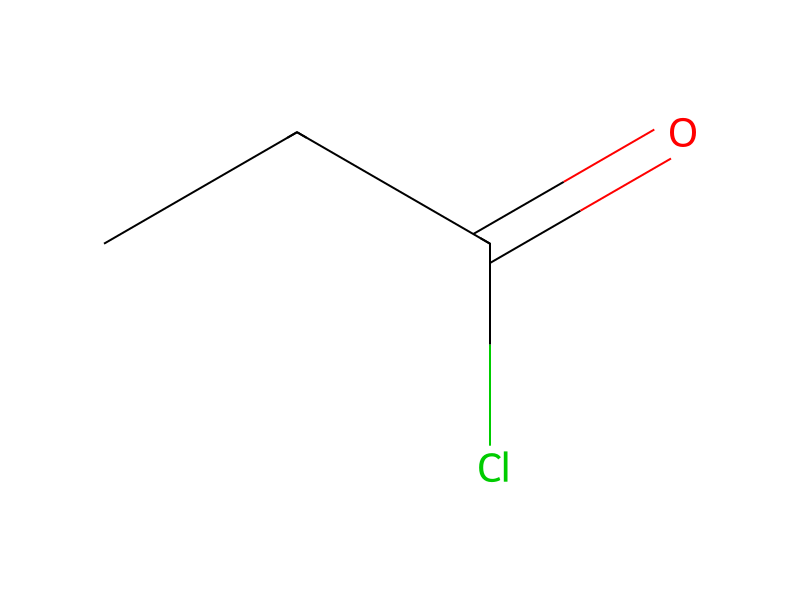
Grundinformationen
- Standard-SMILES
CCC(=O)Cl- InChIKey
RZWZRACFZGVKFM-UHFFFAOYSA-N- Summenformel
- C3H5ClO
- Durchschnittliche Molmasse
- 92,52 g/mol
- Monoisotopische Masse
- 92,00289246
Überblick
Propionyl chloride appears as a colorless liquid with a pungent odor. Corrosive and very irritating to skin and eyes. Used to make other chemicals.
Namen und Bezeichner
- Bevorzugter Name
- Propionyl chloride
- IUPAC
- propanoyl chloride
- Lokaler Name
- Propionylchlorid
- Englischer Name
- Propionyl chloride
- Summenformel
- C3H5ClO
- Molmasse
- 92.52
Namen und Synonyme
Propionyl chloridePROPANOYL CHLORIDE79-03-8Propionic acid chloridePropionic chlorideMB6VL5OMB9UN1815NSC-83547CHLORO ETHYL KETONEDTXSID4058819UN-1815RefChem:176428
Weitere Namen anzeigen
propionylPropionylchloridPropionyl chloride, 98.5%PropionchloridePropionyl clorideAKOS BBS-00004085PROPIONYL CHLORIDE extrapure
DTXCID0048133201-170-0PropionylchlorideMFCD00000745PROPIONYL-D5 CHLORIDEUNII-MB6VL5OMB9propanoylchloridepropanoic chloride
Datenbank-Bezeichner
- CAS
79-03-8- PubChem CID
- 62324
- DTXSID
DTXSID4058819- UNII
- MB6VL5OMB9
- EC Number
- 201-170-0
- Nikkaji
- J4.227G
Eigenschaften
Berechnete Struktureigenschaften
- XLogP
- 1,2
- Polarare Oberfläche (TPSA)
- 17,1 Ų
- H-Brücken-Donoren
- 0
- H-Brücken-Akzeptoren
- 1
- Frei drehbare Bindungen
- 1
- Schwere Atome
- 5
- Formalladung
- 0
- Komplexität
- 42,2
Experimentelle und physikochemische Eigenschaften
Chemical Classes
Toxic Gases & Vapors -> Acid Halides
Flammable agents - 3rd degree
SpringerMaterials PropertiesSchoenflies notation
OdorPungent odor
Density
1.0646 g/cu cm at 20 °C
1.065 @25 °C
Color/FormColorless liquid
SolubilitySoluble in ether
CorrosivityCorrosive
Flash Point
54 °F (NFPA, 2010)
54 °F (12 °C)
Boiling Point
80 °C
80 °C @760 [mm Hg]
Decomposition
Decomposes in water and alcohol.
When heated to decomposition it emits highly toxic fumes of Cl-
Melting Point
-94 °C
-94 °C
Vapor Density3.2 (Air = 1)
Physikochemische Eigenschaften
- Schmelzpunkt
- -94 °C · -94 °C
- Siedepunkt
- 77 · 77-79 °C (lit.)
- Dichte
- 1.059 g/mL · 1.059 g/mL at 25 °C (lit.)
- Dampfdichte
- 3.2 · 3.2 (vs air)
- Dampfdruck
- 106 hPa · 106 hPa (20 °C)
- Brechungsindex
- 20 · n20/D 1.404(lit.)
- Flammpunkt
- 53 °F · 53 °F
- storage temp.
- 30 °C · Store below +30°C.
- Aggregatzustand
- Liquid
- Farbe
- Clear
- Explosionsgrenze
- 3.6 · 3.6-11.9%(V)
- Wasserlöslichkeit
- REACTS
- Merck
- 14 · 14,7828
- BRN
- 385632 · 385632
- InChI
- 1S/C3H5ClO/c1-2-3(4)5/h2H2,1H3
- InChIKey
- RZWZRACFZGVKFM-UHFFFAOYSA-N
- SMILES
- CCC(Cl)=O
- CAS Datenbank
- 79 · 79-03-8(CAS DataBase Reference)
- NIST chemische Informationen
- Propanoyl chloride(79-03-8)
- EPA chemische Informationen
- Propanoyl chloride (79-03-8)
Sicherheit und Regulatorisches
GHS-Klassifizierung
GHS Classification
Danger
H225: Highly Flammable liquid and vapor [Danger Flammable liquids]
P210, P233, P240, P241, P242, P243, P260, P264, P280, P301+P330+P331, P302+P361+P354, P303+P361+P353, P304+P340, P305+P354+P338, P316, P321, P363, P370+P378, P403+P235, P405, and P501 (click each P-code to see the statement)
Danger
H225 (100%): Highly Flammable liquid and vapor [Danger Flammable liquids]
P210, P233, P240, P241, P242, P243, P260, P261, P264, P264+P265, P270, P271, P280, P301+P317, P301+P330+P331, P302+P361+P354, P303+P361+P353, P304+P340, P305+P354+P338, P316, P317, P321, P330, P363, P370+P378, P403+P233, P403+P235, P405, and P501 (click each P-code to see the statement)
Gefahrenhinweise
Hazards IdentificationWater-reactive material (WR)
Regulatory Information
Chemical: Propanoyl chloride
List I Chemical: A chemical specified by regulation that, in addition to legitimate uses, is used in manufacturing a controlled substance in violation of the Act and is important to the manufacture of a controlled substance. (21 eCFR 1310.02)
Status: Active Update: 23-03-2020 https://echa.europa.eu/registration-dossier/-/registered-dossier/5578
Propionyl chloride: Does not have an individual approval but may be used under an appropriate group standard
The New Jersey Worker and Community Right to Know Act requires public and private employers to provide information about hazardous substances at their workplaces. (N.J.S.A. 34:5A-1 et. seq.)
Other Safety InformationIMAP assessments - Propanoyl chloride: Human health tier I assessment
DOT LabelFlammable Liquid Corrosive
Fire Hazards
Excerpt from ERG Guide 155 [Substances - Toxic and/or Corrosive (Flammable / Water-Sensitive)]:
· HIGHLY FLAMMABLE: Will be easily ignited by heat, sparks or flames.
Fire Potential
Flammable ... .
Dangerous fire hazard when exposed to heat or flame.
Health Hazards
Excerpt from ERG Guide 155 [Substances - Toxic and/or Corrosive (Flammable / Water-Sensitive)]:
· TOXIC and/or CORROSIVE; inhalation, ingestion or contact (skin, eyes) with vapors, dusts or substance may cause severe injury, burns or death.
Hazards Summary
Decomposed vigorously by water; [Merck Index] Reacts with water producing propionic acid and hydrochloric acid; Corrosive and highly irritating to skin and eyes; [CAMEO] Reacts violently with water; Causes burns; Inhalation may cause corrosive injuries to upper respiratory tract and lungs; [Alfa Aesar MSDS]
DOT ID and Guide1815 155
Reactive GroupAcyl Halides, Sulfonyl Halides, and Chloroformates
Reactivity AlertsHighly Flammable
Reactivity Profile
Acid halides, such as PROPIONYL CHLORIDE, are water reactive; some are violently reactive. They are incompatible with strong oxidizing agents, alcohols, amines, and alkali. May react vigorously or explosively if mixed with diisopropyl ether or other ethers in the presence of trace amounts of metal salts [J. Haz. Mat., 1981, 4, 291].
Sicherheit und Schutzausrüstung
Fire FightingExcerpt from ERG Guide 155 [Substances - Toxic and/or Corrosive (Flammable / Water-Sensitive)]:
Accidental Release Measures
· CALL 911. Then call emergency response telephone number on shipping paper. If shipping paper not available or no answer, refer to appropriate telephone number listed on the inside back cover.
· ELIMINATE all ignition sources (no smoking, flares, sparks or flames) from immediate area.
First Aid
Excerpt from ERG Guide 155 [Substances - Toxic and/or Corrosive (Flammable / Water-Sensitive)]:
General First Aid:
Firefighting HazardsCarbon oxides, Hydrogen chloride gas
Exposure Control and Personal Protection
· Wear positive pressure self-contained breathing apparatus (SCBA).
TIH (Toxic Inhalation Hazard) - Term used to describe gases and volatile liquids that are toxic when inhaled. Some are TIH materials themselves, e.g., chlorine, and some release TIH gases when spilled in water, e.g., chlorosilanes. [ERG 2016].
Fire Fighting Procedures
Dry powder
To fight fire, use CO2, dry chemical, do not use water.
Wear self-contained breathing apparatus for firefighting if necessary.
Storage Conditions
Keep container tightly closed in a dry and well-ventilated place. Containers which are opened must be carefully resealed and kept upright to prevent leakage. Never allow product to get in contact with water during storage. Reacts violently with water. Storage class (TRGS 510): Flammable liquids
Cleanup Methods
ACCIDENTAL RELEASE MEASURES; Personal precautions, protective equipment and emergency procedures: Wear respiratory protection. Avoid breathing vapors, mist or gas. Ensure adequate ventilation. Remove all sources of ignition. Evacuate personnel to safe areas. Beware of vapors accumulating to form explosive concentrations. Vapors can accumulate in low areas. Prevent further leakage or spillage if safe to do so. Do not let product enter drains. Contain spillage, and then collect with an electrically protected vacuum cleaner or by wet-brushing and place in container for disposal according to local regulations. Do not flush with water.
Nonfire Spill ResponseExcerpt from ERG Guide 155 [Substances - Toxic and/or Corrosive (Flammable / Water-Sensitive)]:
Disposal Methods
SRP: Recycle any unused portion of the material for its approved use or return it to the manufacturer or supplier. Ultimate disposal of the chemical must consider: the material's impact on air quality; potential migration in air, soil or water; effects on animal, aquatic and plant life; and conformance with environmental and public health regulations. If it is possible or reasonable use an alternative chemical product with less inherent propensity for occupational harm/injury/toxicity or environmental contamination.
Product: Burn in a chemical incinerator equipped with an afterburner and scrubber but exert extra care in igniting as this material is highly flammable. Offer surplus and non-recyclable solutions to a licensed disposal company. Contact a licensed professional waste disposal service to dispose of this material. Contaminated packaging: Dispose of as unused product.
Preventive Measures
ACCIDENTAL RELEASE MEASURES; Personal precautions, protective equipment and emergency procedures: Wear respiratory protection. Avoid breathing vapors, mist or gas. Ensure adequate ventilation. Remove all sources of ignition. Evacuate personnel to safe areas. Beware of vapors accumulating to form explosive concentrations. Vapors can accumulate in low areas. Prevent further leakage or spillage if safe to do so.
Gloves must be inspected prior to use. Use proper glove removal technique (without touching glove's outer surface) to avoid skin contact with this product. Dispose of contaminated gloves after use in accordance with applicable laws and good laboratory practices. Wash and dry hands. Full contact
Avoid contact with skin and eyes. Avoid inhalation of vapor or mist. Use explosion-proof equipment. Keep away from sources of ignition - No smoking. Take measures to prevent the build up of electrostatic charge.
Avoid contact with skin, eyes and clothing. Wash hands before breaks and immediately after handling the product.
Isolation and Evacuation
Excerpt from ERG Guide 155 [Substances - Toxic and/or Corrosive (Flammable / Water-Sensitive)]:
Immediate precautionary measure
When spilled in water
When spilled in water
Toxikologische Informationen
Environmental Fate
TERRESTRIAL FATE: Propionyl chloride reacts vigorously with water to form propionic acid and hydrochloric acid(1); therefore, leaching in soil and volatilization from moist soil are not expected to be important fate processes(SRC). Propionyl chloride is expected to volatilize from dry soil surfaces(SRC) based upon an estimated vapor pressure of 97 mm Hg at 25 °C(SRC), determined from a fragment constant method(2).
AQUATIC FATE: Propionyl chloride reacts vigorously with water to form propionic acid and hydrochloric acid(1). This decomposition reaction will be the dominant fate process in water(SRC).
ATMOSPHERIC FATE: According to a model of gas/particle partitioning of semivolatile organic compounds in the atmosphere(1), propionyl chloride, which has an estimated vapor pressure of 97 mm Hg at 25 °C(SRC), determined from a fragment constant method(2), is expected to exist solely as a vapor in the ambient atmosphere. Vapor-phase propionyl chloride is degraded in the atmosphere by reaction with photochemically-produced hydroxyl radicals(SRC); the half-life for this reaction in air is estimated to be 27 days(SRC), calculated from its rate constant of 5.9X10⁻¹³ cu cm/molecule-sec at 25 °C(SRC) that was derived using a structure estimation method(2). Propionyl chloride hydrolyzes in moist air(3) yielding propionic acid and hydrochloric acid(4).
Adverse EffectsDermatotoxin - Skin burns.
Toxicity Summary
IDENTIFICATION AND USE: Propionyl chloride is used in chemical synthesis. HUMAN STUDIES: There are no data available. ANIMAL STUDIES: It was corrosive in an eye irritation test in rabbits. In dermal irritation test in rabbits severe necrosis was observed after 1, 5 and 15 min of exposure. Propionyl chloride was negative in mutagenicity test in S. typhimurium strains TA 1535, TA 1537, TA 98 and TA 100 and E. coli WP2 uvr A with and without metabolic activation.
Soil Adsorption/MobilityPropionyl chloride reacts vigorously or violently with water to form propionic acid and hydrochloric acid(1); therefore, leaching in soil is not expected to be an important fate process(SRC).
Artificial Pollution Sources
Propionyl chloride's production and use as a chemical intermediate(1) for the introduction of the propionyl group(e.g., in the production of pharmaceuticals) and for the synthesis of propionate esters may result in its release to the environment through various waste streams(SRC). Propionyl chloride is used as an intermediate in the production of agrochemicals and pharmaceuticals and it serves as an intermediate for dyes, textile auxiliaries and peroxide compounds(3).
Environmental BioconcentrationPropionyl chloride reacts vigorously or violently with water to form propionic acid and hydrochloric acid(1); therefore, bioconcentration in aquatic organisms is not expected to be an important fate process(SRC).
Volatilization from Water/Soil
Propionyl chloride reacts vigorously or violently with water to form propionic acid and hydrochloric acid(1); therefore, volatilization of propionyl chloride from water or moist soil is not expected to be an important fate process(SRC). Propionyl chloride is expected to volatilize from dry soil surfaces(SRC) based upon an estimated vapor pressure of 97 mm Hg at 25 °C(SRC), determined from a fragment constant method(2).
Non-Human Toxicity Excerpts
/LABORATORY ANIMALS: Acute Exposure/ /Eye irritation test in rabbits/ Corrosive.
/LABORATORY ANIMALS: Acute Exposure/ Animals /rabbits/ were treated for 1, 5, and 15 min using occlusive conditions. An application site of 2.5x2.5 cm was covered with the liquid test substance. After the application time (1, 5 and 15 min) the skin was washed with Lutrol (50%). The animals were observed for 8 days and skin changes were recorded daily. The report describes findings after 24 hours and at the end of the observation period (8 days). After 24 hours and 8 days, (severe) necrosis was observed after 1, 5 and 15 min of exposure and redness was observed at the edges (both animals). The study was not performed for the 20 hours exposure duration, due to the severe effects observed after 1, 5 and 15 minutes exposure.
/GENOTOXICITY/ Negative in S. typhimurium TA 1535, TA 1537, TA 98 and TA 100 and E. coli WP2 uvr A /with and without metabolic activation/
Environmental Abiotic Degradation
The rate constant for the vapor-phase reaction of propionyl chloride with photochemically-produced hydroxyl radicals has been estimated as 5.9X10⁻¹³ cu cm/molecule-sec at 25 °C(SRC) using a structure estimation method(1). This corresponds to an atmospheric half-life of about 27 days at an atmospheric concentration of 5X10+5 hydroxyl radicals per cu cm(1). Propionyl chloride reacts vigorously or violently with water to form propionic acid and hydrochloric acid(2). Based on a scenario where the chemical is spilled into an excess of water (at least 5 fold excess of water), half of the maximum theoretical yield of hydrogen chloride gas will be created in 0.09 minutes(2). Propionyl chloride vapors hydrolyze in moist air(3).
Probable Routes of Human Exposure
Occupational exposure to propionyl chloride may occur through inhalation and dermal contact with this compound at workplaces where propionyl chloride is produced or used. Available use data indicate that the general population is not exposed to propionyl chloride. (SRC)
Environmental Fate/Exposure Summary
Propionyl chloride's production and use as a chemical intermediate for the introduction of the propionyl group (e.g., in the production of pharmaceuticals) and for the synthesis of propionate esters may result in its release to the environment through various waste streams. If released to air, an estimated vapor pressure of 97 mm Hg at 25 °C indicates propionyl chloride will exist solely as a vapor in the atmosphere. Vapor-phase propionyl chloride will be degraded in the atmosphere by reaction with photochemically-produced hydroxyl radicals; the half-life for this reaction in air is estimated to be 27 days. Propionyl chloride hydrolyzes in moist air. If released to soil, leaching in soil and volatilization from moist soil are not expected to be important fate processes because propionyl chloride reacts and decomposes in water. Propionyl chloride is expected to volatilize from dry soil surfaces based upon its vapor pressure. If released to water, propionyl chloride reacts vigorously with water to form propionic acid and hydrochloric acid. This decomposition reaction will be the dominant fate process in water. Occupational exposure to propionyl chloride may occur through inhalation and dermal contact with this compound at workplaces where propionyl chloride is produced or used. Available use data indicate that the general population is not exposed to propionyl chloride. (SRC)
Antidote and Emergency Treatment
/SRP:/ Immediate first aid: Ensure that adequate decontamination has been carried out. If patient is not breathing, start artificial respiration, preferably with a demand-valve resuscitator, bag-valve-mask device, or pocket mask, as trained. Perform CPR as necessary. Immediately flush contaminated eyes with gently flowing water. Do not induce vomiting. If vomiting occurs, lean patient forward or place on left side (head-down position, if possible) to maintain an open airway and prevent aspiration. Keep patient quiet and maintain normal body temperature. Obtain medical attention. /Halogenated aliphatic hydrocarbons and related compounds/
/SRP:/ Basic treatment: Establish a patent airway (oropharyngeal or nasopharyngeal airway, if needed). Suction if necessary. Watch for signs of respiratory insufficiency and assist ventilations if necessary. Administer oxygen by nonrebreather mask at 10 to 15 L/min. Monitor for pulmonary edema and treat if necessary ... . Monitor for shock and treat if necessary ... . Anticipate seizures and treat if necessary ... . For eye contamination, flush eyes immediately with water. Irrigate each eye continuously with 0.9% saline (NS) during transport ... . Do not use emetics. For ingestion, rinse mouth and administer 5 mL/kg up to 200 mL of water for dilution if the patient can swallow, has a strong gag reflex, and does not drool. Administer activated charcoal ... . Cover skin burns with sterile dressings after decontamination ... . /Halogenated aliphatic hydrocarbons and related compounds/
/SRP:/ Advanced treatment: Consider orotracheal or nasotracheal intubation for airway control in the patient who is unconscious, has severe pulmonary edema, or is in severe respiratory distress. Positive-pressure ventilation techniques with a bag-valve-mask device may be beneficial. Consider drug therapy for pulmonary edema ... . Monitor cardiac rhythm and treat arrhythmias if necessary ... . Start IV administration of D5W /SRP: "To keep open", minimal flow rate/. Use 0.9% saline (NS) or lactated Ringer's (LR) if signs of hypovolemia are present. For hypotension with signs of hypovolemia, administer fluid cautiously. Consider vasopressors if patient is hypotensive with a normal fluid volume. Watch for signs of fluid overload ... .Treat seizures with diazepam or lorazepam ... . Use proparacaine hydrochloride to assist eye irrigation ... . /Halogenated aliphatic hydrocarbons and related compounds/
Sicherheitsdaten
- wgk
- 1
- tsca
- TSCA listed
- ridadr
- UN 1815
- hs_code
- 29399990
- RTECS-Nr.
- UG6657000
- risk_code
- 11-14-34-20/22
- Toxizität
- LD50 orally in Rabbit: 823 mg/kg
- hazard_code
- F,C
- safety_code
- 9-16-26-45
- hazard_class
- 3
- packing_group
- II
- Speicherklasse
- 3 - Flammable liquids
- Giftige Stoffe Daten
- 79-03-8(Hazardous Substances Data)
- Hazard Classifications
- Acute Tox. 3 InhalationAcute Tox. 4 OralEye Dam. 1Flam. Liq. 2Skin Corr. 1B
- Selbstentzündungstemperatur
- 270 °C
Chemie und Industrie
Verwendung und Herstellung
Uses
Used to make other chemicals; [CAMEO]
Toxic Gas from Spilling Chemical in Water [Category: Other]
Chemical intermediate.
Propionyl chloride is used for the introduction of the propionyl group and for the synthesis of propionate esters because of its high reactivity.
Methods of Manufacturing
Propionyl chloride is produced industrially by treatment of propionic acid with phosgene or thionyl chloride. The reaction occurs at about 50 °C in the liquid phase in the presence of dialkylformamides. The product is then separated by distillation.
DEA Listed Chemicals
Propionyl chloride
A chemical specified by regulation that, in addition to legitimate uses, is used in manufacturing a controlled substance in violation of the Act and is important to the manufacture of a controlled substance. (21 eCFR 1310.02)
General Manufacturing InformationPropanoyl chloride: ACTIVE
Anwendungen
VerwendenPropionyl chloride is used as an intermediate in the production of agrochemicals and pharmaceuticals. It serves as an intermediate for dyes, textile auxiliaries and peroxide compounds. It acts as a crop protecting agent.
Darstellung
synthetischePropionyl chloride is synthesized by reacting propionic acid with phosphorus trichloride at 40-50°C for 1h, cooling, standing, separating and distilling to obtain the product.CH3CH2COOH+PCl3→CH3CH2COCl+HOPCl2Propionyl chloride is produced industrially by treatment of propionic acid with phosgene or thionyl chloride. The reaction occurs at ca. 50°C in the liquid phase in the presence of dialkylformamides. The product is then separated by distillation.CH3CH2CO2H + COCl2 → CH3CH2COCl + HCl + CO2Propionyl chloride can also be obtained by the reaction of propionic acid with PCl5.
Vor- und nachgelagerte Produkte
Vorgelagerte Rohstoffe
Nachgelagerte Produkte
Anbieter50 Anbieter
梯希爱(上海)化成工业发展有限公司021-67121386 · [email protected]
上海阿拉丁生化科技股份有限公司400-6206333 13167063860 · [email protected]
上海伟聂化工科技有限公司13046668259 · [email protected]
武汉欣扬瑞和化学科技有限公司153-07155313 15307155313 · [email protected]
常州市紫东联化进出口有限公司0519-85560282 13656141470 · [email protected]
Hebei shuoxi biotechnology co. LTD+8613081092107
河北展药生物科技有限公司15369953316 +8615369953316 · [email protected]
爱斯特(成都)生物制药股份有限公司+86-28-85122536 85324413 · [email protected]
山东前元高分子材料有限公司18678041314 18765609661 · [email protected]
科瑞迪化学400-821-5857 021-64326257 · [email protected]
Henan Xiangtong Chemical Co., Ltd.86-371-61312303 · [email protected]
石家庄感拓生物科技有限公司[email protected]
上海辅欣医药科技有限公司+86-021-021-50872116 · [email protected]
阿法埃莎(中国)化学有限公司400-6106006 · [email protected]
安耐吉化学&3A(安徽泽升科技股份有限公司)400-0056266 · [email protected]
上海瀚鸿科技股份有限公司021-54306202 13764082696 · [email protected]
上海柯维化学技术有限公司021-64609169 18901607656 · [email protected]
南京欣丰康生物科技有限公司025-84683399 13952017251 · [email protected]
上海景颜化工科技有限公司13817811078 · [email protected]
嘉兴市艾森化工有限公司0573-85285100 18627885956 · [email protected]
合肥天健化工有限公司551-65418679 15856988503;15837135945 · [email protected]
山东艺鸿化工有限公司15253143303 15269100373
玛雅试剂+86 (573) 82222445 (0)18006601000 452520369 · [email protected]
四川库利南科技有限公司400-1166-196 18981987031 · [email protected]
Xiamen AmoyChem Co., Ltd+86-86-5926051114 · [email protected]
斯洋(辽宁)生化制品有限公司+86-15221114306; +86-15221114306 · [email protected]
南京化学试剂股份有限公司025-58369808 17895012682 · [email protected]
Hebei Qige Biological Technology Co. Ltd+86 +8618733132031
上海思域化工科技有限公司86-21-34053660 · [email protected]
赛默飞世尔科技(中国)有限公司800-810-5118 · [email protected]
北京伊诺凯科技有限公司400-810-7969 010-59572699 · [email protected]
TCI AMERICA800-4238616 · [email protected]
TOKYO CHEMICAL INDUSTRY CO., LTD.03-36680489 · [email protected]
TCI Europe320-37350700 · [email protected]
上海贤鼎生物科技有限公司4009209199 · [email protected]
深圳康特腾科技有限公司86-0755-86635001 · [email protected]
越林试剂021-62960152 · [email protected]
山东新华制药股份有限公司0533- 2196801 18853385675 · [email protected]
北京环宇世纪化学科技有限公司hysj_bj.com
上海湄水化工科技有限公司021-60549325 18616193163
日照力德士化工有限公司010-51268198 · [email protected]
上海爱蝶实业有限公司021-58957966 18930537195 · [email protected]
成都零六生物科技有限公司400-1166-196 13458535857 · [email protected]
广拓化学(上海)有限公司021-60899189-8001 18918189673 · [email protected]
上海麦克林生化科技股份有限公司15221275939 15221275939 · [email protected]
上海嵩爰化工科技有限公司010-1234567 18521000990 · [email protected]
成都润泽本土化工有限公司13096311329 028-88469284 616445927 · [email protected]
池州凯隆进出口贸易有限公司[email protected]
聊城润恒化工贸易有限公司17862588818 · [email protected]
Sigma-Aldrich西格玛奥德里奇(上海)贸易有限公司021-61415566 800-8193336 · [email protected]
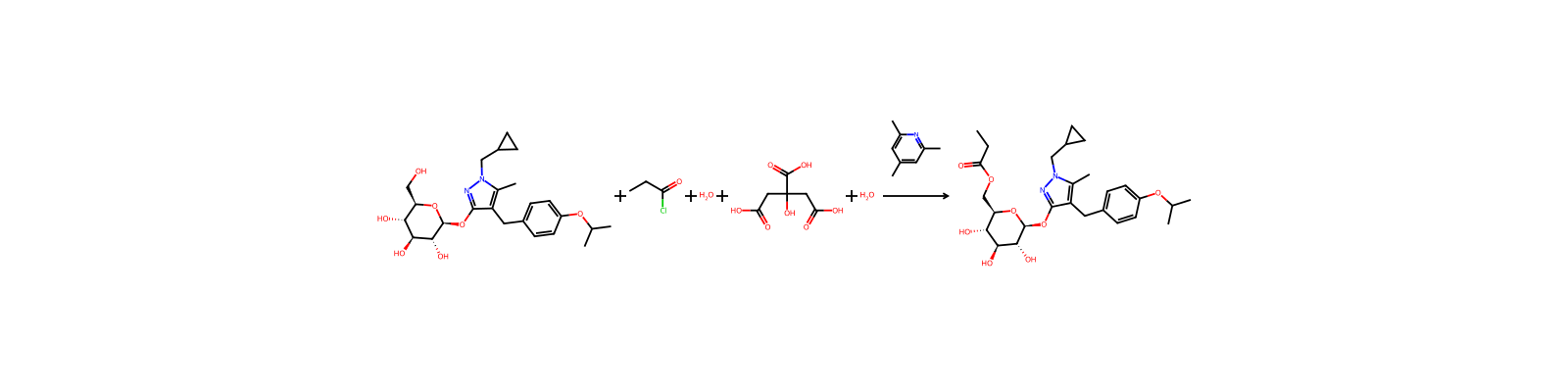
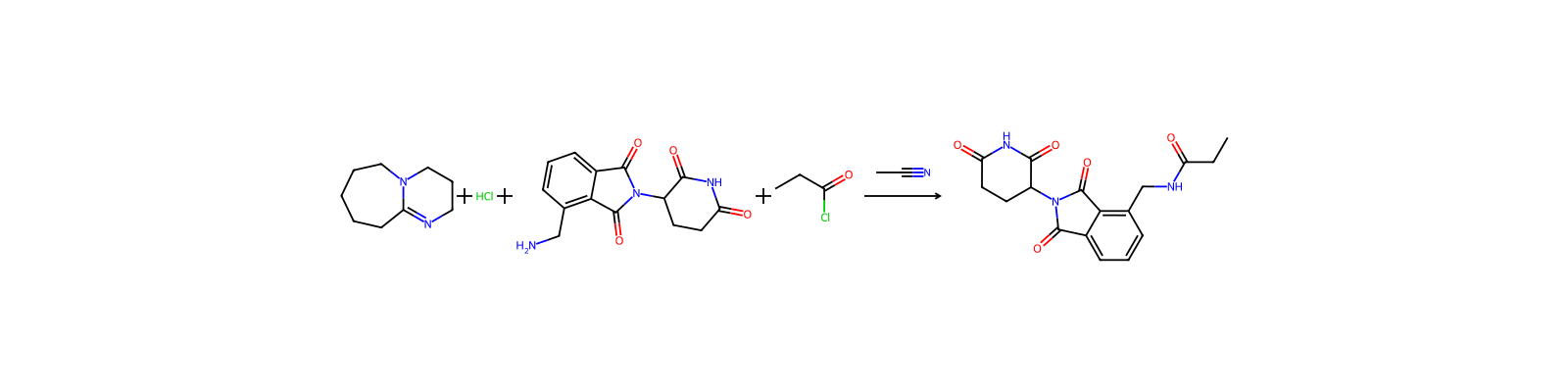
Zugehörige Reaktionen
1.877
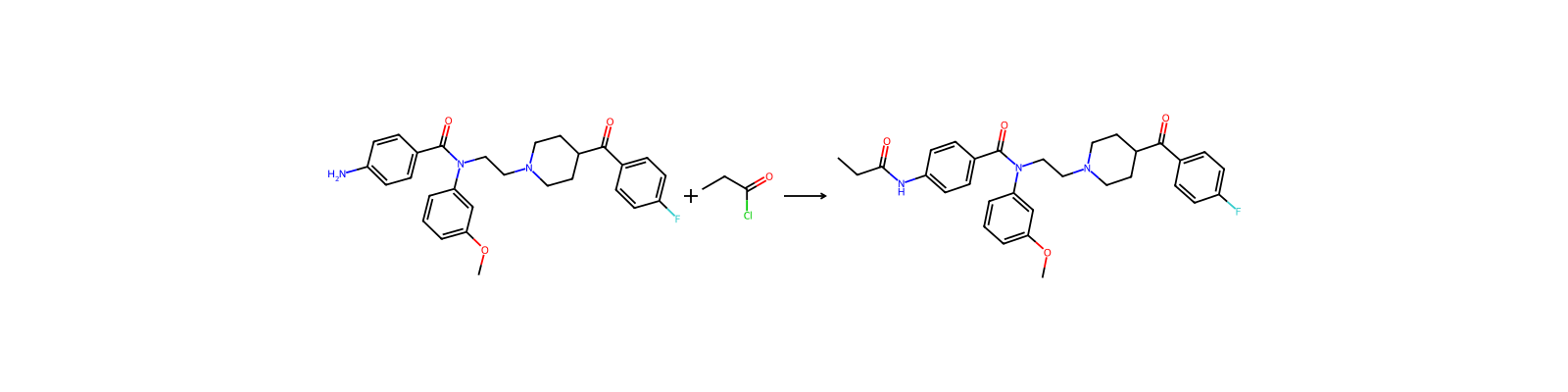
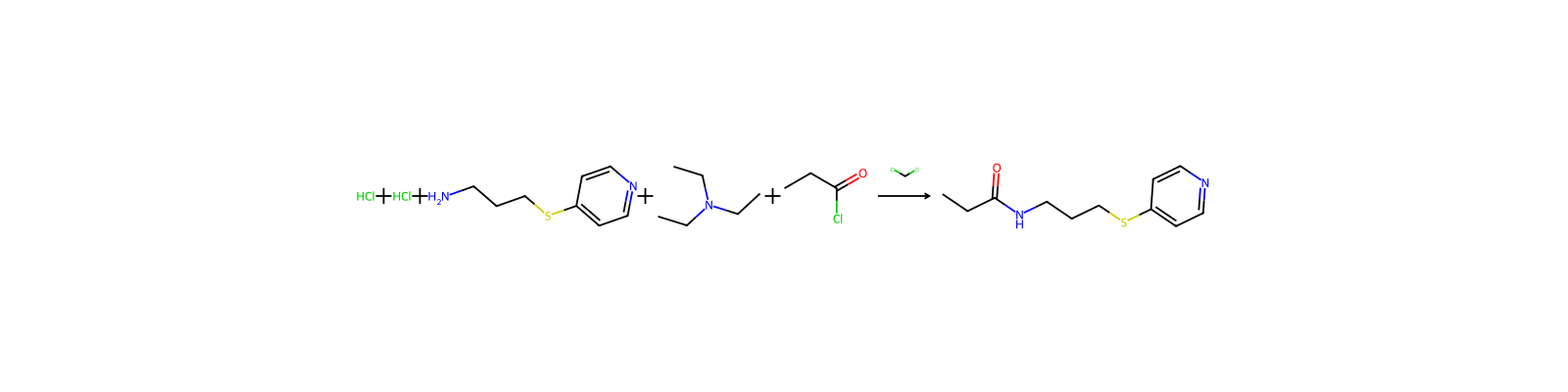


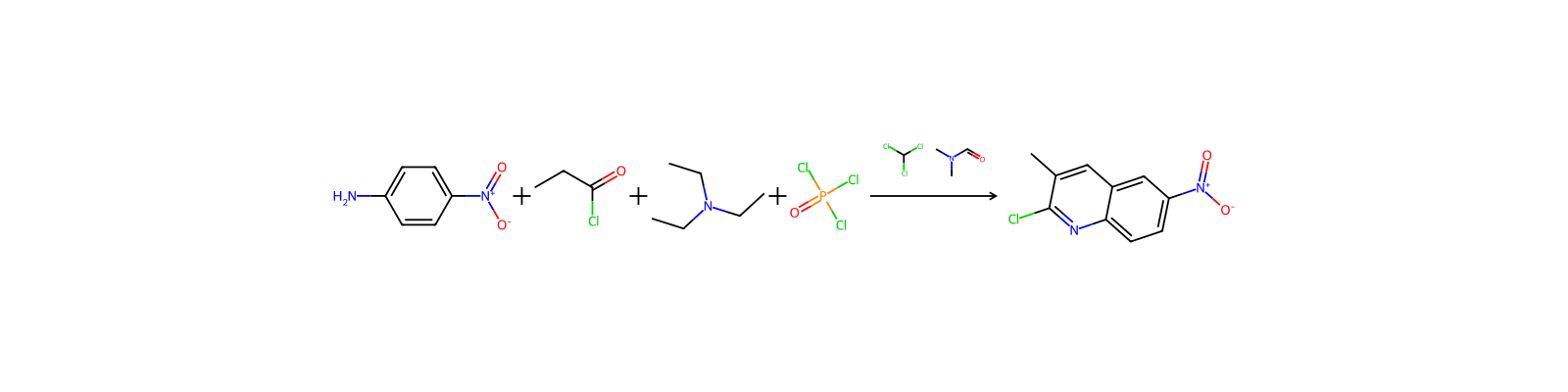
Verknüpfte Notizen
Wird geladen…