
Grundinformationen
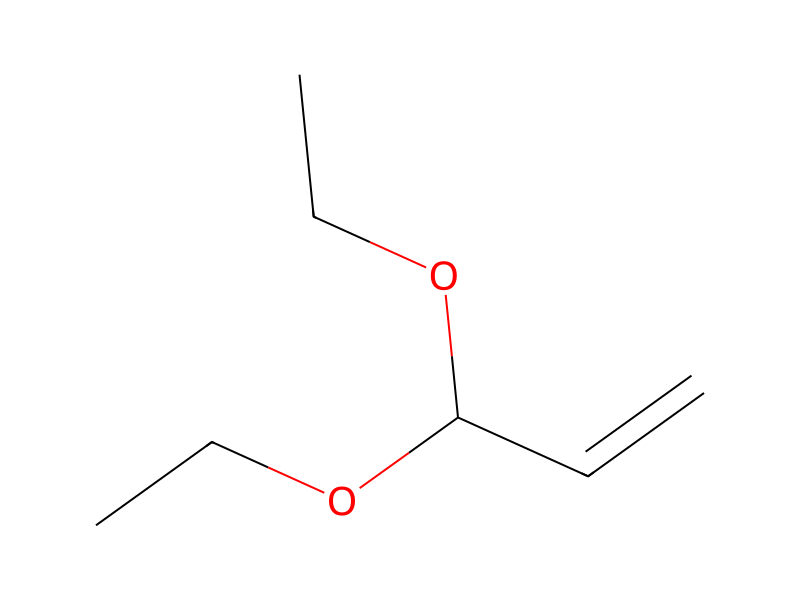
- Standard-SMILES
C=CC(OCC)OCC- InChIKey
MCIPQLOKVXSHTD-UHFFFAOYSA-N- Summenformel
- C7H14O2
- Durchschnittliche Molmasse
- 130,18 g/mol
- Monoisotopische Masse
- 130,09937969
Überblick
3,3-diethoxypropene appears as a colorless liquid with an agreeable odor. Very volatile. Less dense than water. Vapors heavier than air. Used as a solvent and to make cosmetics.
Namen und Bezeichner
- Bevorzugter Name
- 3,3-Diethoxy-1-propene
- IUPAC
- 3,3-diethoxyprop-1-ene
- Lokaler Name
- 3,3-Diethoxypropen
- Englischer Name
- Acrolein diethyl acetal
- Summenformel
- C7H14O2
- Molmasse
- 130.18
Namen und Synonyme
Acrolein diethyl acetal3054-95-3Acrolein diethylacetalAcrolein acetal3,3-Diethoxy-1-propene1,1-Diethoxy-2-propeneAcrolein, diethyl acetal3,3-DiethoxypropenePropenal diethyl acetalAcrylaldehyde diethyl acetalAcrolein, diethylacetalDTXSID0020024
Weitere Namen anzeigen
3,3-DIETHOXYPROP-1-ENE1-Propene, 3,3-diethoxy-3 3-DIETHOXYPROPENEAVAC-013ein DiethyLACROLEIN DEAAvacopan Impurity 6ACROLEINDITHYLACETAL
NSC-60135DTXCID002433XN703369PROPENE, 3,3-DIETHOXY-diethoxypropeneAcrylylaldehyde diethyl acetalRefChem:109416221-276-0
Datenbank-Bezeichner
- CAS
3054-95-3- PubChem CID
- 62477
- DTXSID
DTXSID0020024- ChEMBL
CHEMBL3182978- UNII
- 33XN703369
- EC Number
- 221-276-0
- Nikkaji
- J83.950G
Eigenschaften
Berechnete Struktureigenschaften
- XLogP
- 1,4
- Polarare Oberfläche (TPSA)
- 18,5 Ų
- H-Brücken-Donoren
- 0
- H-Brücken-Akzeptoren
- 2
- Frei drehbare Bindungen
- 5
- Schwere Atome
- 9
- Formalladung
- 0
- Komplexität
- 65,3
Experimentelle und physikochemische Eigenschaften
Chemical Classes
Other Classes -> Acetals
Flammable agents - 3rd degree
SpringerMaterials PropertiesOptical coefficient
Physical Description
3,3-diethoxypropene appears as a colorless liquid with an agreeable odor. Very volatile. Less dense than water. Vapors heavier than air. Used as a solvent and to make cosmetics.
Colorless liquid with a pleasant odor; [CAMEO]
Physikochemische Eigenschaften
- Schmelzpunkt
- 120 · 120-124 °C
- Siedepunkt
- 125 °C · 125 °C (lit.)
- Dichte
- 0.854 g/mL · 0.854 g/mL at 25 °C (lit.)
- Brechungsindex
- 20 · n20/D 1.398(lit.)
- Flammpunkt
- 40 °F · 40 °F
- storage temp.
- 2 · 2-8°C
- Löslichkeit
- Chloroform (Soluble), Ethyl Acetate (Slightly)
- Aggregatzustand
- Liquid
- Farbe
- Clear colorless
- Wasserlöslichkeit
- Slightly soluble in water.
- BRN
- 1701567 · 1701567
- Stabilität
- Light sensitive
- InChI
- 1S/C7H14O2/c1-4-7(8-5-2)9-6-3/h4,7H,1,5-6H2,2-3H3
- InChIKey
- MCIPQLOKVXSHTD-UHFFFAOYSA-N
- SMILES
- CCOC(OCC)C=C
- LogP
- 1.56 · 1.560
- CAS Datenbank
- 3054 · 3054-95-3(CAS DataBase Reference)
- NIST chemische Informationen
- 1 · 1-Propene, 3,3-diethoxy-(3054-95-3)
- EPA chemische Informationen
- 1 · 1-Propene, 3,3-diethoxy- (3054-95-3)
Sicherheit und Regulatorisches
GHS-Klassifizierung
GHS Classification
Danger
H225 (100%): Highly Flammable liquid and vapor [Danger Flammable liquids]
P210, P233, P240, P241, P242, P243, P264+P265, P280, P303+P361+P353, P305+P351+P338, P337+P317, P370+P378, P403+P235, and P501 (click each P-code to see the statement)
Aggregated GHS information provided per 188 reports by companies from 6 notifications to the ECHA C&L Inventory. Each notification may be associated with multiple companies.
Gefahrenhinweise
Regulatory Information
1-Propene, 3,3-diethoxy-: Does not have an individual approval but may be used under an appropriate group standard
The New Jersey Worker and Community Right to Know Act requires public and private employers to provide information about hazardous substances at their workplaces. (N.J.S.A. 34:5A-1 et. seq.)
DOT LabelFlammable Liquid
Fire Hazards
Excerpt from ERG Guide 127 [Flammable Liquids (Water-Miscible)]:
· HIGHLY FLAMMABLE: Will be easily ignited by heat, sparks or flames.
Health Hazards
Excerpt from ERG Guide 127 [Flammable Liquids (Water-Miscible)]:
· Inhalation or contact with material may irritate or burn skin and eyes.
Hazards SummaryMay form unstable peroxides on exposure to air; [CAMEO] A strong eye irritant; [Alfa Aesar MSDS]
DOT ID and Guide2374 127
Reactive GroupEthers
Reactivity AlertsHighly Flammable
Reactivity Profile
Ethers, such as 3,3-DIETHOXYPROPENE, can act as bases. They form salts with strong acids and addition complexes with Lewis acids. The complex between diethyl ether and boron trifluoride is an example. Ethers may react violently with strong oxidizing agents. In other reactions, which typically involve the breaking of the carbon-oxygen bond, ethers are relatively inert.
DOT Hazard Classification
3,3-Diethoxypropene
UN2374
Class 3 Flammable and combustible liquid (49 eCFR § 173.120)
PG II: the degree of danger presented by the material is medium
Air and Water ReactionsHighly flammable. Soluble in water. Likely to slowly form peroxidized product when exposed to air. The formed peroxide is likely to be unstable.
Peroxide Forming Chemical
3,3-Diethoxypropene
D*: Other compounds that may form peroxides
Bretherick's
Sicherheit und Schutzausrüstung
Fire FightingExcerpt from ERG Guide 127 [Flammable Liquids (Water-Miscible)]:
Accidental Release Measures
· CALL 911. Then call emergency response telephone number on shipping paper. If shipping paper not available or no answer, refer to appropriate telephone number listed on the inside back cover.
· ELIMINATE all ignition sources (no smoking, flares, sparks or flames) from immediate area.
First Aid
Excerpt from ERG Guide 127 [Flammable Liquids (Water-Miscible)]:
General First Aid:
Exposure Control and Personal Protection· Wear positive pressure self-contained breathing apparatus (SCBA).
Nonfire Spill ResponseExcerpt from ERG Guide 127 [Flammable Liquids (Water-Miscible)]:
Isolation and Evacuation
Excerpt from ERG Guide 127 [Flammable Liquids (Water-Miscible)]:
Immediate precautionary measure
Personal Protective Equipment (PPE)Excerpt from ERG Guide 127 [Flammable Liquids (Water-Miscible)]:
Emergency Response Planning GuidelinesCAUTION: The majority of these products have a very low flash point. Use of water spray when fighting fire may be inefficient.
Sicherheitsdaten
- F
- 8-13
- wgk
- 3
- ridadr
- UN 2374
- hs_code
- 29110000
- RTECS-Nr.
- AS1370000
- risk_code
- 11-36
- hazard_code
- F,Xi
- safety_code
- 9-16-26-33-29-7/9
- hazard_class
- 3
- packing_group
- II
- Speicherklasse
- 3 - Flammable liquids
- Hazard Classifications
- Eye Irrit. 2Flam. Liq. 2
Chemie und Industrie
Verwendung und Herstellung
UsesUsed as a solvent and to make cosmetics; [CAMEO]
Anwendungen
VerwendenAcrolein diethyl acetal is a reagent used for the synthesis of a variety of compounds, including cinnamaldehydes.
Vor- und nachgelagerte Produkte
Nachgelagerte Produkte
Anbieter50 Anbieter
梯希爱(上海)化成工业发展有限公司021-67121386 · [email protected]
衢州润东化工有限公司0570-8789886 18892685668 · [email protected]
上海阿拉丁生化科技股份有限公司400-6206333 13167063860 · [email protected]
武汉欣扬瑞和化学科技有限公司153-07155313 15307155313 · [email protected]
上海遐瑞医药科技有限公司+86-021-61551413 · [email protected]
河北展药生物科技有限公司15369953316 +8615369953316 · [email protected]
爱斯特(成都)生物制药股份有限公司+86-28-85122536 85324413 · [email protected]
Dayang Chem (Hangzhou) Co.,Ltd.+86-0571-88938639 17705817739 · [email protected]
科瑞迪化学400-821-5857 021-64326257 · [email protected]
Syntechem Co.,Ltd[email protected]
上海迈瑞尔生化科技有限公司4006356688 18621169109 · [email protected]
武汉易泰科技有限公司上海分公司18930552037 · [email protected]
北京东华力拓科技发展有限公司010-88425576 · [email protected]
阿法埃莎(中国)化学有限公司400-6106006 · [email protected]
安耐吉化学&3A(安徽泽升科技股份有限公司)400-0056266 · [email protected]
Allfluoro Pharmaceutical Company Limited+86-400-0216110 +86-15958047586 · [email protected]
上海瀚鸿科技股份有限公司021-54306202 13764082696 · [email protected]
山东西亚化学有限公司13355009207 13355009207 · [email protected]
玛雅试剂+86 (573) 82222445 (0)18006601000 452520369 · [email protected]
四川库利南科技有限公司400-1166-196 18981987031 · [email protected]
天津希恩思生化科技有限公司400 638 7771 · [email protected]
Xiamen AmoyChem Co., Ltd+86-86-5926051114 · [email protected]
武汉欣扬瑞和化学科技有限公司027-83855316 18171155316
上海思域化工科技有限公司86-21-34053660 · [email protected]
赛默飞世尔科技(中国)有限公司800-810-5118 · [email protected]
江苏艾康生物医药研发有限公司025-66113011 13913916777 · [email protected]
TCI AMERICA800-4238616 · [email protected]
TOKYO CHEMICAL INDUSTRY CO., LTD.03-36680489 · [email protected]
TCI Europe320-37350700 · [email protected]
上海贤鼎生物科技有限公司4009209199 · [email protected]
深圳康特腾科技有限公司86-0755-86635001 · [email protected]
越林试剂021-62960152 · [email protected]
上海将来实业股份有限公司400-0066400 13621662912 · [email protected]
上海将来实业股份有限公司021-61552785 · [email protected]
上海石洋化工有限公司021-56795766 · [email protected]
成都零六生物科技有限公司400-1166-196 13458535857 · [email protected]
上海御略医药科技有限公司021-60345187 13671753212 · [email protected]
上海麦克林生化科技股份有限公司15221275939 15221275939 · [email protected]
杭州杰恒化工有限公司0571-87396432 · [email protected]
上海嵩爰化工科技有限公司010-1234567 18521000990 · [email protected]
上海有朋化工有限公司021-69005955 13701776567 · [email protected]
上海凯赛化工有限公司021-33516722 13701817765 · [email protected]
上海彤源化工有限公司021-021-69182866 13701855675 · [email protected]
上海蓝润化学有限公司021-69515658 ; 69515628 13701998368 · [email protected]
上海容立化学科技有限公司021-69992220 13701886816 · [email protected]
上海康拓化工有限公司021-69185552 13701777608 · [email protected]
Sigma-Aldrich西格玛奥德里奇(上海)贸易有限公司021-61415566 800-8193336 · [email protected]
成都瑞欧克科技有限公司028-64353063 · [email protected]
上海波以尔化工有限公司021-50182298 021-50180596 · [email protected]
广东翁江化学试剂有限公司0751-2815987 13927875076 · [email protected]
Zugehörige Reaktionen
49


Verknüpfte Notizen
Wird geladen…