
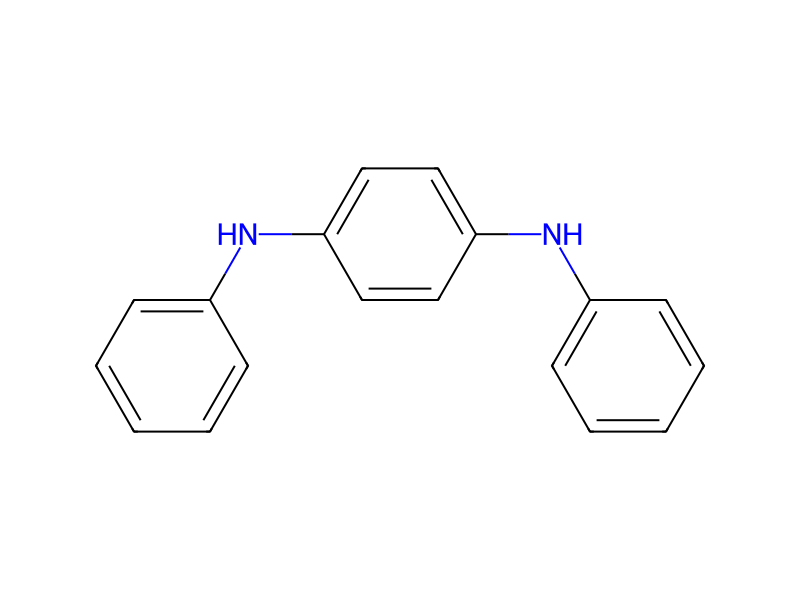
Grundinformationen
- Standard-SMILES
c1ccc(Nc2ccc(Nc3ccccc3)cc2)cc1- InChIKey
UTGQNNCQYDRXCH-UHFFFAOYSA-N- Summenformel
- C18H16N2
- Durchschnittliche Molmasse
- 260,3 g/mol
- Monoisotopische Masse
- 260,13134851
Überblick
N,n'-diphenyl-p-phenylenediamine appears as gray or dark gray powder or flakes. (NTP, 1992)
Namen und Bezeichner
- Bevorzugter Name
- N,N'-Diphenyl-P-Phenylenediamine
- IUPAC
- 1-N,4-N-diphenylbenzene-1,4-diamine
- Lokaler Name
- N,N'-Diphenyl-p-phenylendiamin
- Englischer Name
- N,N-Diphenyl-p-phenylenediamine
- Summenformel
- C18H16N2
- Molmasse
- 260.33
Namen und Synonyme
74-31-7N,N'-Diphenyl-p-phenylenediamineN,N'-Diphenyl-1,4-phenylenediamineDPPDDiphenyl-p-phenylenediamineAgeRite DPPD1,4-DianilinobenzeneFlexamine GNonflex HDiafen FFNonox DPPDAntioxidant H
Weitere Namen anzeigen
JZFDiafennaugardjnocracdpnonflexhantagedpdiafenffusafgy-2
DFFDStabilizer DPPDAltofane DIP1,4-Bis(phenylamino)benzenePermanax 18Usaf gy-2p-PhenylaminodiphenylamineAntigene P
Datenbank-Bezeichner
- CAS
74-31-7- PubChem CID
- 6319
- DTXSID
DTXSID9020538- ChEMBL
CHEMBL1333512- ChEBI
CHEBI:34860- UNII
- DD517SCM92
- EC Number
- 200-806-4
- Nikkaji
- J11.021C
Eigenschaften
Berechnete Struktureigenschaften
- XLogP
- 5
- Polarare Oberfläche (TPSA)
- 24,1 Ų
- H-Brücken-Donoren
- 2
- H-Brücken-Akzeptoren
- 2
- Frei drehbare Bindungen
- 4
- Schwere Atome
- 20
- Formalladung
- 0
- Komplexität
- 231
Experimentelle und physikochemische Eigenschaften
PolymersNitrogen Compounds -> Amines, Polyaromatic
SpringerMaterials PropertiesDensity
Density
1.21 (NTP, 1992) - Denser than water; will sink
1.20
Relative density (water = 1): 1.2
Viscosity5.48X10-1 Pa.s (liquid)
Color/Form
Colorless leaflets from alcohol; commercial grades are greenish-brown
Gray powder
White solid
Solubility
less than 1 mg/mL at 68 °F (NTP, 1992)
Sol in monochlorobenzene, benzene, DMF, ether, chloroform, acetone, ethyl acetate, isopropyl acetate, glacial acetic acid. Slightly sol in alcohol. Almost insol in petr ether, water.
Solubility in water: none
Flash Point
400 °F (NTP, 1992)
232 °C c.c.
Endocrine DisruptorsPotential endocrine disrupting compound
Boiling Point
428 to 437 °F at 0.5 mmHg (NTP, 1992)
220-225 °C @ 0.5 mm Hg
DecompositionWHEN HEATED TO DECOMP, IT EMITS HIGHLY TOXIC FUMES...
Melting Point
293 to 306 °F (NTP, 1992)
150-151 °C
Specific gravity: 1.28; melting point: 145-152 °C
150-151 °C
Vapor Density
9 (NTP, 1992) - Heavier than air; will sink (Relative to Air)
9.0 (Air= 1)
Relative vapor density (air = 1): 9.0
Physikochemische Eigenschaften
- Schmelzpunkt
- 143 · 143-145 °C(lit.)
- Siedepunkt
- 220 · 220-225 °C0.5 mm Hg(lit.)
- Dichte
- 1.2 · 1.2
- Brechungsindex
- 1.63 · 1.6300 (estimate)
- Flammpunkt
- 220 · 220-225°C/1mm
- storage temp.
- 30 °C · Store below +30°C.
- Löslichkeit
- DMSO (Slightly), Methanol (Slightly)
- Aggregatzustand
- Solid
- pka
- 1.85 · 1.85±0.20(Predicted)
- Farbe
- Pale Grey to Very Dark Grey
- Wasserlöslichkeit
- 0.1 g/100 · <0.1 g/100 mL at 20 ºC
- Merck
- 14 · 14,3329
- BRN
- 2215944 · 2215944
- Henry's Law Constant
- 4.7 · 4.7×104 mol/(m3Pa) at 25℃, HSDB (2015)
- Stabilität
- Stable. Incompatible with strong acids, strong oxidizing agents
- InChI
- 1S/C18H16N2/c1-3-7-15(8-4-1)19-17-11-13-18(14-12-17)20-16-9-5-2-6-10-16/h1-14,19-20H
- InChIKey
- UTGQNNCQYDRXCH-UHFFFAOYSA-N
- SMILES
- N(c1ccccc1)c2ccc(Nc3ccccc3)cc2
- LogP
- 4.536 · 4.536 (est)
- CAS Datenbank
- 74 · 74-31-7(CAS DataBase Reference)
- NIST chemische Informationen
- 1 · 1,4-Benzenediamine, N,N'-diphenyl-(74-31-7)
- EPA chemische Informationen
- N,N'-Diphenyl-p-phenylenediamine (74-31-7)
Sicherheit und Regulatorisches
GHS-Klassifizierung
GHS Classification
Warning
H317: May cause an allergic skin reaction [Warning Sensitization, Skin]
P261, P272, P273, P280, P302+P352, P321, P333+P317, P362+P364, and P501 (click each P-code to see the statement)
Warning
H317 (100%): May cause an allergic skin reaction [Warning Sensitization, Skin]
P203, P261, P272, P273, P280, P302+P352, P318, P321, P333+P317, P362+P364, P391, P405, and P501 (click each P-code to see the statement)
Gefahrenhinweise
Regulatory Information
Chemical: 1,4-Benzenediamine, N,N'-diphenyl-
1,4-Benzenediamine, N1,N4-diphenyl- is listed on the EPA's Chemical Data Reporting (CDR) system. Manufacturers and importers of 1,4-Benzenediamine, N1,N4-diphenyl- are required to report information about their production and use of this chemical to the EPA under the Toxic Substances Control Act (TSCA). (40 eCFR Part 711)
Status: Active Update: 26-05-2018 https://echa.europa.eu/registration-dossier/-/registered-dossier/22932
1,4-Benzenediamine, N,N'-diphenyl-: Does not have an individual approval but may be used under an appropriate group standard
DOT LabelPoison
Fire Hazards
This chemical is combustible. This chemical may form explosive dust-air mixtures. (NTP, 1992)
Combustible. Gives off irritating or toxic fumes (or gases) in a fire. Finely dispersed particles form explosive mixtures in air.
Fire Potential
COMBUSTIBLE.
SLIGHT, WHEN EXPOSED TO HEAT OR FLAME.
Health HazardsSYMPTOMS: Symptoms of exposure to this compound may include irritation of the eyes and skin sensitization.
Hazards Summary
May cause skin sensitization; [ICSC] Danger of skin sensitization; [MAK] Food concentrations as low as 0.005% increase frequency of stillbirths in pregnant rats; Emergency treatment: Paraphenylenediamine; In sensitized individuals, paraphenylenediamine may cause allergic contact dermatitis following application as a hair dye and asthma following inhalation; Following ingestion, can cause angioneurotic edema, methemoglobinemia, acute tubular necrosis, and hepatotoxicity; An adult died after ingestion of 3 grams of p-phenylenediamine; Another adult who ingested 1800 mg developed angioneurotic edema and acute renal failure; [HSDB] May cause skin sensitization; [eChemPortal: ESIS] A mild eye irritant; Causes changes in liver weight, renal tubules, and clotting factors in repeated feeding studies of rats; [RTECS] See p-Phenylenediamine.
FDA Requirements...ITS DISTRIBUTION WAS...STOPPED IN 1956 BY US FDA.
Reactive GroupAmines, Phosphines, and Pyridines
Reactivity Profile
N,N'-DIPHENYL-P-PHENYLENEDIAMINE may react with oxidizing materials (NTP, 1992). Neutralizes acids in exothermic reactions to form salts plus water. May be incompatible with isocyanates, halogenated organics, peroxides, phenols (acidic), epoxides, anhydrides, and acid halides. Flammable gaseous hydrogen may be generated in combination with strong reducing agents, such as hydrides.
Chemical DangersDecomposes on heating. This produces toxic fumes including carbon monoxide and nitrogen oxides. Reacts with oxidants. This generates fire and explosion hazard.
Physical DangersDust explosion possible if in powder or granular form, mixed with air.
Air and Water ReactionsInsoluble in water.
Sicherheit und Schutzausrüstung
Fire Fighting
Fires involving this material can be controlled with a dry chemical, carbon dioxide or Halon extinguisher. A water spray may also be used. (NTP, 1992)
Use water spray, powder, foam, carbon dioxide.
First Aid Measures
Fresh air, rest.
Wear protective gloves when administering first aid. Remove contaminated clothes. Rinse and then wash skin with water and soap.
Rinse with plenty of water (remove contact lenses if easily possible).
Rinse mouth.
First Aid
EYES: First check the victim for contact lenses and remove if present. Flush victim's eyes with water or normal saline solution for 20 to 30 minutes while simultaneously calling a hospital or poison control center. Do not put any ointments, oils, or medication in the victim's eyes without specific instructions from a physician. IMMEDIATELY transport the victim after flushing eyes to a hospital even if no symptoms (such as redness or irritation) develop.
Safe StorageSeparated from strong oxidants. Keep in a well-ventilated room.
Storage Conditions
...MATERIALS WHICH ARE TOXIC AS STORED OR WHICH CAN DECOMP INTO TOXIC COMPONENTS DUE TO CONTACT WITH HEAT, MOISTURE, ACID, OR ACID FUMES, SHOULD BE STORED IN COOL, WELL-VENTILATED PLACE, OUT OF DIRECT RAYS OF SUN, AWAY FROM AREAS OF HIGH FIRE HAZARD & SHOULD BE PERIODICALLY INSPECTED & MONITORED.
Nonfire Spill Response
SMALL SPILLS AND LEAKAGE: If a spill of this chemical occurs, FIRST REMOVE ALL SOURCES OF IGNITION, then you should dampen the solid spill material with acetone and transfer the dampened material to a suitable container. Use absorbent paper dampened with acetone to pick up any remaining material. Seal your contaminated clothing and the absorbent paper in a vapor-tight plastic bag for eventual disposal. Solvent wash all contaminated surfaces with acetone followed by washing with a soap and water solution. Do not reenter the contaminated area until the Safety Officer (or other responsible person) has verified that the area has been properly cleaned.
Disposal Methods
SRP: At the time of review, criteria for land treatment or burial (sanitary landfill) disposal practices are subject to significant revision. Prior to implementing land disposal of waste residue (including waste sludge), consult with environmental regulatory agencies for guidance on acceptable disposal practices.
Spillage Disposal
Personal protection: particulate filter respirator adapted to the airborne concentration of the substance. Sweep spilled substance into covered containers. If appropriate, moisten first to prevent dusting. Carefully collect remainder. Then store and dispose of according to local regulations.
Isolation and EvacuationExcerpt from ERG Guide 153 [Substances - Toxic and/or Corrosive (Combustible)]:
Eye PreventionWear face shield.
Fire PreventionNO open flames. Prevent deposition of dust.
Inhalation RiskA nuisance-causing concentration of airborne particles can be reached quickly when dispersed.
Toxikologische Informationen
Interactions/IN/ 1962.../IT WAS SHOWN THAT/ DIPHENYL-P-PHENYLENEDIAMINE (DPPD)...GAVE SOME MEASURE OF PROTECTION /TO CARBON TETRACHLORIDE LETHALITY IN RATS/. THE PROTECTIVE EFFECT OF DPPD WAS CONFIRMED.../IN/ 1965.
Environmental Fate
TERRESTRIAL FATE: Based on a classification scheme(1), an estimated Koc value of 1.3X10+5(SRC), determined from a structure estimation method(2), indicates that N,N'-diphenyl-p-phenylenediamine is expected to be immobile in soil(SRC). Volatilization of N,N'-diphenyl-p-phenylenediamine from moist soil surfaces is not expected to be an important fate process(SRC) given an estimated Henry's Law constant of 2.1X10⁻¹⁰ atm-cu m/mole(3), using a fragment constant estimation method(3). N,N'-Diphenyl-p-phenylenediamine is not expected to volatilize from dry soil surfaces(SRC) based upon a vapor pressure of 6.35X10⁻⁹ mm Hg(4).
AQUATIC FATE: Based on a classification scheme(1), an estimated Koc value of 1.3X10+5(SRC), determined from an estimation method(2), indicates that N,N'-diphenyl-p-phenylenediamine is expected to adsorb to suspended solids and sediment(SRC). Volatilization from water surfaces is not expected(3) based upon an estimated Henry's Law constant of 2.1X10⁻¹⁰ atm-cu m/mole(4), developed using a fragment constant estimation method(4). According to a classification scheme(5), an estimated BCF of 260(SRC), from an estimated log Kow of 4.0(6) and a regression-derived equation(7), suggests the potential for bioconcentration in aquatic organisms is moderate. BCFs for N,N'-diphenyl-p-phenylenediamine were determined to be greater than 100(8,9). N,N'-Diphenyl-p-phenylenediamine was determined to be non-biodegradable using the Japanese MITI test(9), attaining 0.2% of its theoretical BOD in 2 weeks(9).
ATMOSPHERIC FATE: According to a model of gas/particle partitioning of semivolatile organic compounds in the atmosphere(1), N,N'-diphenyl-p-phenylenediamine, which has a vapor pressure of 6.35X10⁻⁹ mm Hg at 25 °C(2) is expected to exist solely in the particulate phase in the ambient atmosphere. Particulate-phase N,N'-diphenyl-p-phenylenediamine may be removed from the air by wet and dry deposition. N,N'-Diphenyl-p-phenylenediamine absorbs light in the environmental UV spectrum, and has the potential for direct photolysis(3).
Adverse EffectsOccupational hepatotoxin - Secondary hepatotoxins: the potential for toxic effect in the occupational setting is based on cases of poisoning by human ingestion or animal experimentation.
Exposure RoutesThe substance can be absorbed into the body by inhalation.
ICSC Environmental DataAvoid release to the environment in circumstances different to normal use. Bioaccumulation of this chemical may occur along the food chain, for example in fish. Environmental effects from the substance have not been investigated adequately.
Soil Adsorption/Mobility
Using a structure estimation method based on molecular connectivity indices(1), the Koc for N,N'-diphenyl-p-phenylenediamine can be estimated to be 1.3X10+5(SRC). According to a classification scheme(2), this estimated Koc value suggests that N,N'-diphenyl-p-phenylenediamine is expected to be immobile in soil(SRC).
Human Toxicity ExcerptsLOW TOXICITY.
Artificial Pollution SourcesN,N'-Diphenyl-p-phenylenediamine's production and use as an flex-resistant antioxidant in rubbers(1) may result in its release to the environment through various waste streams(SRC).
Environmental BiodegradationAEROBIC: N,N'-diphenyl-p-phenylenediamine, present at 100 mg/l, reached 0.2% of its theoretical BOD in 2 weeks using an activated sludge inoculum at 30 mg/l in the Japanese MITI test(1).
Environmental Bioconcentration
An estimated BCF of 260 was calculated for N,N'-diphenyl-p-phenylenediamine(SRC), using an estimated log Kow of 4.0(1) and a regression-derived equation(2). The BCF for N,N'-diphenyl-p-phenylenediamine was determined to be greater than 100(4). The bioconcentration of N,N'-diphenyl-p-phenylenediamine in the lipids of fish (8 week exposure period) were between 264-1418 and 495-2146 for test concentrations of 0.1 mg/l and 0.01 mg/l, respectively(5). According to a classification scheme(3), BCF values of 500 to 2000 are low and from 50 to 150 are high.
Volatilization from Water/Soil
The Henry's Law constant for N,N'-diphenyl-p-phenylenediamine is estimated as 2.1X10⁻¹⁰ atm-cu m/mole(SRC) using a fragment constant estimation method(1). This Henry's Law constant indicates that N,N'-diphenyl-p-phenylenediamine is expected to be essentially nonvolatile from water surfaces(2). N,N'-Diphenyl-p-phenylenediamine is not expected to volatilize from dry soil surfaces(SRC) based upon a vapor pressure of 6.35X10⁻⁹ mm Hg(3).
Non-Human Toxicity ExcerptsIT WAS SHOWN THAT DPPD IN CONCN IN FOOD OF AS LOW AS 0.005% COULD LEAD TO HIGH INCIDENCE OF STILLBIRTHS IN PREGNANT RATS...
Regulatorische Informationen
FDA Requirements...ITS DISTRIBUTION WAS...STOPPED IN 1956 BY US FDA.
Sicherheitsdaten
- wgk
- 1
- tsca
- TSCA listed
- hs_code
- 2921 51 90
- RTECS-Nr.
- ST2275000
- risk_code
- 43-52/53
- Toxizität
- LD50 orally in Rabbit: 2370 mg/kg LD50 dermal Rat 4500 mg/kg
- hazard_code
- Xi
- safety_code
- 24-37-61
- Speicherklasse
- 11 - Combustible Solids
- Giftige Stoffe Daten
- 74-31-7(Hazardous Substances Data)
- Hazard Classifications
- Aquatic Chronic 3Skin Sens. 1
Chemie und Industrie
Pharmakologische Informationen
FDA Pharmacological Classification
DD517SCM92
N,N'-DIPHENYL-1,4-PHENYLENEDIAMINE
Established Pharmacologic Class [EPC] - Standardized Chemical Allergen
Physiologic Effects [PE] - Increased Histamine Release
Physiologic Effects [PE] - Cell-mediated Immunity
Chemical Structure [CS] - Allergens
MeSH Pharmacological ClassificationNaturally occurring or synthetic substances that inhibit or retard oxidation reactions. They counteract the damaging effects of oxidation in animal tissues.
Verwendung und Herstellung
Uses
Used as antioxidant (rubber, polyethylene, feedstuffs, petroleum, vegetable oils, animal fats, and oils), polymerization inhibitor, copper degradation inhibitor, and as an intermediate (dyes, drugs, plastics, and detergents); [HSDB]
Petroleum Production and Refining [Category: Industry]
ANTIOXIDANT FOR RUBBER, POLYETHYLENE, FEEDSTUFFS, PETROLEUM, VEGETABLE OILS, ANIMAL FATS & OILS; POLYMERIZATION INHIBITOR
Polymerization inhibitor, antioxidant for rubber, petr oils, feedstuffs.
THERAP CAT (VET): Antioxidant for feedstuffs
Flex-resistant antioxidant in rubbers; stabilizer; polymerization inhibitor; retards copper degradation; intermediate for dyes, drugs, plastics and detergents.
U.S. Production
2023: <75,000 lb
(1972) 8.13X10+8 GRAMS
(1975) 4.85X10+8 GRAMS
Consumer UsesLubricating agent
Industry UsesOther
Methods of Manufacturing
Prepd by condensing hydroquinone or p-aminophenol with aniline: Calm, Ber 16, 2805 (1883); Clemens, Magoffin, US patent 2,503,712 (1950 to Kodak). Purification: Pecherer, US patent 2,833,824 (1958 to Hoffmann-La Roche).
... from hydroquinone and aniline, acid cat.
Formulations/Preparations
Purity: 9.2% (min)
Flexamine G /is/ trademark for mixt of N,N'-diphenyl-para-phenylenediamine and complex diarylamine-ketone reaction product. Uses: antioxidant used in tires, camelback, wire insulation, neoprene belting and soles. /Flexamine G/
General Manufacturing Information
Plastics Material and Resin Manufacturing
1,4-Benzenediamine, N1,N4-diphenyl-: ACTIVE
...ITS DISTRIBUTION WAS...STOPPED IN 1956 BY US FDA.
IN ORDER TO PREVENT OXIDATION OF VITAMIN E & TO STABILIZE VITAMIN A & CAROTENE IN MIXED ANIMAL FEEDS IT.../BECAME/ COMMERCIAL PRACTICE TO ADD ANTIOXIDANTS. PROBABLY MOST WIDELY USED COMPD WAS DPPD...WHICH WAS USUALLY ADDED TO POULTRY FEEDS IN CONCN OF 0.025%.
Anwendungen
BeschreibungN,N'-Diphenyl-4-phenylenediamine (DPPD) is a rubber accelerant, formerly contained in the "black rubber mix". The most frequent occupational categories are in metal industry, homemakers, health services and laboratories, and building industries.
VerwendenPolymerization inhibitor. Antioxidant for rubber, petroleum oils, feedstuffs.
Vor- und nachgelagerte Produkte
Vorgelagerte Rohstoffe
Nachgelagerte Produkte
Anbieter50 Anbieter
国药集团化学试剂有限公司86-21-63210123 · [email protected]
梯希爱(上海)化成工业发展有限公司021-67121386 · [email protected]
郑州阿尔法化工有限公司+86-18530059196 · [email protected]
湖北永阔科技有限公司027-59223108 15972152991 · [email protected]
上海阿拉丁生化科技股份有限公司400-6206333 13167063860 · [email protected]
湖北万得化工有限公司15377098680 15377098680 · [email protected]
Dayang Chem (Hangzhou) Co.,Ltd.+86-0571-88938639 17705817739 · [email protected]
武汉绿景丰华生物科技有限公司19972070065 · [email protected]
衢州明锋化工有限公司0570-3062502 13819002126;13819008176 · [email protected]
上海迈瑞尔生化科技有限公司4006356688 18621169109 · [email protected]
上海晶抗生物工程有限公司021-54721350 13524668266 · [email protected]
阿法埃莎(中国)化学有限公司400-6106006 · [email protected]
安耐吉化学&3A(安徽泽升科技股份有限公司)400-0056266 · [email protected]
湖北兴琰新材料科技有限公司13129948835 · [email protected]
上海瀚鸿科技股份有限公司021-54306202 13764082696 · [email protected]
武汉丰泰威远科技有限公司+86-27-8746-5837 +86-18627785180 · [email protected]
武汉丰泰威远科技有限公司027-87465837 19945049750 · [email protected]
孝感深远化工有限公司15527621225; 15527621225 · [email protected]
山东西亚化学有限公司13355009207 13355009207 · [email protected]
玛雅试剂+86 (573) 82222445 (0)18006601000 452520369 · [email protected]
天津希恩思生化科技有限公司400 638 7771 · [email protected]
南京化学试剂股份有限公司025-58369808 17895012682 · [email protected]
上海源叶生物科技有限公司13636370518 · [email protected]
艾科试剂4008-755-333 18080918076 · [email protected]
上海思域化工科技有限公司86-21-34053660 · [email protected]
赛默飞世尔科技(中国)有限公司800-810-5118 · [email protected]
TCI AMERICA800-4238616 · [email protected]
TOKYO CHEMICAL INDUSTRY CO., LTD.03-36680489 · [email protected]
TCI Europe320-37350700 · [email protected]
上海贤鼎生物科技有限公司4009209199 · [email protected]
武汉普洛夫生物科技有限公司17612776928 · [email protected]
安徽科迪达化工有限公司0554-2106669 · [email protected]
上海石洋化工有限公司021-56795766 · [email protected]
成都零六生物科技有限公司400-1166-196 13458535857 · [email protected]
上海麦克林生化科技股份有限公司15221275939 15221275939 · [email protected]
杭州杰恒化工有限公司0571-87396432 · [email protected]
上海洽凡生化科技有限公司+86-021-61654350 · [email protected]
上海兴鲁化工科技有限公司02120970332 · [email protected]
Sigma-Aldrich西格玛奥德里奇(上海)贸易有限公司021-61415566 800-8193336 · [email protected]
TargetMol中国(陶术生物)021-021-33632979 15002134094 · [email protected]
上海陶术生物科技股份有限公司+1-781-999-5354; +1-00000000000 · [email protected]
广东翁江化学试剂有限公司0751-2815987 13927875076 · [email protected]
厦门志信化学有限公司+86-5922680277 +86-13806087780 · [email protected]
陕西缔都医药化工有限公司029-029-81120477 17792793610 · [email protected]
上海岚克医药科技发展有限公司0086-21-58956006
上海西陇生化科技有限公司021-52907766-8042
武汉市承天精细化工有限公司18164098996 · [email protected]
湖北齐飞医药化工有限公司027-59322506 18071128681 · [email protected]
武汉克米克生物医药技术有限公司027-13163388153 13163388153 · [email protected]
山东西亚化学有限公司4009903999 13395398332 · [email protected]
Ergänzende Hinweise
DefinitionChEBI: An N-substituted diamine that is 1,4-phenylenediamine in which one hydrogen from each amino group is replaced by a phenyl group.
Zugehörige Reaktionen
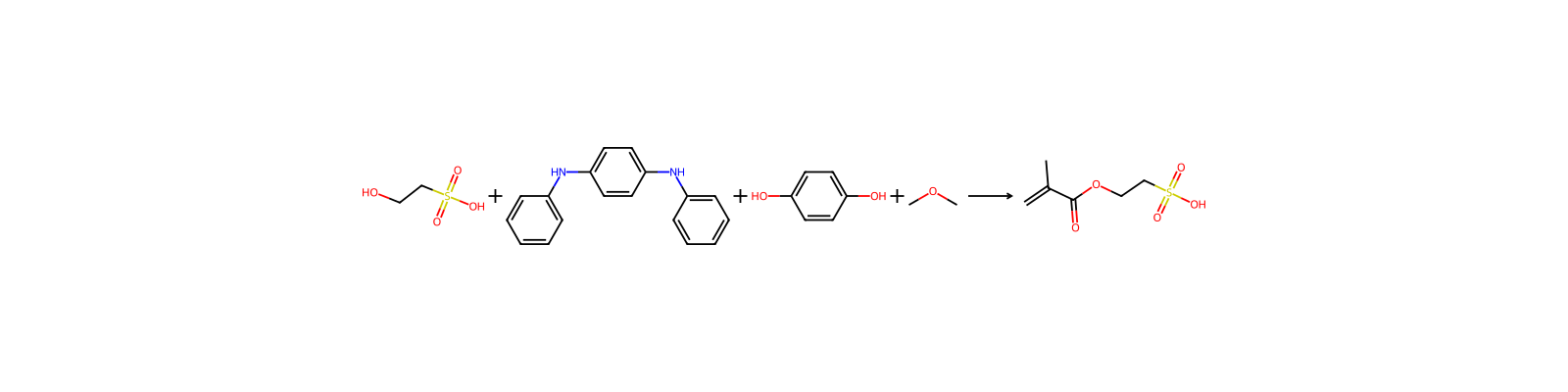
19




Verknüpfte Notizen
Wird geladen…