
Ivermectin B1a
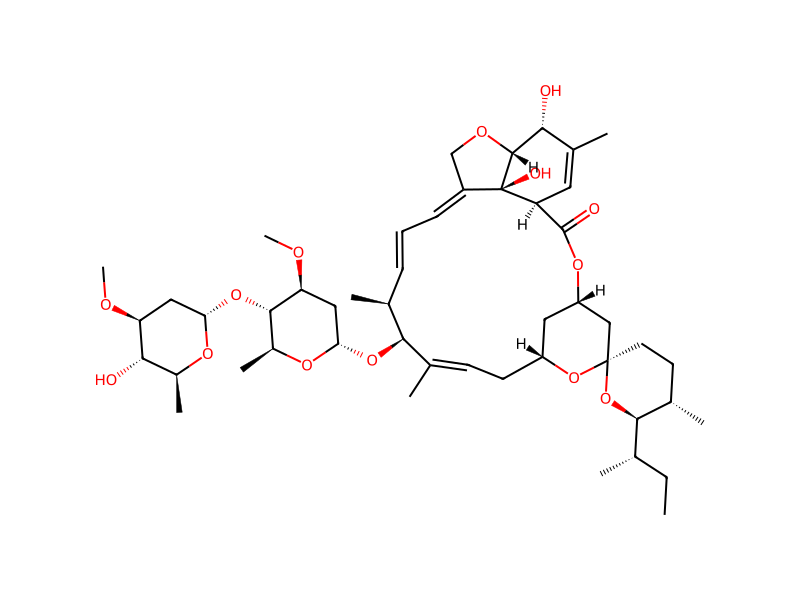
Grundinformationen
- CAS
70161-11-4- Standard-SMILES
CC[C@H](C)[C@H]1O[C@]2(CC[C@@H]1C)C[C@@H]1C[C@@H](C/C=C(\C)[C@@H](O[C@H]3C[C@H](OC)[C@@H](O[C@H]4C[C@H](OC)[C@@H](O)[C@H](C)O4)[C@H](C)O3)[C@@H](C)/C=C/C=C3\CO[C@@H]4[C@H](O)C(C)=C[C@@H](C(=O)O1)[C@]34O)O2- InChIKey
AZSNMRSAGSSBNP-XPNPUAGNSA-N- Summenformel
- C48H74O14
- Durchschnittliche Molmasse
- 875,1 g/mol
- Monoisotopische Masse
- 874,50785705
Überblick
LSM-5397 is a milbemycin.
Namen und Bezeichner
- Bevorzugter Name
- Ivermectin B1a
- IUPAC
- (1R,4S,5'S,6R,6'R,8R,10E,12S,13S,14E,16E,20R,21R,24S)-6'-[(2S)-butan-2-yl]-21,24-dihydroxy-12-[(2R,4S,5S,6S)-5-[(2S,4S,5S,6S)-5-hydroxy-4-methoxy-6-methyloxan-2-yl]oxy-4-methoxy-6-methyloxan-2-yl]oxy-5',11,13,22-tetramethylspiro[3,7,19-trioxatetracyclo[15.6.1.14,8.020,24]pentacosa-10,14,16,22-tetraene-6,2'-oxane]-2-one
- Englischer Name
- Ivermectin
- Summenformel
- C48H74O14
- Molmasse
- 875.099
Namen und Synonyme
Ivermectin B1aDihydroavermectin B1a71827-03-722,23-Dihydroavermectin B1aavermectin H2B1aDTXSID80231815-O-demethyl-22,23-dihydroavermectin A1a91Y2202OUWH2B1aDTXCID303181CHEBI:63941(1R,4S,5'S,6R,6'R,8R,10E,12S,13S,14E,16E,20R,21R,24S)-6'-[(2S)-butan-2-yl]-21,24-dihydroxy-12-[(2R,4S,5S,6S)-5-[(2S,4S,5S,6S)-5-hydroxy-4-methoxy-6-methyloxan-2-yl]oxy-4-methoxy-6-methyloxan-2-yl]oxy-5',11,13,22-tetramethylspiro[3,7,19-trioxatetracyclo[15.6.1.14,8.020,24]pentacosa-10,14,16,22-tetraene-6,2'-oxane]-2-one
Weitere Namen anzeigen
Component B1aIvermectin component bDihydroaverMectin B1a, IverMectin, 22,23-DihydroaverMectin B1a
Avermectin A1a, 5-O-demethyl-22,23-dihydro-(1R,4S,5'S,6R,6'R,8R,10E,12S,13S,14E,16E,20R,21R,24S)-6'-((2S)-butan-2-yl)-21,24-dihydroxy-12-((2R,4S,5S,6S)-5-((2S,4S,5S,6S)-5-hydroxy-4-methoxy-6-methyloxan-2-yl)oxy-4-methoxy-6-methyloxan-2-yl)oxy-5',11,13,22-tetramethylspiro(3,7,19-trioxatetracyclo(15.6.1.14,8.020,24)pentacosa-10,14,16,22-tetraene-6,2'-oxane)-2-oneRefChem:1087879(1'R,2R,4'S,5S,6R,8'R,10'E,12'S,13'S,14'E,16'E,20'R,21'R,24'S)-6-((2S)-butan-2-yl)-21',24'-dihydroxy-12'-(((2R,4S,5S,6S)-5-(((2S,4S,5S,6S)-5-hydroxy-4-methoxy-6-methyloxan-2-yl)oxy)-4-methoxy-6-methyloxan-2-yl)oxy)-5,11',13',22'-tetramethyl-3',7',19'-trioxaspiro(oxane-2,6'-tetracyclo(15.6.1.14,8.020,24)pentacosane)-10',14',16',22'-tetraen-2'-one276-046-2615-075-0(2aE,4E,5'S,6S,6'R,7S,8E,11R,13R,15S,17aR,20R,20aR,20bS)-6'-((2S)-butan-2-yl)-20,20b-dihydroxy-5',6,8,19-tetramethyl-17-oxo-3',4',5',6,6',10,11,14,15,17,17a,20,20a,20b-tetradecahydro-2H,7H-spiro(11,15-methanofuro(4,3,2-pq)(2,6)benzodioxacyclooctadecine-13,2'-pyran)-7-yl 2,6-dideoxy-4-O-(2,6-dideoxy-3-O-methyl-alpha-L-arabino-hexopyranosyl)-3-O-methyl-alpha-L-arabino-hexopyranosideIvermectin Component B1a
Eigenschaften
Berechnete Struktureigenschaften
- XLogP
- 4,1
- Polarare Oberfläche (TPSA)
- 170 Ų
- H-Brücken-Donoren
- 3
- H-Brücken-Akzeptoren
- 14
- Frei drehbare Bindungen
- 8
- Schwere Atome
- 62
- Formalladung
- 0
- Komplexität
- 1.680
Experimentelle und physikochemische Eigenschaften
PesticidesPesticide
Collision Cross Section292.7 Ų [M+Na]+ [CCS Type: TW; Method: calibrated with polyalanine and drug standards]
Sicherheit und Regulatorisches
GHS-Klassifizierung
GHS Classification
Danger
H300 (100%): Fatal if swallowed [Danger Acute toxicity, oral]
P203, P260, P264, P270, P273, P280, P301+P316, P302+P352, P317, P318, P319, P321, P330, P362+P364, P391, P405, and P501 (click each P-code to see the statement)
Aggregated GHS information provided per 27 reports by companies from 2 notifications to the ECHA C&L Inventory. Each notification may be associated with multiple companies.
Gefahrenhinweise
Regulatory InformationAvermectin A1a, 5-O-demethyl-22,23-dihydro-: Does not have an individual approval but may be used as a component in a product covered by a group standard. It is not approved for use as a chemical in its own right.
Hazard Classes and CategoriesAcute Tox. 2 (100%)
Toxikologische Informationen
Health EffectsAvermectins are neurotoxic and have reproductive and developmental effects. (L1826)
Exposure RoutesIvermectin is moderately well absorbed. Improved absorption with high fat meal.
Toxicity Summary
Ivermectin binds selectively and with high affinity to glutamate-gated chloride ion channels in invertebrate muscle and nerve cells of the microfilaria. This binding causes an increase in the permeability of the cell membrane to chloride ions and results in hyperpolarization of the cell, leading to paralysis and death of the parasite. Ivermectin also is believed to act as an agonist of the neurotransmitter gamma-aminobutyric acid (GABA), thereby disrupting GABA-mediated central nervous system (CNS) neurosynaptic transmission. Ivermectin may also impair normal intrauterine development of O. volvulus microfilariae and may inhibit their release from the uteri of gravid female worms. It has low solubility in water and extensive non-specific binding. It opens GABA-insensitive chloride channels, reducing membrane resistance and increasing conductance inward. (T10)
Chemie und Industrie
Pharmakologische Informationen
Metabolism/Metabolites
Primarily hepatic. Ivermectin and/or its metabolites are excreted almost exclusively in the feces over an estimated 12 days, with less than 1 % of the administered dose excreted in the urine. Route of Elimination: Ivermectin is metabolized in the liver, and ivermectin and/or its metabolites are excreted almost exclusively in the feces over an estimated 12 days, with less than 1% of the administered dose excreted in the urine. Half Life: 16 hours (also reported at 22-28 hours)
Verwendung und Herstellung
Uses
For the treatment of intestinal (i.e., nondisseminated) strongyloidiasis due to the nematode parasite <i>Strongyloides stercoralis</i>. Also for the treatment of onchocerciasis (river blindness) due to the nematode parasite <i>Onchocerca volvulus</i>. Can be used to treat scabies caused by <i>Sarcoptes scabiei</i>. Active ingredient in some commercial ant bait traps. (L829)
Anwendungen
VerwendenIvermectin B1a (dihydroavermectin B1a) is the major component (>80%) of the commercial anthelmintic, ivermectin. Members of the avermectin/milbemycin anthelmintic class exert their anthelmintic effects by binding to glutamate-gated chloride channels expressed on nematode neurones and pharyngeal muscle cells. The avermectins and milbemycins are also potent insecticides. The individual 25-sec-butyl (B1a) and 25-iso-propyl (B1b) components of ivermectin have received little separate study.
Anbieter50 Anbieter
陕西缔都医药有限责任公司029-81124775 17791530730 · [email protected]
济南百隆化学有限公司[email protected] · [email protected]
Zugehörige Reaktionen
1
Notizen zur Verbindung
Wird geladen…