HuagongsheHuagongshe Chemie-Druckbericht · Nur für Forschungszwecke
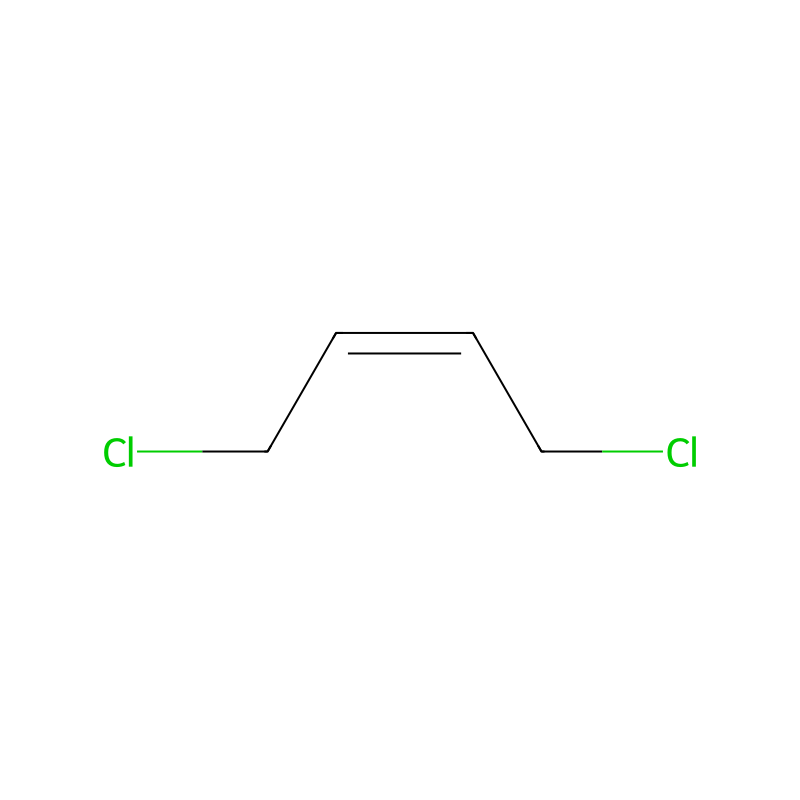
cis-1,4-Dichlorbut-2-en
(Z)-1,4-dichlorobut-2-ene · oro-2-butene · cis-1,4-DichL · cis-1,4-Dichloro-2-b · Pyridoxine Impurity 6 · 1,4-Dichlor-2-butencis · (Z)-1,4-Dichlorobutene · CIS-1,4-DICHLOROBUTENE
Identifikatoren & physikalische Daten
| CAS No. | 1476-11-5 |
|---|---|
| Summenformel | C4H6Cl2 |
| Durchschnittliche Molmasse | 124,99 g/mol |
| Monoisotopische Masse | 123,98465555 g/mol |
| SMILES | ClC/C=C\CCl |
| InChIKey | FQDIANVAWVHZIR-UPHRSURJSA-N |
| PubChem CID | 6432115 |
| ChEMBL | CHEMBL3182662 |
| EC No. | 216-021-5 |
| DTXSID | DTXSID3027405 |
| Lokaler Name | cis-1,4-Dichlorbut-2-en |
Chemische & physikalische Eigenschaften
| XLogP | 1,7 |
|---|---|
| Polarare Oberfläche (TPSA) | 0 |
| H-Brücken-Donoren | 0 |
| H-Brücken-Akzeptoren | 0 |
| Frei drehbare Bindungen | 2 |
| Schwere Atome | 6 |
| Formalladung | 0 |
| Komplexität | 34,8 |
| Stoffklassen | Other Classes -> Halogenated Aliphatics, Unsaturated |
| SpringerMaterials Properties | Schoenflies notation |
| Dichte | 1.188 @ 25 °C/4 °C1.188 g/mL at 25 °C(lit.) |
| Viscosity | 0.0035678 Pa-sec @ melting point |
| Color/Form | Colorless liquid |
| Löslichkeit | Sol in alcohol, ether, acetone, benzeneIn water , 580 mg/l @ 25 °CChlorform (Sparingly), Methanol (Slightly)Not miscible or difficult to mix in water. Soluble in alcohol, ether, acetone and benzene. |
| Siedepunkt | 152.5 °C152 °C758 mm Hg(lit.) |
| Decomposition | Decomposition vapors contain phosgene and hydrogen chloride gasesboth are toxic and irritating. /Dichlorobutene/ |
| Schmelzpunkt | -48 °CHeat of Vaporization: 4.9201X10+7 J/kmol @ melting pointSurface Tension: 0.045796 Newtons/m @ melting point−48 °C(lit.) |
| Dampfdruck | 4.09 [mmHg]4.09 mm Hg @ 25 °C |
| Surface Tension | 24 dynes/cm = 0.024 N/m at 20 °C /Dichlorobutene/ |
| Brechungsindex | Index of refraction: 1.4887 @ 25 °C/Dn20/D 1.489(lit.) |
| Flammpunkt | 132 °F |
| Lagerbedingungen | 2-8°C |
| Aggregatzustand | Liquid |
| Farbe | Clear colorless to yellow |
| BRN | 1719692 |
| Henry-Konstante | 3.0×10⁻² mol/(m3Pa) at 25℃, Hiatt (2013) |
| Stabilität | Light Sensitive, Moisture Sensitive |
| CAS Datenbank | 1476-11-5(CAS DataBase Reference) |
| NIST chemische Informationen | 2-Butene, 1,4-dichloro-, (Z)-(1476-11-5) |
| EPA chemische Informationen | cis-1,4-Dichloro-2-butene (1476-11-5) |
Sicherheit & Vorschriften
| GHS-Einstufung | DangerH226 (98%): Flammable liquid and vapor [Warning Flammable liquids]P203, P210, P233, P240, P241, P242, P243, P260, P262, P264, P270, P271, P273, P280, P284, P301+P316, P301+P330+P331, P302+P352, P302+P361+P354, P303+P361+P353, P304+P340, P305+P354+P338, P316, P318, P320, P321, P330, P361+P364, P363, P370+P378, P391, P403+P233, P403+P235, P405, and P501 (click each P-code to see the statement)Aggregated GHS information provided per 51 reports by companies from 8 notifications to the ECHA C&L Inventory. Each notification may be associated with multiple companies. |
|---|---|
| Regulatorische Informationen | Chemical: 2-Butene, 1,4-dichloro-, (Z)-2-Butene, 1,4-dichloro-, (2Z)-: Does not have an individual approval but may be used as a component in a product covered by a group standard. It is not approved for use as a chemical in its own right. |
| Brandpotenzial | Flammable /Dichlorobutene/ |
| Gefahrenübersicht | A skin, eye, and respiratory tract irritantA lachrymatorMay cause kidney, liver, and heart injury[HSDB] Very toxic by inhalation and toxic by skin contact and ingestionCauses burnsInhalation may produce pneumonitis and pulmonary edema[MSDSonline] See 1,4-Dichloro-2-butene. |
| Special Reports | A REVIEW WITH 17 REFERENCES ON ACUTE TOXICITY OF CHLOROPRENE, 1,3-DICHLORO-2-BUTENE, & 1,4-DICHLORO-2-BUTENE. DATA INCL MUTAGENIC, SKIN, EYE & INHALATION TESTING, LETHAL, & TERATOGENIC DOSE VALUES.[CLARY JJENVIRON HEALTH PERSPECT 21: 269-74 (1977)] |
| Flammable Limits | 1.5-4% /Dichlorobutene/ |
| Hazard Classes and Categories | Flam. Liq. 3 (98%) |
| Explosive Limits and Potential | Vapor may explode if ignited in an enclosed area. /Dichlorobutene/ |
| Skin, Eye, and Respiratory Irritations | ... BOTH LIQUID AND VAPOR ARE HIGHLY DANGEROUS TO THE SKIN, EYES, LUNG, & INTERNAL ORGANS. /DICHLOROBUTENES/Lacrimator |
Anwendungen & Verwendung
Verwenden
It is employed as an intermediate for the production of other chemicals such as in the production of chloroprene. It is also used as a starting material in the production of adiponitrile, butane-1,4-diol, and tetrahydrofuran. It is also used in the preparation of functionalized 3,5-disubstituted cyclopent-2-enones.