StartseiteMCPWorkbenchSkills
StartseiteWorkbenchBenachrichtigungenMein Bereich
llms.txt · MCP-AnleitungDatenschutz · Nutzungsbedingungen · Supportv1.8.3
  1. Startseite
  2. /Verbindung

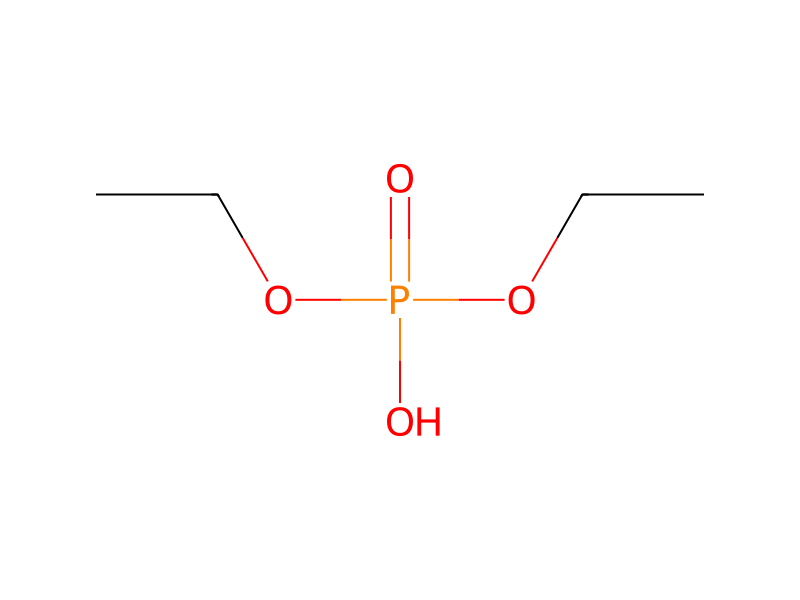
Diethylhydrogenphosphat

Diethyl phosphate

HCID 654
Neue Reaktion
Drucken
GrundinformationenÜberblickNamen und BezeichnerEigenschaftenSicherheit und RegulatorischesChemie und IndustrieZugehörige ReaktionenNotizen zur Verbindung
TeilstruktursucheÄhnliche Strukturen suchen

Grundinformationen

CAS
51501-07-6
Standard-SMILES
CCOP(=O)(O)OCC
InChIKey
UCQFCFPECQILOL-UHFFFAOYSA-N
Summenformel
C4H11O4P
Durchschnittliche Molmasse
154,1 g/mol
Monoisotopische Masse
154,03949583

Überblick

Diethyl hydrogen phosphate is a dialkyl phosphate having ethyl as the alkyl group. It has a role as a mouse metabolite and a human xenobiotic metabolite. It is a conjugate acid of a diethylphosphate(1-).

Namen und Bezeichner

Bevorzugter Name
Diethyl phosphate
IUPAC
diethyl hydrogen phosphate
Lokaler Name
Diethylhydrogenphosphat
Englischer Name
Diethyl phosphate
Summenformel
C4H11O4P
Molmasse
154.1

Namen und Synonyme

diethyl hydrogen phosphateDiethyl phosphate598-02-7Diethyl acid phosphatediethylphosphatephosphoric acid, diethyl esterdiethoxyphosphinic acidO,O-Diethyl hydrogen phosphateEthyl phosphate, di-Ethyl phosphate, (ETO)2(HO)PODTXSID1044699W0QQU4CAB7
Weitere Namen anzeigen
IETHYLPHOSPHATEdi-ethylphosphatETHYLACIDPHOSPHATEO,O-DIETHYLPHOSPHATEdiethylacidphosphatediethylphosphoricacidDiethyl phosphate,98%
CHEBI:27708NSC-97178RefChem:587273DTXCID9024699DTXCID20820146209-912-5DTXSID10872492Phosphoric acid diethyl ester

Datenbank-Bezeichner

CAS
51501-07-6、52932-96-4、53397-17-4、598-02-7
PubChem CID
654
DTXSID
DTXSID1044699

Eigenschaften

Berechnete Struktureigenschaften

XLogP
-0,3
Polarare Oberfläche (TPSA)
55,8 Ų
H-Brücken-Donoren
1
H-Brücken-Akzeptoren
4
Frei drehbare Bindungen
4
Schwere Atome
9
Formalladung
0
Komplexität
103

Experimentelle und physikochemische Eigenschaften

Chemical Classes · 3 Einträge

Other Classes -> Organophosphates, Other

Organophosphate diesters (OPDE)

Organophosphate

SpringerMaterials PropertiesOptical coefficient
Physical Description · 3 Einträge

Liquid

Colorless clear liquid; [MSDSonline]

Solid

Collision Cross Section129.2 Ų [M-H]- [CCS Type: DT; Buffer gas: N2; Ionization: ESI-; Dataset: TOXCAST; Source Identifier: DTXSID1044699]

Physikochemische Eigenschaften

Schmelzpunkt
6 °C · 6 °C
Siedepunkt
80 °C/0.7 · 80 °C/0.7 mmHg
Dichte
1.19 · 1.19
Brechungsindex
1.417 · 1.4170
Flammpunkt
75 °C · 75 °C
storage temp.
2 · Sealed in dry,2-8°C

Sicherheit und Regulatorisches

Sicherheitsangaben dienen nur zur Orientierung und ersetzen weder das Sicherheitsdatenblatt (SDB) des Lieferanten noch geltende Vorschriften oder eine fachliche Bewertung.

GHS-Klassifizierung

GHS Classification · 5 Einträge

This chemical does not meet GHS hazard criteria for 44% (37 of 84) of reports.

Warning

H315 (56%): Causes skin irritation [Warning Skin corrosion/irritation]

P261, P264, P264+P265, P271, P280, P302+P352, P304+P340, P305+P351+P338, P319, P321, P332+P317, P337+P317, P362+P364, P403+P233, P405, and P501 (click each P-code to see the statement)

Aggregated GHS information provided per 84 reports by companies from 6 notifications to the ECHA C&L Inventory. Each notification may be associated with multiple companies.

Gefahrenhinweise

Regulatory Information · 2 Einträge

Hazard Traits - Developmental Toxicity; Neurotoxicity

Phosphoric acid, diethyl ester is listed on the EPA's Chemical Data Reporting (CDR) system. Manufacturers and importers of Phosphoric acid, diethyl ester are required to report information about their production and use of this chemical to the EPA under the Toxic Substances Control Act (TSCA). (40 eCFR Part 711)

Hazards SummaryAn irritant; [MSDSonline]
Hazard Classes and CategoriesSkin Irrit. 2 (56%)

Toxikologische Informationen

Toxicity Summary · 1 Eintrag

S-Ethylisothiouronium diethylphosphate is a specific inhibitor of inducible NO synthase on hepatic NO production level. S-Ethylisothiouronium diethylphosphate affects systemic hemodynamic indices in the following way: the peripheral vascular resistance increases, the stroke volume and central blood volume increase, and the work of the left ventricle improves. (Wikipedia)

Chemie und Industrie

Pharmakologische Informationen

Metabolism/Metabolites · 2 Einträge

Diethyl phosphorothioate is a known human metabolite of Chlorpyrifos-oxon, Chlorpyrifos, and Diazoxon.

Metabolism of organophosphates occurs principally by oxidation, by hydrolysis via esterases and by reaction with glutathione. Demethylation and glucuronidation may also occur. Oxidation of organophosphorus pesticides may result in moderately toxic products. In general, phosphorothioates are not directly toxic but require oxidative metabolism to the proximal toxin. The glutathione transferase reactions produce products that are, in most cases, of low toxicity. Paraoxonase (PON1) is a key enzyme in the metabolism of organophosphates. PON1 can inactivate some organophosphates through hydrolysis. PON1 hydrolyzes the active metabolites in several organophosphates insecticides as well as, nerve agents such as soman, sarin, and VX. The presence of PON1 polymorphisms causes there to be different enzyme levels and catalytic efficiency of this esterase, which in turn suggests that different individuals may be more susceptible to the toxic effect of organophosphate exposure.

Verwendung und Herstellung

UsesThis is a man-made compound that is used as a pesticide.
U.S. Production2023: 41,165 lb
Consumer UsesSurfactant (surface active agent)
Industry UsesSurfactant (surface active agent)
General Manufacturing Information · 2 Einträge

Paint and Coating Manufacturing

Phosphoric acid, diethyl ester: ACTIVE

Vor- und nachgelagerte Produkte

Vorgelagerte Rohstoffe

Diethylphosphonat

Zugehörige Reaktionen

8
Reaktionsaufzeichnung erstellen
Reaktionsgleichung von HRID 299870
HRID 299870als Edukt
Reaktionsgleichung von HRID 477202
HRID 477202als Edukt
Reaktionsgleichung von HRID 620445
HRID 620445als Edukt
Reaktionsgleichung von HRID 1118110
HRID 1118110als Edukt
Reaktionsgleichung von HRID 1140267
HRID 1140267als Edukt
Reaktionsgleichung von HRID 1197203
HRID 1197203als Edukt
Reaktionsgleichung von HRID 1265198
HRID 1265198als Produkt
Reaktionsgleichung von HRID 2309818
HRID 2309818als Edukt

Notizen zur Verbindung

Auf dieser SeiteGrundinformationenÜberblickNamen und BezeichnerEigenschaftenSicherheit und RegulatorischesChemie und IndustrieZugehörige ReaktionenNotizen zur Verbindung
ChEMBL
CHEMBL1232324
ChEBI
CHEBI:27708
UNII
W0QQU4CAB7
EC Number
209-912-5
Nikkaji
J1.649G
Löslichkeit
Chloroform (Slightly), DMSO (Slightly), Methanol (Slightly)
pka
1.42 · 1.42±0.50(Predicted)
Aggregatzustand
clear liquid
Farbe
Colorless to Yellow
Stabilität
Moisture Sensitive
InChI
InChI=1S/C4H11O4P/c1-3-7-9(5,6)8-4-2/h3-4H2,1-2H3,(H,5,6)
InChIKey
UCQFCFPECQILOL-UHFFFAOYSA-N
SMILES
P(O)(OCC)(OCC)=O
EPA chemische Informationen
Phosphoric acid, diethyl ester (598-02-7)
Carcinogen ClassificationNo indication of carcinogenicity to humans (not listed by IARC).

Sicherheitsdaten

tsca
TSCA listed
hs_code
2919900090
RTECS-Nr.
TC0665000
risk_code
36/37/38-39/23/24/25-23/24/25-11
hazard_code
Xi,T,F
safety_code
37/39-26-36-45-36/37-16-7

Nachgelagerte Produkte

DiethylcyanidophosphatMethansulfonsureDiethyl Phenyl PhosphateTEPP (ISO)Difluoromethylphosphonic acid diethyl esterDiphosphorus(III,V)oic acid tetraethyl esterDiphosphoric acid P1,P1-diethyl-P2,P2-dimethyl ester1-diethoxyphosphoryloxypentane

Ergänzende Hinweise

DefinitionChEBI: A dialkyl phosphate having ethyl as the alkyl group.