
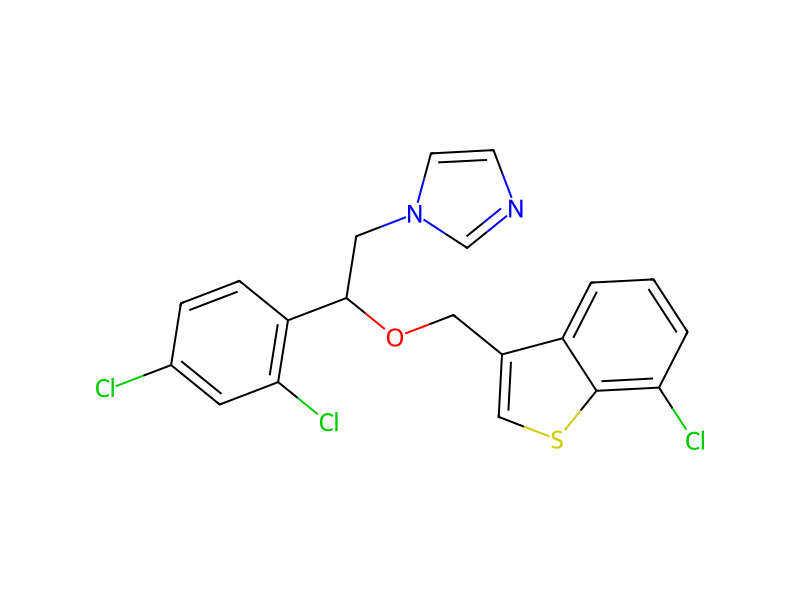
Grundinformationen
- Standard-SMILES
Clc1ccc(C(Cn2ccnc2)OCc2csc3c(Cl)cccc23)c(Cl)c1- InChIKey
JLGKQTAYUIMGRK-UHFFFAOYSA-N- Summenformel
- C20H15Cl3N2OS
- Durchschnittliche Molmasse
- 437,8 g/mol
- Monoisotopische Masse
- 435,99706714
Überblick
1-{2-[(7-chloro-1-benzothiophen-3-yl)methoxy]-2-(2,4-dichlorophenyl)ethyl}imidazole is a member of the class of imidazoles that carries a 2-[(7-chloro-1-benzothiophen-3-yl)methoxy]-2-(2,4-dichlorophenyl)ethyl group at position 1. It is a dichlorobenzene, a member of imidazoles, an ether and a member of 1-benzothiophenes.
Namen und Bezeichner
- Bevorzugter Name
- Sertaconazole
- IUPAC
- 1-[2-[(7-chloro-1-benzothiophen-3-yl)methoxy]-2-(2,4-dichlorophenyl)ethyl]imidazole
- Englischer Name
- Sertaconazole
- Summenformel
- C20H15Cl3N2OS
- Molmasse
- 437.77
Namen und Synonyme
Sertaconazole99592-32-2SertaconazolSertaconazolumFI-7045Demofix72W71I16EG1-(2-((7-Chlorobenzo(b)thien-3-yl)methoxy)-2-(2,4-dichlorophenyl)ethyl)-1H-imidazole1-{2-[(7-chloro-1-benzothiophen-3-yl)methoxy]-2-(2,4-dichlorophenyl)ethyl}-1H-imidazole7-Chloro-3-(1-(2,4-dichlorophenyl)-2-(1H-imidazol-1-yl)ethoxy-methyl)benzo(b)thiopheneDTXSID0048551Ginedermofix
Weitere Namen anzeigen
Sertaconazole nitrateeno(RS)-1-(2-((7-chloro-1-benzothiophen-3-yl)methoxy)-2-(2,4-dichlorophenyl)ethyl) -1H-imidazoleZalainFI-7056DermofixEnolase γ
1H-Imidazole, 1-(2-((7-chlorobenzo(b)thien-3-yl)methoxy)-2-(2,4-dichlorophenyl)ethyl)-7-Chloro-3-[1-(2,4-dichlorophenyl)-2-(1H-imidazol-1-yl)ethoxy-methyl]benzo[b]thiophene1-(2-((7-chloro-1-benzothiophen-3-yl)methoxy)-2-(2,4-dichlorophenyl)ethyl)-1H-imidazole1H-Imidazole, 1-[2-[(7-chlorobenzo[b]thien-3-yl)methoxy]-2-(2,4-dichlorophenyl)ethyl]-RefChem:56490DTXCID6028107CHEBI:82866D01AC14
Datenbank-Bezeichner
- CAS
99592-32-2- PubChem CID
- 65863
- DTXSID
DTXSID0048551- ChEMBL
CHEMBL1201196- ChEBI
CHEBI:83682- UNII
- 72W71I16EG
- EC Number
- 841-355-9
- Nikkaji
- J369.930G
Eigenschaften
Berechnete Struktureigenschaften
- XLogP
- 6,3
- Polarare Oberfläche (TPSA)
- 55,3 Ų
- H-Brücken-Donoren
- 0
- H-Brücken-Akzeptoren
- 3
- Frei drehbare Bindungen
- 6
- Schwere Atome
- 27
- Formalladung
- 0
- Komplexität
- 488
Experimentelle und physikochemische Eigenschaften
DrugsPharmaceuticals
LogP6.2
Solubility
Practically insoluble
6.37e-03 g/L
Endocrine DisruptorsPotential endocrine disrupting compound
Physical DescriptionSolid
Physikochemische Eigenschaften
- Schmelzpunkt
- 146 · 146-147°
- Siedepunkt
- 614.1 · 614.1±55.0 °C(Predicted)
- Dichte
- 1.43 · 1.43±0.1 g/cm3(Predicted)
- storage temp.
- Refrigerator
- Löslichkeit
- DMSO (Slightly), Methanol (Slightly)
- Aggregatzustand
- Solid
- pka
- 6.68 · 6.68±0.12(Predicted)
- Farbe
- White to Pale Yellow
- InChI
- InChI=1S/C20H15Cl3N2OS/c21-14-4-5-16(18(23)8-14)19(9-25-7-6-24-12-25)26-10-13-11-27-20-15(13)2-1-3-17(20)22/h1-8,11-12,19H,9-10H2
- InChIKey
- JLGKQTAYUIMGRK-UHFFFAOYSA-N
- SMILES
- C1N(CC(OCC2=CSC3=C(Cl)C=CC=C32)C2=CC=C(Cl)C=C2Cl)C=CN=1
- CAS Datenbank
- 99592 · 99592-32-2(CAS DataBase Reference)
Sicherheit und Regulatorisches
GHS-Klassifizierung
GHS Classification
Warning
H315 (100%): Causes skin irritation [Warning Skin corrosion/irritation]
P261, P264, P264+P265, P271, P280, P302+P352, P304+P340, P305+P351+P338, P319, P321, P332+P317, P337+P317, P362+P364, P403+P233, P405, and P501 (click each P-code to see the statement)
The GHS information provided by 1 company from 1 notification to the ECHA C&L Inventory.
Gefahrenhinweise
Hazard Classes and CategoriesSkin Irrit. 2 (100%)
Toxikologische Informationen
Exposure RoutesBioavailability is negligible.
Toxicity Summary
Sertaconazole interacts with 14-α demethylase, a cytochrome P-450 enzyme necessary to convert lanosterol to ergosterol. As ergosterol is an essential component of the fungal cell membrane, inhibition of its synthesis results in increased cellular permeability causing leakage of cellular contents. Sertaconazole may also inhibit endogenous respiration, interact with membrane phospholipids, inhibit the transformation of yeasts to mycelial forms, inhibit purine uptake, and impair triglyceride and/or phospholipid biosynthesis.
Carcinogen ClassificationNo indication of carcinogenicity to humans (not listed by IARC).
Sicherheitsdaten
- Alarmwort
- Warnung
- Gefahrenhinweise
- Code Gefahrenhinweise Gefahrenklasse Abteilung Alarmwort Symbol P-Code H315
Chemie und Industrie
Pharmakologische Informationen
ATC Code
D - Dermatologicals
G - Genito urinary system and sex hormones
QD - Dermatologicals
QG - Genito urinary system and sex hormones
Protein Binding>99% to plasma
Pharmacodynamics
Sertaconazole is an imidazole/triazole type antifungal agent. Sertaconazole is a highly selective inhibitor of fungal cytochrome P-450 sterol C-14 α-demethylation via the inhibition of the enzyme cytochrome P450 14α-demethylase. This enzyme converts lanosterol to ergosterol, and is required in fungal cell wall synthesis. The subsequent loss of normal sterols correlates with the accumulation of 14 α-methyl sterols in fungi and may be partly responsible for the fungistatic activity of fluconazole. Mammalian cell demethylation is much less sensitive to fluconazole inhibition. Sertaconazole exhibits <i>in vitro</i> activity against <i>Cryptococcus neoformans</i> and <i>Candida spp.</i> Fungistatic activity has also been demonstrated in normal and immunocompromised animal models for systemic and intracranial fungal infections due to <i>Cryptococcus neoformans</i> and for systemic infections due to Candida albicans.
Mechanism of Action
Sertaconazole interacts with 14-α demethylase, a cytochrome P-450 enzyme necessary to convert lanosterol to ergosterol. As ergosterol is an essential component of the fungal cell membrane, inhibition of its synthesis results in increased cellular permeability causing leakage of cellular contents. Sertaconazole may also inhibit endogenous respiration, interact with membrane phospholipids, inhibit the transformation of yeasts to mycelial forms, inhibit purine uptake, and impair triglyceride and/or phospholipid biosynthesis.
FDA Pharmacological Classification
72W71I16EG
SERTACONAZOLE
Established Pharmacologic Class [EPC] - Azole Antifungal
Chemical Structure [CS] - Azoles
Sertaconazole is an Azole Antifungal.
MeSH Pharmacological ClassificationSubstances that destroy fungi by suppressing their ability to grow or reproduce. They differ from FUNGICIDES, INDUSTRIAL because they defend against fungi present in human or animal tissues.
Absorption, Distribution and ExcretionBioavailability is negligible.
Cellular LocationsCytoplasm
Verwendung und Herstellung
Uses
Use (kg; approx.) in Germany (2009): >100
For the topical treatment of interdigital tinea pedis in immunocompetent patients 12 years of age and older, caused by <i>Trichophyton rubrum</i>, <i>Trichophyton mentagrophytes</i>, and <i>Epidermophyton floccosum</i>.
Anwendungen
BeschreibungSertaconazole has been developed and launched for the treatment of dermatological fungal infections by Ferrer Internacional S. A. Mylan received FDA approval for sertaconazole nitrate cream for the treatment of athlete's foot (tinea pedis) at the end of 2003.
VerwendenAn imidazole antifungal agent, inhibits the synthesis of ergosterol, an essential cell wall component of fungi.
Vor- und nachgelagerte Produkte
Vorgelagerte Rohstoffe
Anbieter50 Anbieter
北京华美互利生物化工010-56205725 · [email protected]
杭州品高化工有限公司0571-87658025 · [email protected]
普善实业(陕西)有限公司029-81310890 18165209495 · [email protected]
T&W GROUP021-61551611 13296011611 · [email protected]
Dayang Chem (Hangzhou) Co.,Ltd.+86-0571-88938639 17705817739 · [email protected]
LGM Pharma1-(800)-881-8210 · [email protected]
Syntechem Co.,Ltd[email protected]
銳迪國際科技有限公司18024082417 · [email protected]
孝感深远化工有限公司15527621225; 15527621225 · [email protected]
云南西力生物技术股份有限公司0871-65217109 · [email protected]
Clearsynth Labs Limited+91-22-26355700 · [email protected]
南京世洲生物科技有限公司13675144456 · [email protected]
PT CHEM GROUP LIMITED+86-85511178; +86-85511178 · [email protected]
天津普西唐生物医药科技有限公司010-60605840 · [email protected]
陕西缔都医药化工有限公司029-81024372 17792795018 · [email protected]
石家庄通洋进出口有限公司[email protected]
上海陶术生物科技股份有限公司+1-781-999-5354; +1-00000000000 · [email protected]
BOC Sciences16314854226; +8616314854226 · [email protected]
湖北威德利化学科技有限公司027-83989310 18627915365
EMMX Biotechnology LLC888-539-0666 · [email protected]
上海源叶生物科技有限公司13636370518 · [email protected]
海南海神同洲制药有限公司—
深圳市祥根生物医药有限公司0755-28967200 13631290199 · [email protected]
武汉中瑞希康化学制品有限公司15623071665 · [email protected]
爱必信(上海)生物科技有限公司13761418683 · [email protected]
武汉华玖医药科技有限公司027-59225746 18062681621 · [email protected]
Shanghai Acmec Biochemical Technology Co., Ltd.+86-18621343501 · [email protected]
江苏艾康生物医药研发有限公司025-66113011 19370895928 · [email protected]
武汉峰耀同辉化学制品有限公司027-87466105 15377573527 · [email protected]
河南天孚化工有限公司+86-0371-55170693 +86-19937530512 · [email protected]
厦门盈融达化工有限公司+86-0592-6210733 · [email protected]
湖北康鑫源顺医药化工有限公司027-51831887 15337167856 · [email protected]
成都圣美凯生物科技有限公司028-85157043 15882256948 · [email protected]
上海吉至生化科技有限公司021-4009004166/18616739031 18616739031 · [email protected]
career henan chemical co+86-0371-86658258 · [email protected]
爱诗伦生物科技(上海)有限公司021-50676523 18019098996 · [email protected]
海蔚化学86-21-51086038 · [email protected]
Casorganics US Corp+17326109938 · [email protected]
Hebei Chuanghai Biotechnology Co., Ltd+86-15350571055 · [email protected]
爆牛贸易重庆有限公司+86-023-6139-8061 +86-86-13650506873 · [email protected]
上海博湖生物科技有限公司021-57763112 13585886131 · [email protected]
Hefei Hirisun Pharmatech Co., Ltd+8615056975894 · [email protected]
武汉福鑫化工有限公司027-59207852 13308628970 · [email protected]
XIAMEN AMITY INDUSTRY AND TRADE CO., LTD.+8618950047208 · [email protected]
TargetMol中国(陶术生物)4008200310 15002144251 · [email protected]
湖北麦凯斯精化科技有限责任公司13026126800 13026126800;13027176014 · [email protected]
SHANGHAI KEAN TECHNOLOGY CO., LTD.+8613817748580 · [email protected]
上海贝万塔生物科技有限公司021-67187366 19901745723 · [email protected]
广州市禄涞医药科技有限公司13660253774 · [email protected]
北京偶合科技有限公司13552068683 13522913783 · [email protected]
Zugehörige Reaktionen
4


Verknüpfte Notizen
Wird geladen…