StartseiteMCPWorkbenchSkills
StartseiteWorkbenchBenachrichtigungenMein Bereich
llms.txt · MCP-AnleitungDatenschutz · Nutzungsbedingungen · Supportv1.8.0
  1. Startseite
  2. /Verbindung

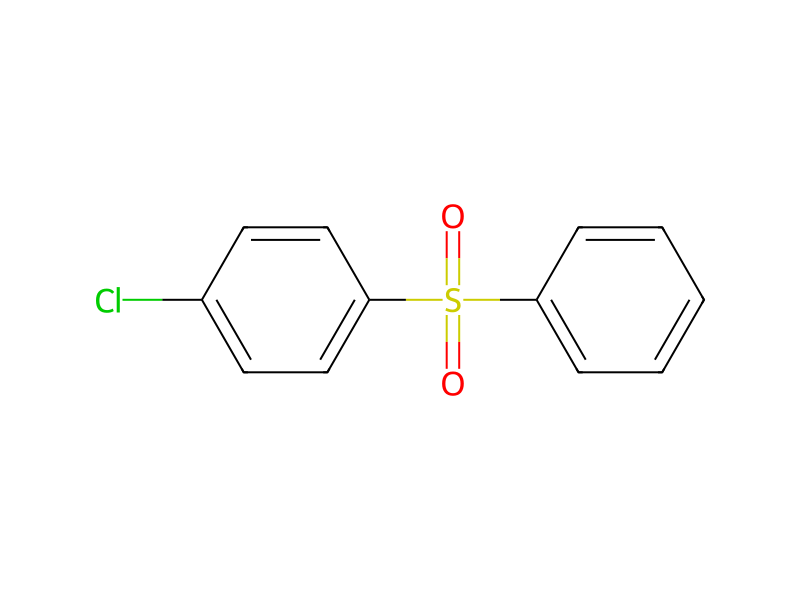
1-Chlor-4-(phenylsulfonyl)benzol

Sulphenone
HCID 6621
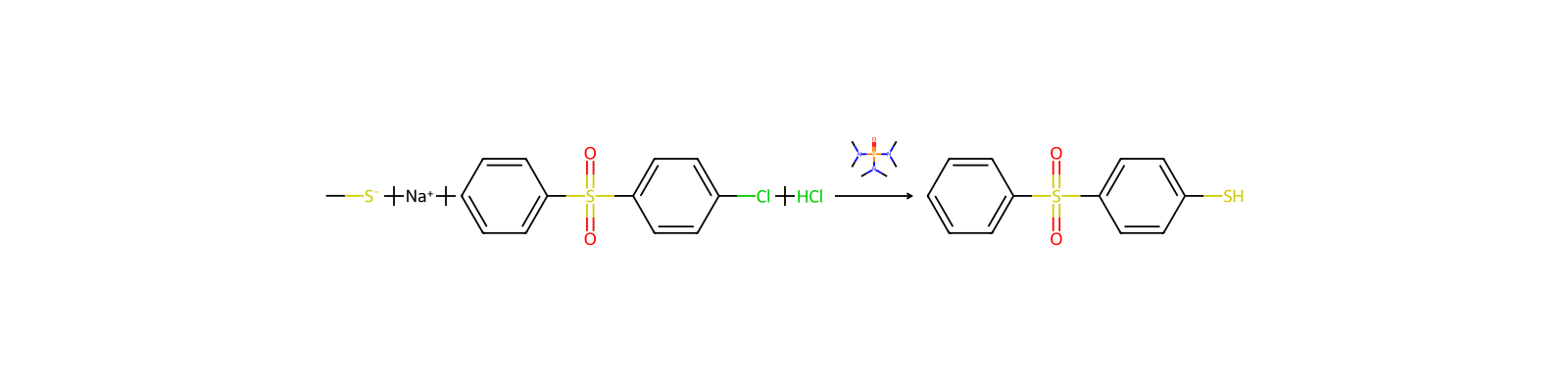
Neue NotizNeue ReaktionAnfrage stellen
Druckvorschau
GrundinformationenNamen und BezeichnerEigenschaftenSicherheit und RegulatorischesChemie und IndustrieZugehörige ReaktionenNotizen zur Verbindung
TeilstruktursucheÄhnliche Strukturen suchen

Grundinformationen

CAS
80-00-2
Standard-SMILES
O=S(=O)(c1ccccc1)c1ccc(Cl)cc1
InChIKey
OFCFYWOKHPOXKF-UHFFFAOYSA-N
Summenformel
C12H9ClO2S
Durchschnittliche Molmasse
252,72 g/mol
Monoisotopische Masse
252,0011784

Namen und Bezeichner

Bevorzugter Name
Sulphenone
IUPAC
1-(benzenesulfonyl)-4-chlorobenzene
Lokaler Name
1-Chlor-4-(phenylsulfonyl)benzol
Englischer Name
Sulfenone
Summenformel
C12H9ClO2S
Molmasse
252.72

Namen und Synonyme

4-Chlorophenyl phenyl sulfone80-00-2SULPHENONESulfenone1-Chloro-4-(phenylsulfonyl)benzene4-Chlorodiphenyl sulfoneTrifensonSulfenonBenzene, 1-chloro-4-(phenylsulfonyl)-p-Chlorophenyl phenyl sulfoneCompound R-242p-Chlorophenyl phenyl sulphone
Weitere Namen anzeigen
r242r-242SULFERONEent17,941SulphenoneRr-242-b[qr]
Sulfone, p-chlorophenyl phenylp-Monochlorophenyl phenyl sulfoneR-242-B4-Chlorodiphenyl sulphone4-ChlordifenylsulfonENT 17,941Caswell No. 211DDTXSID9042259

Datenbank-Bezeichner

CAS
80-00-2
PubChem CID
6621
DTXSID
DTXSID9042259
ChEMBL
CHEMBL3188889
UNII
7NVM546U2M
EC Number
201-242-1
Nikkaji
J3.850D

Eigenschaften

Berechnete Struktureigenschaften

XLogP
3,1
Polarare Oberfläche (TPSA)
42,5 Ų
H-Brücken-Donoren
0
H-Brücken-Akzeptoren
2
Frei drehbare Bindungen
2
Schwere Atome
16
Formalladung
0
Komplexität
306

Experimentelle und physikochemische Eigenschaften

SpringerMaterials Properties13C nuclear magnetic resonance spectrum
PesticidesPesticides -> Organochlorine Pesticides
LogPlog Kow = 3.25 /Estimated/
OdorSlight aromatic odor
TasteTasteless
Color/Form · 3 Einträge

Dimorphic crystals

Colorless crystals

White solid

Solubility · 3 Einträge

At 20 °C acetone (74.4 g/100mL), toluene (44.4 g/100mL), dioxane (65.6 g/100mL), isopropanol (21 g/100mL), hexane 0.4 g/100mL), xylene (18.2 g/100mL), carbon tetrachloride (4.9 g/100mL); slightly soluble in pet ether.

Readily sol in polar and aromatic org solvents

Insoluble in water

DecompositionWhen heated to decomposition it emits very toxic fumes of /hydrogen chloride and sulfur oxides/.
Melting Point

Sicherheit und Regulatorisches

Sicherheitsangaben dienen nur zur Orientierung und ersetzen weder das Sicherheitsdatenblatt (SDB) des Lieferanten noch geltende Vorschriften oder eine fachliche Bewertung.

GHS-Klassifizierung

GHS Classification · 4 Einträge

Warning

H302 (100%): Harmful if swallowed [Warning Acute toxicity, oral]

P261, P264, P270, P271, P280, P301+P317, P302+P352, P304+P340, P317, P321, P330, P362+P364, and P501 (click each P-code to see the statement)

Aggregated GHS information provided per 45 reports by companies from 4 notifications to the ECHA C&L Inventory. Each notification may be associated with multiple companies.

Gefahrenhinweise

Regulatory InformationBenzene, 1-chloro-4-(phenylsulfonyl)-: Does not have an individual approval but may be used as a component in a product covered by a group standard. It is not approved for use as a chemical in its own right.
Hazards SummaryEffects include weakness and weight loss in high-dose oral studies in dogs; [RTECS] An irritant; [MSDSonline]
Hazard Classes and CategoriesAcute Tox. 4 (100%)

Sicherheit und Schutzausrüstung

Disposal Methods · 1 Eintrag

SRP: The most favorable course of action is to use an alternative chemical product with less inherent propensity for occupational exposure or environmental contamination. Recycle any unused portion of the material for its approved use or return it to the manufacturer or supplier. Ultimate disposal of the chemical must consider: the material's impact on air quality; potential migration in soil or water; effects on animal, aquatic, and plant life; and conformance with environmental and public health regulations.

Toxikologische Informationen

Chemie und Industrie

Pharmakologische Informationen

Absorption, Distribution and ExcretionNo significant tissue storage in chronic feeding tests /in lab mammals/.

Verwendung und Herstellung

Uses · 5 Einträge

Used as acaricide; Not currently registered with the EPA for use in the US; [HSDB]

Farming (Pesticides) [Category: Industry]

For sulphenone (USEPA/OPP Pesticide Code: 060510) there are 0 labels match. /SRP: Not registered for current use in the U.S., but approved pesticide uses may change periodically and so federal, state and local authorities must be consulted for currently approved uses./

Acaricide

A miticide

Methods of Manufacturing · 2 Einträge

Preparation: Bender, Pitt, US 2593001 (1952 to Stauffer Chem)

...By reaction of benzenesulfonic acid & chlorobenzene @ 250 °C...

Formulations/Preparations · 3 Einträge

Emulsifiable concn 4 lb/US gal; 50% wettable powder; field concn (wp) of order of 2-3 lb/100 US gal

Commercial product contains 80% sulfenone and 20% related diaryl sulfones.

Technical material consists of about 80% of this compound, with small amount of o- & m-isomers, bis-(p-chlorophenyl) sulfone, & diphenyl sulfone.

General Manufacturing Information · 3 Einträge

Benzene, 1-chloro-4-(phenylsulfonyl)-: ACTIVE

Insecticidal property of bis(p-chlorophenyl)sulfone: Unsymmetrical Deriv was developed for Insecticidal purposes by Stauffer chem. ...Compatible with all commonly-used spray materials. An acaricide with limited insecticidal properties, good residual & ovicidal activity on 2 spotted spider mite. Ovicide on apples & pears. No ...evidence of phytotoxicity except ...on sensitive greenhouse plants & certain sensitive varieties of apples or pears.

Discontinued by Stauffer Chemical Co.

Anwendungen

Zugehörige Reaktionen

8
Reaktionsaufzeichnung erstellen
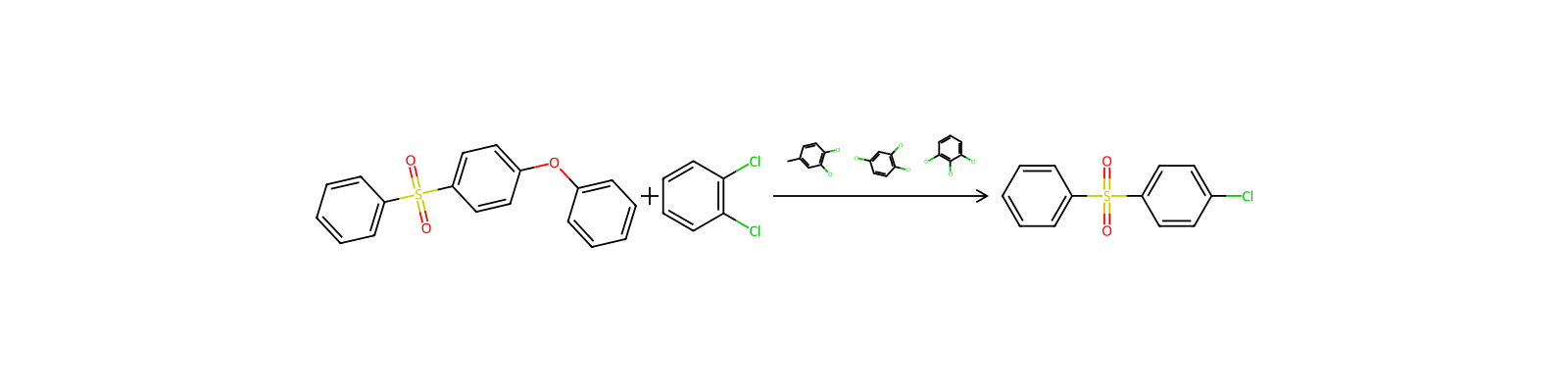
Reaktionsgleichung von HRID 391612
HRID 391612als Eduktuspto-grants-2013_02
Reaktionsgleichung von HRID 646659
HRID 646659als Produktuspto-grants-2010_04
Reaktionsgleichung von HRID 897152
HRID 897152als Eduktuspto-grants-2005_07
Reaktionsgleichung von HRID 944354
HRID 944354als EduktValidation data from https://doi.org/10.1039/C8SC04228D
Reaktionsgleichung von HRID 992251
HRID 992251als Eduktuspto-grants-2002_10
Reaktionsgleichung von HRID 1795783
HRID 1795783als Eduktuspto-grants-2006_04
Reaktionsgleichung von HRID 1815613
HRID 1815613als Eduktuspto-grants-2005_04
Reaktionsgleichung von HRID 2372812
HRID 2372812als Eduktuspto-grants-1992_03

Notizen zur Verbindung

Wird geladen…

Auf dieser SeiteGrundinformationenNamen und BezeichnerEigenschaftenSicherheit und RegulatorischesChemie und IndustrieZugehörige ReaktionenNotizen zur Verbindung
Weitere Aktionen
Neue NotizNeue ReaktionAnfrage stellen
98 °C
Vapor Pressure · 2 Einträge

0.0000039 [mmHg]

8.7X10⁻⁶ mm Hg at 25 °C /Estimated/

Henry's Law ConstantHenry's Law constant = 1.9X10⁻⁷ atm-cu/mole at 25 °C /Estimated/
Physical DescriptionColorless or white solid; [HSDB] White powder; [MSDSonline]

Physikochemische Eigenschaften

Schmelzpunkt
90 · 90-94 °C(lit.)
Siedepunkt
389 °C · 389 °C / 719mmHg
Dichte
1.3319 · 1.3319 (estimate)
storage temp.
-20 °C · -20°C Freezer, Under inert atmosphere
Löslichkeit
74.4 g/100ml · acetone: soluble74.4 g/100ml at 20°C(lit.)
Aggregatzustand
Solid
Farbe
White to Off-White
Merck
14 · 14,8988
Henry's Law Constant
5.2 · 5.2×101 mol/(m3Pa) at 25℃, HSDB (2015)
Stabilität
Stable. Incompatible with strong oxidizing agents.
InChI
1S/C12H9ClO2S/c13-10-6-8-12(9-7-10)16(14,15)11-4-2-1-3-5-11/h1-9H
InChIKey
OFCFYWOKHPOXKF-UHFFFAOYSA-N
SMILES
Clc1ccc(cc1)S(=O)(=O)c2ccccc2
CAS Datenbank
80 · 80-00-2(CAS DataBase Reference)
NIST chemische Informationen
1 · Benzene, 1-chloro-4-(phenylsulfonyl)-(80-00-2)
EPA chemische Informationen
p-Chlorophenyl phenyl sulfone (80-00-2)
Ecotoxicity Values · 4 Einträge

LD50 House sparrows oral >100 mg/kg

LD50 Redwinged blackbirds oral >100 mg/kg

LC50 Fundulus similis (Longnose killifish) 7500 ug/L/24 hr; 6000 ug/L/48 hr; static /Formulated product/

LC50 Mugil curema (White mullet) 11900 ug/L/48 hr; static /Formulated product/

Environmental Fate · 3 Einträge

TERRESTRIAL FATE: Based on a classification scheme(1), an estimated Koc value of 4,700(SRC), determined from a structure estimation method(2), indicates that sulphenone is expected to have slight mobility in soil(SRC). Volatilization of sulphenone from moist soil surfaces is not expected to be an important fate process(SRC) given an estimated Henry's Law constant of 1.9X10⁻⁷ atm-cu m/mole(SRC), using a fragment constant estimation method(3). Sulphenone is not expected to volatilize from dry soil surfaces(SRC) based upon an estimated vapor pressure of 8.7X10⁻⁶ mm Hg(SRC), determined from a fragment constant method(4). Biodegradation data were not available(SRC, 2005).

AQUATIC FATE: Based on a classification scheme(1), an estimated Koc value of 4,700(SRC), determined from a structure estimation method(2), indicates that sulphenone is expected to adsorb to suspended solids and sediment(SRC). Volatilization from water surfaces is not expected(3) based upon an estimated Henry's Law constant of 1.9X10⁻⁷ atm-cu m/mole(SRC), developed using a fragment constant estimation method(4). According to a classification scheme(5), an estimated BCF of 64(SRC), from an estimated log Kow of 3.2(6) and a regression-derived equation(7), suggests the potential for bioconcentration in aquatic organisms is moderate(SRC). Biodegradation data were not available(SRC, 2005).

ATMOSPHERIC FATE: According to a model of gas/particle partitioning of semivolatile organic compounds in the atmosphere(1), sulphenone, which has an estimated vapor pressure of 8.69X10⁻⁶ mm Hg at 25 °C(SRC), determined from a fragment constant method(2), will exist in both the vapor and particulate phases in the ambient atmosphere. Vapor-phase sulphenone is degraded in the atmosphere by reaction with photochemically-produced hydroxyl radicals(SRC); the half-life for this reaction in air is estimated to be 23 days(SRC), calculated from its rate constant of 7.1X10⁻¹³ cu cm/molecule-sec at 25 °C(SRC) that was derived using a structure estimation method(3). Particulate-phase sulphenone may be removed from the air by wet and dry deposition(SRC). Sulphenone does not absorb light at wavelengths >290(4) and therefore, is not expected to be susceptible to direct photolysis by sunlight.

Ecotoxicity Excerpts · 1 Eintrag

/BIRDS and MAMMALS/ The acute oral toxicity, repellency and hazard potential of sulphenone to one or more of 68 species of wild and domestic birds was determined by standardized testing procedures. Redwinged blackbirds were the most sensitive of the bird species tested.

Soil Adsorption/Mobility · 1 Eintrag

Using a structure estimation method based on molecular connectivity indices(1), the Koc for sulphenone can be estimated to be 4,700(SRC). According to a classification scheme(2), this estimated Koc value suggests that sulphenone is expected to have slight mobility in soil.

Artificial Pollution SourcesSulphenone's former production and use as an acaricide(1) and miticide(2) resulted in its direct release to the environment through various waste streams(SRC).
Environmental Bioconcentration · 1 Eintrag

An estimated BCF of 64 was calculated for sulphenone(SRC), using an estimated log Kow of 3.2(1) and a regression-derived equation(2). According to a classification scheme(3), this BCF suggests the potential for bioconcentration in aquatic organisms is moderate(SRC).

Volatilization from Water/Soil · 1 Eintrag

The Henry's Law constant for sulphenone is estimated as 1.9X10⁻⁷ atm-cu m/mole(SRC) using a fragment constant estimation method(1). This Henry's Law constant indicates that sulphenone is expected to be essentially nonvolatile from water surfaces(2). Sulphenone's Henry's Law constant indicates that volatilization from moist soil surfaces is not expected to occur(SRC). Sulphenone is not expected to volatilize from dry soil surfaces(SRC) based upon an estimated vapor pressure of 8.7X10⁻⁶ mm Hg(SRC), determined from a fragment constant method(3).

Non-Human Toxicity Excerpts/LABORATORY ANIMALS: Acute Exposure/ ...Moderately low oral toxicity to lab mammals. No skin irritation.
Environmental Abiotic Degradation · 1 Eintrag

The rate constant for the vapor-phase reaction of sulphenone with photochemically-produced hydroxyl radicals has been estimated as 7.1X10⁻¹³ cu cm/molecule-sec at 25 °C(SRC) using a structure estimation method(1). This corresponds to an atmospheric half-life of about 23 days at an atmospheric concentration of 5X10+5 hydroxyl radicals per cu cm(1). Sulphenone is not expected to undergo hydrolysis in the environment due to the lack of hydrolyzable functional groups(3). Sulphenone does not absorb light at wavelengths >290(4) and therefore, is not expected to be susceptible to direct photolysis by sunlight.

Probable Routes of Human Exposure · 1 Eintrag

Current occupational exposure and general population exposure should be low or non-existent since sulphenone is no longer produced or used in the US (May,2005). In the past, sulphenone was applied directly to apple and pears trees and green house plants as an acaricide and insecticide and exposure to this compound was primarily by inhalation and dermal contact. (SRC)

Environmental Fate/Exposure Summary · 1 Eintrag

Sulphenone's former production and use as an acaricide and miticide resulted in its direct release to the environment through various wastes streams. If released to air, an estimated vapor pressure of 8.7X10⁻⁶ mm Hg at 25 °C indicates sulphenone will exist in both the vapor and particulate phases in the ambient atmosphere. Vapor-phase sulphenone will be degraded in the atmosphere by reaction with photochemically-produced hydroxyl radicals; the half-life for this reaction in air is estimated to be 23 days. Particulate-phase sulphenone will be removed from the atmosphere by wet and dry deposition. Sulphenone does not absorb light at wavelengths >290nm and therefore, is not expected to be susceptible to direct photolysis by sunlight. If released to soil, sulphenone is expected to have slight mobility based upon an estimated Koc of 4700. Volatilization from moist soil surfaces is not expected to be an important fate process based upon an estimated Henry's Law constant of 1.9X10⁻⁷ atm-cu m/mole. Sulphenone is not expected to volatilize from dry soil surfaces based upon its vapor pressure. If released into water, sulphenone is expected to adsorb to suspended solids and sediment based upon the estimated Koc. Volatilization from water surfaces is not expected to be an important fate process based upon this compound's estimated Henry's Law constant. An estimated BCF of 64 suggests the potential for bioconcentration in aquatic organisms is moderate. Hydrolysis is not expected to be an important environmental fate process since this compound lacks functional groups that hydrolyze under environmental conditions. Current occupational exposure and general population exposure should be low or non-existent since sulphenone is no longer produced or used in the US(5,2005). In the past, sulphenone was applied directly to apple and pears trees and green house plants as an acaricide and insecticide and exposure to this compound was primarily by inhalation and dermal contact. (SRC)

Antidote and Emergency Treatment · 2 Einträge

Basic treatment: Establish a patent airway. Suction if necessary. Watch for signs of respiratory insufficiency and assist ventilations if needed. Administer oxygen by nonrebreather mask at 10 to 15 L/min. Monitor for pulmonary edema and treat if necessary ... . Monitor for shock and treat if necessary ... . Anticipate seizures and treat if necessary ... . For eye contamination, flush eyes immediately with water. Irrigate each eye continuously with normal saline during transport ... . Do not use emetics. For ingestion, rinse mouth and administer 5 ml/kg up to 200 ml of water for dilution if the patient can swallow, has a strong gag reflex, and does not drool ... . Cover skin burns with dry sterile dressings after decontamination ... . /Poison A and B/

Advanced treatment: Consider orotracheal or nasotracheal intubation for airway control in the patient who is unconscious, has severe pulmonary edema, or is in respiratory arrest. Positive pressure ventilation techniques with a bag valve mask device may be beneficial. Monitor cardiac rhythm and treat arrhythmias as necessary ... . Start an IV with D5W /SRP: "To keep open", minimal flow rate/. Use lactated Ringer's if signs of hypovolemia are present. Watch for signs of fluid overload. Consider drug therapy for pulmonary edema ... . For hypotension with signs of hypovolemia, administer fluid cautiously. Watch for signs of fluid overload ... . Treat seizures with diazepam (Valium) ... . Use proparacaine hydrochloride to assist eye irrigation ... . /Poison A and B/

Sicherheitsdaten

wgk
3
tsca
TSCA listed
hs_code
2930909899
RTECS-Nr.
WR5775000
risk_code
20/21/22
Toxizität
LD50 orally in mice: 2.7 g/kg (Hazleton)
hazard_code
Xn
safety_code
36
Speicherklasse
11 - Combustible Solids
Giftige Stoffe Daten
80-00-2(Hazardous Substances Data)
Hazard Classifications
Acute Tox. 4 DermalAcute Tox. 4 InhalationAcute Tox. 4 Oral

VerwendenSulfenone is an impurity of Dapson (D193250), an antibacterial used in the treatment of dermatitis herpetiformis.

Vor- und nachgelagerte Produkte

Vorgelagerte Rohstoffe

Chloroschwefelsure4-ChlorbenzolsulfonylchloridBenzene, 1-chloro-2-(phenylsulfonyl)-2-Chlorophenyl 4-chlorophenyl sulfoneBenzene, 1-chloro-3-[(4-chlorophenyl)sulfonyl]-Benzenesulfonic acid,4-chloro-, hydrazideBis(4-chlorphenyl)sulfonN-FluorobenzenesulfonimideBenzolsulfinsureNatrium-p-chlorbenzolsulfinat4-Chloro diphenyl sulfideDiphenyliodonium trifluoromethanesulfonateBenzolboronsäureIodbenzol(p-Chlorphenyl)metaborsure