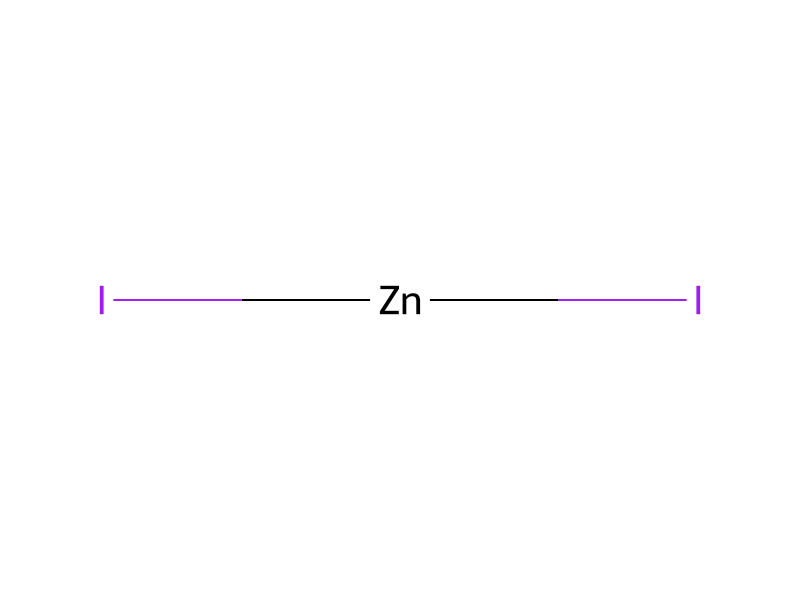
Grundinformationen
- Standard-SMILES
[I][Zn][I]- InChIKey
UAYWVJHJZHQCIE-UHFFFAOYSA-L- Summenformel
- I2Zn
- Durchschnittliche Molmasse
- 319,2 g/mol
- Monoisotopische Masse
- 317,7380882
Überblick
Zinc iodide is a iodide of zinc. It is used in x-rays and electron microscopy. Zinc is a metallic element with the atomic number 30. It is found in nature most often as the mineral sphalerite. Though excess zinc in harmful, in smaller amounts it is an essential element for life, as it is a cofactor for over 300 enzymes and is found in just as many transcription factors. (L48, L49, L69)
Namen und Bezeichner
- Bevorzugter Name
- Zinc iodide
- IUPAC
- diiodozinc
Namen und Synonyme
Weitere Namen anzeigen
Datenbank-Bezeichner
- CAS
10139-47-6- PubChem CID
- 66278
- DTXSID
DTXSID5064968- EC Number
- 233-396-0
Eigenschaften
Berechnete Struktureigenschaften
- Polarare Oberfläche (TPSA)
- 0 Ų
- H-Brücken-Donoren
- 0
- H-Brücken-Akzeptoren
- 0
- Frei drehbare Bindungen
- 0
- Schwere Atome
- 3
- Formalladung
- 0
- Komplexität
- 2,8
Experimentelle und physikochemische Eigenschaften
Sicherheit und Regulatorisches
GHS-Klassifizierung
GHS Classification
This chemical does not meet GHS hazard criteria for 1.7% (1 of 58) of reports.
Danger
H314 (93.1%): Causes severe skin burns and eye damage [Danger Skin corrosion/irritation]
P260, P264, P273, P280, P301+P330+P331, P302+P361+P354, P304+P340, P305+P354+P338, P316, P321, P363, P391, P405, and P501 (click each P-code to see the statement)
Aggregated GHS information provided per 58 reports by companies from 9 notifications to the ECHA C&L Inventory. Each notification may be associated with multiple companies.
Gefahrenhinweise
Regulatory Information
Chemical: Zinc iodide (ZnI2)
Zinc iodide: Does not have an individual approval but may be used under an appropriate group standard
Sicherheit und Schutzausrüstung
Toxikologische Informationen
Toxicity Summary
Anaemia results from the excessive absorption of zinc suppressing copper and iron absorption, most likely through competitive binding of intestinal mucosal cells. Unbalanced levels of copper and zinc binding to Cu,Zn-superoxide dismutase has been linked to amyotrophic lateral sclerosis (ALS). Stomach acid dissolves metallic zinc to give corrosive zinc chloride, which can cause damage to the stomach lining. Metal fume fever is thought to be an immune response to inhaled zinc. (L48, L49, A49)
Signs and Symptoms
Ingestion of large doses of zinc causes stomach cramps, nausea, and vomiting. Acute inhalation of large amounts of zinc causes metal fume fever, which is characterized by chills, fever, headache, weakness, dryness of the nose and throat, chest pain, and coughing. Dermal contact with zinc results in skin irritation. (L49)
Chemie und Industrie
Pharmakologische Informationen
Metabolism/Metabolites
Zinc can enter the body through the lungs, skin, and gastrointestinal tract. Intestinal absorption of zinc is controlled by zinc carrier protein CRIP. Zinc also binds to metallothioneins, which help prevent absorption of excess zinc. Zinc is widely distributed and found in all tissues and tissues fluids, concentrating in the liver, gastrointestinal tract, kidney, skin, lung, brain, heart, and pancreas. In the bloodstream zinc is found bound to carbonic anhydrase in erythrocytes, as well as bound to albumin, _2-macroglobulin, and amino acids in the the plasma. Albumin and amino acid bound zinc can diffuse across tissue membranes. Zinc is excreted in the urine and faeces. (L49)
Verwendung und Herstellung
Uses
Used as a topical antiseptic and astringent; [Merck Index] Used as an analytical reagent; [Hawley]
Using Disinfectants or Biocides [Category: Clean]
Zinc iodide is used in x-rays and electron microscopy. (L69)
Zugehörige Reaktionen
Keine Reaktionsaufzeichnungen unter den aktuellen Filterkriterien.
Verknüpfte Notizen
Wird geladen…