
Lithiumiodid
Lithium iodide
Daten werden ergänzt – lade die Seite später neu, um den aktuellen Stand zu sehen
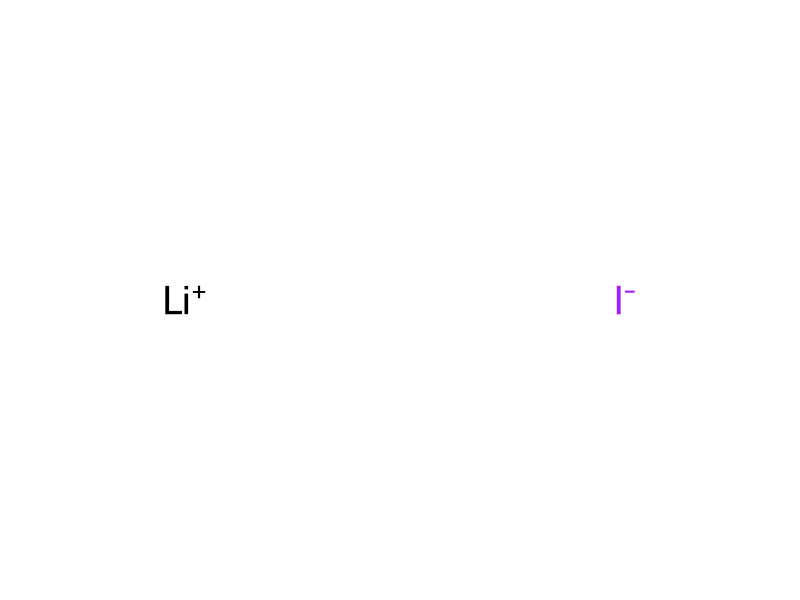
Grundinformationen
- CAS
10377-51-2- Standard-SMILES
[I-].[Li+]- InChIKey
HSZCZNFXUDYRKD-UHFFFAOYSA-M- Summenformel
- ILi
- Durchschnittliche Molmasse
- 133,9 g/mol
- Monoisotopische Masse
- 133,92048
Namen und Bezeichner
- Bevorzugter Name
- Lithium iodide
- IUPAC
- lithium iodide
- Lokaler Name
- Lithiumiodid
- Englischer Name
- Lithium iodide anhydrous
- Summenformel
- ILi
- Molmasse
- 133.85
Namen und Synonyme
Lithium iodideLithium monoiodideLithium iodide (LiI)UNII-S6K2XET783S6K2XET783EINECS 233-822-5LITHIUM IODIDE [MI]DTXSID30908580RefChem:153730DTXCID301337657233-822-510377-51-2
Weitere Namen anzeigen
LiILithiumiodidTenephrolLithiumjodidithium iodideIodide lithiuMlithiumiodide(lii)lithiumiodide(bpc)
lithiumiodideLithium iodide, anhydrouslithium;iodideMFCD00011092Lithium iodide (6LiI)lLithiumiodid21752-61-4LiI.xH2O
Datenbank-Bezeichner
- CAS
10377-51-2、21752-61-4、29911-74-8- PubChem CID
- 66321
- DTXSID
DTXSID30908580- UNII
- S6K2XET783
- EC Number
- 233-822-5、244-572-1
- Nikkaji
- J43.854E
Eigenschaften
Berechnete StruktureigenschaftenWird ergänzt
- Polarare Oberfläche (TPSA)
- 0 Ų
- H-Brücken-Donoren
- 0
- H-Brücken-Akzeptoren
- 1
- Frei drehbare Bindungen
- 0
- Schwere Atome
- 2
- Formalladung
- 0
- Komplexität
- 2
Experimentelle und physikochemische Eigenschaften
Density4.06 @25 °C
Boiling Point1171 °C @760 [mm Hg]
Physical DescriptionTrihydrate: White, extremely hygroscopic solid; Soluble in water; [Hawley] White, light yellow, or pink odorless powder; Soluble in water; [MSDSonline]
Physikochemische Eigenschaften
- Schmelzpunkt
- 446 °C · 446 °C(lit.)
- Siedepunkt
- 1171 °C · 1171 °C
- Dichte
- 3.49 g/mL · 3.49 g/mL at 25 °C(lit.)
- Brechungsindex
- 1.955 · 1.955
- Flammpunkt
- 1170 · 1170-1190°C
- storage temp.
- 30 °C · Store below +30°C.
- Löslichkeit
- 1640 g/l · 1640g/l soluble
- Aggregatzustand
- powder
- Farbe
- White to yellow to beige
- Wichte
- 4.076 · 4.076
Sicherheit und Regulatorisches
Sicherheitsangaben dienen nur zur Orientierung und ersetzen weder das Sicherheitsdatenblatt (SDB) des Lieferanten noch geltende Vorschriften oder eine fachliche Bewertung.
GHS-Klassifizierung
GHS Classification
This chemical does not meet GHS hazard criteria for 17.2% (43 of 250) of reports.
Warning
H302 (14%): Harmful if swallowed [Warning Acute toxicity, oral];H315 (67.2%): Causes skin irritation [Warning Skin corrosion/irritation];H319 (72.4%): Causes serious eye irritation [Warning Serious eye damage/eye irritation];H335 (47.6%): May cause respiratory irritation [Warning Specific target organ toxicity, single exposure; Respiratory tract irritation];H400 (44%): Very toxic to aquatic life [Warning Hazardous to the aquatic environment, acute hazard]
P261, P264, P264+P265, P270, P271, P273, P280, P301+P317, P302+P352, P304+P340, P305+P351+P338, P319, P321, P330, P332+P317, P337+P317, P362+P364, P391, P403+P233, P405, and P501 (click each P-code to see the statement)
Aggregated GHS information provided per 250 reports by companies from 13 notifications to the ECHA C&L Inventory. Each notification may be associated with multiple companies.;Reported as not meeting GHS hazard criteria per 43 of 250 reports by companies.;There are 11 notifications provided by 207 of 250 reports by companies with hazard statement code(s).;Information may vary between notifications depending on impurities, additives, and other factors. The percentage value in parenthesis indicates the notified classification ratio from companies that provide hazard codes. Only hazard codes with percentage values above 10% are shown. For more detailed information, please visit ECHA C&L website.
Gefahrenhinweise
Regulatory Information
Chemical: Lithium iodide (LiI)
Status: Active Update: 25-08-2022 https://echa.europa.eu/registration-dossier/-/registered-dossier/34023
Lithium iodide (LiI): Does not have an individual approval but may be used under an appropriate group standard
Other Safety InformationIMAP assessments - Lithium iodide (LiI): Human health tier I assessment
Chemie und Industrie
Verwendung und Herstellung
Uses
Used in photography; [Merck Index] Trihydrate: Used in air conditioning and as a catalyst; [Hawley] Used in organic synthesis; [Ullmann]
Photographic Processing [Category: Other]
General Manufacturing Information
Lithium iodide (LiI): ACTIVE
Lithium iodide (6LiI): ACTIVE
Anwendungen
VerwendenIt is used as a absorbent in refrigeration process, as a catalyst, and in photography. It is also useful for organic synthesis, pessat iodination, cleavage of esters, ethers, epoxides, decarboethoxylation, carbonylation, and aldol condensation. It is used for manufacturing medicines and mineral waters. It is used in electochemicstry and redox reactions. Lithium iodide is also a catalyzed conjugate addition reaction of β-dicarbonyl compounds. It is also useful for tetrathioquinodimethane.
Darstellung
synthetischeThe trihydrate salt is obtained by neutralization of lithium hydroxide or lithium carbonate solution with pure hydriodic acid followed by concentration of the solution for crystallization: LiOH + HI → LiI + H2O When heated in a vacuum, the trihydrate dehydrates to anhydrous salt.
Vor- und nachgelagerte Produkte
Nachgelagerte Produkte
Zugehörige Reaktionen
553






Notizen zur Verbindung
Wird geladen…