StartseiteMCPWorkbenchSkills
StartseiteWorkbenchBenachrichtigungenMein Bereich
llms.txt · MCP-AnleitungDatenschutz · Nutzungsbedingungen · Supportv1.8.0
  1. Startseite
  2. /Verbindung

1,4-Dihydroxyanthrachinon

Quinizarin

HCID 6688
Neue NotizNeue ReaktionAnfrage stellen
Druckvorschau

Daten werden ergänzt – lade die Seite später neu, um den aktuellen Stand zu sehen

GrundinformationenÜberblickNamen und BezeichnerEigenschaftenSicherheit und RegulatorischesChemie und IndustrieZugehörige ReaktionenNotizen zur Verbindung
TeilstruktursucheÄhnliche Strukturen suchen

Grundinformationen

CAS
81-64-1
Standard-SMILES
O=C1c2ccccc2C(=O)c2c(O)ccc(O)c21
InChIKey
GUEIZVNYDFNHJU-UHFFFAOYSA-N
Summenformel
C14H8O4
Durchschnittliche Molmasse
240,21 g/mol
Monoisotopische Masse
240,04225874

Überblick

Quinizarin is a dihydroxyanthraquinone having the two hydroxy substituents at the 1- and 4-positions; formally derived from anthraquinone by replacement of two hydrogen atoms by hydroxy groups. It has a role as a dye.

Namen und Bezeichner

Bevorzugter Name
Quinizarin
IUPAC
1,4-dihydroxyanthracene-9,10-dione
Lokaler Name
1,4-Dihydroxyanthrachinon
Englischer Name
1,4-Dihydroxyanthraquinone
Summenformel
C14H8O4
Molmasse
240.21

Namen und Synonyme

Quinizarin1,4-Dihydroxyanthraquinone81-64-11,4-dihydroxyanthracene-9,10-dioneQuinizarineChinizarinSolvent Orange 86Smoke Orange R1,4-DihydroxyanthrachinonMacrolex Orange GG1,4-Dihydroxy-9,10-anthraquinone9,10-Anthracenedione, 1,4-dihydroxy-
Weitere Namen anzeigen
DSD ACID1,4-DHAQQUINAZARINQuinizalin4-Dihydroxyanthraquinone
Anthraquinone, 1,4-dihydroxy-1,4-Dioxyanthraquinone1,4-Doa1,4-DIHYDROXY-9,10-ANTHRACENEDIONEC.I. 58050DTXSID80444648S496ZV3CSCI 58050

Datenbank-Bezeichner

CAS
81-64-1
PubChem CID
6688
DTXSID
DTXSID8044464
ChEMBL
CHEMBL17594
ChEBI
CHEBI:37487

Eigenschaften

Berechnete StruktureigenschaftenWird ergänzt

XLogP
3,7
Polarare Oberfläche (TPSA)
74,6 Ų
H-Brücken-Donoren
2
H-Brücken-Akzeptoren
4
Frei drehbare Bindungen
0
Schwere Atome
18
Formalladung
0
Komplexität
342

Experimentelle und physikochemische Eigenschaften

Chemical ClassesDyes -> Anthraquinone Dyes
SpringerMaterials Properties13C nuclear magnetic resonance spectrum
Color/Form · 2 Einträge

ORANGE CRYSTALS FROM ACETIC ACID; ORANGE PLATES FROM ETHER; DEEP RED NEEDLES FROM ALCOHOL, BENZENE, TOLUENE, XYLENE

YELLOW RED LEAFLETS FROM ETHER; RED CRYSTALS FROM TOLUENE, ACETIC ACID

Solubility · 5 Einträge

MODERATELY SOL IN ALCOHOL WITH RED COLOR

SOL IN ETHER WITH BROWN COLOR & YELLOW FLUORESCENCE

SOL WITH VIOLET COLOR IN AQ ALKALIES & IN AMMONIA

1 G SOL IN ABOUT 13 G OF BOILING GLACIAL ACETIC ACID

For more Solubility (Complete) data for 1,4-DIHYDROXY-9,10-ANTHRACENEDIONE (6 total), please visit the HSDB record page.

Flash Point222 °C
Melting Point196 °C
Vapor Pressure0.00000002 [mmHg]
Physical Description

Sicherheit und Regulatorisches

Sicherheitsangaben dienen nur zur Orientierung und ersetzen weder das Sicherheitsdatenblatt (SDB) des Lieferanten noch geltende Vorschriften oder eine fachliche Bewertung.

GHS-Klassifizierung

GHS Classification · 6 Einträge

This chemical does not meet GHS hazard criteria for 0.3% (7 of 2238) of reports.

Warning

H315 (90.9%): Causes skin irritation [Warning Skin corrosion/irritation]

P261, P264, P264+P265, P271, P280, P302+P352, P304+P340, P305+P351+P338, P319, P321, P332+P317, P337+P317, P362+P364, P403+P233, P405, and P501 (click each P-code to see the statement)

Aggregated GHS information provided per 2238 reports by companies from 17 notifications to the ECHA C&L Inventory. Each notification may be associated with multiple companies.

Not Classified

Gefahrenhinweise

Regulatory Information · 4 Einträge

Chemical: 9,10-Anthracenedione, 1,4-dihydroxy-

9,10-Anthracenedione, 1,4-dihydroxy- is listed on the EPA's Chemical Data Reporting (CDR) system. Manufacturers and importers of 9,10-Anthracenedione, 1,4-dihydroxy- are required to report information about their production and use of this chemical to the EPA under the Toxic Substances Control Act (TSCA). (40 eCFR Part 711)

Status: Active Update: 14-06-2022 https://echa.europa.eu/registration-dossier/-/registered-dossier/20342

9,10-Anthracenedione, 1,4-dihydroxy-: Does not have an individual approval but may be used under an appropriate group standard

Hazards SummaryA mutagen and irritant; Effects in high-dose animal studies include changes in renal tubules and weight loss; [RTECS] Emergency treatment: irritants; [HSDB] An irritant; [MSDSonline]
Hazard Classes and Categories · 2 Einträge

Skin Irrit. 2 (90.9%)

Hazardous to the aquatic environment (Acute) - Category 1

Toxikologische Informationen

Chemie und Industrie

Pharmakologische Informationen

Mechanism of Action · 1 Eintrag

LAXATIVE EFFECTS OF 6 ANTHRAQUINONES WERE RELATED TO THEIR ABILITY TO UNCOUPLE PHOSPHORYLATION IN BOTH PLANT (PHASEOLUS AUREUS) & ANIMAL (GUINEA PIGS INTESTINE) MITOCHONDRIA. THE STRUCTURAL REQUIREMENTS WERE: A RIGID PLANAR STRUCTURE AND AT LEAST 1 OH GROUP, PREFERENTIALLY IN POSITION 1, 1 AND 8, 2, 3, 6, AND 7.

Verwendung und Herstellung

Uses · 5 Einträge

Used as an antioxidant in synthetic lubricants and a fungicide for control of powdery mildew; [HSDB] Used in the fuel and textile processing industries and as a coloring agent and intermediate; [IUCLID]

Petroleum Production and Refining [Category: Industry]

ANTIOXIDANT IN SYNTHETIC LUBRICANTS

IN THE SYNTHESIS OF EXPERIMENTAL ANTITUMOR AGENTS

FUNGICIDE FOR CONTROL OF POWDERY MILDEW

U.S. Production2023: 75,000 - <500,000 lb
Industry UsesIntermediate
Methods of Manufacturing · 1 Eintrag

...BY DIAZOTIZING P-CHLOROANILINE, CONDENSING WITH PHTHALIC ANHYDRIDE, & HYDROLYZING: BRITISH PATENT 373,999, CA 27, 3946 (1933); BY TREATING ANTHRAQUINONE WITH AMMONIUM PERSULFATE IN SULFURIC ACID: WACKER, J PRAKT CHEM [2] 54, 90 (1896). BY HEATING P-CHLOROPHENOL, PHTHALIC ANHYDRIDE & EITHER SULFURIC ACID OR ALUMINUM CHLORIDE: REYNOLDS, BIGELOW, J AM CHEM SOC 48, 420 (1926); US PATENT 1,845,632, CA 26, 2203; ORG SYN COLL VOL I, 476 (NEW YORK, 1941).

General Manufacturing Information · 4 Einträge

Synthetic Dye and Pigment Manufacturing

9,10-Anthracenedione, 1,4-dihydroxy-: ACTIVE

THE CONDENSATION OF ALKYLENEDIAMINES WITH QUINIZARIN GAVE COMPD MARKEDLY ACTIVE AGAINST BOTH LEUKEMIAS & SOLID TUMORS IN MICE.

1,4-DIHYDROXYANTHRAQUINONE IS FUNGICIDE @ 4000 PPM FOR CONTROL OF POWDERY MILDEW (ERYSIPHE POLYGONI) ON INOCULATED CRANBERRY BEAN SEEDLINGS.

Zugehörige Reaktionen

29
Reaktionsaufzeichnung erstellen
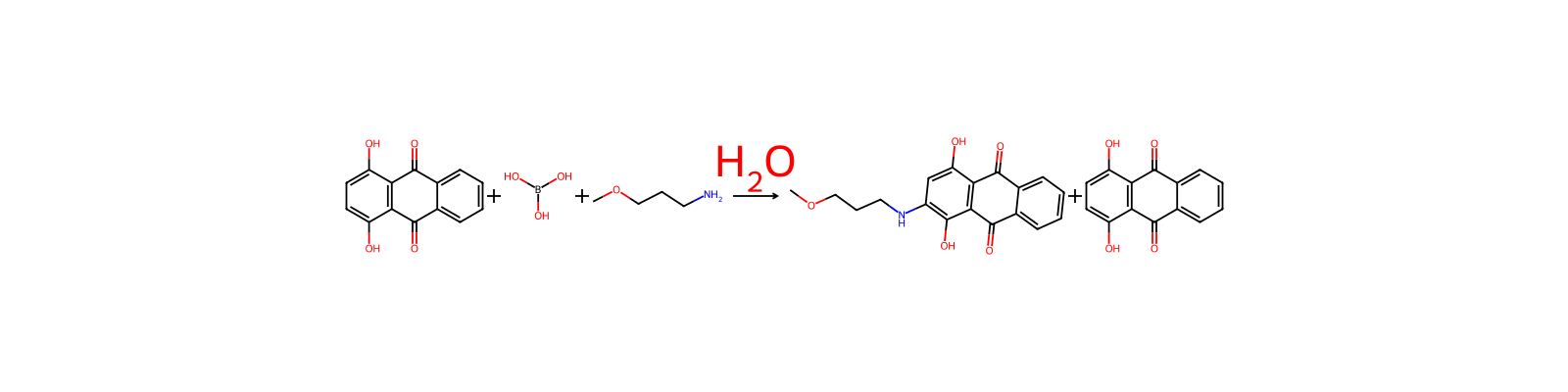
Reaktionsgleichung von HRID 21817
HRID 21817als Eduktuspto-grants-1995_06
Reaktionsgleichung von HRID 21818
HRID 21818als Eduktuspto-grants-1995_06
Reaktionsgleichung von HRID 21819
HRID 21819als Eduktuspto-grants-1995_06
Reaktionsgleichung von HRID 34898
HRID 34898als Produktals Eduktuspto-grants-1988_08
Reaktionsgleichung von HRID 236676
HRID 236676als Produktuspto-grants-1987_02
Reaktionsgleichung von HRID 480260
HRID 480260als Eduktuspto-grants-2003_11
Reaktionsgleichung von HRID 525979
HRID 525979als Eduktuspto-grants-2016_05
Reaktionsgleichung von HRID 546802
HRID 546802als Eduktuspto-grants-2011_05
Seite 1 von 4

Notizen zur Verbindung

Wird geladen…

Auf dieser SeiteGrundinformationenÜberblickNamen und BezeichnerEigenschaftenSicherheit und RegulatorischesChemie und IndustrieZugehörige ReaktionenNotizen zur Verbindung
Weitere Aktionen
Neue NotizNeue ReaktionAnfrage stellen
UNII
8S496ZV3CS
EC Number
201-368-7
Nikkaji
J3.861J、J710.748J
· 2 Einträge

Dry Powder

Yellow-red, orange, or deep red solid; [HSDB] Orange powder; [MSDSonline]

Stability/Shelf LifeBLACK PPT WITH CO2; SUBLIMES @ HIGH VACUUM
Collision Cross Section148.9 Ų [M-H]- [CCS Type: DT; Buffer gas: N2; Ionization: ESI-; Dataset: TOXCAST; Source Identifier: DTXSID8044464]
Other Experimental PropertiesUV: 1-545 (Organic Electronic Spectral Data, Phillips et al, John Wiley & Sons, New York) /1,5-Dihydroxyanthraquinone/

Physikochemische Eigenschaften

Schmelzpunkt
195 · 195-200 °C
Siedepunkt
450 °C · 450 °C
Dichte
1.3032 · 1.3032 (rough estimate)
Dampfdichte
8.3 · 8.3 (vs air)
Dampfdruck
1 mm · 1 mm Hg ( 196.7 °C)
Brechungsindex
1.543 · 1.5430 (estimate)
Flammpunkt
222 °C · 222 °C
storage temp.
30 °C · Store below +30°C.
Löslichkeit
1 g/l · <1g/l
pka
pK (18°) 9.51
Aggregatzustand
powder
Farbe
red-brown
Wasserlöslichkeit
1 g/L · <1 g/L (20 ºC)
Merck
14 · 14,8064
BRN
1914036 · 1914036
Henry's Law Constant
1.2 · 1.2×102 mol/(m3Pa) at 25℃, Duchowicz et al. (2020)
InChI
1S/C14H8O4/c15-9-5-6-10(16)12-11(9)13(17)7-3-1-2-4-8(7)14(12)18/h1-6,15-16H
InChIKey
GUEIZVNYDFNHJU-UHFFFAOYSA-N
SMILES
Oc1ccc(O)c2C(=O)c3ccccc3C(=O)c12
LogP
4.2 at · 4.2 at 25℃
CAS Datenbank
81 · 81-64-1(CAS DataBase Reference)
NIST chemische Informationen
9 · 9,10-Anthracenedione, 1,4-dihydroxy-(81-64-1)
EPA chemische Informationen
Quinizarin (81-64-1)
Non-Human Toxicity Excerpts · 4 Einträge

ACUTE TOXICITY OF 1,4-DIHYDROXYANTHRAQUINONE WAS TESTED IN ANIMALS & DID NOT SENSITIZE MANY, BUT PRODUCED A VERY SEVERE REACTION IN THOSE AFFECTED.

1,4-DIHYDROXYANTHRAQUINONES DID NOT ALTER COLONIC WATER ABSORPTION BUT RESTRICTED SODIUM ABSORPTION & CAUSED AN APPARENT RELEASE OF POTASSIUM INTO THE LUMEN.

IN VITRO STUDY INDICATED ANTHRAQUINONE DYES TO BE INHIBITORS OF MITOCHONDRIA ADENINE NUCLEOTIDE TRANSLOCATION & OXIDATIVE PHOSPHORYLATION. MOST OF THE DYES INHIBITED MITOCHONDRIAL (14)C-ADP UPTAKE IN A PARTIALLY COMPETITIVE-NONCOMPETITIVE MANNER.

QUINIZARIN GLUCOSIDE TETRAACETATE WAS RENDERED MUTAGENIC TO SALMONELLA TYPHIMURIUM BY ENZYME EXTRACTS OF RAT CECAL BACTERIA (APPARENTLY BY AGLYCONE FORMATION).

Sicherheitsdaten

wgk
2
tsca
TSCA listed
ridadr
UN 3077 9 / PGIII
hs_code
2914 69 80
RTECS-Nr.
CB6600000
risk_code
36/37/38-43-50/53
Toxizität
LD50 orally in Rabbit: > 5000 mg/kg
hazard_code
Xi,N
safety_code
22-24/25-36/37-26-61-60
packing_group
III
Speicherklasse
13 - Non Combustible Solids
Giftige Stoffe Daten
81-64-1(Hazardous Substances Data)
Hazard Classifications
Aquatic Acute 1Aquatic Chronic 1
Anwendungen · 2 Einträge

BeschreibungChinizarin bildet aus Eisessig gelbrote Blättchen mit einem Schmelzpunkt von 200-202 ℃ oder tiefrote Nadeln mit einem Schmelzpunkt von 194-196 ℃ aus Alkohol, Benzol, Toluol und Xylol. Ein Gramm löst sich in 13 g siedendem Eisessig. Es ist in Wasser, Alkohol, Ether, Toluol, Xylol und Benzol löslich. Die alkoholische Lösung ist rot, während die Ether-Lösung braun ist und gelbe Fluoreszenz zeigt. In Alkalien und Ammoniak löst sich die Verbindung und ergibt eine violette Lösung. Chinizarin findet Verwendung bei der Herstellung einer großen Anzahl von Anthrachinonfarbstoffen.

Verwenden1,4-Dihydroxyanthraquinone, also known as quinizarin, is of great importance in manufacturing disperse, acid, and vat dyes.

Vor- und nachgelagerte Produkte

Vorgelagerte Rohstoffe

Borsure1,4-DihydroxybenzolPhthalsureanhydrid4-ChlorphenolSchwefelsure

Nachgelagerte Produkte

1,4-Bis(ethylamino)anthrachinon1,4-Diamino-2,3-dihydroanthrachinon1,4-Bis(isopropylamino)anthrachinon9,10-Anthracendion, Hydroxybis(phenylamino)-, sulfoniert, Natriumsalz1,4-Bis(p-tolylamino)anthrachinonDinatrium-2,2'-(9,10-dioxoanthracen-1,4-diyldiimino)bis(5-methylsulfonatHydroquinine (anthraquinone-1 4-diyl)Solvent Blue 104Tracid Light Yellow G1,4-Bis(butylamino)anthrachinonN-[4-[(9,10-Dihydro-4-hydroxy-9,10-dioxo-1-anthryl)amino]phenyl]acetamidNatrium-3,3'-(9,10-dioxoanthracen-1,4-diyldiimino)bis(2,4,6-trimethylbenzolsulfonat)DISPERSE DYENatrium-4-[(9,10-dihydro-4-hydroxy-9,10-dioxo-1-anthryl)amino]toluol-3-sulfonat1,4-Diaminoanthrachinon9,10-Anthracendion, 1,4-Diamino-, N,N'-gemischte 2-Hydroxyethyl und Methylderivate1-Hydroxy-4-(p-toluidino)anthrachinon1,4-Bis[(2,6-diethyl-4-methylphenyl)amino]anthrachinonNatrium-1-amino-9,10-dioxo-4-phenylaminoanthracen-2-sulfonatTransparent Blue1,4-Bis(methylamino)anthrachinonDinatrium-2,2'-(9,10-dioxoanthracen-1,4-diyldiimino)bis(5-butylbenzolsulfonat

Ergänzende Hinweise

DefinitionChEBI: Quinizarin is a dihydroxyanthraquinone having the two hydroxy substituents at the 1- and 4-positions; formally derived from anthraquinone by replacement of two hydrogen atoms by hydroxy groups It has a role as a dye.